Can anyone provide a DEFINITIVE date from when early Mark Spitfires were fitted with Dowty/Rotol propellor assemblies – ie wooden blades.
We need to know if it is likely/possible that any Mk I Spitfires during the Dunkirk and very early Battle of Britain period might conceivably have had such a propellor assembly fitted rather than the DeHavilland metal bladed airscrews.
My own experience/knowledge says not. However, since one should never say never it would be nice to know if anyone can confirm for Mark12 and I, one way or the other, what the situation was. If any evidence of such propellor fitment in OPERATIONAL service during May/June 1940 exists then we’d be hugely grateful to be pointed in that direction.

By: Seafire - 31st January 2009 at 11:27
Mk.I Serials fitted with Rotol
per Vickers 339 27/3/40
“Mod 124 (mod landing lamp control)… to suit the incorporation of the Rotol airscrew control. This mod is applicable to the 22 machines fitted… in accordance with amendments dated 3/8/39 and 21/9/39.”
from another document in this file, date unrecorded: (all had alteration No.36 to provide armour protection for pilot) aircraft fitted with Rotols:
[Note: all delivered to 54 Sqn except as noted:]
N3030 [to 19 Sqn 3/10/39, then to 54 10/1/40]
N3096
N3097
N3103
N3104
N3110
N3111
N3122
N3124
N3130
N3160
N3171 [to AMDP charge, to Boscombe 19/3/40 for comparative trials]
N3172
N3173
N3174
N3176
N3180
N3183
N3184
N3185
N3187
N3188
Vickers 340 23/4/40: …ten Spitfire are to be selected… and fitted with Rotol…. The aeroplanes so fitted are urgently required for allotment to service units, and I am to request you to proceed immediately with the necessary work.
from Vickers 342 8/8/40 [re communications in May. Note these aircraft not delivered until July- I assume they are the same 10, but don’t know for sure. Most went to 54, but a number to 609 and other squadrons]
selected for fitment of specially modified Merlin III and Rotol
R6977
R6979
R6981
R6993
R6995
R7015
R7017
R7019
R7020
R7021
Hope this helps,
Bob
By: VoyTech - 12th January 2009 at 10:56
Yes, it does look like that one.
BTW, I like the starboard side of your Spifire!
By: VoyTech - 9th January 2009 at 10:34
This is the same Spitfire as in Spitfireman’s post 18. The only other candidate for wheels down landing that I have come across is N3103 of 54 Sqn in which P/O Gribble landed on the beach on 25 May. That Spitfire must have alighted rather gently as two days later P/O Stevenson of 74 Sqn arranged salvage of its blind-flying panel, machine guns and ammunition boxes.
By: VoyTech - 9th January 2009 at 10:27
This to me is N3295 of 222 Sqn. On 31 May P/O G Davies landed wheels down and taxied to the dunes before setting the Spitfire on fire.
By: Mike Williams - 9th January 2009 at 00:38
It was 19 Squadron that on 1 Nov 1939 recorded in their ORB: “A new type of “Spitfire” fitted with a “Rotol” constant speed airscrew was collected by Squadron Leader Cozens who began to carry out intensive flying and reliability trials with this aircraft.”
54 Squadron was completely reequipped with Rotol Spitfires in December 1939. I’m fairly certain that 74 Sqdn and Hornchurch had some as well early in 1940. It looks like 41 Squadron had them too. The more I look, the more I find.
54 Squadron loses over Dunkirk:
From Form 541
24.5.40 F/O Linley P.9455
25.5.40 P/O Allen N.3178
25.5.40 P/O Buckland N.3096
25.5.40 Sgt. Phillips P.9388
25.5.40 P/O Gribble N.3103
27.5.40 F/Lt Pearson N.3030
28.5.40 P/O Deere N.3180
From Form 540:
24.5.40: “F/Off Linley and Sgt Phillips did not return from this patrol at 1830 hours, but P/O Gribble reported that he had flown low over the bearch and had seen 2 Spitfires apparently undamaged and three pilots nearby who waved to him. P/O Gribble took off at 2046 hours with messages which he was to drop near the three pilots. On arriving there, however, the aircraft had been destroyed by fire and the pilots had disappeared.”
25.5.40 P/O Allen: Aircraft caught fire and he baled out.
25.5.40 “Sergt Buckland failed to return and up to the present no news has been received of him.”
25.5.40: “P/O Gribble’s aircraft was damaged and he forced landed on the beach near Dunkirk”
27.5.40: “F/ Lieut Pearson was missing. He was last seen heading towards Dunkirk.”
28.5.40: “P/O Deere’s engine was hit during this engagement, the pilot gave over the R/T that he had landed safely seemingly in our own lines.”
(Forms 540 and 541 are not in agreement as to the date Phillips did not return)
So, at least P.9455, P.9388, N3103 and N.3180 seem to have forced landed on the beach near Dunkirk.
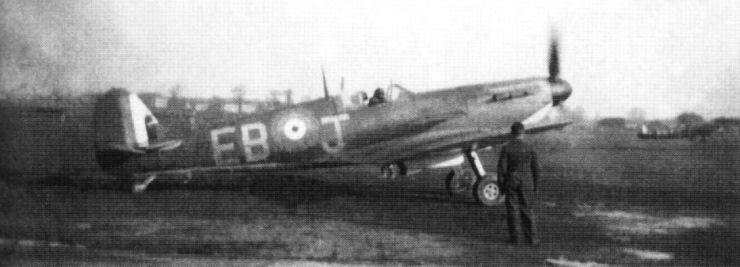
54 Squadron Spits with Rotol props prior to Dunkirk :
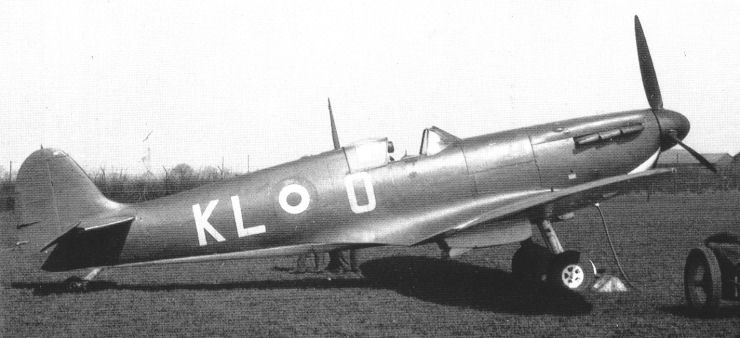

41 Squadron Spitfire at Hornchurch- looks like a Rotol prop to me (unknown when photo was taken).
By: antoni - 8th January 2009 at 20:17
According to Morgan and Shaklady.
In May 1939 the choice of propeller for the Spitfire MK II was being considered at a meeting held at Eastleigh with representatives of the Air Ministry, Rolls Royce, Rotol Airscrews and Supermarine. The prototype Mk II, K9791 was ballasted to full load and series of trials with various propellers initiated.
1) Rotol with Scharz blades 10ft 6in dia 170mm bearings.
2) Fixed pitch wood type Type 3001700.
3) Rotol, Scharz blades, 10ft 6in dia 150mm bearings.
4) Rotol with magnesium blades RA 611 10ft 6in dia, 1509mm bearings.
5) Propeller 4, pointed spinner.
6) Rotol, Schwarz blades 10ft 2in dia 150mm bearings.
7) Rotol magnesium blades RA 621 10ft 6in dia 150mm bearings.
8) Propeller 8 (sic), pointed spinner.
9) De Havilland 2 pitch 10ft 9in dia 114mm bearings x 126mm.
10) Rotol, Supermarine Jablo blades 10ft 4in dia 150mm bearings.
11) Rotol, magnesium blades RA 630 10ft 6in dia 150mm bearings.
12) Rotol, magnesium blades RA 640 10ft 9in dia 150mm bearings.
13) Rotol, Supermarine Jablo blades, faired roots 10ft 3in dia.
Supermarine agreed to design and construct a fixed pitch, four blade Jablo for trials. A Mr Collins of the Air Ministry said that the best propeller for the Spitfire Mk II appeared to be the Rotol CS with magnesium blades. Further trials took place in November 1939.
DH2 pitch Merlin II.
Rotol mag RA 640.
Rotol mag RA 611.
Rotol mag RA 621.
Rotol mag RA 630
Rotol Jablo 3001800
Rotol Schwarz RA 554 150mm Rt 10ft 2in dia.
3001700 wood fixed pitch
Rotol Jablo 3001900.
3001700 wood fixed pitch Merlin II.
Rotol Schwarz 150mm Rt 10ft 6in dia.
K9788 was then tested with three different propellers with the Merlin XII at different boost.
Rotol mag.
Heine Jablo
De Havilland.
Engine failure occurred with the Heine in April 1940. and a Merlin RM 4Sengine was installed and the trials continued. One of the results of the trials was that MAP instructed de Havilland to produce metal blades and not to use magnesium and Rotol was to concentrate on wood and Jablo blades.
By: chumpy - 8th January 2009 at 20:07
The book ‘Rotol’ The history of an Airscrew co. by Bruce Stait published 1990, gives some interesting detail as to the early production orders.
No actual dates for delivery’s / operational usage etc, but might help confirm the time line etc. ie Enquries from Supermarine for Rotol units in the summer of 1937.
Chumpy.
By: Mark12 - 8th January 2009 at 14:58
This one?
Yes. That is one of them.
Looking for the squadron code and or serial.
Mark
By: Mark12 - 8th January 2009 at 14:07
I’ve collected quite a few Spitfire/Dunkirk photos and studied a great deal more for a pending book and all blades appear bent ( metal ), never broken ( wood )
All the evidence in my collection ( so far ) indicates no wooden bladed Spitfires force- landed during that period, on the beachI notice from this wartime advert that a different company made the blades and they were then fitted to a ROTOL hub.
With two of the aircraft in question the blades are not bent. The Spitfires appear to have landed wheels down on the beach and then been ‘fired’ by their pilots. The resulting incendiary melting and breaking the fuselage at the cockpit. The nose falls forward and engages one or more of the blades with the sand. Then degradation takes place, the wreckage settles, the souvenir/scientists recover their parts, the sea does its thing etc etc.
mark
By: VoyTech - 8th January 2009 at 12:45
To my certain knowledge only wooden bladed Rotol prop assemblies have ever been found on early mark Spitfire wrecks, or, as to be expected, the metal blades on the more usual DeHavilland props as per the Mk I.
How many of those wooden-blade Rotol recoveries do you mean?
Looking through quite a lot of photos of crashed Spitfires (isn’t ebay great even if the only thing you can afford are those low res previews?) I have not found a single Rotol-propeller Mk I/IIs with broken (i.e. wooden) blades that could be dated at before 1942. They all seem to be bent (i. e. metal) in 1940/41.
By: Arabella-Cox - 8th January 2009 at 12:24
Voytech – thank you!
Since Mark12 and I both have that image already we have been sitting on the answer all along! Ho-hum.
Anyway, an interesting discussion.
By: VoyTech - 8th January 2009 at 11:41
Al Deere’s Spitfire on Dunkirk beach. Rotol propeller. Metal blades.
By: Arabella-Cox - 8th January 2009 at 09:17
Anneorac – thank you for that!
Yes, of course Rotol propellors had been in use for a while on Hurricanes over France but thank you for making that point. The issue of interest relates to the limited use of Rotol propellor assemblies on Mk I Spitfires.
What is very interesting, though, is to have it clarified that the Rotol blades were magnesium only on the Spitfire I. That does help – so, thank you! I had clearly missed the point in BeaufighterVI’s post – so thank you Peter! (Too much red wine last night!!)
Clarifying that they were Rotol not Dowty-Rotol is not being pedantic – just accurate. I think that a number of warbird types tend to call them Dowty-Rotol blades because that is what they became whereas, as you so rightly say, they were just Rotol in 1940.
By: anneorac - 8th January 2009 at 09:09
So, the question is; metal or wooden Rotol blades at this stage?
I don’t actually know (I suspect Magnesium) but the one thing I can tell you are the drawing numbers for the blades.
Stealing from Beaufighter Mk.VI’s Table.
Spitfire I RX5/4 magnesium blades RA.640
Spitfire II RX5/1 magnesium blades RA.640
Spitfire II RX5/3 Jablo or Hydulignum RA.675
What is beyond doubt is that Rotol props with wooden blades were over Dunkirk but fitted to Hurricanes with RX5/2 props with Weybridge DR.291 blades or possibly RX5/5 props with Jablo RA.4067 blades.
One last pedantic point. These are Rotol propeller assemblies, Dowty/Rotol did not exist until the 1960s.
Anne
By: Arabella-Cox - 7th January 2009 at 21:18
Fascinating stuff!
So, it seems that 54 Squadron were pretty much fully equipped with Rotol propellors by the start of 1940.
Indeed, looking at the well known shots of 54 Squadron taken around the time of Dunkirk/early Battle of Britain the wide root and distinctive shape of the Rotol props can be clearly seen. Not only that, but “Al” Deere’s “Kiwi 1” photographed in “Nine Lives” clearly has a Rotol prop. In the line up of pilots in front of a 54 Squadron Spitfire pre-Battle of Britain it is even possible to see the Rotol badge on the front of the spinner.
So, the question is; metal or wooden Rotol blades at this stage?
By: antoni - 7th January 2009 at 20:30
Rotol propellers were first fitted to a number of No. 54 Sqn Mk Is in the spring of 1940 and these were used operationally over Dunkirk.
I never thought I would live to see the day that I could correct the very knowledgeable VoyTech. 54 Squadron;’s ORB contains the following entries.
1st November 1939. A new type of “Spitfire” fitted with a “Rotol” constant speed airscrew was collected by Squadron Leader OO ZENS who began to carry out intensive flying and reliability trials with this aircraft.
10th December 1939. The squadron commenced to reequip with Rotol Spitfires. Six new aircraft being flown from No 9 MU Cosford by pilots of the squadron.
19th December 1939. One Rotol Spitfire was collected from No 6 MU Brize Norton.
21st December 1939. One Rotol Spitfire was collected from No 6 MU Brize Norton and a second one from No 27 MU Shawbury.
29th December 1939. “B” Flight reequipped with Rotol Spitfires.
In December 1939 No. 54 Squadron recorded the delivery of the following “Rotol Spitfires”: N3097, N3103, N3104, N3110, N3111, N3122, N3124, N3130, N3160, N3172, N3174, N3176, N3183, N3185, N3187, N3188. In January 1940 N3180 and N3184 were also taken on charge and the old Spitfires sent to No. 152 Squadron.
I did not compile the list so I cannot confirm the veracity of it. I have seen the pages from the ORB and the quotes are accurate.
According to Morgan and Shacklady MAP had instructed Supermarine to fit the Rotol constant speed unit to ten Spitfires after first replacing the Merlin IIIs with a specially modified engine but does not give a date. There is more information on the propeller trials that started in May 1939 but I don’t have time to write it out tonight.
By: Beaufighter VI - 7th January 2009 at 18:26
The Supplement to the Merlin II Handbook for the Series III, IV & X Engines Revised and printed in March 1940 by RR gives the following options for propellers.
Fixed pitch Airscrew
Two-pitch Airscrew
Variable Pitch Airscrew, Rotol Internal Cylinder
Variable Pitch Airscrew, De Havilland with centrifugal weights
Variable Pitch Airscrew, Rotol External Cylinder, feathering & non feathering types.
Variable Pitch Airscrew, De Havilland Hydromatic, feathering type.
From a table of airscrew types in another publication the early Spitfires were fitted with the following Dowty props. as follows:-
Spitfire I RX5/4 magnesium blades
Spitfire II RX5/1 magnesium blades
Spitfire II RX5/3 Jablo or Hydulignum
These were all constant speed peopellers.
Mention is also made of Spitfire D being fitted with both RX and RS props with Weybridge blades.
By: Arabella-Cox - 7th January 2009 at 17:51
Just to thank one-and-all for the input thus far.
Just to clarify, I think I ought to explain why the question has been posed.
As part of a major undertaking by American researcher/author Larry Hickey for his “Eagles over Europe” project both Mark12 and I (and others!!) have been helping to identify (or not!) various photos of shot down/crashed Spitfires in France c.May/June 1940. At least two photos show Spitfires with Rotol airscrews and we are trying to establish a time-line and thus rule in or out various known losses and tie them in with photographs which are mostly of German origin. From this perspective we need to establish when the Rotol props came into use. It was suggested that the two photos might depict Dunkirk period losses, although the Rotol props clearly raised a question mark here.
Hope that clarifies things just a little.
By: Arabella-Cox - 7th January 2009 at 16:46
I think the question is posed in a confusing manner. Rotol propellers were first fitted to a number of No. 54 Sqn Mk Is in the spring of 1940 and these were used operationally over Dunkirk. But these early Rotol propellers had metal blades. I don’t think wooden blades were used in opertional service before Mk V Spitfires.
VoyTech. An interesting point! However, I think we are specifically interested in an aeroplane(s) that was fitted with blades of the wooden variety although I must defer to Mark12 to check the photo-references relating to the specific query.
I have seen evidence of metal blades on four-bladed Rotol hubs on Mk IX Spitfires but the 54 Squadron operational use in the Spring of 1940 is new to me. To my certain knowledge only wooden bladed Rotol prop assemblies have ever been found on early mark Spitfire wrecks, or, as to be expected, the metal blades on the more usual DeHavilland props as per the Mk I. Was the usage of these “early” metal (presumably hollow?) blades peculiar to 54 Squadron – or was the usage more widespread than just that squadron?
By: Bradburger - 7th January 2009 at 16:42
Andy,
I don’t know if this is any use : –
http://www.spitfireperformance.com/spit1vrs109e.html
You’ll have to scroll down to the bit about climb performance, in which the various propellers, and the timeline as to when fitted, are discussed.
Also a bit more discussion about them here also, including input from Mike Williams who’s responsible for the WWII/Spitfire performance site: –
http://forum.keypublishing.co.uk/showthread.php?t=83873
It still doesn’t say whether they were wood or metal (I always understood they were wooden), so maybe we need to identify the Rotol blade type/numbers fitted to the C/S prop units for the answer?
Cheers
Paul


 Sign In








 January 7, 2009 at 12:45 pm