I was re-reading “2nd TAF Spitfire” by Hugh Smallwood about the history of ML407 and got stuck into his talk about Spitfire Wing types and the type of wing ML407 had.
He says there was a modified Universal wing (C Wing) that had a single .5 mg along with the 20mm, the same as an E wing. He says that is what ML407 had.
None of the photos of ML407 during it’s operational life are clear enough to see this though.
This lead to another question.
When did the “E” wing make it’s operational debut? I’ve only seen photos of Spits with E wings with partial D-Day stripes, which puts it early July as the soonest the E wings showed up.
Now there is a photo of what appears to be an E winged MK732 in the ML407 book and it appears to have full D-Day stripes on the wing, which puts it in mid to late June 1944.
The logbook I have of a 91 Squadron Spit XII Flight Commander documents the first E wing XIV showing up at 91 Squadron on July 14, 1944.
And this leads to the last question. Did the Spitfire squadrons operate both Universal and E wing Spits together? Or did they try and seperate them so that the guys filling the guns were operating one type? Again the ML407 book seems to show both types with 485 Squadron but I haven’t seen any other photo evidence in my books showing both with other squadrons.
So to clarify
-Was there really a Universal Wing (C wing) that used the .5mg and 20mm?
-When did the E wing become operational with the squadrons?
-Was it common to operate both E and Universal wing Spits together?
-What wing did ML407 have? Any photos to support it?
Dan

By: G-ORDY - 31st March 2025 at 12:11
My apologies for dragging up an old thread but I have recently updated the entry for MH350 in “The Book” and I have come across a reference which suggests that some of No. 485 Sqdn’s Spitfires had their armament changed “just before D-Day” from the standard 2 Hispano cannon and 4 Browning .303 inch machine guns to the “e” configuration of 2 Hispano cannon and 2 .5 inch Browning M2 machine guns.
MH350 started out life as a standard L.F.IX when delivered to No 485 Sqdn in August 1943 but by the time it went to Norway in May 1945 it was sporting the “e” type armament which it still has today.
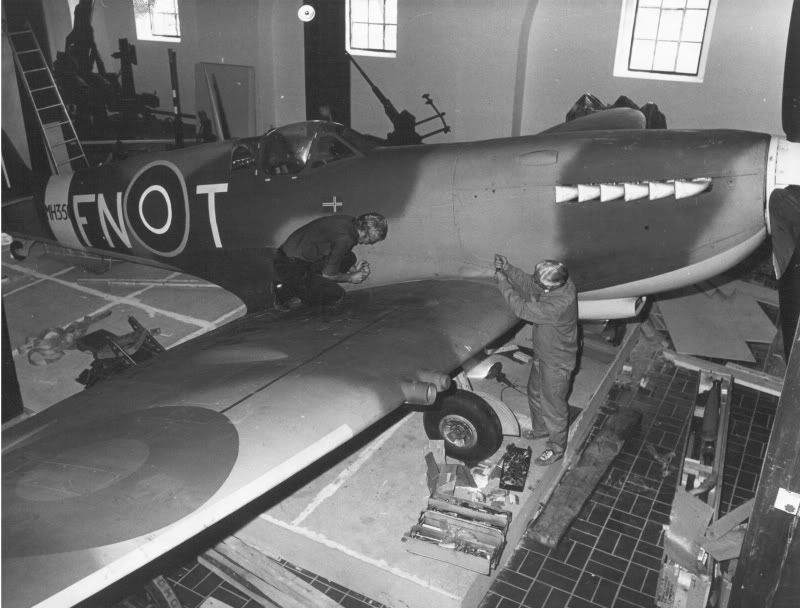
MH350 was on strength with No. 485 Sqdn during June 1944 but was transferred to No. 84 Group Support Unit, 2nd TAF, at Aston Down, Wilts, on 15 June (paperwork date?) and the remainder of the squadron is said to have converted to the L.F.IXe following their move to Coolham, Sussex, at the end of June 1944.
I’m wondering if anyone has a copy of the ORB for No. 485 Sqdn for June 1944 which may shed some light on this?
Was MH350 converted in June 1944 or later in its career?
Thanks!
By: Cranswick - 31st March 2025 at 12:11
Introduction of the 0.5 gun
Not perhaps the precise information that G-ORDY is looking for but there is a note in the 2ndTAF’s Spit Armament file at Kew which says that by mid-April 1944 it had been decided that 84 Group units would be the first to receive the revised armament (ie. 0.5 guns in lieu of 2 x 0.303) and the order would be 135, 131, 143, 145 an 132 Airfields (later renamed Wings).
135 Wing comprised 222, 349 and 485 Sqns. The 2nd TAF’s Order of Battle for 1 June 44 shows 222 and 485 equipped with ‘Spit.IX LF.5’ (sic). The OOB for 8 June shows 349 similarly equipped, but no other 2ndTAF squadrons (yet).
Unless this was wishful thinking, it would seem 485 got the 0.5 in May 44.
The plan was not adhered to as 125 Wing in 83 Group also got 0.5 Spits in mid-June 44 (132, 453, 602 Sqns).
By: G-ORDY - 31st March 2025 at 12:10
That’s very interesting Cranswick – thanks. Is there any indication of how the change was to take place? I’m wondering if the aircraft were converted on site, at an RSU or exchanged for different aircraft.
ML407 also served with No. 485 from April – December 1944. It was, I believe, a “standard” L.F.IX upon delivery which became an L.F.IXe later in its career but it now has Trainer wings – with extra tankage of course! During its Irish service it had no cannon ports which would suggest a wing exchange / rebuild during the conversion.
By: Cranswick - 31st March 2025 at 12:10
New Spits for old?
That’s very interesting Cranswick – thanks. Is there any indication of how the change was to take place? I’m wondering if the aircraft were converted on site, at an RSU or exchanged for different aircraft.
Original plans were for 50 modification sets (mod 1029) to be installed in the field but at the end of December 1943 this was changed to 60 sets to be incorporated in new Spits at Castle Bromwich under ‘high priority special arrangements’. So it looks like the re-equipment came about via exchange for new aircraft.
Volunteer required to analyse the serials in 485, 222 and 349 ORBs (that was the planned order) and the corresponding Form 78s ….
By: Seafire - 31st March 2025 at 11:45
Volunteer required to analyse the serials in 485, 222 and 349 ORBs (that was the planned order) and the corresponding Form 78s ….
Well, I haven’t had the chance to do that, BUT…
I did an analysis using the individual histories, and that shows the following:
222 Sqn got their first IXs (from Vs) in late Mar ’44, into April. I did not note a wholesale change of aircraft after that date (until Nov or so). Not sure if this means 222 got them first, or just that something’s missing.
485 Sqn got a new batch of IXs at end April/first few days of May. The prior batch got dispersed to new units from 8 June.
349 Sqn got a new batch (which I take to be the ‘e’s) about 15 June. Prior to that they took on some of the IXs shed by 485/222.
[Erroneous statement removed]
XIVe was issued from sometime in July, as I recall.
Now, about those dates. I have noticed that the dates given in the individual aircraft records often are a little off the dates recorded in ORBs, etc. Thus a whole batch (16 or so) might show “349S 15 June” but the OOB might indicate that 349 was re-equipped as of 8 June. I surmise that this reflects the paperwork catching up with reality. Also note that in the first half of 1944 there seems to be a general lack of documentation for exchanges/ issues to squadrons in the individual records.
In the case of 485 (for example), there is good consistency of “a squadron’s worth” of aircraft issued within a few days or so, if not a bunch on the same day. The previous group, however, do not show issue to other squadrons until about 8 June (which, by the way, is an extremely busy date for transfers!). I surmise that in a case such as this, when the new batch came the old batch were sent to servicing/ storage and then issued (individually) as required. It is also possible that, until the ‘e’ had proven itself, some ‘c’ were retained, but the general intention was homogeneity within a squadron (in fact, within a wing).
In the case of a swap between squadrons the individual records usually tie-up pretty neatly, although often they are off by a day or two from one direction to the other. Sometimes this is probably accurate (based on the logistics of movements, etc) and other times it probably reflects the flow of paperwork!
Now, as for ‘e’s, as stated the first issues were straight from the factory. Likewise, XIVe’s were delivered as such- that is, in that configuration, if not bearing that actual designation! I would expect that subsequently some IXs and XIVs that had been ‘c’ [term used descriptively] got converted to ‘e’, but I have found no information yet about this. I currently suspect that it happened less often than I previously imagined, but I honestly don’t know.
There are some relevant files at Kew that I never got a chance to look at…
bob
By: VoyTech - 31st March 2025 at 11:41
Also in mid June ‘e’s came to 302/308/317 Sqns.
(…)
It is also possible that, until the ‘e’ had proven itself, some ‘c’ were retained, but the general intention was homogeneity within a squadron (in fact, within a wing).
Well, doesn’t seem to apply to 131 Wing (302/308/317). They did exchange their whole set of LF.IXs in early to mid-June 1944 but those of the new ones that I have seen photos of were all ‘c’ wing, not ‘e’ wing.
Mark12 has once pointed out the two modifications introduced about the same time in 1944:
Mod 1029: ‘To introduce 2 x.5″ guns in lieu of the 4 x.303″ guns’.
Mod 1209: ‘To introduce fixed parts for the wing bomb scheme’.
Due to similarity of numbers these are likely to be confused. I believe the exchange of LF.IXs in 131 Wing (with seemingly identical ones) was connected with Mod 1209, not 1029.
By: G-ORDY - 31st March 2025 at 11:37
Well, I haven’t had the chance to do that, BUT…
I did an analysis using the individual histories, bob
Just as a matter of interest can you confirm the movements of MH350 and /or ML407 during May-June 1944?
I’m still wondering about this change of armament, we know that MH350 was changed to “e” configuration without doubt. Could this have been the reason why it was sent to No. 84 G.S.U. ?
I have also noted several apparently brand-new aircraft (e.g. MH603) were transferred from M.U.’s to units such as No. 405 A.R.F. before they were issued for squadron service. Now I can’t see a logical explanation for this – what could an Aircraft Repair Flight do which an M.U. couldn’t – unless it was for something like Mod 1029 to be carried out ?
Anyone seen the ARF files at Kew?
By: oscar duck - 31st March 2025 at 11:36
My Spitfire Mk XIV RM797 has all mounts for .5/20mm and 4 x .303 blanked off altough the blast tube and mountings are still fitted.
By: Seafire - 31st March 2025 at 11:35
Less information
Just as a matter of interest can you confirm the movements of MH350 and /or ML407 during May-June 1944?
I’m still wondering about this change of armament, we know that MH350 was changed to “e” configuration without doubt. Could this have been the reason why it was sent to No. 84 G.S.U. ?
MH350’s histories disagree between “Spitfire the History” and the Air Britain serial books, the former being suspect (and sketchy). Consequently, I don’t have dates of movement for that one, BUT: she obviously would have been an LF.IX (not ‘e’) and if, as you say, she left 485 in June that would agree with my observation about the departures of the earlier aircraft after equipping with ‘e’s. According to Air Britain she next went to 64 Sqn, who converted to LF.IX from V, getting mostly second hand aircraft. They do not appear to have used the IXe. This leads me to surmise that MH350 was converted to ‘e’ when being refurbished in preparation for 332/Norway.
ML407 seems to have been delivered as one of the first batch of LF.IXe, supplied new to 485 as such.
I don’t know about the ARFs offhand, and can’t get to possible sources until later.
VoyTech said: Well, doesn’t seem to apply to 131 Wing (302/308/317). They did exchange their whole set of LF.IXs in early to mid-June 1944 but those of the new ones that I have seen photos of were all ‘c’ wing, not ‘e’ wing.
Oops, I confused the aforementioned intended sequence of issuing ‘e’s with a conclusion of reality. My mistake, and I will revise my earlier post! Interesting observation about the similar mod numbers, but that doesn’t affect my calculations.
If I remember right, 125 Wing (per 2TAF books) got the first ‘e’s that ALSO had the wing bomb carriers? I’ll doublecheck when I get the chance.
bob
By: VoyTech - 31st March 2025 at 11:26
No. 405 A.R.F. (…) Aircraft Repair Flight
Are you sure this is correct? I have 405 ARF as Aircraft Reception Flight. I think repairs were handled by RSUs (Repair and Salvage Units).
what could an Aircraft Repair Flight do which an M.U. couldn’t
What an MU could do depended very much on the actual MU in question. Some MUs handled repairs, some did overseas crating/uncrating, and some were just storage units without staff or equipment for any kind of repair/assembly/disassembly operations. “RAF Flying Training and Support Units” by the late Ray Sturtivant and John Hamlin is a recommended source here.
By: Mark12 - 31st March 2025 at 11:26
Are you sure this is correct? I have 405 ARF as Aircraft Reception Flight. I think repairs were handled by RSUs (Repair and Salvage Units).
What an MU could do depended very much on the actual MU in question. Some MUs handled repairs, some did overseas crating/uncrating, and some were just storage units without staff or equipment for any kind of repair/assembly/disassembly operations. “RAF Flying Training and Support Units” by the late Ray Sturtivant and John Hamlin is a recommended source here.
…but Ray Sturtivant in “RAF Flying Training and Support Units” 1997 edition lists ARF as ‘Aircraft Repair Flight’.
Mark
By: G-ORDY - 31st March 2025 at 11:25
…but Ray Sturtivant in “RAF Flying Training and Support Units” 1997 edition lists ARF as ‘Aircraft Repair Flight’.
Mark
And if anyone is going to Kew they can find the relevant files at:
AIR 29: Operations Record Books Miscellaneous Units
Subseries: REPAIR AND SALVAGE UNITS
AIR 29/810 No. 405 Heston and Detling
1943 July-1944 Aug.
By: VoyTech - 31st March 2025 at 11:22
mod 820 (Outboard cannon front mounting – removal)
Do you have a copy of that?
The one item which was mandatory for wing bomb installation was the stronger (4-spoke, presumably) wheel and tyre
Presumably not. Most 1944 photos of Spitfire LF.IXs with wing bomb carriers show 5-spoke wheels.
By: Seafire - 31st March 2025 at 11:22
Huh?
Mod 1029 was not issued, as a leaflet, until 21-4/2-5-44, and, although I don’t have a copy, at present, its wording was very similar to 1214 (issued as leaflets in May, 1944,) which did the same mod to the XIV; it said “The work is to be effected by a contractor’s working party under Air Ministry arrangements……,” which seems to preclude M.U.s, and the like.
It’s entirely possible that the “E” winged IXs were, in fact, XVI airframes, since the XVI, as an official Mark no., did not exist until 4-8-44, though the IX, with the Merlin 266, did.
Edgar
I can’t see why you would propose that “E” wing equals XVI ‘airframe’. The XVI was simply a project to use up a batch of engines that were surplus to requirements, by installing them in IX airframes. It was decided to keep those at “home” (including 2TAF) so as not to further complicate the supply chain for the Spitfire in other theatres. And I’m pretty sure that I have a memo along the lines of “we’re getting ready to issue these to units, so we need to settle the designation question.” They were not serving as “LF.IX with Merlin 266” before they got around to assigning a new designation.
The project for the .5″ installation was already in the works for the IX/XIV, at the request of Fighter Command/ 2TAF. If IXs for 2TAF were to be ‘e’ configuration, then logically the XVI for 2TAF would also be.
I’m not clear on the specific application of a mod leaflet, but I don’t imagine that it would have to come before a mod could be accomplished by the company. I don’t think that’s what you’re suggesting, but I don’t want anyone to infer that if the leaflet wasn’t published until late April, there couldn’t be any ‘e’ aircraft prior to that.
bob
By: Mark12 - 31st March 2025 at 11:21
The 10 inch or 10.25 inch wheel issue is more likely to relate to improved braking surface area with the new wheel and brake combination. Heavier aircraft etc.
Mark
By: Mark12 - 31st March 2025 at 11:20
….just looked it up in my index of Spitfire mods.
Mod 820 – Class 3B – A/C V. IX, XII – Description: To remove the outboard Cannon front mount casting.
So were Spitfires MH415 and MH434 Mk IX wings built not with Mk. Vb front castings, as suspected, but Mk Vc front castings with mod 820 incorporated?
It is classified as an Armament Group 62 mod, rather than a Wing Group 08 mod. It sounds like it is a lot of work to gain a small performance benefit
I suspect they tried it and tested it and found that mounting the simpler hemispherical cap had the same performance effect and dropped it.
Edgar do you have details of the actual modification?
Mark
By: Seafire - 31st March 2025 at 11:18
Words
Please don’t put words into my mouth; I said that it was “entirely possible” which is not the same as equal to. The Merlin 266 was a low-level engine, and the IXs were L.F., so “possible” seems a fair word to use.
It was not my intention to put words in your mouth. You said “It’s entirely possible that the “E” winged IXs were, in fact, XVI airframes…” I was mildly horrified, if there is such a thing, at your apparent reversing of chronology. Perhaps I can make it more clear once I have a sift through my files.
The memo regarding the “Nomenclature of Aircraft. Spitfire LF MK XVI” has an added note “It has been found necessary by AEAF to segregate Spitfire LF IX aircraft fitted with the Merlin 266 engine from those Spitfire LF IX aircraft fitted with Merlin 66 engine.” This gives the impression (so it’s another “possibility”) that they were already in service by this date.
Edgar
The impression, maybe, but it isn’t right. What it means is that the Air Min had already decided that, since there was no real difference in performance, it was an LF.IX whether it had a Merlin 66 or a 266- much as an LF.V could have a 45M or a 50M or a 55M. But there were some installational differences, and possibly (I’m still a little vague on this!) some differences in tool-kit required, so those uppity folks that actually had to deal with such issues pressed their point.
I’ve got quite a few memos on this issue, but haven’t had a chance to go back through them. I’ll try to do so quickly-like.
Mark12: So were Spitfires MH415 and MH434 Mk IX wings built not with Mk. Vb front castings, as suspected, but Mk Vc front castings with mod 820 incorporated?
I think so, though I still question the “built with” part. Isn’t the ‘b’ cannon port part external to the wing skin? Looking at some photos recently I thought I could see it as the outer layer. The ‘c’ piece is internal. There’s still work to be done on this chimney pot issue!
bob
By: VoyTech - 31st March 2025 at 11:15
The impression, maybe, but it isn’t right. What it means is that the Air Min had already decided that, since there was no real difference in performance, it was an LF.IX whether it had a Merlin 66 or a 266- much as an LF.V could have a 45M or a 50M or a 55M. But there were some installational differences, and possibly (I’m still a little vague on this!) some differences in tool-kit required, so those uppity folks that actually had to deal with such issues pressed their point.
I don’t really think it was for technical reasons. Differences in engine installations of the various Mk Vs were no less than those between Mk IX and XVI. But, Packard Merlins were delivered under Lend-Lease Act which put important limitations on what the Crown was able to do with them if not used by the RAF. Note that after the war Mk IXs (all-British made) were sold worldwide, while Mk XVIs (with the Lend-Lease engines) were retained in RAF use. The only country to actually buy ex-RAF Mk XVIs was Greece which used a lot of the US military funding anyway.
Isn’t the ‘b’ cannon port part external to the wing skin? Looking at some photos recently I thought I could see it as the outer layer. The ‘c’ piece is internal.
Exactly! The “Mk IX wings built with Mk Vb front castings” theory seems to have been born from the “Mk IXB” designation in some documents. However, “Mk IXB” had nothing to do with the armament installation. It was an ad hoc informal name given at unit level to the “new” Mk IX as opposed to the “old” one before the official designation of “LF.IX” was introduced. I can’t see a reasonable way of using the Mk VB-style cannon chimney pot with the Mk VC-style cannon installation.
By: Seafire - 31st March 2025 at 11:06
I don’t really think it was for technical reasons. Differences in engine installations of the various Mk Vs were no less than those between Mk IX and XVI. But, Packard Merlins were delivered under Lend-Lease Act which put important limitations on what the Crown was able to do with them if not used by the RAF. Note that after the war Mk IXs (all-British made) were sold worldwide, while Mk XVIs (with the Lend-Lease engines) were retained in RAF use. The only country to actually buy ex-RAF Mk XVIs was Greece which used a lot of the US military funding anyway.
I’ve seen nothing to indicate that “ownership” was an issue at all. The designation was definitely at the behest of FC/2TAF, and when I get it all together I’ll post a document to that effect.
Keep in mind that the XVI was simply a way to use up some surplus engines, owing to the decision to keep Canadian Mosquito production on single-stage instead of switching to two-stage. A little over 1000 XVIs were built, as compared to almost 4000 LF.IX (and another 1600+ HF and F), and I suspect a fair number were consumed during the six months of fighting in Europe [edit: at very rough count, about 150-160 lost on ops, and another 125 or so SOC or otherwise out of service by the end of July ’45 (date chosen arbitrarily)]. They were kept at home during the war to simplify the supply chain (and thereby freeing up IXs for Southern Europe). There may be a bit of “keep it British” at play with exports, too, and also there would be a lot more spare engines and spare parts available.
The “Mk IX wings built with Mk Vb front castings” theory seems to have been born from the “Mk IXB” designation in some documents. …I can’t see a reasonable way of using the Mk VB-style cannon chimney pot with the Mk VC-style cannon installation.
Actually, I think Mark12 either proposed or agreed with the suggestion that the mysterious “one pot C” might have used up some extra ‘b’ castings since the outer cannon bay was surplus to requirements in the IX (until the ‘e’).
Personally I’ve seen no evidence that the lack of a second pot ever happened at the factory, and what little information I have, including mention of the mod that Edgar brought up, indicates that it was for retrospective action (or at least possible to be). I will admit that the few IXs I’ve seen with this are from a pretty tight serial (or delivery date) range, but there are also Vs to be found without the stub. I suspect that the amount of work for little gain explains why few seem to have been modified.
—–
Getting back, well, if not on track, then at least to another tangent: If I interpret Edgar’s suggestion correctly, it is that Merlin 266 Spits might have been in use as LF.IX(e)s before the new designation (XVI) came in.
When I started looking into my files, for a moment I had the fear that he might have been onto something. The weekly statements of deliveries DO show too many IXs from Castle Brom, and do not show XVIs until the week ending 28 Oct 44. However, I also have a note from Contracts to Vickers agreeing their figure of 191 “Mk.XVI” delivered to end of October, and when that is taken into account the figures can be brought into agreement. Naturally they would have been counted as IXs until the new designation became known- but if it was approved in August, why did it take until the end of October for Castle Brom to know about it. Didn’t they get the e-mail?
Equally importantly, the aircraft that I’d identified as XVIs when I did an analysis of issue to squadrons adds up to the right number according to agreed totals delivered, so there aren’t a significant number that I’m counting as IXs but that are really XVIs (that is, with Merlin 266). My analysis shows about six squadrons at least beginning to get XVIs by the end of November, divided between 2TAF and Fighter Command (and starting sharply on the 9th according to the record cards.) This seems to agree with the information I’ve seen about the appearance of XVIs- unless of course they all also missed the point about aircraft that hadn’t caught up with their proper designation yet. But there is no real conflict of XVIs being issued as replacements to LF.IX squadrons, either, which I would expect if there were some “LF.IX (Merlin 266)” units that had equipped before November. The need to segregate them was the reason for the new designation in the first place. There may have been a little overlap, but they basically switched outright from LF.IX to XVI, not a gradual transition.
Well, I hope you, dear reader, were able to follow my convoluted reasoning!
bob
By: Seafire - 28th December 2016 at 12:17
My apologies for dragging up an old thread but I have recently updated the entry for MH350 in “The Book” and I have come across a reference which suggests that some of No. 485 Sqdn’s Spitfires had their armament changed “just before D-Day” from the standard 2 Hispano cannon and 4 Browning .303 inch machine guns to the “e” configuration of 2 Hispano cannon and 2 .5 inch Browning M2 machine guns.
…the remainder of the squadron is said to have converted to the L.F.IXe following their move to Coolham, Sussex, at the end of June 1944.
I’m wondering if anyone has a copy of the ORB for No. 485 Sqdn for June 1944 which may shed some light on this?
I just stumbled across this thread again, and HAVE been looking at the ORBs. 485 Squadron received a new batch of LF.IXs (or as the ORB records it, Spit IXB) in late April, and they were still flying the same aircraft in July, when (for the first time) the ORB identifies them as “Spit IX LF(E)”. I believe that they’d had the ‘e’ armament since arriving on the squadron, and it is just a case of the terminology catching up.
bob


 Sign In








 January 16, 2007 at 10:06 pm