Alec Brew in his “The Turret Fighters – Defiant and Roc” mentions a strange incident over the Irish Sea where a Defiant pilot – chilling in his cockpit on an obviously nice day with the canopy back, put his elbows up on the sills of the cockpit…
….accidently kicked his control column…
– and hit his secondary firing button for the turret guns – which were facing forward and at zero elevation. The firing circuit master switch in the cockpit was “live” for some reason…
…and the Brownings fired through the tops of his Irving sleeves!
Unfortunately Brew doesn’t reference this anecdote; I’ve a feeling it could be 307 (Polish) Sqn, as they spent time patrolling the Irish Sea from Kirton then Jurby on the Isle of Man in late 1940 before returning to Kirton again when the LW began to raid Liverpool regularly. Prior to this operational assignment they’d been kept out of the way over the Irish Sea as they worked up on their new Defiants, and before they had VHF radios and IFF kit installed!
But this is JUST a guess – has anyone ever read more or know more about this event???

By: JDK - 3rd November 2010 at 06:55
I can’t pretend that I was pleased to see this thread re-emerge. However ‘Defiant B’s post was most interesting, and a great first post to the forum.
I am curious as to how the statement in our book can be said to be ‘inaccurate’. I’ve re-read both our author’s statement as quoted and Defiant B’s interesting illumination of the detail but apart from being brief and thus (arguably) not doing justice to the complexity of Boulton Paul’s interrupter gear, I can’t see how it’s actually wrong. (Defiant B’s preamble relating to the nature of interrupter gear types does not mean that the usual uses of the term exclude or define this specific use.)
On the other hand I’m delighted the book is regarded as ‘otherwise excellent’.
Andy, that’s a good shot, another copy of which we used in the book, as well as a couple of companion images showing the structure with cupola off and with the guns removed. I’d add that this image still has part of the turret mounting frame (a sort of lying-down ‘K’) visible in the middle. That is (of course) not part of the turret, and is a remnant of a full frame the side members of which have been retouched out.
Regards,
By: Creaking Door - 3rd November 2010 at 01:17
Strange to see this thread resurfacing after its brief but hectic former existence.
In fact the Defiant is fitted with a sophisticated interrupter gear, which allows independent control of the left and right hand pairs of guns in both rotation and elevation. It consists of a brass cylinder with a pair of sliding contacts (one for each pair of guns) that are moved via a cable according to the guns elevation. A chain drive rotates the cylinder in synchronisation with the turret. Insulated areas on the cylinder isolate the gun circuits as required. The contacts control the guns through relays thus reducing arcing around the insulated areas.
There are only two insulated areas for each gun one to avoid hitting the tail the other a small strip that prevents firing when the guns are in the forward stowed position.
I actually found I had a diagram of the interrupter system used on Boulton-Paul turrets; this is from ‘British Aircraft Armament – Volume 1’ by R. Wallace Clarke and is presumably reproduced from an AP for the turret.
Welcome to the forum by the way.
By: Arabella-Cox - 1st November 2010 at 15:53
BP Defiant Turret
This image just emerged from a pile of turret photographs I was sorting and is stamped Dowty Boulton Paul Ltd, Defiant Turret (Type A).
Thought it might be of interest (and topical!) to see the turret in its entirity. One normally only ever sees the top bit!
By: Defiant B - 1st November 2010 at 15:37
I have only just been told about this forum and on reading it I have noticed that some inaccuracies have crept in. There is also a potential for misunderstanding about interrupter gear. Normally for fixed gun installations interrupter gear is only fitted if the guns are mounted where they fire through the propeller arc. Where guns are mounted in movable turrets interrupter gear is fitted to prevent bullets fired from the turret hitting other parts of the structure. I am not suggesting that previous contributors have got this wrong but there is a possibility of confusion. The Boulton Paul Defiant is not fitted with any method of allowing firing through the propeller arc.
A serious inaccuracy is the statement that “the Defiant had specific electric cut out or insulation points around the ring so as to prevent the gunner from shooting off parts from his own aircraft”. This quote is taken from page 31 of Mark Ansell’s otherwise excellent book on the BP Defiant. In fact the Defiant is fitted with a sophisticated interrupter gear, which allows independent control of the left and right hand pairs of guns in both rotation and elevation. It consists of a brass cylinder with a pair of sliding contacts (one for each pair of guns) that are moved via a cable according to the guns elevation. A chain drive rotates the cylinder in synchronisation with the turret. Insulated areas on the cylinder isolate the gun circuits as required. The contacts control the guns through relays thus reducing arcing around the insulated areas.
There are only two insulated areas for each gun one to avoid hitting the tail the other a small strip that prevents firing when the guns are in the forward stowed position. The interrupter gear is described in AP 1659C, Vol 1, Chap 3. The interrupter gear end is just visible at the top centre of the top photo on page 69 of Mark Ansell’s book.. It is also visible just under the turret ring immediately to the right of the ammunition boxes in the lower left photo on page 72.
There are two other mechanisms, which control or are controlled by the turret rotation, the details are in the same AP.
1. Cam-operated air valves which control air cylinders that raise or lower the movable fairings. There are 2 valves one for each fairing. A gunner-operated lever extends an extra portion of the cam to allow the appropriate fairing to be raised when the guns are stowed. This lever covers the main switch to prevent the turret from being turned when the guns are stowed; it is labelled fairings up/down but actually has no effect when the turret is in any other rotational position.
2. There is a mechanical device that prevents rotation over the forward fixed portion of the fairing unless the guns are elevated enough to clear. There is provision for the guns to be lowered to the stowed position, this is where the electrical interrupter is required..
Other facts. The turret was designed as a drop in self contained unit with a possible continuous 360-degree rotation. Therefore all the connections are electrical through slip rings. The turret is powered by a 24-volt supply. The hydraulic system is independent of the main aircraft with its own self-contained electric pump. The guns are spaced 28.44 inches apart horizontally and 6.46 inches vertically. The Pilot’s control column is unusual in that it is fixed to the seat and thus elevates with it.
Observations. The pilot’s gun button has a safe position in which it is impossible (unless faulty) for the guns to be fired. In the fire position it is still difficult to depress the button accidentally because of the skirt. Going back to the interrupter gear, the insulated area on the cylinder preventing the guns from firing in the forward stowed position is very small and would appear to be difficult to maintain in alignment. The wiring is basic and I can find no combination of switch positions that would allow the pilot to fire the guns accidentally.
My conclusions for the possibility of bullets passing through the pilot’s sleeves are that it is certainly possible. The gun spacing is less than my elbow span even with hands clasped. All that is needed is for an electrical fault and the gunners switch to be set to Pilot.
Consider this possible scenario:- The pilot relaxing has the canopy slid back, seat raised, goggles and helmet on with his arms resting on the sides, hands still on the control column. The guns are stowed so there should not be any possibility of them firing. Playing about he presses the gun button, the interrupter gear is slightly misaligned and the gunner has set the control to “Pilot” for whatever reason.. The guns fire probably only from one pair, given the separate interrupter segments. The pilot is not going to admit to actually pressing the button but he must report the spent cartridges, possible propeller damage and some unknown fault. This is only one possibility but there is one certainty, the gun reportedly only fired when the pilot’s button was pressed, there are many other possible electrical failures such as shorting at the slip rings and sticking relays.
One other point I have noticed is that in the still frames taken from the film there is the end of a square shaft visible. This is where the handle for manual rotation of the turret is normally stowed so it is likely that the film was staged without a power supply. I have not seen the film so the handle could be elsewhere. No one is infallible and corrections or comments are invited.
By: Creaking Door - 28th June 2010 at 09:32
Interestingly not JUST if he moved the joystick –
So to energise electric motor (and hydraulic pump) the gunner would have to operate two distinct switches, the ‘master switch’ and the ‘armature switch’ (by gripping the joystick)?
There do seem to be an inordinate number of safety features on this turret, but maybe not so surprising if the gunner has got wriggle himself around inside without inadvertently traversing the turret.
By: phylo_roadking - 28th June 2010 at 01:22
LOL you buy the 3-DVD set from the IWM, tho’ I think parts of them can be tracked down on YouTube. I was sent the screengrabs.
Yes, I assumed that was why the gunner’s left hand was being used…given that the camera is looking over his right shoulder, using the right hand would have obscured the view.
But surely the gunner would switch the ‘pilot-off-gunner’ selector switch well before looking down and to the right, away from his gunsight, would have been an issue
Yes, to switch from “off” to gunner”….could have been done at leisure, I would assume after the guns were unlocked from straight ahead” for takeoff.
But from “gunner” to “pilot”? Remember…when this was to be done –
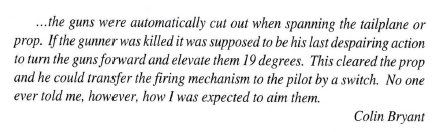
…the gunner MIGHT have been somewhat preoccuopied! 😮
By: Creaking Door - 28th June 2010 at 01:14
But surely the gunner would switch the ‘pilot-off-gunner’ selector switch well before looking down and to the right, away from his gunsight, would have been an issue.
Also aren’t these stills from an instructional film? There would have to be concessions for positioning the camera (and fuses could have been pulled to prevent the cameraman falling off the turret if the gunner moved his joystick) so these actions probably don’t reflect exact operational use.
Where can I see these films?
By: phylo_roadking - 28th June 2010 at 00:48
The bulb was to warn the gunner that the turret would turn if he moved the joystick…..
Ah, I see that now, my big red line is obscuring the line referring to the “main switch”
Interestingly (for Scalectrix fans :D) not JUST if he moved the joystick –

the gunner can see which way the ‘pilot-off-gunner’ selector is switched just by looking at it.
I wonder…it means him intentionally looking down and to the right, away from his gunsight…
Although here he’s switching it with his left hand, remember from James’ pics in the other thread where it is…
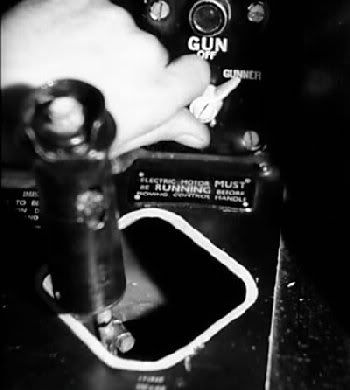
…down at the bottom of the right side of his controls, in front of the joystick.
By: Creaking Door - 28th June 2010 at 00:28
In BOTH pics you can see that the switch is “on”, turned to the “gunner” position…
AND THE LAMP IS *NOT* LIT!
Aren’t you confusing the bulb lighting for the ‘master switch’ for the turret motor (and hydraulic power) and the ‘pilot-off-gunner’ selector switch of the firing circuit?
The bulb was to warn the gunner that the turret would turn if he moved the joystick…..the gunner can see which way the ‘pilot-off-gunner’ selector is switched just by looking at it.
By: phylo_roadking - 28th June 2010 at 00:24
Do you have a similar passage for the firing circuit?
Yes I do…from the Defiant MkI Manual again –
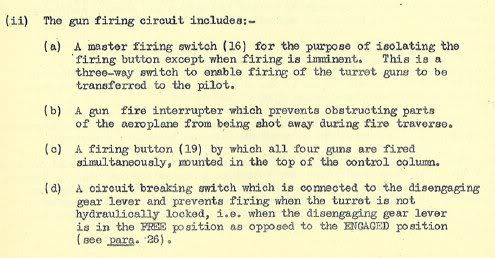
…and as I said at the top of the thread, see how it pokes a finger in Clarke’s eye??? 😮 And yet if it’s so wrong – we are supposed to believe it simply wasn’t amended between September 1939 and October 1942? :rolleyes:
By: phylo_roadking - 28th June 2010 at 00:12
No, you’ve lost me there.
In BOTH pics you can see that the switch is “on”, turned to the “gunner” position….
AND THE LAMP IS *NOT* LIT! :eek::p
(I wonder if this was one of the light reduction steps taken to dull the illumination in the turret when nightfighting?)
Isn’t the bulb designed to indicate that the electric motor that runs the hydraulic pump is running? My knowledge of the turret systems is letting me down here but I’d assumed the traverse and elevation were hydraulically powered (and that the motor was remote from the turret so the gunner couldn’t hear or feel it working).
Would the guns fire without hydraulic power? I’d say probably yes.
Yes, to both….the gunner had a crank handle to turn the turret with one hand in the absence of hydraulics for any reason…but according to that section of the manual the lamp should be on when the master switch is “on”. And you can see that it isn’t…
By: Creaking Door - 27th June 2010 at 23:44
…is it that impossible for Sgt Loftig to have rested his arms up on the cockpit sills???
I’ll concede that it looks possible…
…but as I said earlier I simply don’t have the knowledge to argue about the position of the pilot’s arms or whether it would be possible for the pilot to inadvertently press his firing button. So for the sake of my argument I’ve assumed that both those are possible, difficult, but not impossible.
Those issues aside I’m still far from convinced that this anecdote is anything other than a ‘line-shoot’. 🙂
By: Creaking Door - 27th June 2010 at 23:30
If that bulb had popped…then the gunner wouldn’t have that little glowing reminder out of the corner of his eye that the master switch was still “on” and energised…whether at “pilot” OR “gunner”…
Isn’t the bulb designed to indicate that the electric motor that runs the hydraulic pump is running? My knowledge of the turret systems is letting me down here but I’d assumed the traverse and elevation were hydraulically powered (and that the motor was remote from the turret so the gunner couldn’t hear or feel it working).
Would the guns fire without hydraulic power? I’d say probably yes.
NOTICE ANYTHING??? I just have…
No, you’ve lost me there.
By: Creaking Door - 27th June 2010 at 23:16
…the Operating manual for the Defiant MkI specifically says the condensers were to stop arcing acros the switch contacts…
Fair enough, I’d expect there to be condensers (capacitors) on the power circuit; especially to protect the wireless from interference caused by the electric motor that drives the hydraulic pump. However we should be clear what the condensers fitted to the ‘main switch’ (and other switches) are actually for.
As far as I know (and with the usual disclaimer regarding my electrical knowledge) the condenser fitted across a switch is designed to prevent (or reduce) ‘arcing’ during the opening and closing of that switch but the switch will be fundamentally designed to avoid any possibility of arcing in its open position.
A switch works by opening two contacts so that the voltage difference between them is unable to arc across the gap, because the air between acts as an insulator, but at some point during opening the contacts are close enough, without touching, for the electricity to jump the gap; to arc. This arcing generated extreme heat which damages the contacts and leaves an oxide layer which degrades current flow. To prevent this arcing, a condenser is fitted between the contacts, this provides an alternative path for a limited current to flow while the contacts are critically close and so prevents arcing.
Condensers are not designed to prevent spontaneous arcing that would allow an open switch to become a closed switch.
Do you have a similar passage for the firing circuit?
By: phylo_roadking - 27th June 2010 at 23:09
By the way – is it that impossible for Sgt Loftig to have rested his arms up on the cockpit sills??? Doesn’t look out of the bounds of possibility to me…
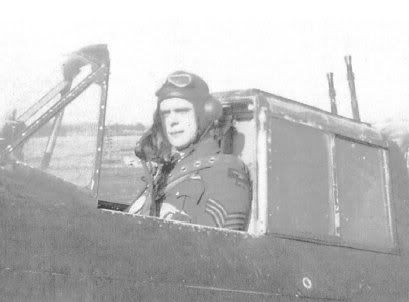
By: phylo_roadking - 27th June 2010 at 22:53
You might also notice is that there’s something else buried in there that might have some bearing on a “human/mechanical error” issue causing the Irish Sea incident…

If that bulb had popped…then the gunner wouldn’t have that little glowing reminder out of the corner of his eye that the master switch was still “on” and energised…whether at “pilot” OR “gunner”…;)
HERE you can see the actual position of the bulb in a screen capture from “The Royal Air Force at War: The Unseen Films” from The Imperial War Museum Official Collection – does this count as a primary source?…right above the word “GUN” –
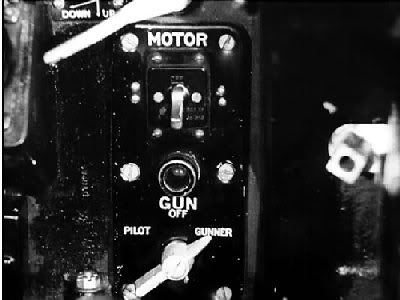
NOTICE ANYTHING??? I just have….
Here’s another capture for emphasis –
😮
By: phylo_roadking - 27th June 2010 at 22:34
Creaking_Door, I’ve had another look through some of the material I was first sent by Hendon regarding this. And a page that was previously of little use in the debate here and elsewhere has some answers to the issue of the part played by the Condensers…
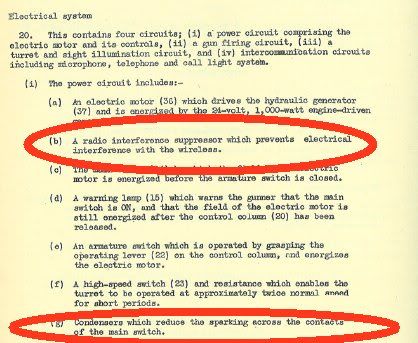
As you can see, the Operating manual for the Defiant MkI specifically says the condensers were to stop arcing acros the switch contacts….ad that there was a separate and additional suppressor fitted to the circuit to prevent interference with the radio 😉
By: phylo_roadking - 27th June 2010 at 22:33
James –
Ah, so despite saying so you aren’t interested in the veracity of the anecdote. Sorry, I thought what you said was what you meant.
I’m interested in the veracity of the anecdote insomuch as how it bears on the Clarke issue. Obviously a pilot’s firing button that isn’t physically connected to the wiring circuit as per Clarke can’t cause a misfire…
I don’t know (or care) if Clarke made a mistake in his book. As a publisher, I’m well aware the error-free book probably does not exist (rather like APs). As you also have signally failed to grasp, I’m not interested in AP reliability, and at no point have I entered that part of the discussion, beyond your touching believe that need = result.
Then can I ask why on earth you chipped in in such detail on an issue that from the very beginning involved both a discussion of Clarke…
(And I’m perfectly aware no book is perfect, including Air Publications; but I find it rather unrealistic to believe that the SAME mistake could appear in effect in FIVE Air publications – all with a separate document-controlled Amendement process – and that it would be permitted to remain there in total for at least five years that *I* can see – AND at the same time they should all agree so closely with the features of the aircraft as descibed in an anecdote from Mark’s book that you edited?)
I’m not interested in AP debate or switchery detail at this level, and I’m comfortable that the flaws the the story and the route for resolution are available to the interested reader.
…AND involved from the beginning a discussion at that level? 😮
It’d be nice if you were to state if you were going to contact Alec or not, but it’s not important, obviously. If I get time I may ask Mark to take a look at the thread – I think you’ll understand that I won’t be definite about it as I can’t personally recommend joining the discussion, and I’d like to give him the opportunity to decline.
Actually, Mark has replied to my PM AND I’ve also emailed Crowood since you first suggested it. I didn’t realise you were keeping a checklist of replies.
I note you’ve failed to ‘pursue’ acknowledging the even more basic physical and structural issues I’ve raised or respond with a page reference to the anecdote as requested. Even a ‘yes but’ might have helped.
1/ I’m tracking down some material on all that myself before commenting – I wasn’t aware I was against a time limit?
2/ Alec’s anecdote is of course on Pages 35 and 36, in Chapter Two “Specification F.9/35“
On a more constructive level, with someone who has expressed an interest in the detail we’re discussing…
By: JDK - 27th June 2010 at 01:35
Phylo,
Ah, so despite saying so you aren’t interested in the veracity of the anecdote. Sorry, I thought what you said was what you meant.
I don’t know (or care) if Clarke made a mistake in his book. As a publisher, I’m well aware the error-free book probably does not exist (rather like APs). As you also have signally failed to grasp, I’m not interested in AP reliability, and at no point have I entered that part of the discussion, beyond your touching believe that need = result.
I note you’ve failed to ‘pursue’ acknowledging the even more basic physical and structural issues I’ve raised or respond with a page reference to the anecdote as requested. Even a ‘yes but’ might have helped.
The success of communication is measured by the comprehension at the recipient’s end, not on how one feels one’s putting it over. I’m sorry to be blunt, and I’m always learning we could do better – but I’ve plenty of people who ask me to communicate for cash, so I don’t think I’m a disaster at it.
I’m not interested in AP debate or switchery detail at this level, and I’m comfortable that the flaws the the story and the route for resolution are available to the interested reader. It’d be nice if you were to state if you were going to contact Alec or not, but it’s not important, obviously. If I get time I may ask Mark to take a look at the thread – I think you’ll understand that I won’t be definite about it as I can’t personally recommend joining the discussion, and I’d like to give him the opportunity to decline.
Sorry to be so grumpy about it, but I’ve other things to do where people want the help, so I’ll move onto them. Good luck with your learning.
Yours,
Certainly, but no harm in anyone speculating over the technicalities and probability from a purely academic perspective, if your mind has such a bent to it (like mine)! 🙂
Indeed, provided you acknowledge the limitations and exclusions of the idea, otherwise others will point them out … repeatedly. Academically, if you “tacle the q like that in the xam, you get 0 marks” as Molesworth sa.
If we took everything on this forum that was ‘subjected to analysis beyond its merit’… :rolleyes:
Which is why I don’t bother with numerous threads here, and certain posters. I assumed the question posed wanted an answer, or knowledgeable input, rather than being an excuse for something quite else!
I have a bad allergy to selective data collection, ignoring feedback and obsessive technological discussion. But that all might be a mis-communication as well.
Regards,
By: phylo_roadking - 26th June 2010 at 18:00
James – sorry to pursue this…but obviously “get it” you don’t.
I’ve suggested that paperwork – such as APs – are not primary data in checking how the thing works, rather than an official statement of how its supposed to be used.
…except it has to work the way the “instructions” say – whether in practice the crews ever used them that way or not. Or else ALL the manuals/Notes would be amended, or even just one of them….to reflect the new reality – and that did not happen.
In other words – that’s why I’m trying to find out ALSO what the normal training/regime was for Defiant conversion…as in – was what Colin Bryant says they were TOLD to do ever practiced for real???
I’m afraid that APs, including revisions, are not a 100% reliable guide to actual use of equipment – it’s naive to believe otherwise.
1/ I’m quite aware of that – note my empahsis; for instance, whole sections such as the gun control transfer COULD in practice have been completely ignored. But the use or not is certainly no guarantee that an aircraft type was set up/functioned differently than the manuals/Notes say!
2/ Remember the Amendment process – if something changed, then they changed too, sooner or later. Are you aware of the example of the instructions on not exceeding a particular airspeed when climbing to
operational altitude in a MkII fitted with Marston radiators? SOMEONE somewhere had to work out there was a problem, THEN the Pilot’s Notes for the MkII were amended.
3/ there’s the reality check of it saying the same thing in THREE AP streams –
A/ the Manual/Pilot’s Notes for the MkI
B/ The Manual/Pilot’s Notes for the MkII
C/ AP1659C for BP Turrets.
I’ll be quite happy to find out that noone ever DID what the manual said intentionally I.E. never intentionally transferred the control of the guns to the Pilot…
But not doing it is 100% different from the facility to do do it being physically removed as Clarke says! 😮
Can you see that that’s two completely different aspects?
So finally, I’m interested in Alec’s input, mildly interested in a page ref to the story, but otherwise IMHO an obvious line-shoot for minor amusement is being subjected to analysis beyond its merit.
I don’t think you’ve grasped that I’m interested in far more than just Alec’s anecdote; that just kickstarted my interest in several different areas of the whole issue. Whether or not it happened, whether ot not it was pilot error, gunner error, electrical fault or mechanical fault…discussion of it on several occasions has brought up the question of the veracity of Clarke’s statement.
And that statement and how it differs from the apparent historical reality of what the APs say is a separate issue from the Irish Sea anecdote.


 Sign In








 June 21, 2010 at 9:42 pm