Way way back, many years before I was a twinkle in the milkman’s eye, my dad was in the Merchant Navy. It was sometime in the 1950’s when they were near New Zealand. They had been training in co-operation with the New Zealand Air Force to enable rough sea landings of flying boats.
The trick is apparently, to sail the ship around in circles of about a mile diameter. The wake from the ship on the inside of the circle all flows to the centre of the circle, the wake itself helping to form a barrier, and this creates an area of calmer water, which then allows the seaplane/flying boat to make a safe landing.
The following two pictures were taken from the bridge of the ship, one of which can be seen looking down on the Sunderland as it flew past!
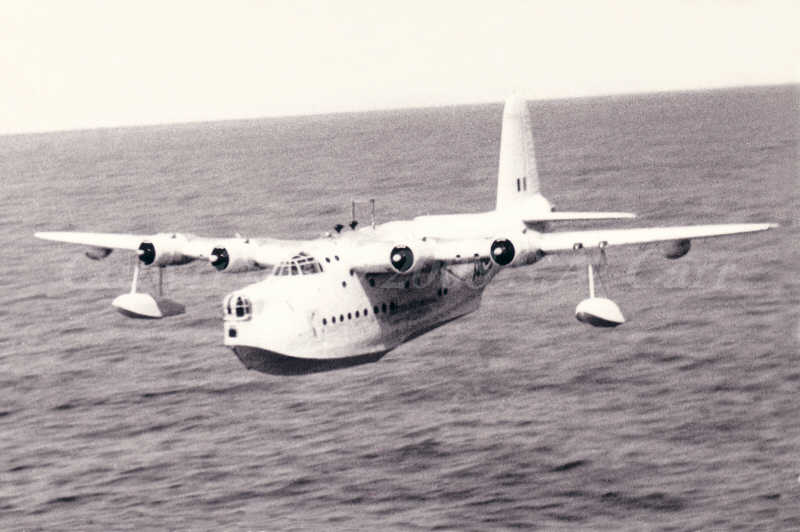
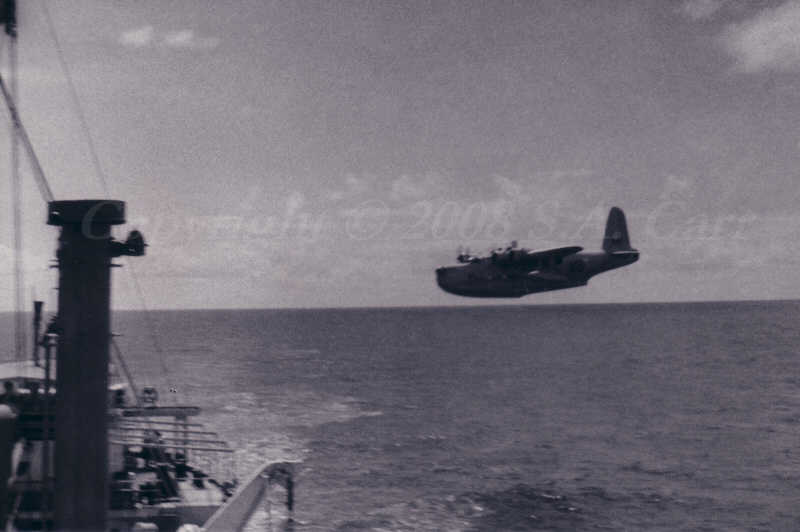
Steve

By: Arabella-Cox - 21st January 2008 at 15:37
Another message from my dad….
“We got a Radio message from N.Z. asking if we would play in an air/sea rescue exercise. The Sunderland left it’s base in Auckland harbour, while we sent out a Homing Signal ( instead of a real distress signal ).
Her D/F equipment could not have been all that good, for there was another ship on our starboard bow, about ten miles away, and when the aircraft came in sight, it went to the other ship first, circled her, found it was the wrong one, and then came over to us.
She buzzed us a few times, and then sent us a signal to say they had a broken oil line, and would have to leave. She disappeared over the horizon, and then all went quiet. Sparkie could not raise her at all, and we were starting to get worried. Finally their base radioed that she had landed safely.”
Steve
By: Pondskater - 21st January 2008 at 14:08
Great photos Vultee. I wasn’t aware this technique had ever actually been tried, never mind photographed.
Thanks for sharing it
Allan
By: flyernzl - 20th January 2008 at 23:44
If it is A then definitely NZ4105 ex PP110. BOC RNZAF 13/6/1953,
WFU Hobsonville, in store by Jan65, to GSB for sale as scrap Aug66.

By: Arabella-Cox - 20th January 2008 at 16:06
Here’s my dad’s ship, taken by the Sunderland crew.
Quote from dad…..
“I was in the “Auckland” from 18th March 1960 to 15th December 1961, but the most likely time for the photos would be spring 1961.”
Steve
By: Arabella-Cox - 20th January 2008 at 12:00
Thanks for that. Just sent the links to my dad, he’ll be interested to see it.
Steve
By: lauriebe - 20th January 2008 at 11:25
Could it be NZ4105? Rather a sad looking photo of it here:
http://www.adf-serials.com/nz-serials/gallery/Sunderland/CK_HB060968_NZ4105
There is a history of all Sunderlands to serve with the RNZAF here:
By: Arabella-Cox - 20th January 2008 at 10:08
Looking at the original large scans, the code letter is ‘A’. There’s no other letters following the roundel, just a serial which is too small to make out.
Steve
By: flyernzl - 20th January 2008 at 03:19
Interesting. I have heard of that technique, but never seen it put into practice. I wonder how the take-off would have worked.
Any chance of making out the code letter on the Sunderland – is it A?


 Sign In








 January 19, 2008 at 4:49 pm