there a lot of experimental aircraft that are designed to be very agile 😎 which one you think have the best sustain turn rate , instantenious turn rate , best nose pointing (AoA ) , best turning at slow – high speed
1) HiMAT
The HiMAT plane’s rear-mounted swept wings, digital flight control system, and forward controllable canard made the plane’s turn radius twice as tight as that of conventional fighter planes. At near the speed of sound and at an altitude of 25,000 feet, the HiMAT vehicle could substain an 8-G turn (that is, one producing acceleration equal to 8 times that of gravity). By comparison, at the same altitude, an F-16’s maximum sustained turning capability is about 4.5 Gs.
The three-phase HiMAT project began in 1973. In August 1975 Rockwell International was awarded a contract to construct two HiMAT aircraft. The aircraft allowed researchers to test advanced technologies at a reduced cost. The goals of HiMAT included a 100 percent increase in aerodynamic efficiency over 1973 technology and maneuverability that would allow a sustained 8-G turn at 0.9 Mach and an altitude of 25,000 feet. The program achieved both goals.
http://www.nasa.gov/centers/dryden/news/FactSheets/FS-025-DFRC.html
2) X-36
[IMG]http://www.dfrc.nasa.gov/gallery/photo/X-36/Medium/EC97-44294-6.jpg
For control, a canard forward of the wing was used as well as split ailerons and an advanced thrust vectoring nozzle for directional control. The X-36 was unstable in both pitch and yaw axis, so an advanced digital fly-by-wire control system was put in place to stabilize the aircraft
The X-36 possessed high maneuverability that would be ideal for use as a fighter
http://en.wikipedia.org/wiki/McDonnell_Douglas_X-36
3) X-31
X-31 achieved controlled flight at a 70° angle of attack. On April 29, 1993, the second X-31 successfully executed a rapid minimum-radius, 180° turn using a post-stall maneuver, flying well beyond the aerodynamic limits of any conventional aircraft.
The X-31 featured fixed strakes along the aft fuselage, as well as a pair of movable computer-controlled canards to increase stability and maneuverability. There are no horizontal tail surfaces, only the vertical fin with rudder. Pitch and yaw are controlled by the three paddles directing the exhaust (thrust vectoring). Eventually, simulation tests on one of the X-31s showed that flight would have been stable had the plane been designed without the vertical fin, because the thrust-vectoring nozzle provided sufficient yaw and pitch control
http://en.wikipedia.org/wiki/Rockwell-MBB_X-31
4) Su-47
The Su-47 has extremely high agility at subsonic speeds, enabling the aircraft to alter its angle of attack and its flight path very quickly while retaining maneuverability in supersonic flight. The Su-47 has a maximum speed of Mach 1.6 at high altitudes and a 9g capability
Thrust vectoring
The thrust vectoring (with PFU engine modification) of ±20° at 30°/second in pitch and yaw will greatly support the agility gained by other aspects of the design.
http://en.wikipedia.org/wiki/Sukhoi_Su-47
5) F-15 ACTIVE
Canard Foreplanes: The canards fitted to the front of the aircraft improve pitch maneuverability.
Thrust-Vectoring Nozzles: By using a combination of the movable nozzles and vanes in the jet pipe, the STOL/MTD can direct exhaust forward, outward or at an angle of up to 20 degrees to the axis of the aircraft.[citation needed]
Combined Canard, Elevator and Nozzle effect: With its highly advanced flight control software, the STOL/MTD coordinates the movement of the forward canards to give up-force, and the tailplanes and nozzles produce a down-force when maneuvering. This produces a pitching moment larger than that possible with the conventional elevator-only configuration. As a result, maneuverability is far improved.
Fast Stop-Start: By vectoring engine exhaust from above and below the nozzles and turning the canard foreplanes to act as giant airbrakes, the STOL/MTD could decelerate very rapidly and then accelerate fast using its powerful F100 engines. This kind of maneuver might be useful in a dogfight.
http://en.wikipedia.org/wiki/McDonnell_Douglas_F-15_STOL/MTD
6) Su-37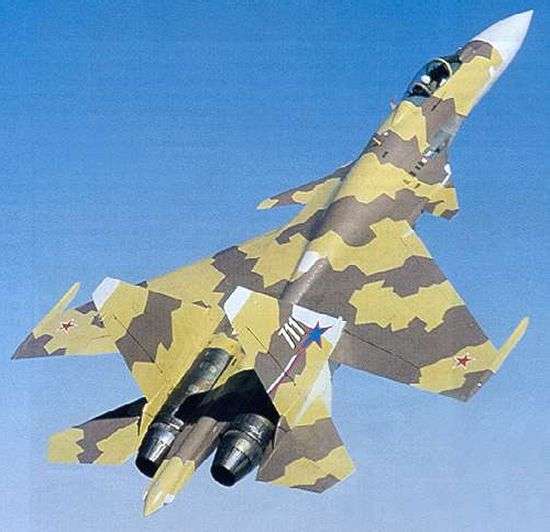
The Su-37 uses the ‘unstable integral triplane’ layout, which, in combination with the small specific load acting on the wing, high power-to-weight ratio, integral electrical remote control system and powerplant TVC feature, ensures the aircraft superagility, increased range of controlled flight and improved takeoff and landing characteristics. The TVC feature incorporated into the aircraft flight control loop makes it possible to minimize, when required, the flight speed and perform aerobatics at speeds nearing zero without angle-of-attack limitations (hence superagility).
According to Mikhail Simonov, the aircraft has virtually no angle-of-attack limitations. It can fly flatwise to the air stream, with its tail forward, i. e., with 90 and even 180 deg angles of attack.


 Sign In








 March 30, 2013 at 2:48 am