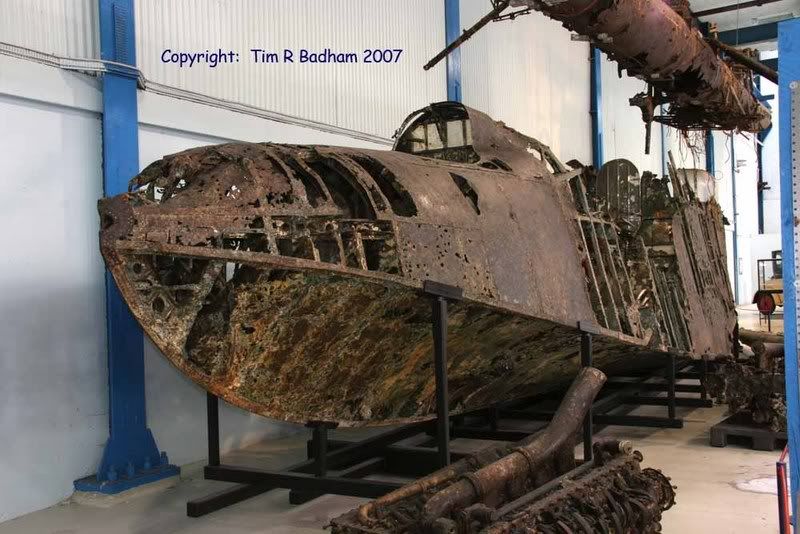
For years a Tempest is almost finished apart from the engine. Any news on that current state of things? Despite all the effort spent on the various ex-Indian Tempests, no example is close to flight which is a pity don’t you think?
Cheers
Cees

By: VX927 - 3rd March 2009 at 10:26
Has the engine returned yet?
can’t wait for this to take to the skies. Must have had that engine in the US for 4-5 years now?
I think it’s more like 10 Years! PM inbound!
By: markstringer - 3rd March 2009 at 10:07
Has the engine returned yet?
can’t wait for this to take to the skies. Must have had that engine in the US for 4-5 years now?
By: Yak 11 Fan - 1st September 2008 at 17:58
Think that has been done to death loads of times before…
By: Cees Broere - 1st September 2008 at 17:50
How about: where are the missing Indian Tempests/
Myth or fact. Did Doug Arnold destroy several airframes?
Cheers
Cees
By: Seafuryfan - 1st September 2008 at 16:13
Heh heh flanker Man, nice one 🙂
Oh dear, started new page. Sorry all those expecting news – enjoy my little Sea Fury Avatar instead heh heh
PS: How’s this for sad, my new 1/72 Sky Guardians die-cast F15 (Legends, £12 :eek:) has rotating compressor blades when you blow down the intakes, I kid you not!
Anyway, back to the thread i.e Tempests!
By: Flanker_man - 1st September 2008 at 13:56
Regarding Sabre reliability; if you talk to any of the Erks who looked after Tiffies or Tempests or their Pilots, mid or late-war, they all say that when they were going they were ok, it was getting them started without them going BANG which was one of the problems.
The record speaks for itself really because if you look through the Typhoon and Tempest production lists and the number of engine-failures which ended the machine’s lives I’d say it has to be one of the highest seen in any type’s history, other than maybe the early B-29s when they were having valve trouble with the R-3350s.
The Napier people always harped on that it was a marvellous engine but the old boys who had to fly behind them had far too many engine related mishaps to say anything along those lines! Running well on a test-rig is one thing, combat is totally different.
Tom
When I was growing up and starting to get interested in aviation, I always thought that the Sabre was designed and built by a company called ‘Recalcitrant’ 😮
That’s what all the books and mags I read referred to it as – “the Recalcitrant Sabre”……… :rolleyes:
Ken
By: Sonic-events - 1st September 2008 at 11:36
Tempest Update
Hi , Spoke to one of the owners of the Tempest last week and he tells me he is off to Reno to the races and will be meeting Mike Nixon from Vintage V12 to get the latest on the engine rebuild, he also states there are no compatible engines anywhere in UK or Europe.
By: JDK - 1st September 2008 at 10:39
Blohm & Voss 138?
Do tell more.
That wasn’t hard, was it? And the list of ‘survivors’ is quite short. I was impressed with the engines – tall.
Details here
By: Creaking Door - 31st August 2008 at 19:57
Blohm & Voss 138?
Do tell more.
By: JDK - 31st August 2008 at 13:41
Can’t have been that bad if the RAF carried on using them.
😮
Short list of RAF-used disasters anyone?
On the two stroke theme, I was looking at a trio or ‘two-strokes’ used on an aircraft recently. They’d been fished up from the sea.
“Three Junkers Jumo 205 D six-cylinder vertical opposed-piston compression-ignition two-stroke engines, each rated at 880hp for take-off.”
By: DaveR - 31st August 2008 at 11:13
As it is part of my interest I always have to stick up for the Sabre…no other engine was rushed into service as quickly as the Sabre (you could probably include the vulture in that category but look what Rolls Royce did with that!!). It needed at least another couple of years of ‘shakedown’ (for the want of a better word). Testing was basically completed in the field in combat…eventually the problems were overcome and I have been told that the Sabre was as reliable as the Merlin. If you then move onto the Sabre engined Tempest there were not that many engine failures outside of combat damage and they soldiered on well into the 1950’s with the TT.5’s. Can’t have been that bad if the RAF carried on using them.
By: Tom_W - 30th August 2008 at 21:27
Regarding Sabre reliability; if you talk to any of the Erks who looked after Tiffies or Tempests or their Pilots, mid or late-war, they all say that when they were going they were ok, it was getting them started without them going BANG which was one of the problems.
The record speaks for itself really because if you look through the Typhoon and Tempest production lists and the number of engine-failures which ended the machine’s lives I’d say it has to be one of the highest seen in any type’s history, other than maybe the early B-29s when they were having valve trouble with the R-3350s.
The Napier people always harped on that it was a marvellous engine but the old boys who had to fly behind them had far too many engine related mishaps to say anything along those lines! Running well on a test-rig is one thing, combat is totally different.
Tom
By: Creaking Door - 29th August 2008 at 11:14
Two-strokes are fine for small single-cylinder or very large slow-revving engines but not so good for high-revving multi-cylinder aero-engines.
Why? Two strokes rev pretty hard AFAIK.
The Rolls two stroke project was the Crecy.
Actually, that’s a very good question.
The Rolls-Royce Crecy, although it was a two-stroke, had sleeve-valves and was of course supercharged so it doesn’t really qualify the ‘no valves’ argument. Many small two-strokes use reed-valves.
I suppose the real answer is that the supercharger technology required to make two-strokes compare with four-strokes had not developed when most of these aero-engines were conceived. When the supercharger technology had developed the crankshaft power of the engine was mainly being used to drive the supercharger and significant power was being delivered from the exhaust; the piston-engine had become little more than a heavy, complex, combustion chamber. And the gas turbine was already showing its potential.
The ultimate developments of the piston-engine were the Wright R-3350 Turbo-Compound and the Napier Nomad, a liquid-cooled two-stroke diesel, without valve-gear, but with a gas-turbine grafted on!
The ‘Allison X24’ engine I mentioned was actually the liquid-cooled sleeve-valve Pratt & Whitney H-3730.
By: JDK - 29th August 2008 at 09:00
All very interesting. But:
Yep, I did mean Hendon’s Typhoon. It’s pretty convincingly done, but then it becomes obvious when you look hard enough. A big give-away are the pretend exhaust stubs which are actually attached to the cowlings themselves.
http://farm4.static.flickr.com/3233/2526391474_2e23854767.jpg?v=0
Hmmm. They are (or are representing) exhaust shrouds, not the exhausts themselves. See:


I think they were quickly abandoned in service, and all but the front one would be blackened by the exhaust, which is why they aren’t noted more often.
By: TempestV - 29th August 2008 at 08:13
Yep, I did mean Hendon’s Typhoon. It’s pretty convincingly done, but then it becomes obvious when you look hard enough. A big give-away are the pretend exhaust stubs which are actually attached to the cowlings themselves.
http://farm4.static.flickr.com/3233/2526391474_2e23854767.jpg?v=0
The engine from this example was removed in the US shortly after it ceased flying, and it’s never been complete since as far as I’m aware.
Well I take my hat off to the craftsmen who put this tiffie’s front end back together then. Its had me fooled for years!
By: DaveR - 28th August 2008 at 22:02
MN235 was only tested for a few hours in the states before a landing mishap meant it needed a new engine. A spare engine made it out but it was never put back in the air. I have seen Hendons documentation on the status of it when delivered back to the UK and I don’t remember the engine being one of the missing items, cowlings, aeileron, cannons and various other parts were missing. I believe that the engine could well be the original unit still installed. The smithsonian have a complete Sabre engine sitting on a pallet that was ‘found’ in one of their stores when inventory was taken. The history is not known but it is believed that this was the spare unit intended to get it back in the air.
By: Cees Broere - 28th August 2008 at 17:57
Interesting, In an article in flypast about exavation work on freeman field a photograph showed a large elliptical radiator in one of the pits which could only have been MN235’s radiator then?
IIRC the current radiator was a cut down lorry item and the spinner was welded together using Hasting items.
Any more gen about this aircrafts restoration during the sixties?
Tempest or Typhoon, bothe very similar so still on topic/:)
Cheers
Cees
By: Ant.H - 28th August 2008 at 16:57
Yep, I did mean Hendon’s Typhoon. It’s pretty convincingly done, but then it becomes obvious when you look hard enough. A big give-away are the pretend exhaust stubs which are actually attached to the cowlings themselves.
http://farm4.static.flickr.com/3233/2526391474_2e23854767.jpg?v=0
The engine from this example was removed in the US shortly after it ceased flying, and it’s never been complete since as far as I’m aware.
By: TempestV - 28th August 2008 at 14:29
Regards Hendon’s Typhoon, I dont think there’s anything ‘real’ forward of the firewall. The cowlings, rad housing, spinner etc are all look-alikes, not the genuine bits. I believe the prop is off an Avro Shackleton.
Are you sure you mean the Typhoon in Hendon? I thought this was shipped complete back from the USA. It looks pretty real forward of the firewall to me.
Hendons Tempest II restored by TFC at Duxford with origional parts.
Hendons Tempest V assembled by the RAF – I think this has a prop from another type fitted.
By: Cees Broere - 28th August 2008 at 13:57
So that makes three Mk V’s then?
Hmm
Cees


 Sign In








 August 23, 2008 at 3:09 pm