This thread is what it says it is, it is worshipping European shipyards and ship system manufacturers and designers. The thread was inspired by carriers are too big thread. I feel that the innovation and balance that European designers have shown in recent years is remarkable and that they are well placed to continue to dominate the international naval ship market and contribute to the western worlds domination of the oceans. Fo now I will stick to surface ships, primarily frigates, I am not leaving anything out out of dislike (except the french FREMMs) just for ease.
Platforms:
Type 45, 7000 tons IEP, plenty of upgrade room (72 VLS cells?) a large main gun and space for a Merlin. Oh and the epic sensor suite, what is not to love about Sampson and S1850M? I believe this to be the best destroyer/large frigate design in service today and if asked to design such a ship for export it would be my baseline. Kudos to the Royal Navy for an exceptional design.
Absalon/F125: I have lumped these together as they are not that far apart doctrinally, both are essentially colonial gun boats, the product of western naval supremacy. Their primary focus is interaction with the land and are thus well equipped for helicopters and small craft. Yet they are well enough designed that they provide considerable capability to those countries unwilling to fund true amphibious forces like the one the UK has or the Netherlands is pursuing. Again, excellent well thought out designs that perfectly combine cost, technology and capability to create a doctrinally compatible unit.
RNLN OPV: The perfect frigate for the post soviet space (if you have a few proper frigates left) the primary reason for this love affair will be explained below in the systems section. However from a platform perspective, they are well armed or for the ocean patrol role and come with a helicopter.
Systems
Thales Integrated Mast (i-mast family): This system (in its i-mast 400 form) has been selected for RNLN OPVs. It features a volume search radar (SMILE) a surface search radar (SEASTAR) and an optical surveillance system (GATEKEEPER) all fixed within a single integrated structure and providing full 360 degree coverage. A truly exceptional system that I would be happy to see used on any platform, especially frigates (Thales has proposed a larger i-mast 500 variant).
video: http://www.youtube.com/watch?v=8sMgEsHC1Lc
Millenium Ahead CIWS: A fantastic 35mm gun used on the Absalon class as a CIWS, a great piece of equipment.
Oto 76mm with Strales: A fully integrated AAW gun system with a secondary anti surface role, another great piece of equipment.
Of course there are many more and feel free to list them.
For the purposes of fun, if I were to create a littoral combat ship for baltic defense duties it would have the Thales I-Mast, a 16 cell Mark 41 VLS for 64 ESSM, a Strales mount, and either RAM launcher or a Millenium gun. The hull would be the Meko CSL design and the rear cargo area below the flight deck would take Patria M2004 sea mines.
Comment away!

By: crobato - 11th January 2009 at 01:47
i don’t think that this is really a problem of x-band because a object can also be optimised to have a small rcs in s-band instead of x-band. for sure making radar absorbing materials for longer wavelengths is a problem but imho it is to much simplified that a s-band radar will detect a vlo e.g. at horizon search before a x-band can detect it.
Making RAS/RAM for S-band and longer bands is a bit of a _big_ problem—LITERALLY—on a small airframe. Its a much better choice to VLO on the X-band because of the size considerations, making it harder to lock and guide a missile against it instead.
there are dozens of parameters which have to be considered. e.g. do we speak about a low flighing target which pops up at 30 or 40 km or about a target flighing high enough to be detectable at 150 km? the first one should be no problem because a primary design goal for apar was the early detection of sea skimmers; it performs well on low flighing objects and at this range there is enough power to make vlo targets visible. the maximal horizon search range of apar is quoted to be 75 km which makes sense to me. a high resolution mfr is neither designed for long range search nor is it very useful here. a dedicated long range volume search radar can be used to start a cued search and tracking of targets with the mfr.
APAR’s relative short range to SAMPSON lies not just in using a higher wave length, but that its also in CW as opposed to PRF. But then again CW is likely to expose a target with more energy than PRF over time, and that what’s make VLO objects visible.
i think this is also the main reason why the type 45 also carries the s1850m. bae and others don’t get tired to claim that sampson doesn’t need a second vsr but there is no info about power/time budget if sampson is used without a second vsr.
if i got an initial track from the vsr and if the mfr is not used for volume search, it has much more time for tracking these targets. if the target is difficult to track, more time/power etc. can be used on it.
I think the SMART-L operates at 1-2GHz, while SAMPSON is at 2 to 4GHz. So the two is close. I think that’s what BAE meant.
and using a s-band mfr doesn’t change much on the vlo example if the sarh needs x-band terminal illumination or if the arh-sam has a tiny j (ku)-band seeker. vlo-targets will reduce the performance of all of these systems.
(btw the rcs of a bird at x-band is about 10^-3 to 10^-4 sqm)
Still, having to engage earlier is better than engaging later, as we are all dealing with probabilities here, and we want the probabilities to stack up in favor as high as possible. To lock on and engage the VLO target optimized at X-band is a separate issue that can be handled by a separate development. I suspect if you start getting creative with the way the illumination X-band is modulated, just a theory of mine, it may be possible to lock on to the object. This is something potentially in favor of APAR due to its high power, frequency agility and backend electronics compared to a tiny ARH missile seeker.
By: LordAssap - 10th January 2009 at 23:37
=radar;1345609]you are right, if you want to have a single, well balanced radar, s-band is the choice but how many non-aegis aaw-ships are using only a single radar?
The T-45 and Horizon doesn’t need the equivalent of the SPY, they do not guide the ASTER in the terminal phase of the engagement ASTER posses its own seeker.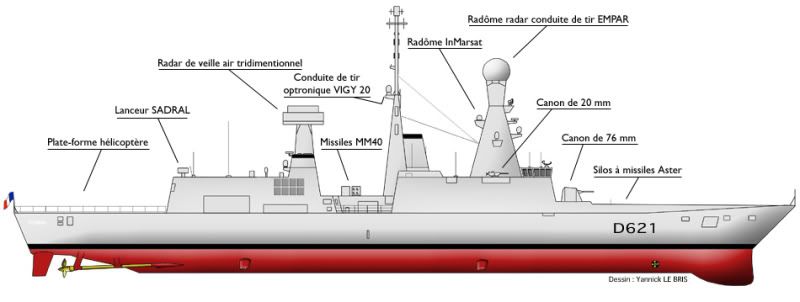
The reason for the developement of the T-45 SAMPSON radar, was the will of MoD to give it the ability to fire and guide BOTH SM2s and ASTER which is not the case of the EMPAR but doesn’t mean it is less capable when using ASTERs…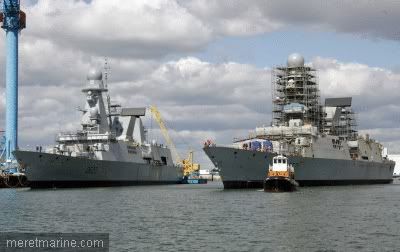
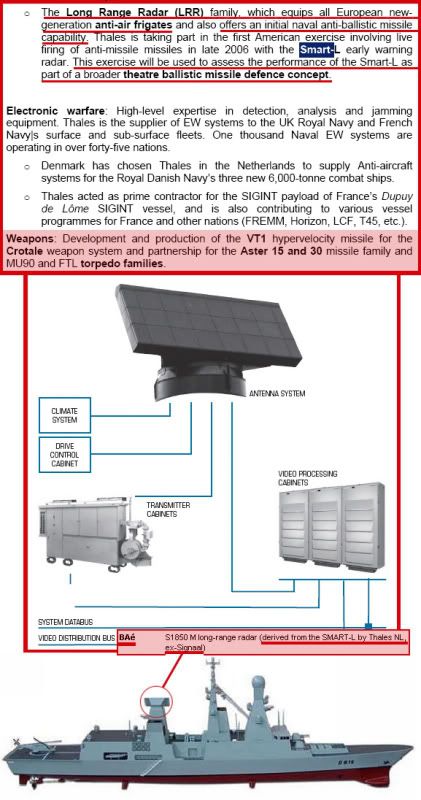
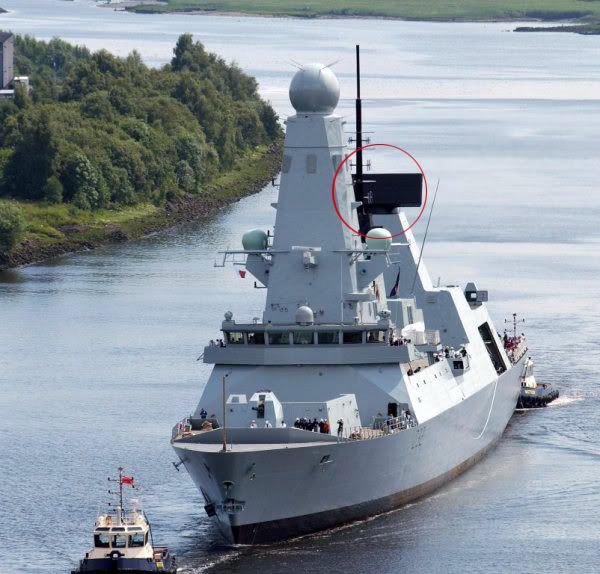
As for the Thales S 1850M surveillance radar, for the story, when it was turned ON in Brest for the first tests they figured they could easaly monitor the trafic over Paris Roissy…

Just to give you an idea…
By: radar - 10th January 2009 at 22:13
The difference is that a small UCAV or AshM is more likely to be “stealthed” against X-band. It’s progressively more difficult to stealth against longer frequency bands because of the physical size the resonating structures and thickness of radar absorbing structures and materials, have to be correspondingly and proportionally increased in size with the lengthening wavelength. So the VLO object is more likely to be seen earlier and ahead by an S-band rather than an X-band radar. Missile terminal guidance is another matter however since all that has to be at least in the X-band. But of course, the L-band radar can also spot the VLO object too, but even if there is no sure fire solution, don’t you think its better to have two radars seeing it, and engaging the target earlier with the second radar, rather than one radar seeing it, and engaging the target later with the second radar?
i don’t think that this is really a problem of x-band because a object can also be optimised to have a small rcs in s-band instead of x-band. for sure making radar absorbing materials for longer wavelengths is a problem but imho it is to much simplified that a s-band radar will detect a vlo e.g. at horizon search before a x-band can detect it.
there are dozens of parameters which have to be considered. e.g. do we speak about a low flighing target which pops up at 30 or 40 km or about a target flighing high enough to be detectable at 150 km? the first one should be no problem because a primary design goal for apar was the early detection of sea skimmers; it performs well on low flighing objects and at this range there is enough power to make vlo targets visible. the maximal horizon search range of apar is quoted to be 75 km which makes sense to me. a high resolution mfr is neither designed for long range search nor is it very useful here. a dedicated long range volume search radar can be used to start a cued search and tracking of targets with the mfr.
i think this is also the main reason why the type 45 also carries the s1850m. bae and others don’t get tired to claim that sampson doesn’t need a second vsr but there is no info about power/time budget if sampson is used without a second vsr.
if i got an initial track from the vsr and if the mfr is not used for volume search, it has much more time for tracking these targets. if the target is difficult to track, more time/power etc. can be used on it.
and using a s-band mfr doesn’t change much on the vlo example if the sarh needs x-band terminal illumination or if the arh-sam has a tiny j (ku)-band seeker. vlo-targets will reduce the performance of all of these systems.
(btw the rcs of a bird at x-band is about 10^-3 to 10^-4 sqm)
By: Merlock - 9th January 2009 at 08:51
What’s wrong with the FREMM ? Genuine question… :confused:
*Cough*
Please ? 😮
________
Buy Vapir Vaporizer
By: crobato - 9th January 2009 at 01:15
The difference is that a small UCAV or AshM is more likely to be “stealthed” against X-band. It’s progressively more difficult to stealth against longer frequency bands because of the physical size the resonating structures and thickness of radar absorbing structures and materials, have to be correspondingly and proportionally increased in size with the lengthening wavelength. So the VLO object is more likely to be seen earlier and ahead by an S-band rather than an X-band radar. Missile terminal guidance is another matter however since all that has to be at least in the X-band. But of course, the L-band radar can also spot the VLO object too, but even if there is no sure fire solution, don’t you think its better to have two radars seeing it, and engaging the target earlier with the second radar, rather than one radar seeing it, and engaging the target later with the second radar?
By: radar - 8th January 2009 at 17:58
S-band is actually a very sweet spot for a naval SAM radar because it is a good balance of range and tracking qualities. Remember, the SPY-1 can continually track using S-Band and has enough tracking resolution to feed missile midphase updates. At the same time, frequency isn’t too short for all the weather phenomenon and small useless things like birds to show up on radar as it does on X-band.
you are right, if you want to have a single, well balanced radar, s-band is the choice but how many non-aegis aaw-ships are using only a single radar?
the horizon program is using empar (C-band) and S1850M (L-band), type 45 is sampson (S-band) and S1850M (L-band) and lcf/f-124 is apar (X-band) with smart-l (L-band). from my point of view using S-band together with L-band is not the best choice. as i said, it makes no sence to compare apar with sampson without thinking about the second radar on this ship.
and hey how big is the difference between a large bird and a small uav or a small stealthy ashm? i would prefer to get some more echos from one of my radars and then to use a smart software to suppress birds than getting no echo from a real target.
By: crobato - 8th January 2009 at 01:32
most articles describing apar and sampson pointing out the limited range of apar compared to sampson but apar has to be seen as one part of the apar/smart-l combo. from my point of view this X/L-band combo is more interesting than a S/L-band combo. i do not need two radars which are both capable of doing long range volume search. if i decide to use two radars why not using one frequency band for long range detection and one for high resolution tracking and medium range horizontal search?
S-band is actually a very sweet spot for a naval SAM radar because it is a good balance of range and tracking qualities. Remember, the SPY-1 can continually track using S-Band and has enough tracking resolution to feed missile midphase updates. At the same time, frequency isn’t too short for all the weather phenomenon and small useless things like birds to show up on radar as it does on X-band.
i don’t know if Silicon Carbide is the first choice in future but afaik right now there is also no S-band radar using it. if there will be such a radar ready to be fielded in the future perhaps we will compare it to the others.
Lockheed Martin is trying to develop a SiCa based array.
By: TinWing - 7th January 2009 at 21:46
I am not that hot on the APAR idea. It ties itself to using X-band for the sole purpose so the emissions can also acts as illumination for the SM-2 semi active homers. However, X-band on modulated CWI simply does not have the range and volume of S-band on PRF, the latter probably having a range of 2 or 3x, although APAR delivers the superior resolution. But then of course, having Smart-L to produce an S or L-band or NATO E band for wide volume search mitigates this.
But in the future, to keep using X-band means that your AESA arrays are tied to a Gallium product, GaAs for now. GaN delivers far greater power but at the expense of great heat and so far remains unreliable despite all the research put into it. I won’t throw all my eggs on that one. But if you use S-Band, you open up your array design to use Silicon Carbide, which delivers power densities similar to GaN, but transfers heat better, so far has proven reliable, and a hell of a lot cheaper, enabling the potential to build huge arrays at low costs. Except that SiCa doesn’t do X-band. But it will be perfectly alright if your S-band AESA use SiCa, and S-band is sufficient to provide mid phase updates to any active homing missile (this array cannot do X-band illumination naturally). If you have to use X-band somehow, you have to put a separate small dedicated array, not necessarily an X-band GaAs type AESA, but even a mechanical array.
In other words, the Ceafar S-band/CeamountX-band combination falls closer to the ideal than APAR?
By: radar - 7th January 2009 at 21:39
I am not that hot on the APAR idea. It ties itself to using X-band for the sole purpose so the emissions can also acts as illumination for the SM-2 semi active homers. However, X-band on modulated CWI simply does not have the range and volume of S-band on PRF, the latter probably having a range of 2 or 3x, although APAR delivers the superior resolution. But then of course, having Smart-L to produce an S or L-band or NATO E band for wide volume search mitigates this.
most articles describing apar and sampson pointing out the limited range of apar compared to sampson but apar has to be seen as one part of the apar/smart-l combo. from my point of view this X/L-band combo is more interesting than a S/L-band combo. i do not need two radars which are both capable of doing long range volume search. if i decide to use two radars why not using one frequency band for long range detection and one for high resolution tracking and medium range horizontal search?
i don’t know if Silicon Carbide is the first choice in future but afaik right now there is also no S-band radar using it. if there will be such a radar ready to be fielded in the future perhaps we will compare it to the others.
By: Sintra - 7th January 2009 at 12:37
Look, you better ask the builders of the ship (Type 45 Daring Class) and the heads of the RN for this. Because they and its a fact, have an alternative proposal for the Block II ships to use the Mk. 41. The proposal adds a new AESA array for the specific purpose of SM-2 illumination. It appears this is all a serious consideration for the moment, though its not set in stone yet.
There are no block II ships. Six T45 were ordered with the PAAMS, and that´s it, no more T45´s for the RN, the rest was canned.
What you have described seem´s like LockMart proposal to fit the MK41 VLS on the Daring´s that was made almost a decade ago.
By: kev 99 - 7th January 2009 at 09:53
Look, you better ask the builders of the ship (Type 45 Daring Class) and the heads of the RN for this. Because they and its a fact, have an alternative proposal for the Block II ships to use the Mk. 41. The proposal adds a new AESA array for the specific purpose of SM-2 illumination. It appears this is all a serious consideration for the moment, though its not set in stone yet.
What block II ships?
:confused:
By: crobato - 7th January 2009 at 00:57
following this argumentation would bring empar and others in front of sampson because sampson is also not a lightweight. this shows that weight is not everything.
personally i prefer the idea behind the apar/smart-l combo but it’s hard to make a rating between it and samspon. they differ in many points but in sum i see them head on head.
I am not that hot on the APAR idea. It ties itself to using X-band for the sole purpose so the emissions can also acts as illumination for the SM-2 semi active homers. However, X-band on modulated CWI simply does not have the range and volume of S-band on PRF, the latter probably having a range of 2 or 3x, although APAR delivers the superior resolution. But then of course, having Smart-L to produce an S or L-band or NATO E band for wide volume search mitigates this.
But in the future, to keep using X-band means that your AESA arrays are tied to a Gallium product, GaAs for now. GaN delivers far greater power but at the expense of great heat and so far remains unreliable despite all the research put into it. I won’t throw all my eggs on that one. But if you use S-Band, you open up your array design to use Silicon Carbide, which delivers power densities similar to GaN, but transfers heat better, so far has proven reliable, and a hell of a lot cheaper, enabling the potential to build huge arrays at low costs. Except that SiCa doesn’t do X-band. But it will be perfectly alright if your S-band AESA use SiCa, and S-band is sufficient to provide mid phase updates to any active homing missile (this array cannot do X-band illumination naturally). If you have to use X-band somehow, you have to put a separate small dedicated array, not necessarily an X-band GaAs type AESA, but even a mechanical array.
By: crobato - 7th January 2009 at 00:41
Sorry but why some one could want SM-2 instead of Aster-30? The european is much better as far as i know.
ASROC: I don’t know about UK, but we use a light torpedo MU-90 delivered by a Teseo ASM missile. The system used the ASM launcher, the missile is called MILAS and it is operative in the italian navy.
It has a better range (35km instead of 28km) and it can be guided (when the missile is away you can update the solution, change the trajectory and change the releasing point).TOMAHAWK: right, is better than Scalp but, look at the spanish: they got the missile, but they are able just to press the “fire” button.
Look, you better ask the builders of the ship (Type 45 Daring Class) and the heads of the RN for this. Because they and its a fact, have an alternative proposal for the Block II ships to use the Mk. 41. The proposal adds a new AESA array for the specific purpose of SM-2 illumination. It appears this is all a serious consideration for the moment, though its not set in stone yet.
By: kato - 6th January 2009 at 21:45
How many missiles do you need to perform similar missions?
One to three. Per Customer. :diablo:
By: Merlock - 6th January 2009 at 20:56
There seems to be a glut and redundancy of new European short-medium range SAM missiles:
And What about SSM missiles ? Why not Exocet VL or Brimstone VL ? 😎
________
WATER BONGS
By: vajt - 6th January 2009 at 20:53
There seems to be a glut and redundancy of new European short-medium range SAM missiles:
Naval VL Crotale – Range 16km with version Mk3
MICA VL – Range of 20km
IRIST-SL – Range 30km
Diehl VL LFK-NG – Range 10km
ASTER 15 – Range 30km
CAAM – Range ?
RAM – Range 9km?
How many missiles do you need to perform similar missions? All can be used to shoot down both aircraft and missiles.
—–JT—–
By: Arabella-Cox - 6th January 2009 at 20:46
Would it cost more to integrate additional weapons with Sylver than to integrate SM-2 with PAAMS?
Sorry but why some one could want SM-2 instead of Aster-30? The european is much better as far as i know.
ASROC: I don’t know about UK, but we use a light torpedo MU-90 delivered by a Teseo ASM missile. The system used the ASM launcher, the missile is called MILAS and it is operative in the italian navy.
It has a better range (35km instead of 28km) and it can be guided (when the missile is away you can update the solution, change the trajectory and change the releasing point).
TOMAHAWK: right, is better than Scalp but, look at the spanish: they got the missile, but they are able just to press the “fire” button.
By: radar - 6th January 2009 at 19:08
The beauty of SAMPSON is that it is placed on top of a tall mast, even taller than even APAR which comes second place on this regard. The taller you are placed, the farther your radar horizon can reach allowing for earlier target engagement. This is the biggest advantage of the SAMPSON, all others like being AESA or using ARH missiles, should take their places behind.
following this argumentation would bring empar and others in front of sampson because sampson is also not a lightweight. this shows that weight is not everything.
personally i prefer the idea behind the apar/smart-l combo but it’s hard to make a rating between it and samspon. they differ in many points but in sum i see them head on head.
By: swerve - 6th January 2009 at 18:49
“CAMM”?
BTW anybody know if Crotale VT-1 is going to sea?
Common Anti-air Modular Missile. Based on the Asraam airframe. Been under development for several years. Planned to replace Rapier & Seawolf in British service. Much longer range than either, active radar seeker. According to what MBDA were saying at Farnborough last year, it should do everything Aster 15 can (except the range – a bit shorter), at lower price, & quad-packable in Sylver launchers down to A35.
Test launch video – http://www.youtube.com/watch?v=7oRmGFVLJ08
VT-1 has been at sea for years. It’s recently been fired from Sylver A35, & is now being marketed for VL use.
By: kato - 6th January 2009 at 18:43
BTW anybody know if Crotale VT-1 is going to sea?
It’s been “at sea” for over a decade (Crotale Naval CN2 VT1). Just not the vertically launched version.


 Sign In








 December 1, 2008 at 7:11 pm