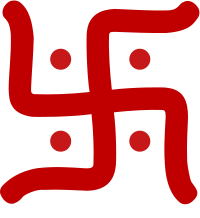
Anti-Semitism used to be widespread in Europe. As the Nazis took over in 1932 in Germany, the systematic persecution of Jews commenced, and after the outbreak of war, systematic genocide. The Holocaust and the occupation of European countries by the Wehrmacht resulted in making the tilted swastika ? the insignia of antisemitists since the end of the 1800s – the symbol of evil. The Nazi Swastika also tainted the Finnish Level Swastika, originating from the year 1918.
These two insignias share the shape but the symbolic content is completely different. They share no background. An uninformed person cannot tell them from apart: he does not know that the German symbol, tainted as evil is not the same as the Finnish, untainted and honourable swastika, and he abhors both. The Swastika is an ancient sign of luck originating from Asia, widespread in the world. Even today it is recognized as the insignia of the Falun Gong. The Swastika is included in the Finnish ornamentics for ages. By an extraordinary chance it was adopted to symbolic use at the same time but independently in Germany and in Finland.
Full article about the history of Finnish swastika by WW2 bomber pilot Aarno Ellilä:
http://www.virtualpilots.fi/feature/articles/honorable_swastika/

By: JDK - 25th February 2007 at 00:09
Yes it is. Sorry about that, just slipped into writing the name in Icelandic for no good reason:o
No need to apologise, I’d not seen the name written that way before. Live & learn!
By: Dan Hamblin - 24th February 2007 at 22:41
Thinking about it logically, this means that people from the far east where the swastika means peace, could come to Europe and see the Nazi swastika and think it means good luck?
Regards,
Dan
By: BlueRobin - 24th February 2007 at 13:16
If there’s one thing I remember from enforced RE at school, is that the Swastika comes from Hinduism and that the “wheel” went the other way.
http://en.wikipedia.org/wiki/Swastika
proves me partially wrong, actually Dharmism derived and goes the same way?
By: Eric Mc - 24th February 2007 at 12:47
Easily done.
By: galdri - 24th February 2007 at 12:05
For those of us with a less extensive keyboard, would that be ‘Thor’?
Yes it is. Sorry about that, just slipped into writing the name in Icelandic for no good reason:o
By: Clave - 24th February 2007 at 10:30
Stuff like this gets hijacked all the time, I quite like the blue Finnish swastika – on the side of a Hurricane anyway… 🙂
By: Eric Mc - 24th February 2007 at 10:17
For many many years, in Dublin there was a family run business called “The Swastika Laundry”. The business had been established WAY before WW2 and continued under that name right into the 1980s. I think it only ceased using the name when the business itself ceased.
By: JDK - 24th February 2007 at 06:34
When you hear a thunder, that would be Þór travelling in his chariot;)
For those of us with a less extensive keyboard, would that be ‘Thor’?
By: Steve T - 24th February 2007 at 04:17
What a fascinating thread.
Indeed the Nazi employment of this ancient symbol has cast a long, dark shadow. One of the sillier results can be found among the recent deluge of beautifully-finished diecast model aircraft: one of the numerous firms turning these out does a series of Hurricanes in 1:72; one of these is a basically handsome depiction of an Ilmavoimat (sp?) aircraft in black and green camo…the national marking being a white disc with a big blue SQUARE in the centre! Sure, it’s just a 1:72 model…but geez, that’s not just “laundering” history, it’s tossing it completely aside…Even when I went hunting for Finnish markings for an old 1:72 Me109 I was refinishing, I ultimately had to settle for the postwar style cockades. If it looks anything like a Hakenkreuz…it’s just not politically palatable, or so it seems!
S.
By: galdri - 24th February 2007 at 00:47
Another use of the upright Swastika (not the Nazi slanted one) is in old Norse mythology. There the Swastika was called Hamarsmark Þórs (Þórs cote of arms), Þór was the pagan Warrior God who travelled in a chariot pulled by (Mythological) horses, and his weapon was a hammer. When you hear a thunder, that would be Þór travelling in his chariot;)
By: contrailjj - 23rd February 2007 at 23:23
Here in Ontario we have the village of Swastika… http://www.answers.com/topic/swastika-ontario
and let us not forget the ‘Ugunskrusts’ in Latvia.
Even though I knew it was a cultural element, I was still quite amazed (when touring the Mekong in 2003) at the prevalence of the swastika in the region – on shrines, coffins, ‘churches’, etc.
By: EN830 - 23rd February 2007 at 22:57
We certainly saw many of them in Goa recently, painted on all sorts of buildings, religious shrines, memorials and even the odd elephant
By: Drem - 23rd February 2007 at 22:46
The Honourable
The main difference being of course is that The Finnish Swastika was not “angled” like the Nazi version.
Here in Edinburgh at our National War Memorial in the Castle, if you look hard enough, you will find a Swastika, the original sign being for good luck if memory serves me correct..
By: Mark12 - 23rd February 2007 at 22:44
Anti-Semitism used to be widespread in Europe. As the Nazis took over in 1932 in Germany, the systematic persecution of Jews commenced, and after the outbreak of war, systematic genocide. The Holocaust and the occupation of European countries by the Wehrmacht resulted in making the tilted swastika ? the insignia of antisemitists since the end of the 1800s – the symbol of evil. The Nazi Swastika also tainted the Finnish Level Swastika, originating from the year 1918.
These two insignias share the shape but the symbolic content is completely different. They share no background. An uninformed person cannot tell them from apart: he does not know that the German symbol, tainted as evil is not the same as the Finnish, untainted and honourable swastika, and he abhors both. The Swastika is an ancient sign of luck originating from Asia, widespread in the world. Even today it is recognized as the insignia of the Falun Gong. The Swastika is included in the Finnish ornamentics for ages. By an extraordinary chance it was adopted to symbolic use at the same time but independently in Germany and in Finland.
Full article about the history of Finnish swastika by WW2 bomber pilot Aarno Ellilä:
http://www.virtualpilots.fi/feature/articles/honorable_swastika/
Borneo, November 2000.
Mark

By: Creaking Door - 23rd February 2007 at 22:16
There is the original spinner from Charles Lindbergh’s aircraft ‘Spirit of St Louis’ in the National Aerospace Museum in Washington DC (which was replaced following a post-record-flight crash)…
…and guess what symbol is painted inside?
By: CSheppardholedi - 23rd February 2007 at 21:46
Indeed the symbol is much older than Hitler and the Nazis. Native Americans also used the symbol. My High School mascot was the Blackhawks, a tribe of the American MidWest. The School flag had a chief in full head-dress and buried in the decorations on it was…..you guessed it, a swastika. I pointed this out to one of our teachers and he was quite shocked. Had to inform the teacher that this was much older than the German one and had nothing to do with theirs!!!


 Sign In








 February 23, 2007 at 9:30 pm