I finally found the story 🙂
http://www.rafpa.com/News%2520of%2520Interest1.html
The RAF discovered that a 15 year-old
‘Gate Guard’ Grand Slam bomb – was
actually LIVE!!!!
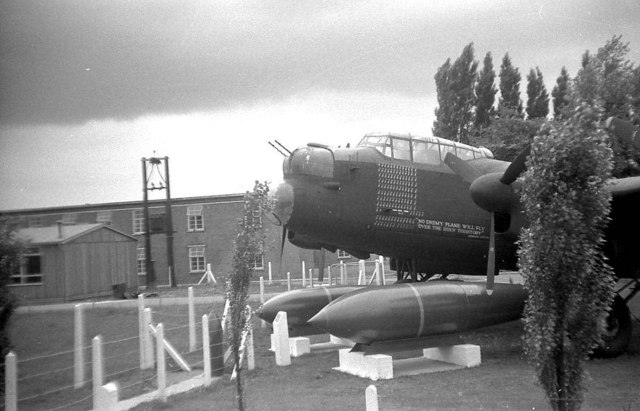
Apparently when Lincolnshire County Council were widening the road past RAF Scampton’s main gate in
about 1958, the ‘gate guards’ there had to be moved to make way for the new carriageway. Scampton was
the WWII home of 617 Sqn, and said “gate guards” were a Lancaster…and a Grand Slam bomb.
When they went to lift the Grand Slam, thought for years to just be an empty casing, with an RAF 8 Ton
Coles Crane, it wouldn’t budge. “Oh, it must be filled with concrete” they said. Then somebody had a horrible
thought …. No!….. Couldn’t be? … Not after all these years out here open to the public to climb over and be
photographed sitting astride! …. Could it? …. Then everyone raced off to get the Station ARMO. He carefully
scraped off many layers of paint and gingerly unscrewed the base plate.
Yes, you guessed it, live 1944 explosive filling! The beast was very gently lifted onto an RAF ‘Queen Mary’
low loader, using a much larger civvy crane (I often wonder what, if anything, they told the crane driver), then
driven slowly under massive police escort to the coastal experimental range at Shoeburyness. There it was
rigged for demolition, and when it ‘high ordered’, it proved in no uncertain terms to anyone within a ten mile
radius that the filling was still very much alive!
Exhaustive investigations then took place, but nobody could find the long-gone 1944, 1945 or 1946 records
which might have shown how a live 22,000 lb bomb became a gate guard for nearly the next decade and a
half. Some safety distance calculations were done, however, about the effect of a Grand Slam detonating at
ground level in the open. Apart from the entire RAF Station, most of the northern part of the City of Lincoln,
including Lincoln Cathedral, which dates back to 1250, would have been flattened.
The Grand Slam was a 22,000 lb (10,000 kg) earthquake bomb used by RAF Bomber Command against
strategic targets during the Second World War. It was the most powerful non-atomic bomb used in the war.
Known officially as the Bomb, Medium Capacity, 22,000 lb, it was a scaled-up version of the Tallboy bomb
and closer to the original size that the bombs’ inventor, Barnes Wallis, had envisaged when he first
developed his earthquake bomb idea. It was also nicknamed “Ten ton Tess”.
When the success [of the Tallboy bomb] was proved, Wallis designed a yet more powerful weapon… This
22,000 lb. bomb did not reach us before the spring of 1945, when we used it with great effect against
viaducts or railways leading to the Ruhr and also against several U-boat shelters. If it had been necessary, it
would have been used against underground factories, and preparations for attacking some of these were
well advanced when the war ended. —Sir Arthur Travers Harris (1947).
On 18 July 1943, work started on a larger version of the Tallboy bomb, which became the Grand Slam. As
with the original Tallboy, the Grand Slam’s fins generated a stabilizing spin and the bomb had a thicker case
than a conventional bomb, which allowed deeper penetration. After the hot molten Torpex was poured into
the casing, the explosive took a month to cool and set. Like the Tallboy, because of the low rate of
production and consequent high value of each bomb, aircrews were told to land with their unused bombs on
board rather than jettison them into the sea if a sortie was aborted.
After release from the Avro Lancaster B.Mk 1 (Special) bomber, the Grand Slam would reach nearsupersonic
speed, approaching 1,049 ft/s (320 m/s), 715 mph (1150 km/h). When it hit, it would penetrate
deep underground before detonating. The resulting explosion could cause the formation of a camouflet
(cavern) and shift the ground to undermine a target’s foundation.
Unlike Tallboy, Grand Slam was originally designed to penetrate concrete roofs. Consequently, it was more
effective against hardened targets than any existing bomb. The first Grand Slam was tested at the Ashley
Walk Range in the New Forest, on 13 March 1945. By the end of the war, 42 Grand Slams had been
dropped on active service


By: Arabella-Cox - 5th September 2017 at 18:57
Up to a few years ago there was the body of a Grand Slam at Boscombe Down. Used as a test weight by the Ground Equipment Section!
By: David Burke - 5th September 2017 at 16:39
The list doesn’t seem to include the weapons at RAF Scampton and I recall seeing on WIX years ago what appeared to be a casing in an American scrapyard.
By: antoni - 5th September 2017 at 15:18
Haynes Dambusters Workshop Manual lists the following:
Brooklands Museum, Tallboy and Grand Slam with E Type trolleys.
RAF Museum Hendon, Grand Slam with H Type trolley.
Yorkshire Air Museum, Tallboy and Grand Slam with no tail.
617 Squadron, RAF Lossiemouth, Tallboy and Grand Slam, site not accessible to public.
BBMF, RAF Coningsby, Tallboy and Grand Slam, site not accessible to public.
Explosive Ordnance Disposal TIC, Chattenden, Tallboy and Grand Slam, site not accessible to public.
Site of former Holton Ley Clay railway station, Tallboy with replica tail.
Belgian Army base, Meerdaal, Tallboy with replica tail, site accessible to public.
Pakistan Air Force museum, Karachi, Tallboy.
Dumfries and Galloway Aviation Museum not included but there is a photo on their website of theirs.
By: David Burke - 5th September 2017 at 14:49
What the RAFM text says is that it was put on the gate in 1960. It then jumps to October 1960 and says around this time it was moved back. Around that time isn’t terribly accurate.
Its also interesting that the RAFM text implies that here codes where changed when No.83 Squadron arrived but there are photographs of her which are later than 1960 which show her still in No.467 markings complete with Grand Slam and Tallboy.
Interestingly there is also a Flickr image that shows it close to the road with bombs in place.
By: TonyT - 5th September 2017 at 13:20
http://www.fightercontrol.co.uk/forum/viewtopic.php?f=18&t=62841
nice pic
But we know the RAFM Lancaster was gate guard by 1960 and the Tallboy and Grandslam arrived in 1961. About that time the aircraft was moved further away from the road. So the only thing that hasn’t been confirm is the filling of he Grand Slam
Lanc was moved back in 1960
Oct 1960 Vulcan equipped No 83 Squadron re
turned to Scampton; when it was
realised that Sugar had such strong links with the station and unit the No 467
Squadron codes were replaced by the original No 83 Squadron markings as
OL
–
Q. Around this time the aircraft was moved back slightly as it was
supposedly a traffic hazard to vehicles on the A.15 road.
1961 Display enhanced with addition of ‘Grand Slam’ and ‘Tallboy’ bombs.
Photos
–
Illustrated London News 15 April 1961. Wingspan International
May/June 2001 p.39 (1961 photo)
; Aviation Classics 001 Avro Lancaster
(2009) p.112.
The aircraft was inspected regularly by the station commander and had an officer in charge of it; latterly
some internal items were removed for use in airworthy specimen PA474.
Photos as of 1965; RAFM photo collection PC73/59/80-90 inclusive.
https://www.rafmuseum.org.uk/documents/collections/74-A-12-Avro-Lancaster-R5868.pdf
By: TonyT - 5th September 2017 at 12:59
2014

By: TonyT - 5th September 2017 at 12:56
By: David Burke - 5th September 2017 at 12:03
But we know the RAFM Lancaster was gate guard by 1960 and the Tallboy and Grandslam arrived in 1961. About that time the aircraft was moved further away from the road. So the only thing that hasn’t been confirm is the filling of he Grand Slam
By: jack windsor - 5th September 2017 at 10:51
is that the one that gets watered each day by the ghost dog…
By: Bluebird Mike - 5th September 2017 at 10:42
Memory is failing me, but don’t they have an example actually at Scampton too, outside Gibson’s office..?
By: Moggy C - 5th September 2017 at 10:20
Choose from
RAF Museum
Brooklands Museum
RAF Lossiemouth
Dumfries and Galloway Aviation Museum
Battle of Britain Memorial Flight Visitors’ Centre, RAF Coningsby.
Moggy
By: TonyT - 5th September 2017 at 10:09
So if they didn’t blow up the Grand Slam that was on the gate, one question remains………………… where is it?
By: TonyT - 5th September 2017 at 10:04
Stranger things have happened Andy
During 1982 Hans Dittes heard rumours that a swimwear manufacturer in Turin, Italy was selling off a number of aero engines for scrap. Apparently these had been collected by his father during World War II and by the end of hostilities had managed to secure 12 different powerplants. Nervous of what the occupying forces might do to the collection after VE day he bricked the collection behind a wall in the factory. Thirty-five years passed before the present owner (his son) decided the wall should be removed to make extra space, and the engines were discovered. By sheer chance when Hans Dittes visited the factory the only engine remaining was the DB 605 D-1, still located on its transport cradle.
By: Arabella-Cox - 4th September 2017 at 23:15
Thank you, David.
You beat me to it.
A great urban myth, though.
The aeroplane concreted inside a wall at Croydon airport has just raised its head again, too!
Mind you, less contentious than buried Spi..
By: David_Kavangh - 4th September 2017 at 23:12
It is a real shame that this story keeps appearing on the Internet. It is NOT true. it is an urban myth. The idea that the whole of north of the City of Lincoln and the Cathedral would have been destroyed just shows what nonsense it is. Just look at a map!
The story is often told that Lancaster NX611 would have been the gate guardian, despite the fact this was supposed to have happen in the late 1950s and NX611 wasn’t on the gate until 1970.
Recently someone from in Australia said he had evidence that this was true. He never produced any evidence to support this story.
By: ZRX61 - 4th September 2017 at 21:02
It wasn’t the last time. My step dad worked at a tax office in Portsmouth for many years. There was a Tesco next door & they’d been using a naval shell as a door stop for years. Each day someone would open the doors, put the shell in place & then move it again when they closed for the day.
One day some EOD bloke from Vernon happened to go there to do some shopping & decided to have a look at it…. Live 6in shell. Oops…Tescos evacuated, tax office evacuated, Commercial Rd closed off, hospital across the street evacuated. I think they took it out by the RM base at Eastney & took care of it.
Not sure what year, some time in the ’70’s.
By: Arabella-Cox - 4th September 2017 at 20:19
I suspect that, if it is true, that the view at the time was that the bomb was not dangerous without any of the fusing fitted. They are almost certain to have placed it on the gate knowing full well it was full of Torpex, or whatever it was found to be filled with.
Anon.
By: jack windsor - 4th September 2017 at 19:33
what he said…(post 2).
By: Graham Boak - 4th September 2017 at 16:07
The description of the results of a detonation are certainly mythical, Lincoln not being that close to Scampton..
By: Arabella-Cox - 4th September 2017 at 16:05
I can’t recall where, when or by whom…but I think possibly a RAF Wittering EOD type told me that the story was an urban myth.
Now, I’m not saying it is, or was, but that is certainly what I was told. Although I have no means of verifying.


 Sign In








 September 4, 2017 at 12:34 pm