Hi All
I’ve been studying the Stirling rear turret and it appears that on early aircraft the remote ammunition ‘servo’ system was fitted as well as the FN4 turret which could not use the servo system as it stored all its ammunition in the turret itself! The only reason for installing the servo would be if the FN20 was always intended to be added later and that doing so would make the mod easier when the FN20 became available.
Does anyone know when the first FN20s were available for use and/or when the first ones were fitted to Stirlings?
My reasoning for this theory hangs on the following ‘evidence’:
1. The AP for the Stirling dated June 1940 shows the servo system. The APs don’t say which turret was fitted but I can’t find any early MKI pics that don’t have an FN4 turret.
2. All the photos of the N6000 series have FN4 turrets (excluding the few early ones possibly) I have a pic of N6012 that clearly shows the servo ammunition boxes in the mid fuselage – however these may just be the storage boxes for spare ammunition – Does anyone have a pic of the boxes that would have been used to store spare ammunition?
3. The weight of the ammunition would affect the C of G and when you look at the C of G calculation pages in the AP it notes the weight of almost 1000 rounds of ammunition in the rear turret – if the servo system were being used then there would have been no weight attributed to the rear turret as all the rounds would be mid fuselage
4. I have some RAF memos that talk about removing the servo system on a/c where it had been decided to keep the FN4 this is dated around mid 1941.
Can anyone shed any more light one way or the other please?
Cheers
James

By: Flying_Pencil - 24th June 2015 at 04:39
Turrets are quite complex piece of equipment!
These do not have the compensating gun sight found on other turrets either!
By: turretboy - 23rd June 2015 at 19:59
Hi James,
From the FN121 AP: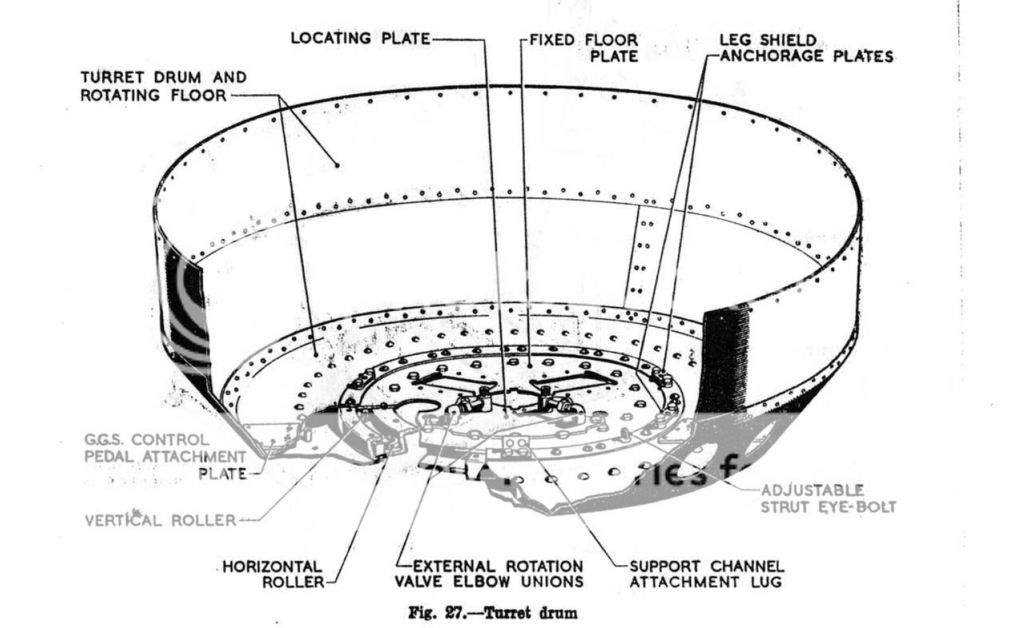
There are two notches in the circular centre opening that align with stationary base of the rotating service joint. I imagine the ammunition ducts & the hydraulic lines from the external rotation valve did their part to keep the floor from rotating with the turret.
By: jamesinnewcastl - 23rd June 2015 at 19:28
Hi Mike
OK I hadn’t thought about a section in the bowl being held still – However, how was that section held in place? I assume that there was some sort of structure to hold it still or was it just held by the duct ends? I suppose too that even though two of the belts would be twisting together they should be moving together too and so the risk of a disruption while twisting may not have occurred.
I’ve re-read Air Ministry’s attachment text and it states essentially that two sorts of turrets could be fitted to the Manchester, where a turret did not have a servo feed the ducts were terminated around section 40 and so not used I suppose.
This means that the Manchester could have had FN4s but they would not have been fed by the ducts, so possibly my thoughts on the ducts being fitted whether or not a turret could use them is actually demonstrated by the Manchester design as well as the Stirling.
Things seem to be clearer, I’ve also thought that the requirement for the servo and ducts, etc may have originated in the original specification for the Stirling – anyone know where I could get a copy?
Cheers all
James
By: turretboy - 23rd June 2015 at 18:49
The servo feed unit is a system within the turret. I’m quite sure that it was not a feature of the FN4.
In the FN20/120 it was powered by hydraulic motor & electric motor in the FN121.
From the FN121 AP: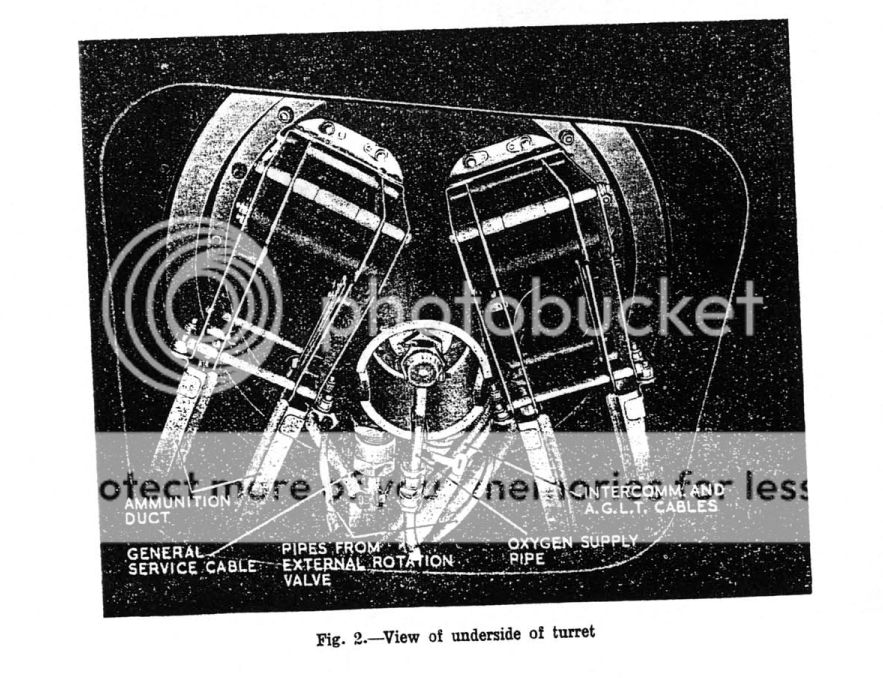
The hydraulic & oxygen services enter through the rotating service joint.
Floor Panel – FN121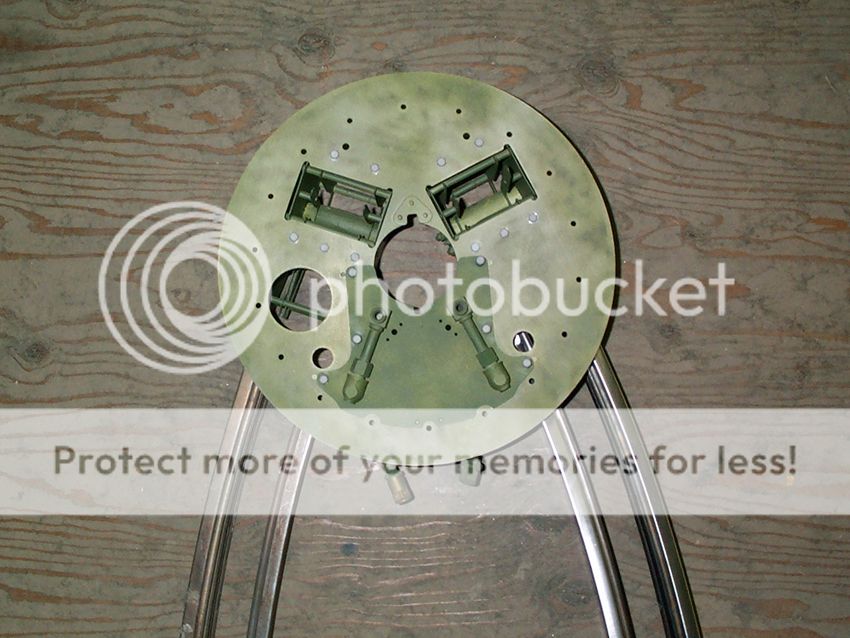
The floor remains stationary while the turret rotates about it. The ammunition belt twists unsupported in the turret before it reaches the servo unit.
I hope this helps.
By: jamesinnewcastl - 23rd June 2015 at 18:05
My copy of AP 1659A shows a Stirling turret but it is complete with In-turret ammo boxes? There are some suspicious looking black bits under the bowl though – they look rectangular?
Apologies for the enormous image again
James
By: jamesinnewcastl - 23rd June 2015 at 17:54
Hi Air Ministry
Looks like I am wrong in stating that the FN4 only ever had ammunition boxes in the turret!
Here’s the equivalent AP for the Stirling showing the ducts – sorry about the sizing!
So you answer leads me back onto my original investigation which is how do the 4 ammunition belts pass up into the bottom of the turret given that the turret can swing +/- 90 degrees? Do the ducts end just under the turret and the ammunition belts simply twist as they go up into the turret? That sounds like a recipe for a lot of bullets and clips in a heap!
I’ve not found a drawing or pic of an FN4 with ammunition entry points, would you have one?
By: Arabella-Cox - 23rd June 2015 at 17:03
Actually, having thought about it, are you getting confused over the ammunition ducts?
The following extracts are from AP1600A Vol. I Manchester (with FN4 rear turret):-
[ATTACH=CONFIG]238595[/ATTACH]
[ATTACH=CONFIG]238596[/ATTACH]
By: Arabella-Cox - 23rd June 2015 at 12:34
The FN20 was ready for service in 1940, but the FN20 installation in the Stirling was only ready for testing at A & AEE in mid-1941.
It was problematic from the start and even after urgent mods, it was never really regarded as satisfactory. A & AEE only passed it due to the urgency of the situation (presumably, pressure from Bomber Command).
As to whether it was always intended as the standard turret for the Stirling I cannot say.
Interestingly, many in B.C. preferred the FN4 turret to the FN20 but it had gone out of production and the FN20 and its successors were “it” for most of the war.


 Sign In








 June 22, 2015 at 11:45 pm