do anyone have information about these things 😎
AAM-4B ( AA missiles with AESA seeker )
The AAM-4B is fitted with a missile seeker featuring Active Electronically-Scanned Array (AESA) radar and a greatly improved data link
By incorporating AESA capabilities into the AAM-4B, it seems possible that Japan has designed a uniquely capable air-to-air missile. While most front-line fighters of today are outfitted with AESA, no known air-to-air missiles are similarly equipped.
Technical Research and Development Institute indicated that the AAM-4B could be launched from a far greater distance than the AAM-4, an increase in range of as much as 20 percent. The Institute also stated that activation of the AAM-4B’s autonomous guidance system would be possible from a range 40 percent greater than that possible with the AIM-120B AMRAAM. Also, the AAM-4B was reportedly designed to match or outperform the Russian AA-12 Adder. The enhanced performance of the AAM-4B is claimed to be partly the result of an increase in the level of power transmission incorporated in the AESA.
http://defense-update.com/20120314_japan-making-its-f-2-fighter-fleet-more-lethal.html
ASM-3 (stealth supersonic ramjet missiles with very small size )

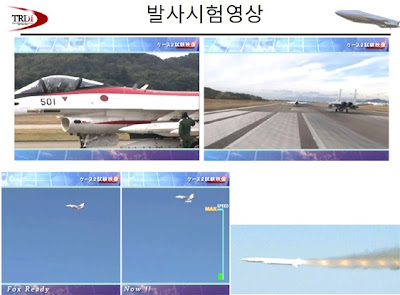
Mitsubishi Heavy Industries is currently developing the (X)ASM-3 high-speed anti-ship missile as a successor to Japan’s Type 93 (ASM-2). The new missile has an integrated solid propellant/ramjet motor and a range of 200 km. It reportedly includes a dual-mode imaging IR and active radar terminal seeker.
http://all-about-military.blogspot.co.uk/2010/01/japans-asm-3-supersonic-anti-ship.html
Opher ( autonomous LOAL IR guider bomb )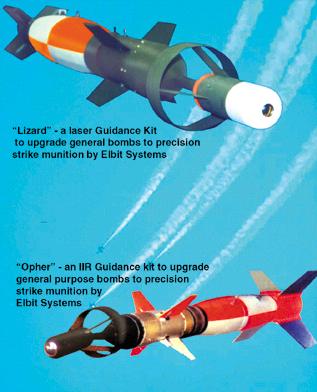
“When a pilot arrives in the target areas he can release up to four Opher systems in the approximate direction of the target. The infra-red imaging seeker on the bombs then autonomously acquires the target and guides the bomb to it.
“This is a unique weapon; it can be used at day or night. Its also good for operations in the European scenario where low cloud interrupts the guidance of weapons that rely on line-of-sight targeting, such as laser guided bombs and optically-guided missiles.
http://www.flightglobal.com/news/articles/opher-bomb-deployed-in-kosovo-52884/
Autonomous target acquisition – no target designation required before or after launch
Fire and Forget
Pilot friendly
Point target hit capability
Multiple bomb release per sortie
No A/C modification
Adverse weather capability
Convertible to LIZARD by switching to laser seeker
Targets: motorized vehicles, ships
The algorithm exploits object parameters such as geometry and intensity of the thermal signature to discriminate the target return soil. The kits are added to a dumb bomb Mk82 227kg of which now have a CEP of 120 cm against moving targets until 150m/ho resulting in at least one “mobility kill” leaving the target paralyzed.
The processor Opher has an algorithm to differentiate the types of target. A tank with the engine running can be differentiated from others with engine off. The combat car with engine running has priority acquisition because the other may have already been destroyed. A tank on fire is the last priority.
The Opher was integrated into the F-4E, A-4, F-15, F-16, Kfir, Mirage, AMX and MiG-21 Lancer

By: Mercurius - 6th June 2013 at 18:42
I can take a stab and answering most of those questions.
What is so little info available? Because all three are made by companies that are notoriously tight-lipped.
Japanese missiles are never exported, so have seen no combat use.
In 1999, the Italian Air Force AMXs used Opher against Serbian targets.
There is not much information on the Type 99 Modified (AAM-4B). Japan’s Technical Research and Development Institute (TRDI) is understood to be developing a Ka-Band AESA seeker for this missile, which is expected to serve on the F-2 and F-15J. Work on the new missile probably started in FY2010, and a total of 56 F-2 are expected to be made compatible with it, a process said to involve a new datalink and an upgraded J/APG-2 fire control radar.
The goals of the Type 99 Modified programme are to extend the missile’s range and active-homing range; to improve its homing capability against manoeuvring targets and small targets such as cruise missile; and to increase resistance to countermeasures.
Development of the XASM-3 probably started in the early 2000s. It is intended to replace the Type 93 (ASM-2). It is powered by an integrated solid propellant ramjet and has a range of 200 km or more. Terminal guidance is reported to be via a dual-mode imaging IR and active radar terminal seeker. Measures such as shaping and the use of low-reflectivity composite materials have probably been used to minimise the radar cross-section.
The missile was first seen in 2006 when a Mitsubishi F-2 test aircraft of the Technical Research and Development Institute (TRDI) was seen carrying what were probably captive-test missiles. I have not seen any reports of powered and guided flight tests, but it seems reasonable to assume that these are under way, since the missile is expected to enter production in 2016.
By: moon_light - 2nd June 2013 at 02:32
There is a reasonable amount of unclassified data on all these weapons, but much of it is not publicly available. For example, the Jane’s online stuff is behind a paywall, and few libraries stock the specialised books such as ‘Jane’s Air Launched Weapons’.
What sort of information were you specifically looking for?
just any info available , such as are they just for testing or in low rate production or have been used in conflict ..etc , why there so little info about them compared to other weapon
By: Mercurius - 1st June 2013 at 19:00
There is a reasonable amount of unclassified data on all these weapons, but much of it is not publicly available. For example, the Jane’s online stuff is behind a paywall, and few libraries stock the specialised books such as ‘Jane’s Air Launched Weapons’.
What sort of information were you specifically looking for?


 Sign In








 June 1, 2013 at 1:50 am
