Received 1338 Monday 22MAY06
Parliamentary Secretary to the Minister for Defence
PARLSEC 049/2006 Monday 22 May 2006
UNMANNED AIRCRAFT TRIAL FOR NORTH WEST SHELF GOING AHEAD
A Defence trial, using an Unmanned Aerial Vehicle (UAV) and an Armidale Class patrol boat, will be conducted across Australia’s North West Shelf region in September 2006, Parliamentary Secretary to the Minister for Defence, Senator Sandy Macdonald announced today.
Senator Macdonald said the proposed trial was a commitment made by the Australian Government in its 2004 election policy Securing Australia’s North West Shelf.
“The North West Shelf region is of vital strategic and economic interest to Australia and enhancing existing security in this area is a priority for the government. Criminal activities such as illegal fishing, drug running and people smuggling must be stopped,” Senator Macdonald said.
Senator Macdonald said the trial will assess the potential of UAVs to operate under a joint, integrated surveillance capability with the Navy’s Armidale Class Patrol Boats to provide an additional layer of surveillance in Australia’s approaches.
The trial is being led by the Defence Science & Technology Organisation (DSTO) in collaboration with the Navy, RAAF, Army and other areas of Defence, as well as the Joint Offshore Protection Command (a partnership between Defence and the Australian Customs Service).
US company General Atomics Aeronautical Systems, Inc. (GA-ASI) will be jointly conducting the trial with Defence. A UAV system, made by the company, will serve as the aerial platform for the trial.
Conducted over 30 days, including a flying period of 14 days, the trial will start with three test flights out of RAAF Edinburgh near Adelaide, followed by four missions from RAAF Learmonth on the north west coast of Western Australia. RAAF Edinburgh will also be the primary mission control site while the UAV is airborne.
Contracts were signed in March with both US companies, paving the way for the trial to proceed during the month of September. The UAV being used has been modified specifically for the purposes of the Australian trial. It will carry only sensor and communications equipment suitable for maritime surveillance missions.
“This UAV trial is a valuable exercise for Defence. The results will assist in developing the requirements for phase one of Air Project 7000. Under this project Defence plans to acquire a long endurance, multi-mission unmanned aerial system,” Senator Macdonald said.
————————————————————————
here is what is coming; bear with me I am translating this from German to English for everyone to read.
————————————————————————————-
CAMCOPTER® S-100 presents
New VTOL UAV system of Schiebel is to roll the drone market up vertically
Since in the middle of the 80’s is well-known the Schiebel electronic devices GmbH from Vienna for the development and production of ultramodern mine detectors.
One began center of the 90’s then for the first time with the development of a small unmanned helicopter. The first concept planned the CAMCOPTER® as the further tools with Entminungsoperationen. The 3,1 prototype was propelled still by a chain saw engine and could be developed and realized by model airplane enthusiasts. The system carried a simple thermal picture monitoring camera in the nose.
To obtain in further consequence also the assistance of the technical University of Vienna taken up around progress in the range of automatic flight stabilization. Result was the CAMCOPTER® 4.5.
The next step was a satellite navigation system and the bundling of on-board electronics into an individual box. 1996 were presented so the system CAMCOPTER® to UAV 5,0 at the market.
Upgrades – above all a stronger drive – led 1998 to CAMCOPTER® the UAV 5,1 and a modification with larger mission radius and an automatically following data link antenna to CAMCOPTER® the UAV 5,1 Mk.2.
Systems of these generations became among other things to US Army, to which Egyptian navy sells and at Thomson CSF
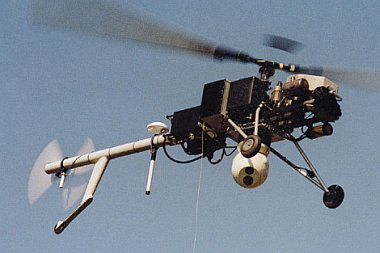
CAMCOPTER® UAV 5,0 (1996) (photo: Schiebel)
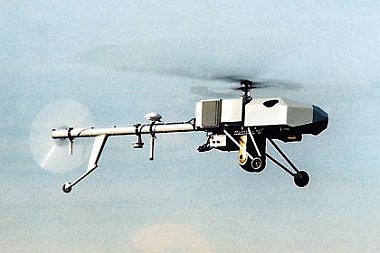
CAMCOPTER® UAV 5.1 (1998) (photo: Schiebel)
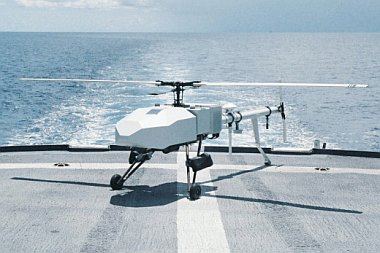
CAMCOPTER® UAV 5.1 Mk.2 (2000) (photo: Schiebel)
In the sea-monitoring employment make possible the employment for one helicopter-threaten even small units the fast and economic monitoring of large sea-areas. Radar contacts can be rapidly optically cleared up without change of course. The employment of the drone is besides around a multiple more economically than all distances with the ship to be put back.
The Egyptian navy procured 2001 two CAMCOPTER® systems.
Although to the Austrian federal army the system admits is, it it was several times demonstrated and at least of considerations for the employment in the context of military tasks as well as in the Assistenzeinsatz border space monitoring was employed, the OEBH none CAMCOPTER® of the systems developed so far procured.
Decisive for it primarily financial bottlenecks in addition, the reduced efficiency probably were in regard to the requirement catalogs set up by the respective troop units (e.g. artillery, air reconnaissance) to an unmanned system. However the OEBH Schiebel with making possible of test flights in suitable area supported – among other things also at the TUEPL in allget out of.
Restrictions within the ranges speed, range, pay load opposite fixed wing drones presented themselves also outside of Austria as permanent competitive disadvantage. Besides the enterprise of unmanned aircraft in civilian controlled air spaces represents a substantial legal problem.
With Schiebel one began therefore 2003 on basis of the collected experiences with the development of a follow-up system – the CAMCOPTER® S-100 VTOL UAV.
From the first day on, the acquisition of a civilian permission – to be able successfully to lock keeping the necessary editions and regulations around a civilian certification procedure – was substantial development target.
As simple and economical an enterprise as possible, was simultaneous large pay load, is of importance enough flying time and an increase of the data link capacities, in order to be able to exist at the international market.
And result is a system for both purely private applications is conceivable by civilian authorities and also in the purely military range to be used can.
Schiebel gives the costs consisting for a system of a ground station, to two S-100 drones including average sensor load with approx.. EUR 2 million on. The operating cost amounts to for instance EUR 100, – to EUR 150, – per flying hour and thus approximately a tenth of a manned sensor carrier on helicopter basis.
According to managing director Hans George Schiebel gives to lease or rent it over the support organization of Schiebel also the possibility of systems including operation during certain periods as well as to support customers within the range training and logistics.
The demand at the market for such a system might be so large that Schiebel its manufacturing production lines by a new work for approx.. 100 coworkers at the airfield Wr.Neustadt east extends. At the same time managing director Hans George Schiebel counts on a Verfuenffachung of the conversion in the next two years. Schiebel has two customers for the new system according to own data already fixed, with up to ten further stands one in advanced negotiations.
Initially one plans with the manufacturing of a S-100 per week, medium-term with an increase on two S-100 per week. The delivery time for the system will amount to about six until new months.
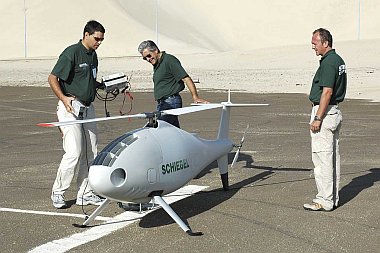
CAMCOPTER® S-100 (photo: Schiebel)
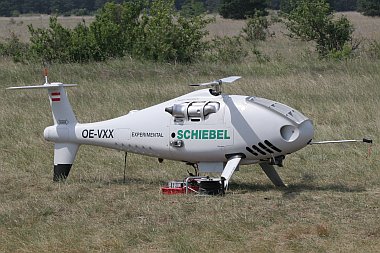
CAMCOPTER® S-100 (photo: Martin Rosenkranz)
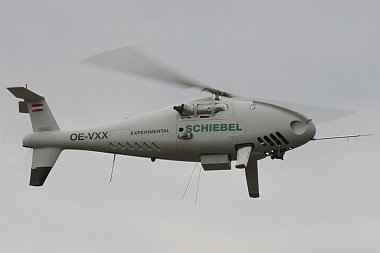
CAMCOPTER® S-100 (photo: Martin Rosenkranz)
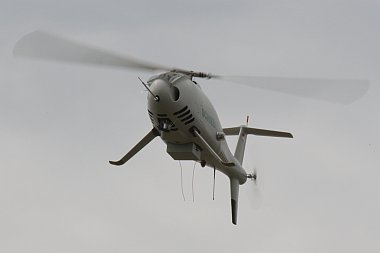
CAMCOPTER® S-100 (photo: Martin Rosenkranz)
The CAMCOPTER® S-100 develops a combination the enormous firmness on a carbon fiber Monocoque structure as well as dynamic parts from forged titanium (whereby the steirische titanium forging specialist “Pankl” came here to the course), with smallest weight ensured.
As power source a 55PS (40kW) serves strong aircraft engine in Wankel technology.
Fully automatic starting and landing procedure, full-autonomous stabilization of the flight attitude, fully automatic waypoint navigation via redundant IN and government inspection department or alternatively flight direction input via Joystick by operators, as well as redundant flight control.
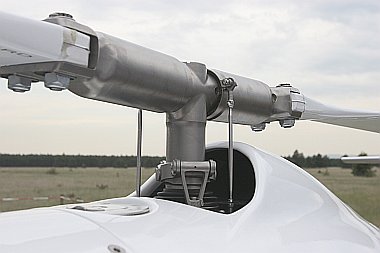
Main rotor head of the CAMCOPTER® S-100 (photo: Martin Rosenkranz)
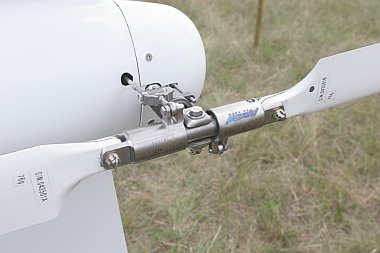
Tail rotor head of the CAMCOPTER® S-100 (photo: Martin Rosenkranz)
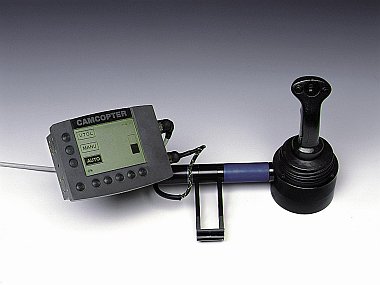
Start, navigation and flight to the waypoints as well as landing take place automatically. Optionally the interference is by a pilot possible possible at any time (photo: Schiebel)
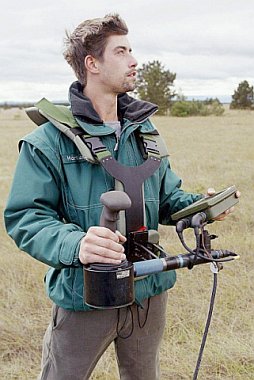
(photo: Schiebel)
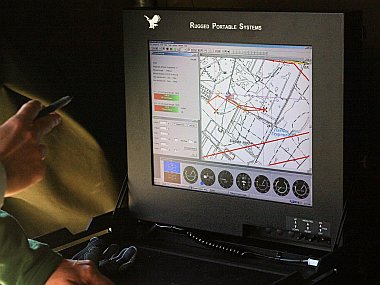
The portable ground station makes possible the input of waypoints, for monitoring of the flight route and also changes during employment (photo: Schiebel)
(photo: Martin Rosenkranz)
The airspeed amounts to for maximum flight duration 55kt (approx. 100km/h) maximally is possible for 120kt (220 km/h). The gradeability amounts to 10m/s the maximum flight altitude of 18.000ft (5.487m)
The empty weight of the drone amounts to 97kg, the maximum take-off mass amounts to 200kg.
The maximum groove load amounts to 50kg, with 25kg pay load is possible up to six hours of length of application. The capacity of the fuel container amounts to 58 litres and can be increased with optional external tank. With a typical fuel need of approx.. 10 litres per flying hour are possible thereby up to 6 hours flying time without auxiliary tank and usual employment radii of – depending upon range of the radio data transmission – up to 180 km.
For the attachment of pay loads four points at the aircraft are intended. The primary point of assembly for pay loads is directly under the main rotor mast and carries for max. 50kg. two lateral points of assembly is able for each to 10kg pay load to be taken up. Beyond that the drone has a secondary pay load bay in the front section, which likewise up to 10kg mass can take up.
The electrical supply of any sensor load is ensured according to standard by a 650W generator. Larger power requirement can be covered by attachment optional generator, for which a free assembly flange at the main gear box is intended.
Schiebel offered as standard sensor load the ESOP™ (Electronically Stablized Observer Payload) which a day light camera, an infrared camera in 3-5 the micron volume and a laser rangefinder in an electronically stabilized, trick and tiltable sensor Gimbal covers.
Communication of and to the drone over two independent simultaneously used dataon the left of ensures their range up to 200km amounts to. For the monitoring of the flight as well as assistance for possible active control by a pilot the picture of a highly soluble color video camera stands for the order of which in the C-volume in real time to the ground station is transferred. A further bi-directional dataleft in the C-volume transmits the data of the sensor load
The system is to be made possible laid out around the simultaneous employment mehrer threatening over a alone network and an integration into existing tactical data groups. Which are used data minutes can be selected thereby by the customer freely.
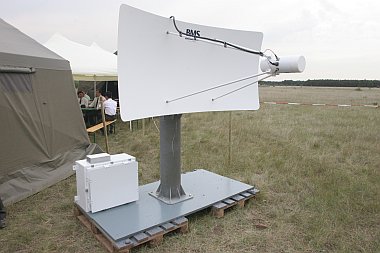
Datalink Antena (photo: Martin Rosenkranz)
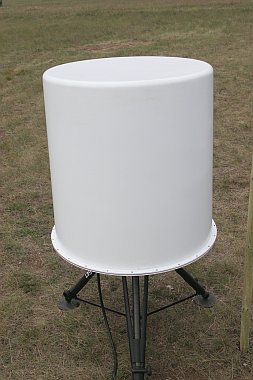
Datalink Antena (photo: Martin Rosenkranz)
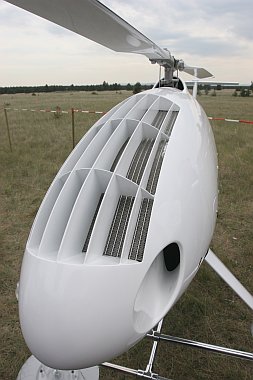
The CAMCOPTER® S-100 in that plan view (photo: Martin rosenkranz)
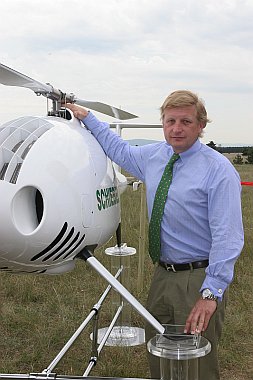
Hans George Schiebel, managing director Schiebel electronic devices GmbH and its CAMCOPTER® S-100 (photo: Martin rosenkranz)
The theoretical application type of the S-100 drone are very multilayered.
It participates from advantage that over it start and lands only in each case very small surfaces is needed, which makes maximum independence from local infrastructure for an operator possible.
Both within the purely private sector and within the range of civilian authorities and naturally also in the military spectrum various application type are conceivable.
That is enough from tasks in the context of the unterhaltungsindustrie (special camera positions and travels for film and television) or the sport reporting (aerial photos of wide sport events such as Marathons, radrennen or Rallyes), over tasks of monitoring in the industriellen range (control and monitoring of buildings; Plants; Pipelines; River -, water or other lines), over tasks in the search service, particularly in the hard-to-travel area and particularly at night (e.g. missed persons in the mountains), the monitoring from bordering or sea area to the fight of illegal immigration, drug transport or e.g. also Piraterie. Naturally also tasks are in the military range conceivable which of artillery clearing-up, over air reconnaissance as well as to the mine clearing operation and and also as instrument in the Rahen from special operations go to transfer.
However must and will for an effective employment in some ranges mentioned still on the sound emissions the drone worked – this can take place both by means of change within the range of the drive as well as within the range of the exhaust sound proofing. The present Auspff has to be the advantage small and easy, a clearly quieter exhaust is simply exchanged in development and can ohen large expenditure will measures for the reduction of the radar signature was by the way no development target.
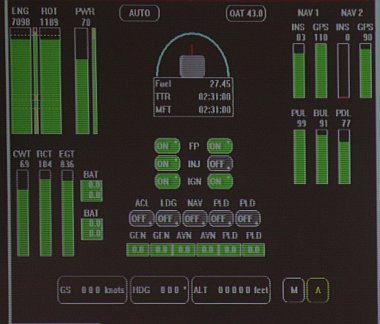
Status indications of the drone, during the flight to the ground station transfer will (photo: Martin Rosenkranz)
In order to be able to bring a S-100 system localindependently to the employment, are usually to two vehicles in the order of magnitude of small LKW’s or also an appropriate military vehicle, e.g. a Pinzgauer, necessarily.
That hands around the necessary data link antennas including current supply, the control element as well as to two S-100 drones transports for ability those operation necessarily at least a person with the theoretical knowledge of a private pilot as well as at least a given first schooling to technician a that the flight preparations to meet can. Theoretical knowledge over propagation from radio signals to the optimal positioning of the data link antennas is of advantage naturally likewise. Within the range of the maintenance Schiebel prepares a two-stage maintenance concept, with which according to certified enterprises can accomplish necessary regular service.
Technical Data CAMCOPTER® S-100 VTOL UAV
source: CAMCOPTER® S-100
————————————————————————————-
The UAEAF has just ordered 40 of these systems as well so it is in production.

By: Ja Worsley - 27th May 2006 at 18:01
Uni: mate this is what is to be trialed of the back of an Armidale up in the North West Shelf, the General Atomics UAV that is being trialed ios the Mariner (Sea version of the Preditor) and it’s trial is being held at RAAF Edinburgh in South Australia. A lot of people have forgotten the RAN requirement for a UAV to assist in Partol boat duties, but then again I am not suprised as it has been very low key compaired to the RAAF requirement.
By: Unicorn - 27th May 2006 at 11:49
I was under the impression the UAV being trialed was the Predator,.
The Ministerial release notes “US company General Atomics Aeronautical Systems, Inc. (GA-ASI) will be jointly conducting the trial with Defence. A UAV system, made by the company, will serve as the aerial platform for the trial”.
General Atomics builds the Predator does it not?
Given the distances involved in the NSW area I would have thought this helicopter-style UAV would have been too slow and too short ranged, particlualrly with only a 180Km data link range.
Unicorn


 Sign In








 May 25, 2006 at 9:42 pm