Someone please remind me: what was the name of the 1950/60s US nuclear armed surface-to-surface missile whose lethal range is greater than the range of the missile itself? I understand that the crews who launched the missile had only a few seconds to take cover.
Just spent 20 minutes going through Wikipedia without much luck!
Best Wishes and Thank You
Phil Rhodes

By: bazv - 10th December 2008 at 10:14
Shame … I was hoping it was the BOMARC,and then I could have posted a photo of Miss Bomarc…
If you scroll to the bottom of this page you can see the lovely Fran Frost…
By: JDK - 10th December 2008 at 07:23
Obviously, I was mistaken (if your interpretation is correct).
Just another assumption. Alertken’s post always contain a lot more gen than most wordier posts, but sometimes may be a bit ‘telegrematic’. 😉
By: Bager1968 - 10th December 2008 at 06:46
The assumption seemed appropriate… considering he listed the “Radius of lethality” in KM ONLY!
I expected he would be trying to show a comparable set of numbers, rather than throw out numbers in two differing and incompatible measurement systems without any attempt to relate them.
Obviously, I was mistaken (if your interpretation is correct).
By: JDK - 10th December 2008 at 05:36
Ummm… this cannot be correct.
Why not? You assumed a mile/km alternative – Alertken, meant ranges of either 2.5 or 1.24 miles, depending on unit – as you’ve (re)found.
By: Bager1968 - 10th December 2008 at 04:45
Honest John M31 was deployed in 1954 with a range of 12 miles.
The improved M50 version was deployed in 1960 and had a longer range.
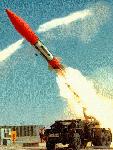
Little John M51 was deployed in 1961, and had a range of 18.2 km (11.3 miles), with a variable-yield W-45 nuclear fission (1-10 kT) warhead.
By: Bager1968 - 10th December 2008 at 04:34
a range of 2.5/1.24miles
Ummm… this cannot be correct.
It is either 2.5km/1.56mi, or 2.0km/1.25mi.*
8 kilometers = 5 miles (approximately).
1 meter = 3.28 feet. 1 km = 3,280 feet. 1 mile = 5,280 feet. 1 km = .62 miles.
EDIT: *the latter…
The Davy Crockett could be launched from either of two launchers: the 4-inch (102 mm) M28, with a range of about 1.25 mi (2 km), or the 6-in (155 mm) M29, with a range of 2.5 mi (4 km).
The M-388 round used a version of the W54 warhead, a very small sub-kiloton fission device. The Mk-54 weighed about 51 lb (23 kg), with a selectable yield of 10 or 20 tons (very close to the minimum practical size and yield for a fission warhead) up to 0.5 kiloton.
By: Flying-A - 10th December 2008 at 03:32
Painted Red?
I recall seeing a color photograph of a Davy Crockett training round that was painted bright red.
By: Phillip Rhodes - 10th December 2008 at 01:11
Why am I thinking of a large winged, flying missile, which had a very short range? Painted Red? Maybe only a development weapon and not deployed?
By: alertken - 9th December 2008 at 21:51
Davy Crockett truck/jeep mounted recoilless gun system.
155mm M-29 or 120mm M-28 artillery pieces fired XM388, a spigot with Mk.54 warhead of 10-20tons yield, over a range of 2.5/1.24miles (J.N.Gibson, History of US Nuclear Arsenal, Bison,1989). Radius of lethality 2.5km. In Service 1962-67. Stated reason for phase-out was realisation that a Sergeant could take the escalation decision.
By: BSG-75 - 9th December 2008 at 21:19
Honest John ?
seem to remember seeing them in that BBC b&w nuclear war movie…. name escapes me… but the missile was Honest John ?
By: oshawaflyboy - 9th December 2008 at 15:41
DUCK!
Hi folks: Little john pops to mind.
By: Arabella-Cox - 9th December 2008 at 15:23
perhaps the Davy Crockett?
Perhaps you are referring to the Mk. 54 Davy Crockett, a recoiless rifle nuclear round? Do not think it was necessarily lethal to the launching crew, but is was the shortest range surface to surface round if I recall, and indeed would have been interesting to say the least. Not a missle per say, so may not be what you are looking for.


 Sign In








 December 9, 2008 at 2:57 pm