Why doesn’t the V1 Flying-Bomb have any ailerons?
This may be down to my basic understanding of what ailerons do (or lack thereof) but surely the best way to steer an aircraft is with a banked-turn? Now I appreciate that the V1 isn’t an ordinary aircraft, and that it only flies on a rather crude autopilot, but isn’t the job of the autopilot made more difficult by only having a rudder and elevators?
I suppose the other factor is that the V1 doesn’t actually have to turn much but rather just hold its take-off course until it calculates it has covered the distance to the target; and the fixed launching-ramps were all aligned with the targets.
Is a rudder sufficient to hold a fixed course against prevailing crosswinds?

By: Flanker_man - 21st March 2017 at 16:27
See JB-2 (USAF) or KGW-1 (US Navy) ‘Loon’ :- https://en.wikipedia.org/wiki/Republic-Ford_JB-2
A US copy of the V.1 – launched from a B-17 – or from a submarine…..
My model of a KGW-1 about to be launched from USS Cusk……….
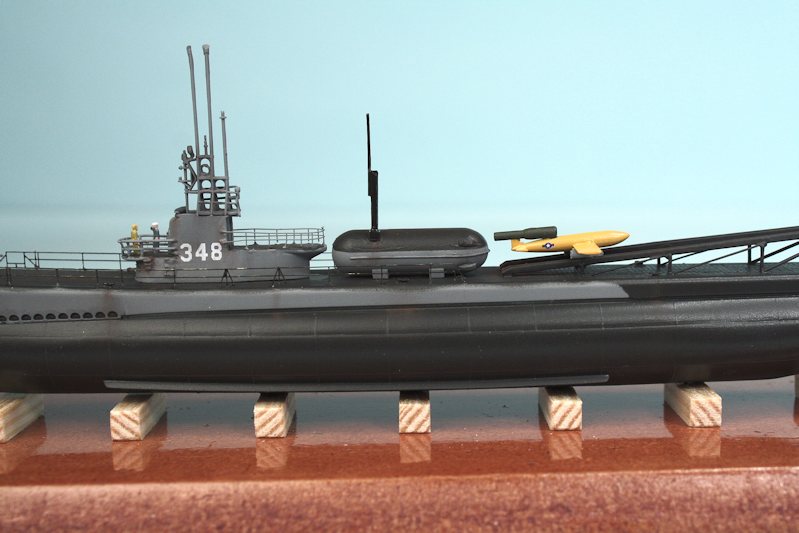
The Soviets had a similar ciopy of the V.1 – the Chelomei 10XN ‘Volna’ – also intended to be submarine launched……(Project 628) – which never came to fruition.

Ken
By: daveg4otu - 21st March 2017 at 16:00
In July 1990 I visited the John P. Stapp Air & Space Park Alamagordo NM and visible from inside the museum buildings were these two V1s (plus assorted other rockets or parts). One is in USAF colours . Presumably used for tests of some kind.(Apologies for the poor quality – these are video stills)

By: Arabella-Cox - 21st March 2017 at 15:58
The RAE report from August 1944 describing the influence of the auto pilot on the longitudinal trim of the V1 can be found in the National Archive (AVIA 6 10608).
It contains a good description of how the auto pilot put the V1 into a dive resulting in the engine cut out or tried to keep it flying if the engine cut out first.
By: Old Fokker - 21st March 2017 at 14:29
There was a “push” control on the elevator activated by the timer (controlled by the propeller on the front of the bomb). Often this “push” caused a temporary cut in fuel flow (low pressurisation of fuel tanks didn’t counteract this), which would cause the engine to cut. This had an adverse effect as originally it was hoped the bomb would penetrate the ground before exploding which would bring down buildings – with the engine cutting, momentum was lost to an extent which meant the bombs tended to explode o the surface. Therefore although less buildings were brought down than intended, the blast wave did tend to kill by percussion so the same desired outcome was achieved.
FB
Later versions did depress the elevators more slowly to minimise the effects of negative g on the fuel flow and prevent the engine cutting out. This is mentioned on page 157 of the ‘The Secret War’ by Brian Johnson, BBC Publications 1978 (companion book to the BBC TV series of the same name).
By: scotavia - 19th March 2017 at 18:01
Some were filled with propaganda leaflets and copies of Signal magazine. And the security service in the Uk planned a scheme of deception using their captive double agents, release of images and news items with incorrect locations where the missiles exploded.Gradually this worked and the German technicians altered their targeting which resulted in many of those which passed thru the anti diver aircraft patrols and ack ack box falling in less densely populated areas.
https://telescoper.wordpress.com/tag/flying-bomb/?iframe=true&theme_preview=true/feed/
By: Duggy - 19th March 2017 at 17:09
Link — http://www.dailymail.co.uk/news/article-2259619/The-kamikaze-doodlebug-Secret-variant-Hitlers-V1-designed-let-pilot-fly-British-targets-surprisingly-volunteered.html
I presume the manned version was different?
By: Fournier Boy - 19th March 2017 at 12:37
There was a “push” control on the elevator activated by the timer (controlled by the propeller on the front of the bomb). Often this “push” caused a temporary cut in fuel flow (low pressurisation of fuel tanks didn’t counteract this), which would cause the engine to cut. This had an adverse effect as originally it was hoped the bomb would penetrate the ground before exploding which would bring down buildings – with the engine cutting, momentum was lost to an extent which meant the bombs tended to explode o the surface. Therefore although less buildings were brought down than intended, the blast wave did tend to kill by percussion so the same desired outcome was achieved.
FB
By: hampden98 - 19th March 2017 at 12:25
Cruise missiles don’t use aileron’s either.
What was the mechanism that cause the V1 to cut and dive towards it’s target?
I read somewhere that a small guillotine severed the controls and fuel line causing the V1’s engine
to cut and the elevator to go full over causing a vertical dive ?
BTW you had to bash V1’s with a wooden mallet to get them to fly straight!
Interesting things V1’s, unless you happened to be underneath one.
By: Rocketeer - 19th March 2017 at 10:28
Likely why easy to tip….little roll authority to correct a decent roll perturbation
By: Fournier Boy - 19th March 2017 at 09:34
The V1 used secondary effect of rudder to produce roll, which was simpler as the “roll” gyro was mounted at angle so that minor laterally instability would be detected straight away and corrected with rudder. Don’t forget the “autopilot” was only to keep it as straight as possible, the actual course it was set upon was calculated on the ground with maths.
It was designed to be built by unskilled labour in 300 man hours, there was no need to over engineer things. If you take aside its purpose, in pure engineering terms it was a remarkable piece of design
FB
By: Creaking Door - 19th March 2017 at 09:30
I’ve already learned two things from starting this thread: firstly I can’t spell ‘ailerons’ (well, not without looking it up), and secondly, that ‘aileron’ (which I knew was a French word) means ‘little wing’!


 Sign In








 March 19, 2017 at 9:26 am