
By: Bager1968 - 27th December 2007 at 07:03
I don’t see any ASW/AEW aircraft on that… how about a couple CL-84?
By: shiplover - 26th December 2007 at 18:37
As the discussion about this design seems to have come to an end I would like to add the ultimate VSS to the collection. It has integrated some of the proposals I received. As a special christmas greeting there is a strange radar of unknown type above the bridge. 😉
By: Turbinia - 11th December 2007 at 16:21
Given the relative difference in price and the difference in growth potential and operational capability you’re better off just building big even if you’re planning a reasonably modest air group in the begining. Even the UK treasury, one of the most tight fisted bodies on the planet finally accepted that truth when approving two large carriers for the CVF role in the late 90’s over a Invincible SLEP or building two ~ three new vessels of a similar size to the Invincibles.
By: X07 - 11th December 2007 at 15:28
25 de Mayo did operate SUe between 1983 and 1986.
Rafale was scheduled to operate on Foch carrier after 1997 refit only as Air Defense F1 version, so with less payload… a little (1.5°) sky jump was fitted on the bow cat for take off.
French navy wanted in the 80′ to buy F18… so I think a version of this fighter would have been able to land on Clemenceau class carriers.
By: roberto_yeager - 10th December 2007 at 11:39
good old Dedalo/Cabot always was a special ship
REALLY INTERESTING!!!!!!!!! DEDALO + AV-8B!!!!! possible last cruise in 1.988-89????
1Saludo
By: Jonesy - 10th December 2007 at 06:13
Shiplover,
I think this design is ok if one is to accept Foch as beeing ok
Again, with all due respect, if one accepts that the CVL needs to be Foch sized to be practical as a platform for operating Hornets why bother with the compromised axial deck VSS-III design?.
Surely it is the cheaper and more logical answer to license the Clemenceau design, increase the angle of the angled deck a couple of degrees and adapt it for your own machinery/sensors if you dont want the French kit?.
By: shiplover - 10th December 2007 at 05:37
VSS III size
I would like to add some information about the size of the ship we are discussing.
25 de Mayo: 19896 tons full load (Janes 89/90)
VSS III: 29130 full load (Friedman aircraft carriers)
Foch: 32.780 full load (Janes 89/90).
Add some blisters (as was done to Foch) and they have the same size.:)
So we are talking about a carrier CVS of Foch size, with a larger landing strip and more powerful catapults. The ship would have a less but more powerful aircraft then Foch.
I think this design is ok if one is to accept Foch as beeing ok.
By: Bager1968 - 10th December 2007 at 01:51
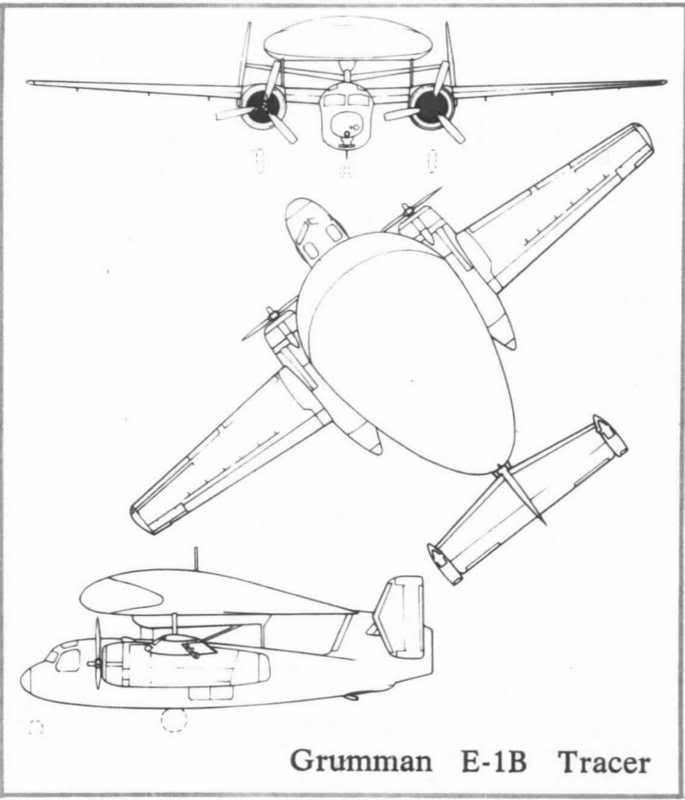
An AEW variant could even have been developed, and fitted with Searchwater radar…
You mean something like this?
E-1 (WF-2) Tracer (modified C-1 Trader {cargo version of S-2} airframe with classic Grumman side-fold wings):
E-1B VAW-11 CVA-19 1962

E-1B VAW-11

E-1B CVA-42 Feb1970
line drawing
By: Jonesy - 9th December 2007 at 22:01
@ Jonesy
I know I’m not going to change your mind, but I’m still hoping Edlaw and I can win this “Battle of the Atlantic”.
Yeah I’m afraid convincing me of the value of a circa 20k ton CATOBAR CVL for Atlantic Ops is going to be a real toughie!.
The way I see it if a service can afford to operate a CATOBAR ship at all, with the whole life maintainance costs associated with a pair of steam cats, an arrestor engine, and cables etc it can afford the, very marginal, cost increase associated with creating a serious, Clemenceau-sized, vessel capable of conventional operations.
This strange little axial deck 20k ton CVL would cost little less, whole-life, than a Clemenceau as all the same expensive bits are common to both, but, would offer drastically reduced capability for the money.
Well… dozens of S-2s are still operational in 2007. And firefighting operations aren’t exactly easy on airframes. The aircraft that went through the Turbo Tracker upgrades in the early 1990s were also stated as being good for 25years. So I think it might be no more of a nightmare than keeping the F-14 in service…
What makes you think that keeping the F-14 in service wasnt a nightmare from the support and logistics viewpoint?!. Also the issue is not whether there were airworthy Trackers by the mid 80’s rather that there may not have been many with the airframe fatigue life left to offer many more catapult shots/traps.
So how is 10 F-18s worse than 8 Sea Harriers on an Invincible? I understand it’s not enough for a 24h sustained BARCAP, but it’ll still provide you with more air defense capability than any carrier at the time bar the U.S. supercarriers.
Not really a fan of the CVS’s, I know precisely how many problems they had originally!, but they have proven their usefulness time and again for comparitively little money. It is this comparable value that is the problem with what you say above IMO.
The squadron of Hornets may be more capable, longer-ranged, better armed etc than a squadron of FRS1’s, but, enough to justify the huge difference in expenditure between the CVS and catobar CVL?. The superior CVL airwing, as oft stated, could easily find itself in METOC conditions that prevent flying operations. If the CVS can still fly off FRS1’s under the same conditions what is the value of the Hornets extra speed, firepower, or avionics?. See what I mean?.
Put simply I dont think the ‘reverse-angled CVL’ pictured above is doing enough to justify its expense over a similar-sized STOVL platform, and, if the pockets are deep enough to build catapult-carriers build ’em to a more sensible size!!!.
HMCS Bonaventure seems to have conducted North Atlantic operations just fine for more than a decade.
The Bonnie operated two squadrons of F2’s in fastjet terms plus cross-decked RN jets of the same vintage. Hardly comparable with F-18 ops off this notional CVL. It also spent as much of its time exercising around Bermuda and Puerto Rico with the USN as it did in the Atlantic and across the UK side of the pond!. hardly a straight line comparison!. 🙂
By: esp 49129 - 9th December 2007 at 10:07
@ Edlaw
The whole point of the reverse angle deck is to minimise overhangs, which reduces the deck pitching a lot.
Got it. Don’t know if we’re saying the same thing, but I’m also thinking that the reverse angle deck allows the arrestor wires to be set closer to the ship’s center, where there’s less pitching movement, since the landing area extends all the way to the bow. This gives pilots an easier target to hit.
@ Jonesy
I know I’m not going to change your mind, but I’m still hoping Edlaw and I can win this “Battle of the Atlantic”. :p
On the surface a CVL with 10 S-2’s, however many of those left with shot/traps left on their airframe lives by the 80s!
Well… dozens of S-2s are still operational in 2007. And firefighting operations aren’t exactly easy on airframes. The aircraft that went through the Turbo Tracker upgrades in the early 1990s were also stated as being good for 25years. So I think it might be no more of a nightmare than keeping the F-14 in service…
10 Hornets may seem to be of value, BUT, in reality what could they achieve?.
BARCAP….with 10 aircraft?. 2 aircraft on a CAP slot plus 2 on DLI ‘Alert5’ and 1 set-up with an emergency buddy pack and there’s half your airgoup gone…for the provision of a single CAP pair!!!. Even if you cycle pilots through the Alert birds you have 2 cabs struck below under maintenance, 2 up on station, 2 on deck and the buddy tanker…that leaves a whole three aircraft…be still my wildly beating heart!
I’m going to assume that you’re a fan of the Invincibles. 😉 So how is 10 F-18s worse than 8 Sea Harriers on an Invincible? I understand it’s not enough for a 24h sustained BARCAP, but it’ll still provide you with more air defense capability than any carrier at the time bar the U.S. supercarriers.
Given that a 20k ton CVL is going to seriously pitch and roll in a standard-issue Atlantic seaway, and catobar ops are going to be an interesting proposition, a 20k ton CVS with 10 SHAR FRS1, 12 HAS.Mk5 and a few AEW.Mk2’s is going to be, operationally, the far better proposition.
HMCS Bonaventure seems to have conducted North Atlantic operations just fine for more than a decade. So I’m to take a giant leap of faith and assume that a modern carrier with stabilization systems should be able to replicate the performance of a 19,000t WWII design… 😀
By: EdLaw - 9th December 2007 at 09:15
The whole point of the reverse angle deck is to minimise overhangs, which reduces the deck pitching a lot. As it is, this ship would be stable enough for normal ops, just look at other carriers that operated successfully in the N. Atlantic.
As for the airwing, the mix is unlikely to be 10 S-2s and 10 F-18s, more likely four Trackers, twelve to sixteen Hornets, and a couple of Sea Kings. This size of ship should be able to accomodate a better airwing than something like the British Invincible class. For ASW, I would rather have a mix of heavily upgraded S-2 Trackers and Sea Kings, than just Sea Kings. The Trackers allow long duration surveillance, and then once you’ve picked up a target, then you bring in the Sea Kings to use their dipping sonars. In the pure ASW role, these carriers could carry a dozen Trackers and a dozen Sea Kings easily. In the strike role, they could carry up to about twenty Hornets – in some senses, they are the natural replacement for the old Colossus class carriers.
By: Jonesy - 9th December 2007 at 06:07
esp,
On the surface a CVL with 10 S-2’s, however many of those left with shot/traps left on their airframe lives by the 80s!, and 10 Hornets may seem to be of value, BUT, in reality what could they achieve?.
BARCAP….with 10 aircraft?. 2 aircraft on a CAP slot plus 2 on DLI ‘Alert5’ and 1 set-up with an emergency buddy pack and there’s half your airgoup gone…for the provision of a single CAP pair!!!. Even if you cycle pilots through the Alert birds you have 2 cabs struck below under maintenance, 2 up on station, 2 on deck and the buddy tanker…that leaves a whole three aircraft…be still my wildly beating heart! 😉
As to the S-2’s I agree that it was an under-rated aircraft that could have been evolved into a modern versatile platform…in many ways the Julie/Jezebel setup that the S-2 embarked was a primitive predecessor to the LF Active sonar that we think is so clever today!!.
Would I choose 10 S-2’s over, say, 12 SeaKing HAS.5/6’s for my fleet ASW in blue water though?. Easy choice….give me the Sea Kings every time. Why?. Dipping sonar. Type195M or the 2069 set beats buoys every time for chasing down subs and with both carriers having limited airgroups neither is going to be sending hunters hundreds of miles away.
Anyway, I just though your argument highlights the need for a CTOL carrier!
Far from it. Given that a 20k ton CVL is going to seriously pitch and roll in a standard-issue Atlantic seaway, and catobar ops are going to be an interesting proposition, a 20k ton CVS with 10 SHAR FRS1, 12 HAS.Mk5 and a few AEW.Mk2’s is going to be, operationally, the far better proposition.
By: esp 49129 - 9th December 2007 at 03:08
Jonesy,
Aha! If the real threat is indeed from Soviet SSNs, then would you rather take a helo-only capable carrier, or a CTOL carrier that could operate S-2 Trackers – the closest thing to an S-3 Viking – in addition to helos? :p
A CTOL carrier has the inherent flexibility to fall back on operating only ASW helos if needed. But it can also carry, say, 10 ASW Trackers, 10 F-18 Hornets, and a gaggle of helos. This would have been perfect for the U.S., Canadians and Australians, which were all operators of these aircraft…
The S-2 Tracker could easily have been upgraded into an effective ASW platform in the early 70s-80s, with digital processing equipment similar to that on the S-3 Viking. The only reason it didn’t happen was because the USN didn’t operate Trackers anymore. However, such an upgrade was later privately funded by various companies as part of Turbo Tracker upgrades, and was put into service on Taiwanese Trackers.
Sure the Tracker might be slower than a Viking, and only carries half as many sonobuoys, but it would have been highly valuable. An AEW variant could even have been developed, and fitted with Searchwater radar…
Anyway, I just though your argument highlights the need for a CTOL carrier! :diablo:
By: Jonesy - 9th December 2007 at 00:32
(@ Jonesy: definitely impressed at how managed to “spin” my argument. Is that skill part of your line of work? )
(Apologies for all the emoticons, I overdid it somewhat)
No need for apologies…better to put in too many and convey the intention to keep things light hearted than risk someone reading antagonism and hostility where none exist in my experience!.
However, if you would prefer not to finish swimming in the cold Atlantic waters , then you probably will want a supersonic , BVR-capable fighter capable of providing 24h BARCAP coverage outside of enemy bombers’ launch envelope, with long-range AEW support. In the later case, the CTOL option is suddenly very attractive, even if you need to plan your launch & recovery cycles more carefully…
The problem with that is, unfortunately, precisely those cold Atlantic waters. The Atlantic is a very unforgiving body of water and the idea of trying to get catobar ops, with F-18s, off an itty-bitty 20-25,000 ton CVL in a normal Atlantic swell is going to be something to behold!.;)
Seriously though, if anyone wants to defend themselves against Soviet massed anti-shipping strikes with subsonic , short-legged , WVR-only capable STOVL fighters, then be my guest.
Your Soviet airstrikes, in that period in the Atlantic, bear little resemblance to Clancy’s Backfire Regts with their massed volleys of ‘Vampires’. Also, before any Kh-22’s or KSR-5’s appear, the Bears would have to have sniffed out the target. Now, you can deride subsonic, WVR, STOVL fighters all you like, but, for sitting on a CAP station 100nm upthreat for an hour and a half waiting to pot the first recce Tuploev that pops up SHAR FRS1 was perfectly adequate.
Essentially then, recreating the axial deck CATOBAR CVL is a solution to a problem no-one would invent and, as you say, an inefficient one at that. Whilst its well and good stating that flying programmes would have to be planned more carefully you cannot reliably figure in emergency deck reconfigurations for an event like an engine blow-out on takeoff and its effect on a launching CAP team.
For example – you’ve found good enough conditions to land-on your previous two CAP pairs and are launching the replacements. You launch two but the third FODs out an engine on launch. Do you send the pair up to one CAP station and gap the other accepting the risk, or put one aircraft on each station accepting the risk, or launch the last remaining aircraft, after you’ve reconfigured the deck for the landing and restarted the takeoff evolution…then launch a buddy-stored bird and generate another aircraft to cover the broken one?. Operational nightmare.
If you wanted to deploy tacair in the 70’s/80’s Atlantic theatre without the spend on a supercarrier you are plain out of luck. More than Hornets you want something deploying Hoovers – the predominant Soviet Atlantic threat in that timeframe was always the Northern Fleet SSN/SSGN force. Seeings as even the Midways were too small for S-3’s the usefulness of something like this axial deck could hardly be seen as worth the cost of building it!.
By: EdLaw - 8th December 2007 at 23:01
The problem is that the radar-equipped (and BVR capable) AV-8B+ wasn’t available in this timeframe. You would be talking the basic Sea Harrier, with just a basic radar, and no BVR capability. In contrast, these ships, due to the deck arrangement, would be able to operate Hornets or possibly Phantoms, and thus would be very useful ships. If I were given a choice between having BVR-capable Hornets, or basic non-BVR Sea Harrier FRS-1s, then I think you know which I would choose! :diablo:
By: Wanshan - 8th December 2007 at 22:08
Seriously though, if anyone wants to defend themselves against Soviet massed anti-shipping strikes with subsonic 😮 , short-legged 😮 , WVR-only capable 😮 STOVL fighters, then be my guest.
AV8Bplus > The Harrier II Plus is capable of deploying a wide range of weapon systems, including the air-to-air AMRAAM and Sparrow missiles
http://www.boeing.com/defense-space/military/av8b/index.htm
Range: 1600 Miles
http://www.boeing.com/defense-space/military/av8b/av8bspec.htm
F-35 (JSF) > also AMRAAM
Combat radius: 600 nmi (690 mi, 1,110 km)
By: X07 - 8th December 2007 at 10:01
x07,
According to my Google searches, 25 de Mayo never actually operated Super Etendards, because she was determined after trials to be too small to do so effectively.
Same thing for the Rafale on Clemenceau. The Rafale landed during trials without any stores, but could it operate effectively (especially in bad weather) and bring back more than a couple hundred kilos? For example, could the Clemenceau’s shorter wires stop a 16t Rafale doing a hard landing in rough seas without breaking anything?
I’ll compromise and concede you a couple of meters: the PROVEN minimum operational length to land a Hornet-sized aircraft is 195m. That’s the design length of the Charles de Gaulle’s angled deck back when it was intended to operate only Rafales. The French then decided to buy Hawkeyes after construction had started, and everyone knows the consequences… 😉
25 de Mayo did operate SUe between 1983 and 1986.
Rafale was scheduled to operate on Foch carrier after 1997 refit only as Air Defense F1 version, so with less payload… a little (1.5°) sky jump was fitted on the bow cat for take off.
French navy wanted in the 80′ to buy F18… so I think a version of this fighter would have been able to land on Clemenceau class carriers.
By: BME330 - 8th December 2007 at 09:58

good old Dedalo/Cabot always was a special ship
By: esp 49129 - 8th December 2007 at 09:45
x07,
According to my Google searches, 25 de Mayo never actually operated Super Etendards, because she was determined after trials to be too small to do so effectively.
Same thing for the Rafale on Clemenceau. The Rafale landed during trials without any stores, and both the Rafale and F-18 were determined after technical evaluations to be capable of operating off the Clemenceau in the air-defense role. But the French Navy was desperate for a Crusader replacement, so we don’t know how compromised these operations would have been. For example, could the Rafales/F-18 bring back more than a couple hundred kilos? And could the Clemenceau’s shorter wires stop a 14-16t Rafale/F-18 doing a hard landing in rough seas without breaking anything?
I’ll compromise and concede you a couple of meters: the PROVEN minimum length to land a Hornet-sized aircraft without significant operational constraints is 195m. That’s the design length of the Charles de Gaulle’s angled deck back when it was intended to operate only Rafales. The French then decided to buy Hawkeyes after construction had started, and everyone knows the consequences… 😉
By: X07 - 8th December 2007 at 09:00
The rationale for reverse angled decks IMHO is that they are the only way you can fit the required ~200m (650ft) angled deck needed to operate F-18 sized aircraft on a postage stamp sized 20,000-25,000t carrier. 😉 (200m is the size of Charles de Gaulle’s angled deck – likely the smallest F-18 capable carrier)
A normal angled deck will run only say ~3/4 of the length of a carrier, which is fine on a large carrier. It also works (barely) on small carriers as long as you limit yourself to operating aircraft the size of A4 Skyhawks. Clemenceau’s angled deck was 165m (540ft) and I would imagine that the angled decks of HMAS Melbourne or 25 de Mayo were even smaller, though I wasn’t able to find any data. 🙁
The overlap between the angled deck and the catapults is a non-issue. First, it would probably be inevitable even with a normal angled deck, assuming you want 50m+ length catapults (Clemenceau didn’t have an overlap with 50m long catapults, but was also significantly – about 40m – longer). Second, a small carrier only has about 20 aircraft, so efficient air operations are much less of an issue than on a supercarrier with 80 aircraft (4x as many aircraft to recover, 2x as many aircraft to launch per catapult on a Nimitz 😮 ).
25 de Mayo angle deck was 165 m long too, after 1980 refit. She was able to operate Super Etendards.
Clémenceau’s and Foch’s angle decks were 165 m long too, but were also able to operate Rafale fighters, similar as F18 A/C fighters… the CDG angle deck is 199 m long to operate E2C, but rafale doesn’t need so much lenght to land (cf rafale’s tests on Foch carrier in the 90′)
X07


 Sign In








 November 22, 2007 at 5:20 pm