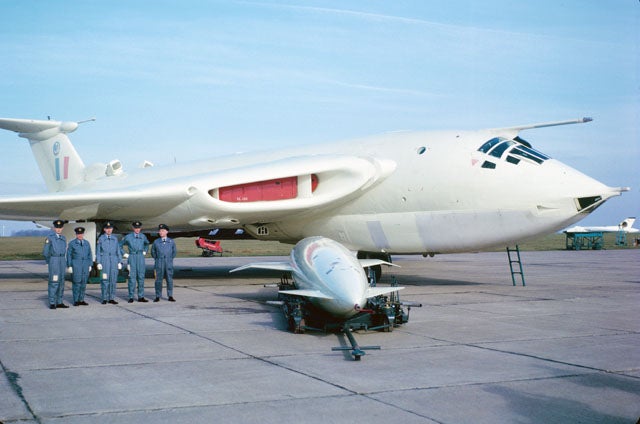
I’ve been studying colour photographs of Victors back in the days of the overall white finish, and the days when the bomber variants wore white undersides (not to be confused with Light Aircraft Grey which appeared on some tankers later).
Thing is, on many photographs, there are sections of the underside (particularly on the nose) where the colour seems to be “more white” than the rest of the airframe. I always assumed the slight cream-ish effect seen on white aircraft on most pictures was simply due to the age of the photo or poor colour correction. Now I’m wondering whether the main anti-flash white was in fact slightly cream-ish?
Okay, we can discount repaint jobs such as the Valiant at Cosford (which is doubtless copied from a photo) but the TSR2 XR220 still wears its original anti-flash white, and it is – by any standards – white. So, it all seems slightly confusing.
Any thoughts?

By: Chox - 23rd April 2011 at 11:58
Di-electrics are the actual transmitter/receiver ‘aerial’ bit of a system
That’s kind of what I was getting at. It rather suggests that the lower nose panels were simply manufactured from a different material and although still painted white, it gives the appearance of being a “different white” to the anti-flash finish applied to the rest of the aircraft.
I’ve given up trying to answer or responding to him Baloffski, I’ve withdrawn posts from here and the Bucc thread because he comes across as seeking answers and then dosen’t listen to replies from others – not good for someone hired to write books.
Good, I’m glad to hear it. What you don’t quite seem to have grasped is that the comments made on the Sea Prince thread were patently wrong. That’s why I didn’t “listen to the replies” as you put it. Anyway, as I’ve asked before, could you please keep your snipes to yourself as they add nothing to the forum.
By: baloffski - 23rd April 2011 at 09:11
Also of use for bulling boots!
Ahem! You may think that Prime Minister; i couldn’t possibly comment!
By: WebPilot - 22nd April 2011 at 13:51
Tornado GMR/TFR are high powered transmitters and ‘paint’, or in this case rubberised Flexane type coating will not hinder the output.
Also of use for bulling boots!
By: pogno - 22nd April 2011 at 12:07
On an aircraft of the 1950,60,70 era, such as the Victor, most of what you see is structural metal skinning, forming the airframe, if you then want to transmit or recieve radar/radio signals you need a none metalic panel through which the waves will travel. An early example is the H2s radar fairing fitted under the rear fuselage on Lancasters.
These panels are made in a number of ways but are esentially thin composite(fibreglass)skins, inside and outside with a filler like honeycombe made of Phenolic all bonded together with resin. making a sheet about 10mm thick. They are assembled and formed in a mould to the shape required. On the victor the whole section below the cockpit was a fibreglass tub with the bombing radar scanner behind it.
The paint requirement for these panels is much stricter than the rest of the aircraft, because anything added to the surface alters the way the radio waves travel through it, causing distortion and loss of effectiveness, so only a thin layer of special paint is applied to these parts, hence the different colour.
Also damage to these panels and the ingress of moisture between the layers also causes distortion.
Richard
By: pagen01 - 22nd April 2011 at 11:20
That is quite an abrupt reply, but hey ho it wouldn’t do for us all to be the same.
I’ve given up trying to answer or responding to him Baloffski, I’ve withdrawn posts from here and the Bucc thread because he comes across as seeking answers and then dosen’t listen to replies from others – not good for someone hired to write books.
By: baloffski - 22nd April 2011 at 11:13
That is quite an abrupt reply, but hey ho it wouldn’t do for us all to be the same.
Di-electrics are the actual transmitter/receiver ‘aerial’ bit of a system, f’rinstance Doppler, which is quite low powered.
Whereas radomes are in essence a lump of airframe made out of material which allows the passage of radio waves.
Tornado GMR/TFR are high powered transmitters and ‘paint’, or in this case rubberised Flexane type coating will not hinder the output.
By: Chox - 22nd April 2011 at 01:32
How come the Tornado had a black (and then grey) radome then?
By: baloffski - 21st April 2011 at 15:09
Di-electrics cannot be painted and light beigy ‘orrible grey is the colour of the raw material they are made of. That is why if you ever see a Tornado in inverted flight, the most striking thing is the Doppler panel under the nose. This was especially the case with the original dark grey/dark green paint scheme (except if the radar had leaked and streaked hydraulic oil trails across it).
By: Chox - 21st April 2011 at 14:07
Why would that be? The paint spec. is for overall white not grey?! I think perhaps you refer to the above photo where the panels do look grey-ish with a blue tint, but that’s down to the photograph. I assume the effect is simply created due to the anti-flash paint being more of a semi-gloss finish, whereas the panel look as if they were a matt finish. It’s difficult to establish precisely what the colours looked like now, four decades on. Colour photographs are, by definition, merely interpretations of the original. Reminds me of the infamous saga when Fuji released their Velvia colour slide film. Everybody loved it because the colours were supposedly “so authentic” and then Fuji admitted that they had deliberately tweaked the colour reproduction to look far more vivid than reality – simply because that’s how people perceived reality! Colours are a nightmare!
By: pagen01 - 21st April 2011 at 08:52
I guess the answer is that the panels (as illustrated above) are white, but so is the rest of the airframe.
The dielectric panels arn’t, they are a very light grey with a slight hue to them.
By: Chox - 20th April 2011 at 19:23
I guess the answer is that the panels (as illustrated above) are white, but so is the rest of the airframe. Presumably it’s the difference in finish rather than the actual colour. Anti-flash is certainly white, but it looks pretty odd when you see the lower panels on the Victor’s nose, which look even whiter!
It speaks volumes for the countless number of colour shots where the white has been mis-matched as a sort of cream. Reminds me of the ancient I-Spy book with a distinctly cream Vulcan on the cover!
By: inkworm - 20th April 2011 at 11:39
I think the probe Inkworm might be referring to could actualy be the port tailplane – a trick of angles?!
Yeah that’s the one, clever angle and makes sense now I look at it again. Looks odd though
By: pagen01 - 20th April 2011 at 08:25
Dialectric panels are a very light grey, but in comparison with light aircraft grey a different shade, consisting more of a blueish hue.
I think the probe Inkworm might be referring to could actualy be the port tailplane – a trick of angles?!
By: Robert Hilton - 20th April 2011 at 08:07
If you mean the fairing in the centre of the tail/fin it’s the RWR (Radar Warning Receiver)
By: inkworm - 20th April 2011 at 06:30
There’s three different colours on there and it’s not my eyes! What’s the probe on the tail for? I don’t recall seeing those fitted before.
By: hunterxf382 - 19th April 2011 at 23:13
http://static.rcgroups.com/forums/attachments/2/5/6/5/a1068038-198-Victor%20with%20Blue%20Steel.jpg would this be the sort of slightly different shading you mean by chance?
By: Chox - 19th April 2011 at 22:17
Thanks for the feedback guys. Maybe the contrast in colour is just a symptom of different materials then and that most of the photos are (as I feared) simply poorly colour-matched!:)
By: FarlamAirframes - 19th April 2011 at 17:48
The bits in my garage are definitely glossy white!
They are original -so not creamy.
The align markers on the dzus are marked in a nice blue – rather than the std red.
By: Fieldhawk - 19th April 2011 at 17:28
Hi Chox.
Are you thinking of the di-electric surfaces, things like dopplers, radars etc?
My memories of the Victors in the 60’s are of anti-flash white and the ‘faded’ roundels and markings.
The anti-flash white was definitely very white, and had to be kept clean. Wadpole cleaner would remove anything, including the skin off your hands.
Hope this helps.


 Sign In








 April 19, 2011 at 3:35 pm