I have been summing up a bit of a comparison between the Vickers Vildebeest/Vincent family and the Fairey Sworfish. The two aircraft look somewhat similar, especially the Vildebeest Mk IV which had a cowled engine and three-bladed propellor.
Both had the Bristol Pegasus engine of similar marks.
Bother were very close in size, the Vilde having just a little more wingspan, length and height over the Swordfish. The Vilde was also slightly faster at top speed by a couple of miles per hour it seems.
All in all they were very similar aircraft, similar design, role, age. Yet when WWII came the Vildebeest and Vincent was largely taken out of service with the RAF and declared surplus, with most of them coming to New Zealand to act as trainers and General Reconnaissance bombers.
Now, both types were designed as torpedo carriers, though the Vildebeest and were taken off that duty during the war and the Swordfish seems to have taken over the role they had.
What I wonder is why wer ethe Vilde and Vincent considered obsolescent, perhaps even obsolete, yet the Swordfish continued production into large numbers and saw service throughout the war? Was it puure luch on the Swordfish’s part that it being also outdated happened to score big points at Taranto so was kept on, while the Vildes were decimated in Singapore?
Or is there more to it? Are there other grand advantages that the Swordfish has (other than ability to land on carriers and fold wings)? Or was it just the FAA were short of planes and kept them chugging on?
I don’t think I’d like to go to war in either type, and they were very brave men who did so.

By: Dave Homewood - 13th September 2008 at 01:47
Oh ha ha – don’t forget we’re downunder to you lot 🙂 (No, I must not perpetuate that silly myth, some of them still believe it…)
The Baffin and Vildebbest/Vincent never needed a crutch to swing the bombs past the prop as their hardpoint attachments were under the wings. The Baffins carried six 250lb bombs – three on each wing – as standard bombing set up. I think from memory the V-bombers may have been a similar set up.
By: XN923 - 12th September 2008 at 17:25
diving steeply from around 6000 to 8000 feet.
Er, isn’t that actually climbing?
Sorry sorry sorry 😮
By: XN923 - 12th September 2008 at 17:23
Do we need to be clear about what the difference between dedicated official dive bombing versus the more informal concept beloved of the media and casual aircrew conversation?
A dedicated dive bomber was normally stressed for the job, and critically had some means of swinging any fuselage bomb clear of the prop arc where appropriate. Aiming and pull out aids were also sometimes fitted. As XN923 says, the RN weren’t that fussed about true vertical or near vertical dives, while it seems the USN and Luftwaffe (for instance) were. And anything that wasn’t level bombing from altitude was ‘dive bombing’ in the accounts.
I can’t speak for the Swordfish, but the Albacore certainly had dive bombing written into its specification, as did the Barracuda . Mind you, the Swedish Air Force developed dive bombing tactics in their Hawker Harts, an aircraft certainly not designed with that in mind, but apparently eminently capable of it. It seems that with biplanes, less dive-bombing specific design was required, and only when monoplanes became the norm did airbrakes, pull-out devices and the concept of ‘stressing for dive bombing’ become necessary. Not all dive bombers needed a crutch to swing the bomb clear as some used wing racks (e.g. Henschel Hs123, Barracuda, though this did later gain a centreline mount). Let’s not forget that where specific design, stressing, pull-out aids are concerned, the Ju 88 and He 177 are technically dive bombers!!
I have read one definition that anything up to 45 deg is glide bombing, anything above that may be called dive bombing. Certainly though in the Second World War you come across phrases such as ‘shallow dive bombing’ (presumably glide bombing) and ‘high dive bombing’ (releasing the bomb above 1,500ft IIRC). So much did the RAF abhor the idea of dive bombing in the 30s (when they grudgingly carried out some testing) that they wanted to call it ‘losing height bombing’! (According to Peter Smith at any rate). The RAF came to the conclusion that with its existing aircraft, Battles and Hampdens etc (!) which could not dive steeply, there was no advantage (!) although in the future purpose built aircraft may be beneficial. A neat way of ducking the issue for the time being. The Fairey Battle did in fact have a wing mounted bomb rack that could extend the bombs from their semi recessed position to allow them to be released in a dive safely, though the Battle could not dive steeply. The P.4/34 was to have been fitted with these devices too but when it morphed into the Fulmar they seem to have been deleted.
By: JDK - 12th September 2008 at 14:15
Swordfish were certainly capable of steep dive bombing, as were Albacores. As Vildebeest says, the standard torpedo bombing tactic was to dive quickly to deck level, as close in to the target as possible, to make the aircraft as difficult to hit by flak as possible. This fact did mean that a good torpedo bomber often made a good dive bomber (though the Albacore and Barracuda specification also included dive bombing explicitly). All the drag on a Swordfish made a fairly effective airbrake
Do we need to be clear about what the difference between dedicated official dive bombing versus the more informal concept beloved of the media and casual aircrew conversation?
A dedicated dive bomber was normally stressed for the job, and critically had some means of swinging any fuselage bomb clear of the prop arc where appropriate. Aiming and pull out aids were also sometimes fitted. As XN923 says, the RN weren’t that fussed about true vertical or near vertical dives, while it seems the USN and Luftwaffe (for instance) were. And anything that wasn’t level bombing from altitude was ‘dive bombing’ in the accounts.
In other words, you could certainly get away with a moderate dive-bombing attempt, and maybe with a more serious one – but they wouldn’t have been a god idea as a rule. The Vildebeest and Swordfish had low terminal velocities due to drag, and therefore would be subject to lower stresses and greater accuracy, but it would be interesting to see qualified reviews of what was called ‘dive bombing’ at the time.
As to the Jimmie Allen account, it’s interesting, but I’m not sure how accurate it is for even pre-war techniques. For instance, the Air Tail on torpedoes was a secret (but I think came in after the Swordfish era.) But the Swordfish certainly had three crew unless on very long range strikes.
Cheers
By: G-ASEA - 12th September 2008 at 13:33
Not the way to drop a Torpedo from a Vildebeast:diablo:
By: Dave Homewood - 11th September 2008 at 23:53
I have both written and recorded oral history evidence that the Vildebeests, Vincents and Baffins were all dive bombed in RNZAF service, diving steeply from around 6000 to 8000 feet. This was demonstrated at airshows, and also before the war the RNZAF had a three-ship aerobatic team that appeared at public events to show off the Vildebeests, and they regularly looped in formation. These big biplanes were much tougher than they looked. Remember they had all metal structure under the fabric.
As for torpedo bombing in a Swordfish, here’s a demonstration of torpedo attacks at that time from the Jimmie Allen Manual of the Royal Air Force, which must rank as the first publication ever released to the public about the Battle of Britain I’d think.
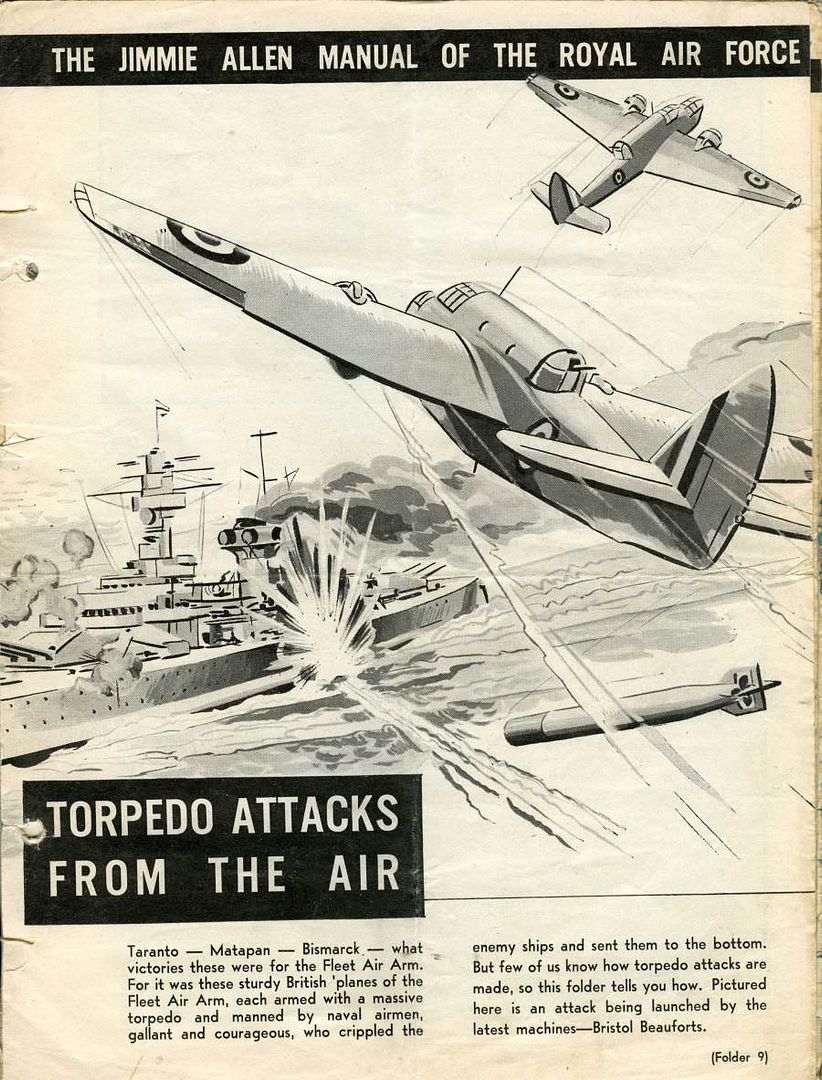
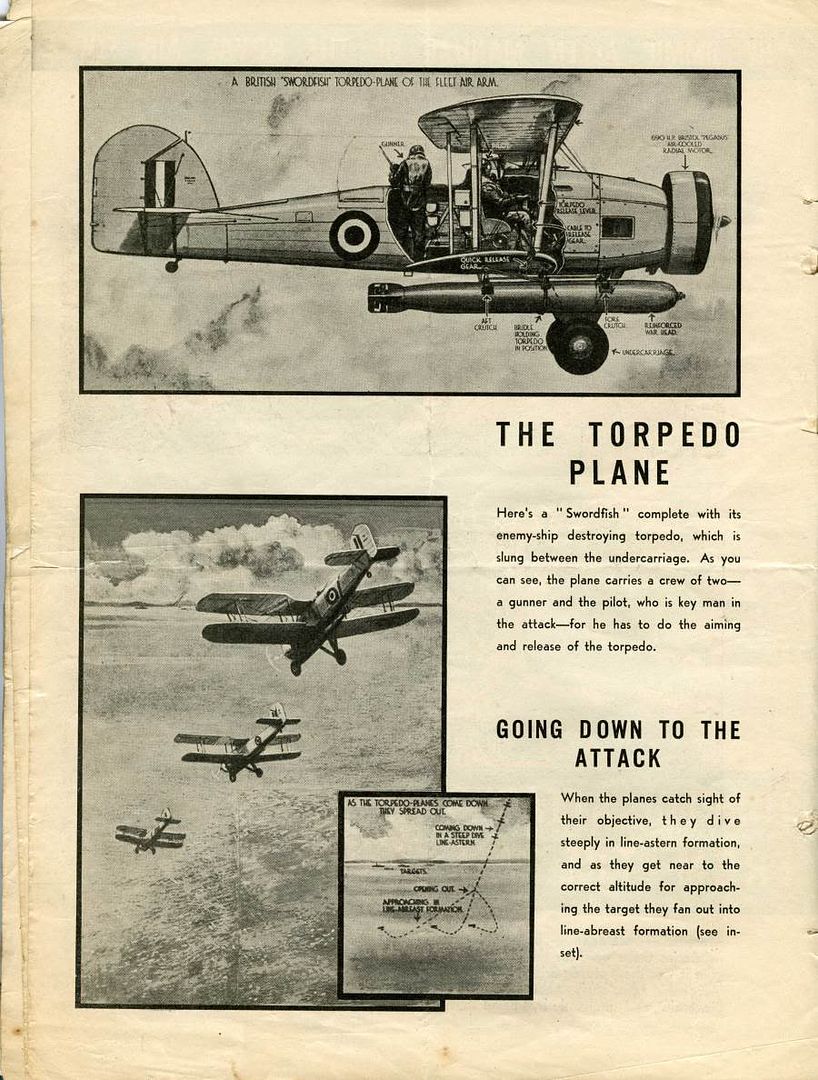
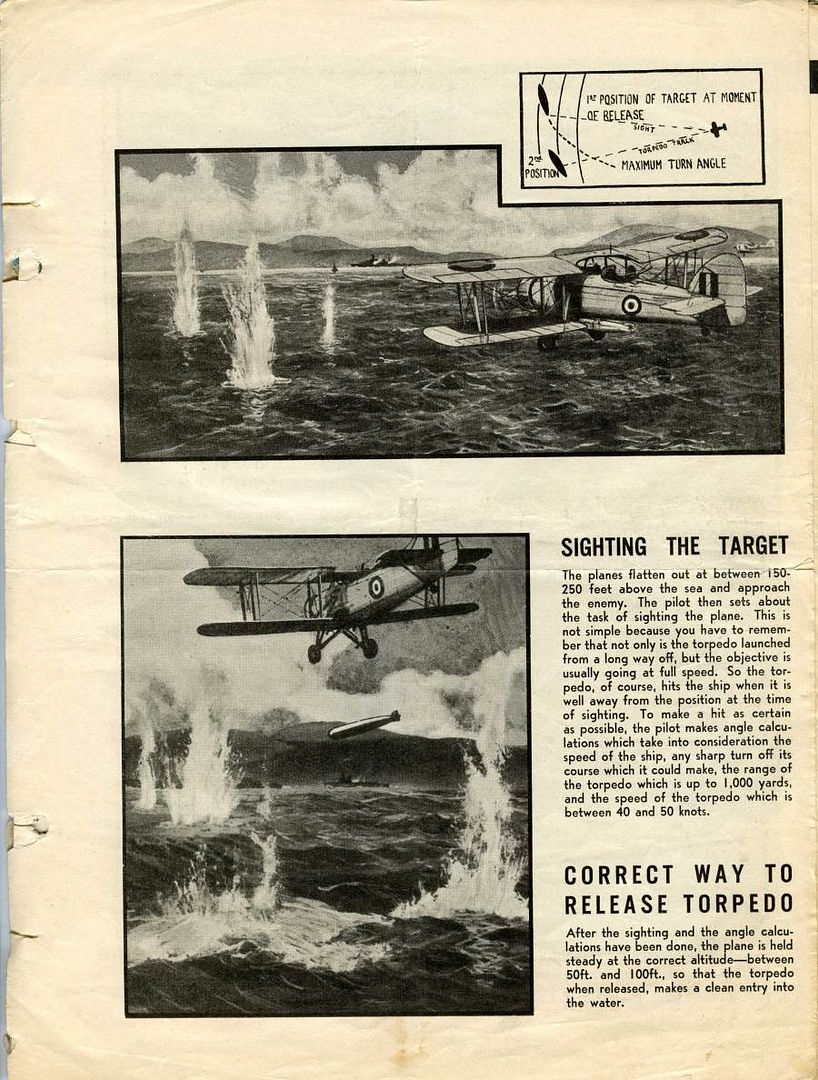
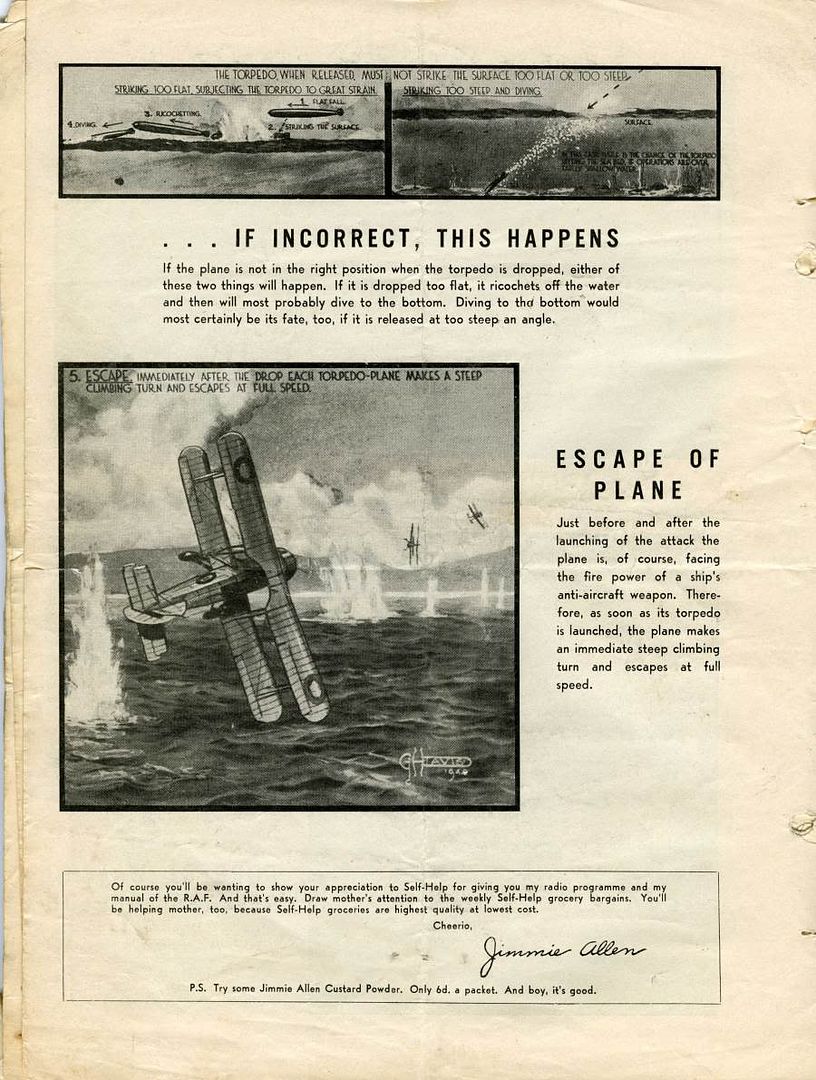
By: XN923 - 11th September 2008 at 21:44
To the RN, dive bombing generally meant 60-70deg. It was generally felt that a vertical or near-vertical dive was unnecessary to achieve accuracy, and their aircraft could not really dive much steeper than that anyway. I imagine a Vildebeest could manage a similar dive angle to a Swordfish. Let’s not forget that the terminal velocity would be pretty low, meaning there would be a lot less strain on the structure when pulling out of a dive than a faster and more heavily loaded monoplane.
By: vildebeest - 11th September 2008 at 20:42
Just been rereading accounts of Vildebeest operations in Malaya. Pilots theselves refer to “dive bombing” on operations in Vildebeests. One pilot at Endau says “Selecting salvos, I then dived straight down on two transports”. Now obviously they are probably using the term loosely and I am not suggesting that means they were going straight down like a Stuka – a full grand piano drop as James might call it – but it does suggest something more than a shallow dive. Unfortunately, showing complete disregard for the need for accurate info to settle debates 65 years later, it seems they were a bit too busy to measure the exact angle of dive…
Paul
By: XN923 - 11th September 2008 at 17:29
I’ve got a couple of referances which cover Swordfish actions in Norway, so I can put something together here if anyone’s interested and it doesn’t take things too far off topic!
Go right ahead.
I think James knows something about the U-64 sinking and the Second Battle of Narvik…;)
PS just looked at that link… says the U-boat was sunk by a 350lb bomb. I presume they must mean 250lb – don’t recall any bomb of the former size in UK service at this time (or any other come to that).
By: Ant.H - 11th September 2008 at 17:25
I’m fairly sure Swordfish dive bombed during the Norwegian campaign, and probably in the Med as well. They weren’t quite as effective as some aircraft like Skuas/Dauntless because their diving speed was lower which imparted less energy to the bombs.
Swordfish were indeed used in several torpedo, level and dive bombing actions in the Norwegian campaign. Perhaps the most significant dive-bombing achievement was the FAA’s first U-Boat kill, U-64, which was sunk in Herjangs Fjord by a floatplane Swordfish launched from HMS Warspite on 13 April.
http://www.uboat.net/boats/u64.htm
I’ve got a couple of referances which cover Swordfish actions in Norway, so I can put something together here if anyone’s interested and it doesn’t take things too far off topic!
By: JDK - 11th September 2008 at 17:22
On the Helldiver front:
The first Fort William Helldiver flew in July 1943, just a few months after the last Hurricane rolled off the assembly line. Fairchild of Canada also made this version of the dive bomber. Intended as replacements for the Dauntless dive-bomber already making a name for itself in the Pacific, 833 of the SBW Helldivers in six variants were completed in Fort William before the surrender of Japan stopped production. Some of the Canadian-made Helldivers were based on the USS Bunker Hill, one of the carriers that supplied the armada of aircraft that sank the famous Japanese battleship Yamato.
The Royal Navy Fleet Air Arm did form a squadron using Canadian-made Helldivers based at Squantum, Massachusetts but the unit was disbanded before it saw action. Helldivers, perhaps of Canadian manufacture, did see service in Vietnam with the French. At its peak during the war, the Fort William CANCAR plant employed over 7,000 people, half of whom were women.
Interesting article: http://www.vanguardcanada.com/CANCARThomas
By: XN923 - 11th September 2008 at 14:41
Swordfish were certainly capable of steep dive bombing, as were Albacores. As Vildebeest says, the standard torpedo bombing tactic was to dive quickly to deck level, as close in to the target as possible, to make the aircraft as difficult to hit by flak as possible. This fact did mean that a good torpedo bomber often made a good dive bomber (though the Albacore and Barracuda specification also included dive bombing explicitly). All the drag on a Swordfish made a fairly effective airbrake!
Part of the reason the Douglas TBD-1 was so ineffective as a torpedo bomber was that it was not capable of a steep dive to launch height so they had to make a long, shallow, straight dive which made them sitting ducks for both flak and fighters – at least the Swordfish was nimble enough to avoid AA most of the time.
I’m fairly sure Swordfish dive bombed during the Norwegian campaign, and probably in the Med as well. They weren’t quite as effective as some aircraft like Skuas/Dauntless because their diving speed was lower which imparted less energy to the bombs.
By: BSG-75 - 11th September 2008 at 14:31
[QUOTE=JDK;1296543]That would be the Royal Australian Air Force, thanks. I think she’s your Queen, too. 😉 Sorry to mention it, but it’s as irritating as the ‘British Air Force’.
QUOTE]
I stand corrected – apologies –
with the doubling up comment, it explains a bit about the Barracuda !
Going (again) back on thread, Swordfish, in daylight, over Norway with no fighter cover (or limited) would have suffered as much as the Skua’s did surely.
I read a long time ago a book about a Vildebeast pilot based in Hong Kong who was captured having never flown against the Japanese in case it was provocative ! – 3.5 years in a camp writing a diary (in code) that his wife managed to read years later,
By: JDK - 11th September 2008 at 13:58
…I read also about the politics behind the purchase, or not, same with the Australian Air Force I think ?
That would be the Royal Australian Air Force, thanks. I think she’s your Queen, too. 😉 Sorry to mention it, but it’s as irritating as the ‘British Air Force’.
As to Paul’s reasonable question as to torpedo bombers being dive-bombing capable, unlike my previous post, I don’t think that was what they were expected to be able to do. Dive bombing, proper dive bombing, was a lot more structurally demanding than torpedo dropping. If the RN could have used on type for both jobs, they would have, as they were ‘doubling up’ roles into few aircraft as far as possible. But as I said, that doesn’t mean it never happened – in an emergency.
By: JDK - 11th September 2008 at 13:48
Not sure either would be able to do a “Stuka/Helldiver” type dive and pull out structurally – again I’ve read of Swordfish glide bombing at a shallow angle, I think (and will happily stand corrected) at Taranto as well as the torpedo attack?
Swordfish did drop bombs at Tarranto, but level, or slight angle, IIRC. I may be wrong.
The Walrus was stressed for catapulting, with the result it was able to be looped aerobatted and used as a dive bomber. 😮 Tough aircraft stressed for catapulting (Swordfish) and with a low (drag-ridden) terminal velocity might do a bit more than more modern higher energy/mass aircraft – in emergency war scenarios.
A Vildebeest dive bombing would be the proverbial grand-piano coming down stairs – probably got more wire than a piano, too…
Regards,
By: BSG-75 - 11th September 2008 at 13:42
Not sure either would be able to do a “Stuka/Helldiver” type dive and pull out structurally – again I’ve read of Swordfish glide bombing at a shallow angle, I think (and will happily stand corrected) at Taranto as well as the torpedo attack?
By: vildebeest - 11th September 2008 at 13:37
To sort of bring the thread back on track, Swordfish and Vildebeest were both of course designed to attack with torpedos. Now, this is surmise on my part so shoot me down if I am talking the proverbial, but my vague recollection is that the standard attack profile for torpedo attacks at the time was basically fly along at a decent altitude to find your target, when in attack range dive as fast as poss to sea level, both to get in attack position as quickly as possible and to present the defenders with a difficult target, fly in a straight line for a while and if you survived that bit, drop torpedo and break as hard as poss to avoid flying over defences and present a hard target again.
If that is right then maybe both the Vildebeest and the Swordfish would have made good dive bombers, being designed to dive fast and manoeuvreable. As I say, pure surmise on my part, but Dave do you have any views from the people you have spoken to on how it performed as a dive bomber, anybody got any views or facts on Swordfish dive bombing?
Paul
By: Dave Homewood - 11th September 2008 at 13:32
When the Vildebeests, Vincents and the Baffins were withdrawn from the RAF (and in the latter’s case for some of them, FAA), before being sold to New Zealand in 1937-39, does anyone know what types they were replaced with in service?
ie which types superceded them in their squadrons? Does anyone know?
Some squadrons that our second hand Vildebeests had served with:
22 Squadron RAF
100 Squadron RAF
42 Squadron RAF
Some squadrons that our second hand Vincents had served with:
55 Squadron RAF in Iraq
84 Squadron RAF
100 Squdron RAF
Some squadrons that our second hand Baffins had served with:
810 Squadron
811 Squadron
812 Squadron at Hal Far
as well as various Middle East units (?) and HMS Furious and HMS Couragious
By: BSG-75 - 11th September 2008 at 13:14
Still, this is all rather later in the war than the discussion we were meant to be having. My point was really that history may have taken a different tack had there been Swordfish on that raid in June 1940. Interestingly, one of the theories about the court-martial of HMS Glorious’ Commander Air was that he refused to sanction a ‘near suicidal’ strike on German army positions during the Norwegian campaign which the Captain demanded. Clearly some people knew of the shortcomings of the Stringbag even in 1940.
I agree – we’ve gone off thread a bit ! Then again, Dive Bombing in a Wildebeast……:eek:
By: Dave Homewood - 11th September 2008 at 12:00
The FAA turned down Helldivers and the Dauntless, but used Avengers as bombers (shallow dive) more than Torpedo bombers.
The RNZAF also used Avengers as bombers rather than torpedo aircraft with No’s 30 and 31 Squadron, and I’m fairly sure they did some dive bombing as well as low level and glide bombing. They also fitted them with sprayers and sprayed fuel onto Japanese crops, soetimes ignititing the fields afterwards thoguht the fuel wrecked the food anyway.
Our Baffins, Vincents and Vildebeests were also used as dive bombers believe it or not (not in action, training only).


 Sign In








 September 9, 2008 at 2:33 pm