Hi all,
A chum and I have been discussing the acquisition, restoration to flying condition and public display of a vintage autogyro.
The Avro Rota would appear to be the machine for us.
Such a project will of course present a number of challenges but we can’t imagine any are insurmountable.
It will also be very expensive to do.
So, if you want to see an old autogyro blattering around UK skies once more, see what you can do out there to find us a project. I wonder if a museum somewhere has one that they would prefer to turn into cash in order to support something more pressing?
The will and the cash is there. I’m sure that the expertise and capacity is out there too.
Any leads on projects/ restoration expertise will be gratefully received. Lets find a pile of bits and get cracking on it. Hoorah!
Hairyplane

By: jpphoopha - 27th December 2007 at 13:08
Has there been any progress on finding/restoring a Cierva Autogiro? I am also very interested in same.
Because there are so few of these aircraft in existence, it may come down to manufacturing a replica.
By: JDK - 24th January 2007 at 10:20
Any Cierva Autogiros shot down in aerial combat?
The French may have lost some in the Battle of France period. They weren’t Avro built C-30 Rotas, but essentially the same machines, though.
By: paulmcmillan - 24th January 2007 at 10:00
Any shot down?
Nearly…
By: Buddha - 24th January 2007 at 02:57
Any Cierva Autogiros shot down in aerial combat?
Any Cierva Autogiros shot down in aerial combat?
By: bazv - 20th August 2006 at 20:33
I think maybe some people are straying from the original post which was specifically about the Avro Rota autogyro (Cierva C30 A).
The Pitcairn types were Cierva based but using a different(earlier) Rotor system,the earlier Cierva types also had auxiliary wings/ailerons to help with stability/control.
The C 30 has a completely different control system and will handle very differently,chapter 14 in ‘Testing for combat’ by Eric Brown gives a fair idea
of the flying ‘qualities’ of the C30.Although he is a bit vague on whether he actually flew it himself or if most of the chapter was taken from the RAE
test pilots handling report(Flt LT H P Fraser).
My comment about making the wings bigger and removing the whirly thing on top was just my wicked sense of humour :diablo: although I do think it is a hybrid and not a true Autogyro.I was not meaning to insult any Pitcairn pilot.
By: 25deg south - 20th August 2006 at 20:02
You might think that somebody who has the wherewithal and resources to rebuild a 1932 autogyro to flying condition would also be smart enough to research as much as possible the information on operating it. It is incorrect to say that the only reference is to read articles by pilots who have flown them. As pointed out previously on this thread Steve Pitcairn operated his vintage autogyro for a number of years until donating it to the EAA Museum last year, and may yet fly it again, and he is glad to talk about its handling qualities. Perhaps even more amazing is Johnny Miller, well known 1930s airshow pilot, who used to loop his autogyro as part of his airshow act. Johnny is still very lucid at the age of 100, in fact still holding a valid pilot’s license and owning a Bonanza (although I’m not sure that he flies solo any more). He still lives in the house he was born in, and saw Glenn Curtiss fly in 1910. Johnny is full of advice for aspiring autogyro pilots and aside from a few items to be aware of says that it shouldn’t be a problem.
As for making the wing a little bigger and making an aeroplane, the autogyro wing is primarily for stability and lateral control, and contributes only 20% of the lift.
The Pitcairns are Cierva type machines and were in fact built under a licensing agreement from Cierva. Early designations were PCA-1 and PCA-2 which stood for “Pitcairn-Cierva Autogyro”.
Wot?
By: Baldeagle - 20th August 2006 at 18:38
You might think that somebody who has the wherewithal and resources to rebuild a 1932 autogyro to flying condition would also be smart enough to research as much as possible the information on operating it. It is incorrect to say that the only reference is to read articles by pilots who have flown them. As pointed out previously on this thread Steve Pitcairn operated his vintage autogyro for a number of years until donating it to the EAA Museum last year, and may yet fly it again, and he is glad to talk about its handling qualities. Perhaps even more amazing is Johnny Miller, well known 1930s airshow pilot, who used to loop his autogyro as part of his airshow act. Johnny is still very lucid at the age of 100, in fact still holding a valid pilot’s license and owning a Bonanza (although I’m not sure that he flies solo any more). He still lives in the house he was born in, and saw Glenn Curtiss fly in 1910. Johnny is full of advice for aspiring autogyro pilots and aside from a few items to be aware of says that it shouldn’t be a problem.
As for making the wing a little bigger and making an aeroplane, the autogyro wing is primarily for stability and lateral control, and contributes only 20% of the lift.
The Pitcairns are Cierva type machines and were in fact built under a licensing agreement from Cierva. Early designations were PCA-1 and PCA-2 which stood for “Pitcairn-Cierva Autogyro”.
By: bazv - 19th August 2006 at 12:43
Yes Cierva was apparently not really that interested in the concept of the helicopter and I agree that his main aim was safer flying.But my own personal view is that the biplanes of the 30’s were safer and easier to fly than the autogyros of the 30’s IE a DH Moth or Avro Cadet etc,and i would imagine somewhat cheaper to operate.
By: 25deg south - 19th August 2006 at 09:45
I do accept that. What I take issue with is the accepted adage that autogiros were “a stepping stone to the helicopter and no more.
Juan de Cierva was initially, I believe,very much more interested in gyroplanes as a safer form of flying machine rather than as a helicopter precursor. Do take a look at the Helicop-Air Girhel from France (about 1960) as a projection of that concept – it looks a bit like an Eircoupe with a three-blade rotor.
There are drawbacks and “gotchas” with gyroplanes as with any type of aircraft, but I think that the popular vision of them as some sort of failed half-way helicopters is missing the point. They are rotorcraft , but fly and perform very differently from helicopters.
I haven’t flown one for many years but I must admit that in looking through this thread, the small scale reproduction tractor engine Cierva type built in Spain using a two blade rotor would make an interesting comparison to the popular pusher layout.
By: bazv - 19th August 2006 at 00:40
I did specifically state that my comments did not enclude the modern type of autogyro.
The original poster was specifically looking at a vintage type autogyro and if anybody seriously wanted to operate this sort of aircraft the only point of reference would be to read articles by pilots who have flown them.
E.G a Pitcairn might not handle like a C 30,one can learn much from history and if the 1930’s autogyro’s had been exceptionally good then everybody would have operated them.I always fancied an autogyro myself but decided there were just a few too many moving parts !!!!!
By: 25deg south - 18th August 2006 at 21:13
I do wonder the qualification for your remarks and am therefore curious as to the experience or knowledge base from which it is derived.
In disagreeing that an autogiro is only a stepping stone to a helicopter, I think that many , including Wallis and the Groen brothers in the U.S.A. might be of a similar opinion.
Some years ago I gained my autogiro P.P.L. endorsement, via Ken Wallis, as part of a development programme within the U.K. aircraft industry. An early lesson that we learned was not to confuse the capabilities of these two very different types of aircraft.
By: bazv - 18th August 2006 at 20:38
Is the Pitcairn a true autogyro ? With its fairly large wing.I know some of the early Ciervas had auxiliary wings/ailerons but only until the rotor control system was developed properly.
If you made the wing a little bigger and got rid of the whirly thing on top you would have……an aeroplane!!!! :diablo:
Dont get me wrong , I would love to see a ‘proper’ Autogyro flying,especially with a lovely radial up front,but anybody dabbling with one of these flying machines really needs to know what they are doing and to realise that they were a stepping stone to the Helicopter and no more.
I dont include the modern light autogyros in this(Wallis etc) they are more akin to a flying motorcycle and at least you can get dual instruction on them!!
By: Baldeagle - 15th August 2006 at 23:23
I talked to Steve Pitcairn, who flew a Cierva type PCA-2 until recently ( http://www.shaftesbury.org/straightup/images/photos/12_LG.jpg ) and he said that aside from having to avoid crosswind landings (no aileron effectiveness as slow speeds) it was quite safe and easy to operate. The one in Ohio should fly by the end of the year, we’ll see how it goes.
By: Consul - 15th August 2006 at 00:26
Fancy a ski u/c on a Cierva if things aren’t difficult enough already? I photographed this in Stockholm last month.
By: bazv - 14th August 2006 at 19:13
Anybody seriously considering operating a cierva type Autogyro should read
the book ‘Flight Path’ by Frank T Courtney and will be left with the impression that these machines should be left safely in museums,he was Ciervas test pilot for a while!They were difficult to operate and fly,especially take off/landing and (like the modern ones) they had to be operated strictly within their safe envelope.At the end of they day they were impractical flying machines and Cierva could not be persuaded to go on and develop a Helicopter which is of course much more practical .
The RAF Autogyros were of course used for Radar testing/calibration for a while.
By: Baldeagle - 14th August 2006 at 06:26
Snapped in Ohio two days ago-
By: steve_p - 2nd August 2006 at 17:55
Snapped at East Fortune last weekend:
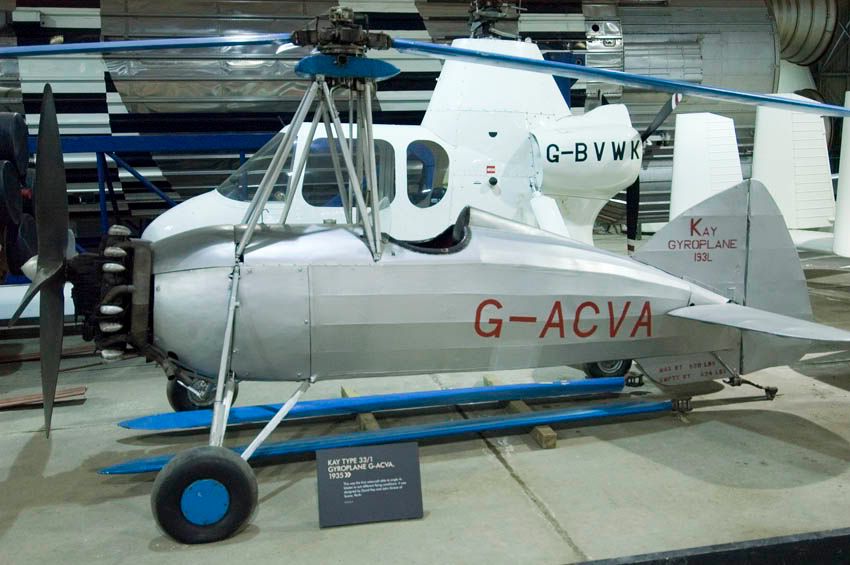
Best wishes
Steve P
By: ExSkyfame - 2nd August 2006 at 14:40
I remember discussing the possibility of G-ACUU with Peter FM Thomas at Skyfame in the sixties. He told me that even though the engineering involved was no real problem (Cheetah engines were relatively easy to obtain in those days) the then Board of Trade described the aircraft as a condemned type (Not eligible for either C of A or even permit to fly. The same applied to the Pou du Ciel. The problem with the Oxford, as I recall, was that they would have required a dismantling of the aircaft to reglue all the glued joints. I remember that the Oxford used to pop and crack, especially during turns, as the glued joints ‘came unstuck’. Keeping aircraft flying in those days was not just a matter of spares, engineering, money and skill, but also a perpetual fight with bureaucracy, something which really used to annoy PFMT.
Grame, ExSkyfame
By: DaveF68 - 20th February 2006 at 13:12
At Calshot it was mounted on the stern of an RAF tender and flown off that (the worlds smallest aircraft carrier?).
Somewhere I have a picture sequence of that trial when the rotor head broke and almost decapitated the pilot.
As Rotor kites, these are probably the rotary equivalent of the SG38 type glider
By: Jan - 20th February 2006 at 11:59
I’ve had a (very) quick look in Phil Butler’s War Prizes on the trials of captured Fa 330s.
Re the Fa 330s landing gear, or lack thereof, at least two of the ones that were tested in the USA post-war had a simple, wide two-wheel landing gear added to facilitate towed flight trials. Photos s/ns T2-4617 and T2-4618 can be found in said book on p 228 and 231.
The AFEE performed tests with a 120 feet tow-cable, which proved both smooth and trouble-free. A 20 feet tow-cable was tried as well, with less than satisfactory results. No mention of an added landing gear, though.
Incidentally, there is brief mention on p 63 of two Fa 330s owned by a farmer, whose estate disposed of them in 1977. The farmer owned part of Beaulieu airfield where some of the AFEE Fa 330 tests were performed. Where did these end up?
Regards,
Jan


 Sign In








 January 17, 2006 at 11:34 am