wandering around the Cosford Vulcan I noticed each engine had a small diameter exhaust type pipe coming out near to the main jet exhaust I wondered if any of you learned chaps could tell me what their original purpose was…..if it is a genuine part and not something the museum has added at some stage. I have also noticed that there are the jet nozzle end pieces missing too.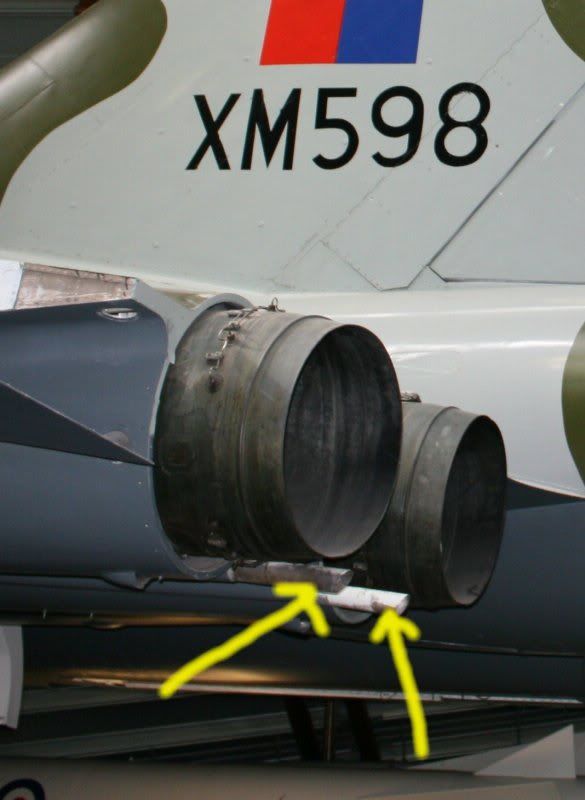

By: Bager1968 - 28th September 2011 at 11:04
Right, now make a thin-wing “Vulcan B.4” fitted with 4 of those Oly-593s and afterburners…
:diablo:
By: pagen01 - 28th September 2011 at 09:38
Oh dear, I wonder if I remember this right. Wasn’t a Vulcan used in the development programme for the Concorde engines?
You remember right Richard, Vulcan B.1 XA903 tested the Olympus 593 for Concorde, it was underslung in the weapons bay area.
Nice pic of it here, http://2.bp.blogspot.com/_8DAL7gPYBiM/TAhj3tNNhFI/AAAAAAAAAXs/1JbsBfIE0J4/s1600/Vulcan+test.jpg
By: pagen01 - 28th September 2011 at 09:33
With the proximity of those fuel dump pipes it could have done a spectacular ‘torch‘ – like the Aussies with their F-111s.
Uh oh, this is how threads end up getting confused,
I said fuel vent pipes (not dump), as far as I’m aware (& I could be wrong) the Vulcan didn’t have fuel dump until the tankers – certainly there is no mention of fuel dump in the Vulcan B.2 course notes about fuel systems or emergencies.
By saying ‘fuel vent pipes’ – you do mean engine breathers, don’t you? I would find it doubtful that fuel vents would be allowed so close to a combustion area. I know that on the aircraft that I work on we are not allowed to have any fuel leaks/stains/weeps in areas near sources of combustion. My guess is that the fuel venting gets carried on out toward the wing tips, as on most aircraft I’ve been involved with.
Jackd you might be right with engine breathers, however I have only seen then annotated as ‘fuel vent pipes’.
These pipes do not terminate anywhere near a combustion area, and take any sort of vented vapour well down stream from the engine area (and associated inlets etc in nacelle undersides), there is only hot burnt fuel coming out of the jet pipes, no ignition source.
As I understand it these vent pipes serve the wing tank groups when they might over pressure, and another vent high in the fuselage serves the centre tanks.
However I’m no techie and this is just from my understanding.
By: TonyT - 28th September 2011 at 08:51
Never worked on them and it looks large, but if like the VC10 that had a collector tank to collect fuel drained from the combustion chambers on shut down etc and oil breathers that filled a collector tank and prevented it making a mess of the aprons, when after start up the VC10 yuo would take it up to 80% to clear the drains and the contents would be sucked out into the jetpipe and vapourised, though on the ten the pipe was in the jetpipe and of a small diameter.
Other possibility is is is the fuel jettision as they are about the right diameter…. but seems an odd place to locate it.
By: |RLWP - 28th September 2011 at 08:43
Oh dear, I wonder if I remember this right. Wasn’t a Vulcan used in the development programme for the Concorde engines?
Richard
By: SpockXL319 - 28th September 2011 at 00:49
The amount of people who I speak to at NEAM (visitors) who think the Vulcan had afterburners, I think they don’t realise how far forward the engines are mounted.
By: mike currill - 27th September 2011 at 23:49
More along the lines of fuel jettison pipes as per the set up on th F-111.
By: jackd - 27th September 2011 at 23:12
Engine Breathers?
By saying ‘fuel vent pipes’ – you do mean engine breathers, don’t you? I would find it doubtful that fuel vents would be allowed so close to a combustion area. I know that on the aircraft that I work on we are not allowed to have any fuel leaks/stains/weeps in areas near sources of combustion. My guess is that the fuel venting gets carried on out toward the wing tips, as on most aircraft I’ve been involved with.
By: Flanker_man - 27th September 2011 at 22:15
Imagine if the Vulcans four Olympus’ had been fitted with afterburners like Concorde……
With the proximity of those fuel dump pipes it could have done a spectacular ‘torch‘ – like the Aussies with their F-111s.
But with FOUR engines and two ‘torches’….
What a sight that would have been 😮
Ken
By: pagen01 - 27th September 2011 at 21:15
No worries can see the pic now!
It does look like the jet pipe fairings have been removed or left off.
By: efiste2 - 27th September 2011 at 18:17
excellent info thanks guys!!!
By: Sven - 27th September 2011 at 15:41
I can see the picture and Pagen’s answer seems right to me; fuel vent pipes. Most Vulcan’s had them (at least all I’ve looked closely at).
By: pagen01 - 27th September 2011 at 10:02
I can’t view your pic (this PC), but there are two thin fuel vent pipes that run down the trough between the engines, they terminate between the jet pipes, the stb’d ones are usually hidden by a flat ECM plate, and similar with the port ones on some aircraft. The jet pipes vary between 200 and 300 series engines, which may answer your second query?


 Sign In








 September 26, 2011 at 10:00 pm