I found this poem tonight, from the Christmas 1942 issue of RNZAF Contact magazine. I love it. Please post your favourite poems of the air war.
The tardy dawn has burst in sullen fire,
Grey mists along the level acres lift,
The pilot looks upon his heart’s desire,
A clean sky with the westering cloud adrift.
There in the height of his plane
Will mount, and climb again,
And there his spirit, breathing power, will rise
Swift as a swallow’s, free, in English skies.
So clear the air; he drinks it as he smiles.
This is his element, his realm of dreams,
In measureless immensity of miles,
Swirling beneath a vault of stellar beams.
For this he grew and planned,
To claim with eye and hand
Unhindered passage where no feet may tread,
Where men, like migrant birds, use wings instead.
His helmet fixed, he gives the word and then,
Waving his squadron as their engines start,
He soars and sings above the world of men,
The beat of battle racing in his heart.
In mortal combat there,
Far in the upper air,
He fights for freedom, one of freedom’s sons,
Lone in his aery sphere of blue and bronze.
What destiny is his he does not know;
He does not ask, for asking names a fate;
He goes where duty summons him to go,
He’d sweep undaunted up to heaven’s gate.
He holds one purpose well,
In flying to excel,
To roll and loop and bank and dive and spin,
To meet the foe in battle, and to win.
This is the Happy Warrior, this is he.
On his gay courage all we love depends;
His is the valiant heart that keeps us free;
By him a Commonwealth its life defends.
We praise he hands and eyes,
Knight of our war-torn skies,
True son of Britain, fearless in his faith,
Ready to serve her, even unto death.

By: Pondskater - 27th September 2011 at 14:04
If I never live again,
This day will always be,
A rapture of my soul.
A treasured memory.
If I go down ere tonight,
At least this day I knew,
With all its combat wild,
In skies of azure hue.
Old Time with the cruel scythe,
Sends all memories to decay;
Yet, neither Death, nor Time,
Can ever steal this day.
If I never live again . . .
Sgt Pilot E Linmar, Missing 13 August 1940
By: David Layne - 25th September 2011 at 14:06
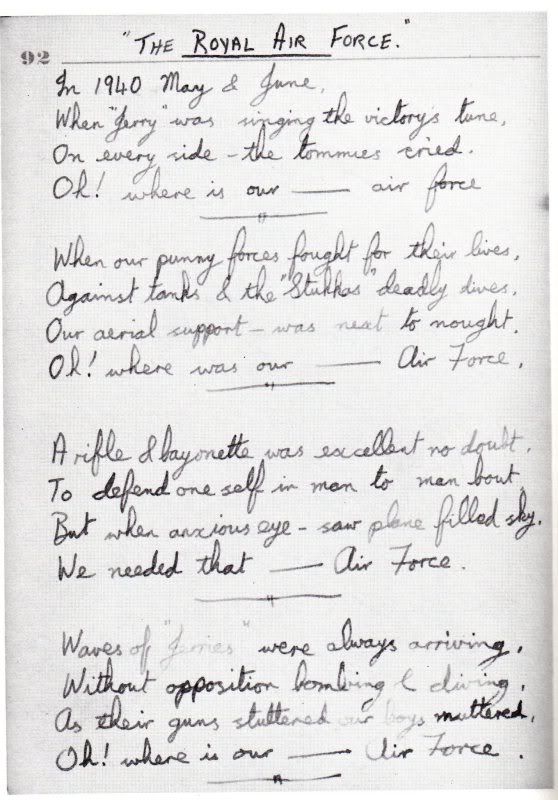
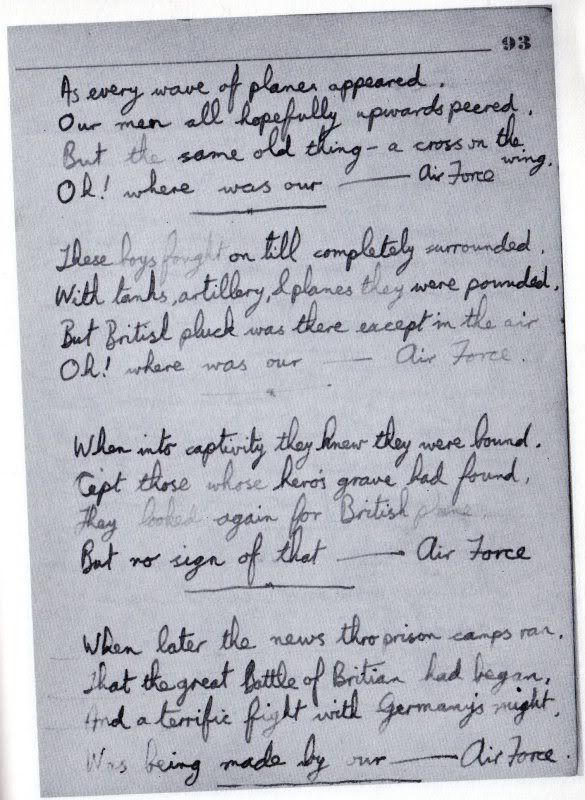
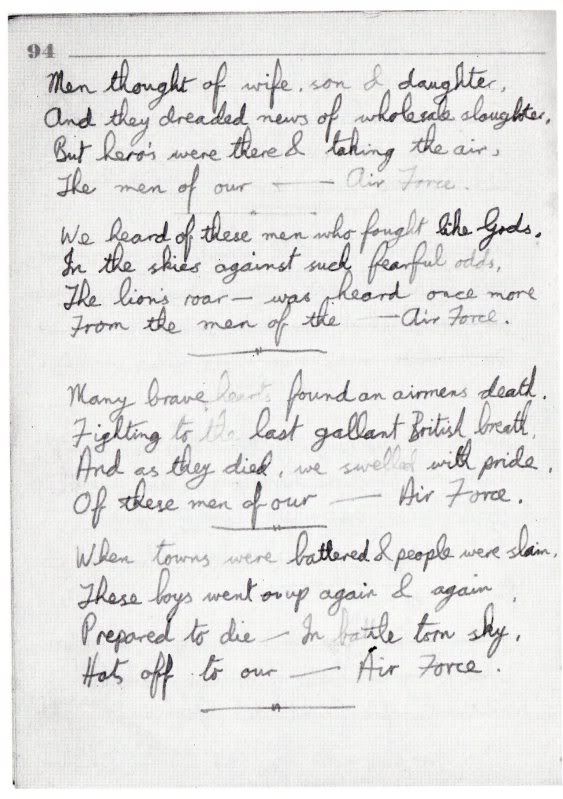
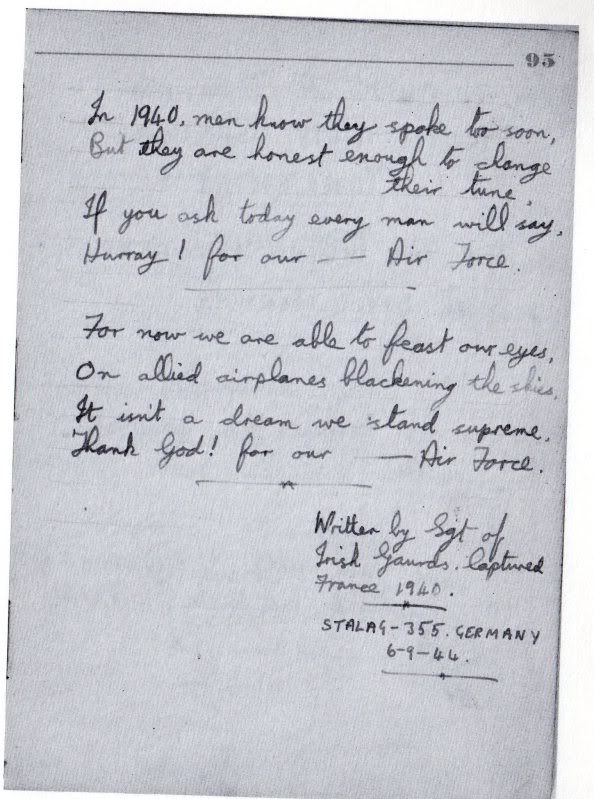
I found this poem about the RAF in a Dunkirk POW’s Red Cross “Wartime Log.”
By: thegypsy - 25th September 2011 at 13:29
War Poetry
THE BOMBER PILOT TO HIS LOVE
Light me a candle in your window, sweet,
And let it burn as brightly as our love;
However thick your curtains and complete
Your blackout, I shall see it from above.
Though high the space and long the distance stretch
Between myself and that far, flickering light,
Its flame shall be my lodestar and will fetch
Me homewards through a century of night.
I’ll set my course upon your lonely bed
And on your heartbeats my direction steer,
While like a star will shine avove my head
That glow of faith, that challenge to your fear.
Keep warm your arms, and when the invading ice
Licks at our leading edge it will recall
Only their warmth and that rich benefice
To which I am inducted after all.
Sleep long, sleep sound, and dream while I am gone
Of happiness past and yet to be
When this moon-crazy interlude is done
And we can live and love at liberty.
But if one morning when you awake you see
The flame has died like dreams that fall apart,
Light me a candle for my memory
And let it burn for ever in your heart.
Flt Lt O C Chave 1912/1943 XV Squadron killed night of 14th Feb 1943
One of the poems in Winged Victory ,Poems of a Flight Lieutenant by Ariel
By: kev35 - 24th September 2011 at 00:30
Here’s another which might be mildly appropriate for this time of year.
SPITFIRE SONG.
The soft murmur of voices drifts on the dawn
As the aerodrome wakes for another morn.
Fuelled and armed, they wait at their stations,
The Spitfires flown by men of all nations.
British, Frenchmen, Czechs and Poles
Most of them young and yet all of them old.
The pilots assemble down at dispersal
Almost as if it’s just a rehearsal.
Now there’s time to sit and wait…
Will Jerry be early or will he be late?
Some sit in silence, locked deep in thought
Trying to remember the lessons they’re taught.
Then the telephone rings, an innocuous sound,
Yet up from their deckchairs the pilots bound.
Always ready they never gamble
On whether it’s routine or if it’s a scramble.
This time it’s breakfast brought down from the mess,
But most of the pilots couldn’t care less.
As the morning wears on and the sun rises
Games and horseplay become their disguises.
Then the bell rings – again and again,
This time it’s the real thing – “pukka gen!”
The pilots clamber into their kites,
Fasten the harness – pull the straps tight,
Plug in the R/T, turn on the sight…
“God, I hope I’ve done everything right!”
Now, as one, all twelve Spitfires move
As though they’re running along a groove,
Then they take flight with a final roar
The squadrons Spitfires are off to war.
The airfield returns to a state of calm
Time for erks to relax in the suns golden balm.
The Spitfires climb southwards, clawing for height
They’ll need the altitude if they’re to fight.
The controller’s voice comes clearly through…
“Mongoose leader I have trade for you,
One hundred plus bandits heading your way!”
The pilots turn to meet their prey.
Climbing and turning, their backs to the sun,
“Tally Ho!” called as they dive on the Hun.
Calmly the enemy hold their formation
To strike at the heart of this island nation.
Down they dived, engines screaming,
Opening fire, their tracers streaming.
Heinkels and Dorniers returned the fire,
Their tracers arcing as if held by wire.
A blinding flash, a Heinkel explodes!
The bombers haphazardly release their loads.
Red three jinks wildly, searching behind,
He never saw the one-oh-nine
That crept up behind him and showered him with lead,
As the first shells hit him he was already dead!
The formation is scattering, leaving stragglers behind,
Crews dead and wounded, maimed and blind.
The Spitfires are through, regrouping en masse
Hoping to make another pass.
They curve in again to attack from the beam,
Tracers hit engines, cause glycol to stream.
Over their headphones there’s excitable chatter,
Barely heard as machine guns clatter.
“I got one! A flamer-look at the blighter!”
“Cut out the noise and watch out for the fighters!”
Blue two’s on his own as he makes an attack
On one of the stragglers falling back.
The Heinkel fills his armoured screen,
Its surfaces dappled black and green.
He picks out an engine and sets it alight…
There’s no return fire-it can no longer fight.
He sees the gunner slumped over the guns
As oil from the engines streams and runs.
He flies past the bomber and turns to see
If he can claim a victory.
The Heinkel force-lands in a farmer’s field,
Shedding pieces of wreckage, aluminium and steel.
Blue two climbs to rejoin the fight
But there’s not another aircraft in sight.
Now he checks ammunition and fuel –
Both of them low, not enough for a duel.
He searches for landmarks to guide him home,
Hands shaking, mouth dry as a bone.
Looking for churches, railways and rivers,
Soaked in sweat he can’t stop the shivers,
Then in the distance he sees the ‘drome
Thank God for that! Almost home.
Down on the ‘drome, the erks hear them coming
In twos and threes, their Merlin’s humming.
The sibilant song of the wind through the gunports
Gives them warning a battle was fought.
Into the circuit, wheels and flaps,
Down and stopped, undo the straps.
Jump down from the cockpit and walk away
Erks rush to make sure the Spitfire’s okay.
The pilots gather to see who’s returned –
Greene got out but he’s badly burned.
Smith was last seen heading for France
Chasing a straggler who hadn’t a chance.
“Who was Red three? I saw him go down…
His kite was burning when it hit the ground.”
No one remembered the new pilot’s name
Who died in action the day he came.
His car remained parked by the mess for a week,
Bags still packed upon the back seat.
Not that people were heartless or didn’t care,
They just didn’t have the time to spare.
Three times more that day they were scrambled
And against incredible odds they gambled.
As night drew near and they stood down at last
They had time to reflect on the day that had passed.
Twelve had assembled that morning at dawn,
Only eight would be there to face the morn.
The C.O. (an old man of thirty-two)
Takes them down to the pub for a pint (or a few.)
Time to go wild, let off some steam.
Thoughts of the day, remote, like a dream.
Back to the station, their spirits high,
Hopefully to sleep as the new day draws nigh.
“It can’t be morning! – Your clock’s not right…
It’s the middle of the bloody night!”
“It’s three a.m. sir, It’s getting light.”
“God! I think I must still be tight!”
Struggling into flying clothes
And cursing the world in the choicest prose
He steps into the cold light outside
And waits for the transport to arrive.
The chill of the air misting his breath
As he tries to banish all thoughts of death.
The soft murmur of voices drifts on the dawn
As the aerodrome wakes for another morn………
Regards,
kev35
By: BlackSwanDown - 24th September 2011 at 00:22
My initial reply to you, written just moments ago, has mysteriously vanished. I must have pushed some sort of key in error. Pity. Oh, well, it seems you must have seen it somehow or you couldn’t possibly have replied. My apologies for my technological shortcomings.
By: kev35 - 24th September 2011 at 00:10
Melissa.
It’s not a kindness, it’s just a simple truth.
Regards,
kev35
By: Sedbergh - 24th September 2011 at 00:10
Gypsy
Many thanks for the information. I will add it to my website at the next update. (Bottom of this page http://www.haddenhamairfieldhistory.co.uk/gliders.htm )
It’s so nice to find the source of such a fantastic poem.
Peter
Sedbergh
The Flying Instructors Lament was first published in Punch in 1940 and was written by then P/O O C Chave who was an Instructor at RAF South Cerney on Oxfords No 3 SFTS.
In 1942 when a Flt Lt he had a small book of Poetry published by Blackwells of Oxford named Winged Victory.Poems of a Flight Lieutenant by Ariel ( nom de plume)
He was killed night of 14th Feb 1943 when in XV Squadron flying Stirlings from RAF Bourn,Cambs on a bombing mission to Cologne.
By: Wellington285 - 21st September 2011 at 16:30
This is a poem that is on the gravestone of Pilot Officer C A Bird,
“He has wings, for as the plane dived deep,
His spirit free within the realms of space,
On new found wings flew with a swiftier sweep,
Fearless and laughing, to the throne of Grace”
Whilst on leave in Cheltenham on July 24th 1940 with his wife he spotted the poem in a magazine and handed it to his wife and said to her, “put that on my gravestone when I’m killed and take me back to Yorkshire”.
The following day he drove his car down the driveway of their home, stopped and returned to say to his wife “I don’t want to leave you today somehow”.
Pilot Officer Bird was killed later that day after shooting at and colliding with a Junker 88 near Aston Down.
Ian
By: kev35 - 21st September 2011 at 13:57
Surprised this one hasn’t come up at all…..
He was no Galahad, no knight sans peur et sans reproche. Sans peur? Fear was the second enemy to beat. He was a common, unconsidered man, who, for a moment of eternity, held the whole future of mankind in his two sweating hands. And did not let it go. Remember him, not as he is portrayed, but as the man he was. To him you owe the most of what you have and love today.
Air Chief Marshal Sir Christopher Foxley-Norris
Or this…..
On weald of Kent I watched once more
Again I heard that grumbling roar
Of fighter planes; yet none were near
And all around the sky was clear
Borne on the wind a whisper came
‘Though men grow old, they stay the same’
And then I knew, unseen to eye
The ageless Few were sweeping by.
Lord Balfour of Inchrye.
Regards,
kev35
By: SoGlad - 21st September 2011 at 12:18
War Poetry
My mother was a WAAF in the war and she collected poetry in a hardbacked notebook. Many of the poems on this thread are in it but this one about airmen always gets me. It was written by John Pudney in 1941 after he was caught in an air raid in London.
Do not despair
For Johnny-head-in-air;
He sleeps as sound
As Johnny underground.
Fetch out no shroud
For Johnny-in-the-cloud;
And keep your tears
For him in after years.
Better by far
For Johnny-the-bright-star,
To keep your head,
And see his children fed.
The last verse just sums up that generation for me; ‘Just shut up and get on with it.’ The same sentiment as in ‘When a Beau goes in’.
By: slicer - 20th September 2011 at 16:59
Wow, Mo, that Noel Coward poem is a real hairs on the back of your neck job. Thank you so much for posting it.
By: thegypsy - 20th September 2011 at 16:34
War Poetry
Sedbergh
The Flying Instructors Lament was first published in Punch in 1940 and was written by then P/O O C Chave who was an Instructor at RAF South Cerney on Oxfords No 3 SFTS.
In 1942 when a Flt Lt he had a small book of Poetry published by Blackwells of Oxford named Winged Victory.Poems of a Flight Lieutenant by Ariel ( nom de plume)
He was killed night of 14th Feb 1943 when in XV Squadron flying Stirlings from RAF Bourn,Cambs on a bombing mission to Cologne.
By: kev35 - 20th September 2011 at 13:05
This is a cracking thread Dave.
I’m sure somewhere in the mausoleum which is euphemistically called my front room I have some stuff sent to me by veterans. I’ll see if I can dig it out.
Regards,
kev35
By: Mo Botwood - 20th September 2011 at 12:45
And one from Noel Coward:
Lie In The Dark And Listen
Lie in the dark and listen.
It’s clear tonight, so they’re flying high –
Hundreds of them: thousands perhaps,
Riding the icy moonlit sky –
Men, machinery, bombs and maps,
Altimeters and guns and charts,
Coffee, sandwiches, fleece-lined boots,
Bones and muscles and minds and hearts,
English saplings with English roots
Deep in the earth they’ve left below.
Lie in the dark and let them go.
Lie in the dark and listen.
Lie in the dark and listen.
They’re going over in waves and waves,
High above villages, hills and streams,
Country churches and little graves,
And little citizens’ worried dreams.
Very soon they’ll have reached the bays
And cliffs and sands where they used to be
Taken for summer holidays.
Lie in the dark and let them go.
Theirs is a world we’ll never know.
Lie in the dark and listen.
Lie in the dark and listen.
City magnates and steel contractors,
Factory workers and politicians,
Soft, hysterical little actors,
Ballet dancers, reserved musicians,
Safe in your warm, civilian beds,
Count your profits and count your sheep,
Life is passing above your heads.
Just turn over and try to sleep.
Lie in the dark and let them go.
There’s one debt you’ll forever owe.
Lie in the dark and listen.
Noel Coward 1943
John B
By: Frazer Nash - 20th September 2011 at 09:40
Supreme and Proud
We had no common bond
Save that of youth.
No shared ambition
Except to venture and survive.
Until, aloft within that roaring fuselage,
Each dependent on the others
We found in war’s intensity
Good cause to say with pride in later years,
To those who chronicled the great events,
We flew in Lancasters.
(author unknown)
By: Halcyon days - 16th September 2011 at 23:30
Came across this one only today-whilst doing some research
on my own air gunner Uncles service history.(who was himself only 20 when he was killed) so I found it very moving and somehow personal.
My brief sweet life is over, My eyes no longer see.
No summer walks, no Christmas Trees, No pretty girls for me.
I’ve got the chop, I’ve had it, My nightly ops are done.
Yet in another hundred years, I’ll still be twenty-one.
So run the words on the 50 and 61
Sqns’ memorial at Skellingthorpe.
Written by air gunner
Sgt R W Gilbert,
By: slicer - 16th September 2011 at 20:42
I remember hearing a very moving poem about a bomber crew on Radio 4’s Poetry Please programme some years ago. I wish I had followed up the details, anybody recall it?
By: Sedbergh - 16th September 2011 at 19:56
Wartime Air Force Poetry
I have two; obviously based on the same theme.
The first from the logbook of George Cliff, a tug-pilot with the No1 Glider Training School, (author unknown). The second is by Vernon Willis of the ATA. Both have a RAF Thame connection.
THE FLYING INSTRUCTORS LAMENT
Woe and alack, misery me, I trundle around in the sky,
And instead of machine – gunning Nazis, I’m teaching young hopefuls to fly.
Thus is my service rewarded, – my years of experience paid,
Never a Hun have I followed right down, nor ever gone out on a raid
They don’t even let us go crazy, – we have to be safe and sedate,
So it’s nix on inverted approaches, they stir up the C.F.I.’s hate.
For it’s Oh, such a naughty example, and what will the A.O.C think?
But we never get posted to fighters – We just get a spell on the Link!
So it’s circuits and bumps from mornin ‘till noon, and instrument flying! till tea,
“Hold her off, give her bank, put your undercart down – you’re skidding, you’re slipping” – that’s me.
And as soon as you’ve finished with one course, like a flash, up another one bobs,
And there’s four more to show round the cockpit and four more to try out the knobs.
But sometimes we read in the papers, of the deeds that old pupils have done,
And we’re proud to have seen their beginnings, and shown them the way to the sun.
So if you find the money and turn out the ‘planes we’ll give all we know to the men,
‘Til they cluster the sky with their triumphs, and burn out the beast from his den.
ODD ODE, An instructors lament.
Those of us who were at Thame,
A grass airfield of Harvard fame.
From dawn to dusk, seven days a week,
As instructors worked – no ‘gongs’ to seek.
Training our pupils for fighters fast.
Sighs of relief …. ‘first hurdle’s past!’
The school boss, Derek Pickup,
Saw things through without a hiccup.
His crew I state with modest pride;
ETTMPFG , the drill applied.
Let’s name a few who did their best
To pass their pupils with zeal and zest’.
‘Nobby’ Pearmund, Willis, ‘Fitz: and Coutts.
‘Popsy’ Leonard, Lambert – no line shoots!
So spare a thought for instructors flying
Rewarding work, ‘though sometimes trying.
Their names won’t be in the Hall of Fame
But they don’t care; They played the game!
Go back to Thame all these years on.
Pupils, aircraft, all have gone,
Now no Harvards can be found
But wait, there, on the breeze, a sound
An airscrew, set to ‘Pitch Full Fine;
Ghosts of school kites on the line.
Now long grass and weeds abound
This wartime, flying training ground.
So think awhile of days long gone.
Youth flees, but memories live on.
The poem above was sent to me by Derek Pearmund, son of ‘Nobby’.
Vernon Willis passed away in 2004 before we found out he had written this.
By: SqL Scramble. - 15th September 2011 at 18:39
Although not an ‘Air Force’ poem in its strictest sense, this poem will, however, always be synonymous with RAF Tempsford and its close association with Voilette Szabo and S.O.E.
The life that I have
Is all that I have
And the life that I have
Is yours
The love that I have
Of the life that I have
Is yours and yours and yours
A sleep I shall have
A rest I shall have
Yet death will be but a pause
For the peace of my years
In the long green grass
Will be yours and yours
and yours
By: SqL Scramble. - 26th September 2004 at 14:38
The poem is based on an actual incident. The Bailey in the poem was 2nd Lt. William R. Bailey of the 305th Bomb Group, 422nd Bomb Squadron. On July 4, 1943, Bailey was the navigator of a B-17 flown by 1st Lt. Frank W. Scott. Scott’s B-17 was hit and set on fire. Seven crewmembers were able to parachute from the flaming B-17. One of those parachutes was burning. However none of the crew survived. The plane was at least five miles out to sea and even those who parachuted safely must have drowned. Based on an investigation that took place after the war, the entire crew was determined to have died that day.
One Chute Burned
by MacKinlay Kantor
Up there on oxygen,
Up above everywhere,
Ten of you trained and projected for bombing,
Wrapped in your mission and in dural metal;
Eighth Air Force Bombers–the Heavy Command
Secret the numbers of wing and of squadron:
Busy with guns . . . Let us open the breeches
Of the big fifties, the hardy machine guns–
Let us go back to the Gunnery School.
First Position Stoppage:
Failure to feed,
Failure to fire,
(Did you burn up, Bailey?)
Broken the striker,
Broken the firing pin
Or broken the firing pin extension,
Or broken the belt-holding pawl arm.
Faulty ammunition,
Faulty this or that:
A broken sear;
Something jammed or broken;
The good clean steel
That never before had broken, and now broke
And let that single Messerschmitt come in.
No one at fault. Not you.
Not another one of the gunners,
Nobody back at the base,
None of the ground crew,
No one who helped you vicarious–
No one who helped you victorious–
Nor the man nor the woman back in the States
Who constructed that piece for the gun.
(Did you burn, was it you,
The chute on fire?)
So this is the way: I shall tell how it happened.
As others hard-eyed of the squadron observed.
Now, wisely I will tell you, young Bailey, I tell you
You could never observe, you were busy as hell!
Still flying behind is such perfect formation,
Not far from the wing tips of others that flew–
The bombing run done, and the bomb bay wide open,
The black bursts puffing in patterns beneath–
Down into that mix-up, that mangled illusion
Where dozens of bursts had already appeared.
Then the swoop, and the fighter deflecting on in–
O swift like a fish, he is trout coming in,
Drawn taut by the line of his own tracer bullets–
An M E-One-Ten, with his two motors mooing–
And so he got in, and he put all his Twenties,
He put his death into the B-17.
So you turned, lazy-daisy, all ten of you people,
The living and dead, with four motors asleep,
And one of them stringing its wet wash of flame.
(Did you burn, and if not you, who was it that burned?)
Flame hanging across, torn behind you in laundry:
Slips of fire, skirts, scarfs and a kerchief of flame.
While everyone else went away, went away,
Still keeping invincible in their formation,
Conducting their way by immutable rule.
And you gentlemen turned, jumbled round; the ball turret.
Transformed to mid-upper. And endless you hung there
Before the B-17 started down.
Did you burn, did you burn up, O Bailey the Kid?
One of you went with all haste to the ground.
Seven white parachutes, now morning-glories
(Lilies of France on the Fourth of July
Over Nantes, the poor city. O lilies of France,
O sorrowing prisoner, swallowing tears.)
The chutes they were magic and fair morning-glories.
But one was on fire–a little flame chewing,
Eating the glossiest silk of the chute.
Who was it had waited not near long enough?
Who let his hand tremble too eager and wild?
Who managed his handle too soon, so the cord
Tossed open the fabric to kiss the high fire?
Somebody’s chute was a little red rose–
Somebody’s chute and his life were a crumple,
Little black crumple, all the way down
Twenty-two thousand feet deep into Nantes.
Six of you wistful and six of you sailing,
Sailing and swinging,
All the way down, four full miles to the ground.
Bailey, who burned?
This is the way that I think of you always:
Cocky and walking untrammeled and quick.
This is the way I shall see you forever,
Tough face and monkey mouth wrinkled and pert.
Leather arms swaying, you walk at the base;
Dingy gold bars on the loops of your jacket;
Childish forever you swagger and sing.
Always your cot with its rumpled gray blanket.
Always your pin-ups with lingerie leer,
Always your silken-limbed blondes on the wall,
Always your tongue running loose, and some
Fellow hauling you off to bed on your fanny,
All the way down to the floor with a bump.
All the way down
To that checkerboard Nantes!
(Tell me, O Bailey, who burned?)
All the way down to the barbed wire fences–
You, who said, “Heil!” for a comical greeting–
Down to the Achtung! And Blitzspiel you gabbed.
Six of you drifting, three dead in the ship,
Or battered so badly they couldn’t bail out,
And another, lone flower, aburning.
Somewhere forever among the cloud strata,
Somewhere aloft on the patterns and railroads,
Off there we bomb and go bombing persistent.
Off there, a Mystic, you look up and hear us–
Secret and shapeless, named Missing in Action . . .
Ask for the news and I will willingly tell you:
Driscoll has salted down twenty-two missions;
Webb has done his, he is through, he is home–
Drawling tall Webb, with his souvenir pistol,
He is alive and is gone back to Texas.
Springstun’s still with us, and Bower, and Greene.
Whisky and Whiskers are living with Greene,
Barking and wagging back under his bed;
He gives them food in an old peanut can.
Otis is with you, and with you is Scott,
With you in blankness, with you in limbo,
Bailey–who burned?
So I will think, sitting silent in Briefing,
So I will wonder in looking at maps:
How did it happen, the thing that has happened?
Now I shall utter in whispers the failures:
How did that Messerschmitt do it to you?
Second Position: the broken ejector . . .
Incorrect oil buffer setting, or bolt track
Burred and distorted to stop the smooth cartridge,
Or–Third Position–the burred cantileer . . .
Still, he came up and he burst your hot motors.
All of his shells in the nose of the gas tanks,
All of his death in your B-17.
Hitler was shouting, ten years were forgotten:
Chancellor new of the Reichstag and Reich.
You in your limitless void of Kentucky,
Played with your bombs on the Fourth of July.
Hitler remote, just a name in the papers–
Papers you never would read at your age.
You were nine, you were ten,
And you liked to read funnies . . .
Fourth of July; and you yell in Kentucky,
Shoot off your crackers and frighten the cats;
Wait for the rockets in dusk, and the candles,
Sparklers and flowerpots. Then you would sleep.
(I did not know you from Adam, Child Bailey,
Ten years ago.)
Then you would sleep with your yellow hair mussy–
Dream of the finger you fried with torpedoes–
Dream of the cap pistol popping so proudly,
And the cherry bombs burst in the garden . . .
Old Mrs. Allen . . . you frightened her cat
Ten years ago.
Go to sleep in the past,
Bailey the Kid, on the Fourth of July.
But where sleep you now with the imps in your spirit?
And who was it died in the B-17?
And who was it dented the deck with his nostrils,
When his parachute blossomed with flame over Nantes?
Over Nantes, over France on the Fourth of July,
Bailey . . . who burned?


 Sign In








 September 25, 2004 at 9:09 am