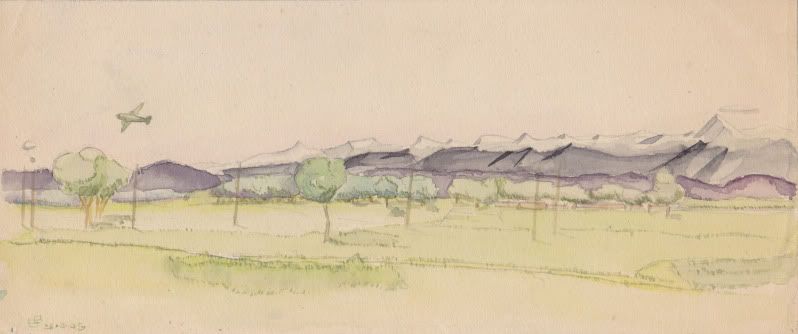
I’ve had this watercolour for a few years now and have always liked it. I think it came from someone who served in the Far East. The initials look like S B to me and it is dated April 1945. The aircraft is obviously a Dakota doing a supply drop. It has the look of a painting that was done in the field as it were.
Question really is if it was painted on the date given and depicts an event of that date or shortly before, where would British units in the Far East be at that time and which RAF units were engaged in supply drops at that particular time?
Regards,
kev35

By: Rogier - 23rd December 2011 at 21:53
You can also ask on this site:
http://www.artconversation.com/questions/
The aircraft shape might be a red-herring. ERIC RAVILIOUS painted occasionally the composition of an aircraft – not an actual identifiable type.
By: Dave Homewood - 23rd December 2011 at 03:42
Best source for the role of the RNZAF men is the NZTEC online copy of New Zealanders with the Royal Air Force
That is NZETC, or New Zealand Electronic Text Centre. The Official Histories there are indeed an excellent source of info, but there’s a lot more out there too.
By: Dave Homewood - 22nd December 2011 at 10:53
Hi Kev,
This is an aside but you may find it of interest. I posted it into a thread we have running on the Wings over New Zealand forum about RNZAF War Correspondent Dorothy Cranstone the other day after coming across it on Papers Past, as she is likely to have been the author of this great article (her husband told me she used to fly on missions with the RNZAF and RAF guys in India-Burma when she could).
Evening Post, Volume CXXXIX, Issue 30, 5 February 1945, Page 6
(Does anyone have more details of this all kiwi crew and their squadron?)
BURMA SKY TRAIN
ARMY FED BY PLANES
NEW ZEALANDERS’ PART
(R.N.Z.A.F. Official News Service.) AIR COMMAND, South-East Asia, February 3.
Battling their way over precipitous mountains and across the jungled plains of north-west Burma, the Fourteenth Army has been almost entirely dependent on the Royal Air Force for supplies. Nowhere in the world is an army contending with such difficulties of communications. New Zealand airmen are playing their part in the solution of the problem.
Operating across the trackless jungle covered ranges, far from any port or railway, building roads and countless bridges as they go, units of the Fourteenth Army have been incessantly fed from the sky by supply-dropping aircraft of the Eastern Air Command. The aircraft maintain a constant goods tram service. This requires skilful flying, especially in the monsoon weather when clouds shroud the mountains and gorges which the aircraft must negotiate before pin-pointing their valuable cargo on to tiny targets.
Today, New Zealanders flew on a supply-dropping mission to our forward troops now closing in on Mandalay. Briefed for a dawn take-off their aircraft was one in a long line flying up out of the famous Imphal Valley, where last year our forces were besieged by the Japanese for three months. Flying at 6000 feet, the aircraft crossed through heavily forested ranges into Burma. Just at sunrise, it flew over the fabled Chindwin River and came down on to the forested foothills and later the plains and paddy fields of north-west Burma. From then on, the aircraft flew at tree-top level to avoid enemy fighters.
FANTASTIC PAGODAS.
Fantastic golden-spired pagodas flashed past. Smoke rose from cosy Burmese villages. Patrolling Spitfires raced ahead. Here a constant menace to low-flying aircraft are the innumerable large birds which hole the planes if hit and often cause disaster.
A tall, fair New Zealander, Flying Officer S. W. Hamilton (Frankton Junction), was piloting one of the Dakotas, and he pointed out the scenes of fierce earlier battles. Braced against the wind at the hatch, three New Zealanders pushed the piles of parachuted cargo out. In all, the aircraft made 12 runs over the dropping zone. Later, the aircraft landed on a dusty airstrip near Shwebo and disembarked food for the troops in that area.
Skimming home over the tree-tops, streams of aircraft were passed. They were all maintaining this sky-train supply service. Flying back into the the ranges towards tiny mountain-girt Imphal, is reminiscent of the Hutt Valley. The Dakota flew for miles beside that marvel of military engineering, the 7000 ft climbing Tamu Road: Suddenly the wireless operator, Warrant Officer P. J. Henricks (Redwoods Valley), made a quick gesture. The hitherto carefree members of the crew snatched up their sets of earphones and listened with intent faces. Dance music was coming over from Los Angeles.
Other New Zealanders in the crew were Warrant Officer L. H. McNamara (Maunganui, North Auckland) and Warrant Officer A. T. Davies (Tauranga).
http://rnzaf.proboards.com/index.cgi?board=Wartime&action=display&thread=14865
By: beachcomber - 22nd December 2011 at 09:58
watercolour
Hi Kev
Looking at the picture I think you are right it was painted in the ‘field’ by someone who has some training in the art of watercolouring. Looking at the picture correct me if I am wrong but it appears that there is no white in the painting something a trained or taught water colourist would do. Having painted water colours in the field I can tell you it is a difficult thing to do try to imagine being in the artists shoes. I can having painted in a similiar situation remember Burma (if that is the location) March-May is the hot dry season temperatures 30-35C are common. So it would be very uncomfortable for the artist when painting and you have to keep the paper wet not easy in that climate. Water colouring is the art of layering colour over colour using the transparency and pigment to achieve results it is not an easy medium. It takes me back to the times spent in the Greek Islands.
Mike
By: JDK - 22nd December 2011 at 09:16
As we can’t see the markings it may not necessarily be an RAF aircraft.
Indeed. It could be a USAAF, or any of the Commonwealth operators as well as RAF.
Do you have any other details on the painting?
By: Moggy C - 22nd December 2011 at 08:43
and which RAF units were engaged in supply drops at that particular time?
As we can’t see the markings it may not necessarily be an RAF aircraft.
It’s a wonderfully emotive painting Kev, full of the atmosphere of the moment in a way that a more ‘technical’ painting can never have.
Moggy
By: JDK - 22nd December 2011 at 06:41
Neat item, Kev, nice to have. Taking a different tack to Don’s help, on the chance that it’s a work by an official war artist, using the catalogue ‘Shared Experience, Art & War’ which covers the work of official war artists of Britain, Australia and Canada, the only listed artist whose initials match is the Australian Stella Bowen, who AFAIK, was never in the far east. However that’s an exhibition catalogue, and far from comprehensive of artists.
It does seem to me to be a competent work, pleasing in its own right, and may be a sketch by a skilled amateur or (as above) by an official war artist. I’d certainly suggest contacting the art department of the Imperial War Museum and see if it matches up with anyone or anything they have.
HTH,


 Sign In








 December 21, 2011 at 3:05 pm