Hi, I am new to the forum and would appreciate any insight on the following. Thanks in advance.
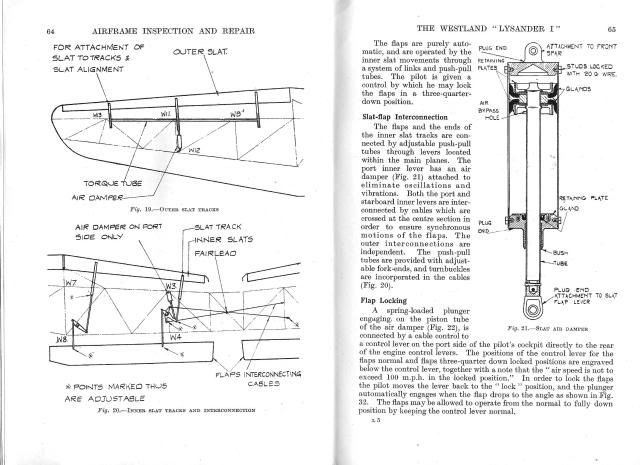
Does anyone know how the auto flaps/slats were mechanized or connected together? A simple sketch would be great. Or a link explaining same? Thanks
And if this is such a good idea, why was it not adopted on any other aircraft, to my knowledge?
“The aircraft has been fitted with a remarkable slat-and-flap system that allows very slow flight indeed, down to an equally low stall speed. Full-span slats, in two sections on each wing, extend automatically as wing incidence increases. The outer slats move individually, but the inners are interconnected and are arranged to extend automatically with the flaps. Consequently, as airspeed is reduced, or when more lift is required as the pilot pulls into a turn, the outer slats extend, followed, if necessary, by the inner slats and flaps. As speed is increased, or incidence reduced, the slats (and flaps) blow in to provide a clean wing…The wing changes shape as required to provide the pilot with the most efficient wing profile for the ambient flight conditions. What’s more, it is achieved by good aerodynamics and not digits as we have to do today… More importantly, the pilot can never forget to lower the flaps for landing, nor can he forget to retract them before the limiting speed is reached after take-off. It is all done automatically, leaving the pilot to look after more important things.”
The above come from PilotWeb.
Blue skies,
Tom
KCMA

By: Airbedane - 19th March 2009 at 06:31
JDK pointed me towards this thread and asked if I’d like to comment.
First, thanks for the kind words and also the quotes. Looking at what’s already been posted, I can’t add anything else of use. On the other hand, I have learned a lot about the Lysander, which has added considerably to my own archive! For example, I’d not seen the drawings before!
Please keep the thread going,
Andy Sephton
(Airbedane)
By: TommyN - 18th March 2009 at 13:19
Thanks for those photos; they are great!
Blue skies,
Tom
By: low'n'slow - 18th March 2009 at 11:40
No problem James……
I’ll trade you some more of your pics of Hinds and Sidestrands from Bicester! 😉
By: JDK - 18th March 2009 at 01:09
Low&Slow; great stuff. I’ve seen similar drawings in the AP, but not the tech write up. I’d be most interested in high-res versions, I’ll PM my e-mail, if that’s OK. I’ll have to be slow to find a pic more often! 😀
I’ve been able to check my notes.
The flap/slat lock was a temporary early item on a few aircraft and the prototypes only. However the mentioned ‘air damper’ stayed, I think through production.
From my book:
Ferry pilot H. A. Taylor wrote; “…the slots and flaps did not, as one might have expected, come into action when pulling out of a dive, or, except at very low speeds, in tight turns. Some of the earlier production Lysanders had a cockpit-operated slot/flap locking device to guard, no doubt, against this prospectively dangerous possibility. This was later deleted….”
Originally in Air Enthusiast Vol 3 1972/3.
Again, I think there is a temptation to regard this unique wing design as a potential problem, which isn’t the case. All the arrangement does is automatically ensures that the wing maintains lift to a lower speed than one without would do. There are no comments I’ve found that touch on it except to say that anticipated issues didn’t eventuate.
Attached are a couple of photos. One shows the Shuttleworth machine in its previous scheme, with the slats and flap deployed.

The other is of the Canadian Warplane Heritage aircraft, showing the mechanism. Leading edge (solid) to the right.

HTH.
By: bazv - 17th March 2009 at 21:24
Because the flap/slat system was a little unusual it probably took some getting used to,most aircraft had at least 1 or 2 ‘idiosyncrasies'(had to spellcheck that one :D) to get familiar with.
In ‘Fly and Deliver’ Hugh Bergel says,presumably on his first flight on type, that he arrived in a series of giant steps (as the system opened and closed) at the bottom of which he hit the aerodrome.Not having a trainer ,or indeed any training on type meant a steep learning curve.
He also says that otherwise the a/c was enjoyable and easy to fly.
‘We Landed by Moonlight’ by Hugh Verity
and
‘Black Lysander’ by John Nesbit-Dufort
were written by operational Lysander pilots and are both really interesting books.
regards baz
Sorry…I should have made it clear that H Bergel was an ATA ferry pilot and therefore his introduction to the exact approach technique was probably non existant…I would hope that RAF pilots converting to type would at least have had a briefing on the flap/slat system and operation of the tailplane trim during an overshoot (go around).
cheers baz
By: TommyN - 16th March 2009 at 19:38
Thanks; this is really great info and the type of detail for which I had hoped.
Interesting to see that there was a flaps-lock at 3/4 position deployment with Not to Exceed 100 mph at this position.
Thanks again. Tom
By: low'n'slow - 16th March 2009 at 16:10
Came across these drawings and explanations in a 1938 Newnes Airframes technical manual. Hope they might be of interest……….

By: JDK - 16th March 2009 at 12:57
Andy Sephton is a qualified test pilot. On that basis, while he can’t bring a period approach and attitude to the aircraft, his views are precise.
I too would like to read more contemporary accounts, but they’re rare. (Thanks to Baz for the suggestions – I absolutely agree.) Those I’ve seen just don’t see it as an issue, although as Baz said it was an idiosyncrasy. IMHO, pilots are an incredibly conservative bunch, greeting each development in aviation (except ‘faster’ ) with massive scepticism. If it was a byway rather than a mainstream development, however valid, then it is really disliked – see Bv141, Rutan types, etc.
W.W.II types were far less ‘standardised’ in handling than modern types as well of course, with all that that implied.
There was a dual-control training Lysander made, but as the RAF didn’t use type-trainers pre-war, they didn’t know what to do with it.
Your theatrical effort appreciated. 😉 The contemporary insight is fascinating isn’t it? Can you let us know the chap’s details?
Working on the pic hunt!
By: bazv - 15th March 2009 at 15:56
Because the flap/slat system was a little unusual it probably took some getting used to,most aircraft had at least 1 or 2 ‘idiosyncrasies'(had to spellcheck that one :D) to get familiar with.
In ‘Fly and Deliver’ Hugh Bergel says,presumably on his first flight on type, that he arrived in a series of giant steps (as the system opened and closed) at the bottom of which he hit the aerodrome.Not having a trainer ,or indeed any training on type meant a steep learning curve.
He also says that otherwise the a/c was enjoyable and easy to fly.
‘We Landed by Moonlight’ by Hugh Verity
and
‘Black Lysander’ by John Nesbit-Dufort
were written by operational Lysander pilots and are both really interesting books.
regards baz
By: TommyN - 15th March 2009 at 15:22
It would be great to get some “actual pilot” views. Yesterday at our EAA Chapter meeting, we had an 88 year young PBY Catalina pilot give a presentation of his combat missions in the WWII Pacific theatre (I spelled theater that way for you guys ). He did a great job with lots of interesting pictures. He would fly up rivers on the islands and land and pick up Aussie coast watchers. Really inspiring.
By: JDK - 15th March 2009 at 08:18
Hi Tom,
Not got to a pic yet, will do. Yours do show it; in the wing picture behind the diagonal rib with lightening holes.
As to the ‘un-natural’ nature of the idea, not at all. All aircraft have to operate within the laws of aerodynamics, and choose which extra aids they use and how they take advantage of them. Not only isn’t it a bad idea, as Andy’s account points out, the pilot can’t stuff up lowering or retracting the flaps as often happens on pilot-operated examples.
I don’t have a specific period comment on the system by a pilot of the 1930s or 40s; however I do have accounts of other problems, such as the tailplane and the second prototype shedding the upper wing fabric in flight – the test pilot saving the aircraft (and himself). The other problems were discussed and dealt with. This wasn’t either a problem at all, or not a big enough problem to get comment.
HTH.
By: TommyN - 13th March 2009 at 14:26
I was joking in my prior post. If you enlarge the photos significantly you can see this mechanism. But the whole scheme seems like a bad idea to me. It’s seems like you are flying the plane via indirection. I wonder if anyone actually knows an experienced older (as in WWII) pilot that can comment as to how natural the auto slat/flap system was? Did they fly the plane to make it do what they wanted or fly the plane to make the slats/flaps do what they should? Blue skies, Tom.
By: mike currill - 13th March 2009 at 12:45
It is a unique system on a production type – Andy Sephton wasn’t aware of any other when I specifically asked. The quote’s absolutely correct as a description.
As Mike says there are numerous types with airflow-actuated mechanically moving slats – but only on the Lysander does that slat deployment also deploy the flaps.
The Lysander’s flaps can’t be lowered by any other means than slowing down and / or increasing the angle of attack.
There is a mechanical connection between the slats and the flaps through the wing, think two interconnected levers. The flap widget is cleverly hidden in the aft upper strut root. I’ll try and find a photo.
An inexperienced Lysander pilot would allow the airspeed to cross back and forth over the flap deployment speed on descent, with the flaps being deployed by the slats and retracting, with the result that descent would look like the aircraft coming down the stairs. Apart from that finger-trouble issue, why it’s not been used elsewhere, I don’t know.
Talking about an approach that looks like it’s going down stairs, I knew a helicopter pilot who flew like that (in gliders too). It sounds like a very sensible idea to me. I guess that would mean that to do a flapless landing in gusty conditions you would have to keep the speed up and accept a longer landing roll as a necessary evil.
By: TommyN - 13th March 2009 at 03:02
Some pictures…
Given the explanation, I can almost see the mechanism in these pictures.
By: TommyN - 12th March 2009 at 14:22
Thanks; appreciate your attempt to find a photo on this…
Blue skies,
Tom
By: JDK - 12th March 2009 at 10:16
Andy Sephton wrote a comprehensive review of flying the Shuttleworth Lysander and on its flap and slot system, which is in the ‘Pilots Note archive’ section on the Historic Aircraft Association website.
Looks like our original quote was ~ah~ based on Andy’s words…
A point clear in Andy’s account (also published elsewhere, and similar published in my book, by him) is that the Lysander had some nasty characteristics, mainly due to the tailplane being the trim system, and in fact Harald Penrose was reluctant to sign the prototype off for production in this form – which was IIRC at least the second mod version – but there was a war coming and the ‘new’ RE-8 was going to be needed in numbers over the Western Front again…
By: low'n'slow - 12th March 2009 at 10:08
Andy Sephton wrote a comprehensive review of flying the Shuttleworth Lysander and on its flap and slot system, which is in the ‘Pilots Note archive’ section on the Historic Aircraft Association website.
This link should take you straight to it:
http://www.haa-uk.aero/pilots-notes-detail.php?pn-id=9
By: JDK - 12th March 2009 at 10:01
It is a unique system on a production type – Andy Sephton wasn’t aware of any other when I specifically asked. The quote’s absolutely correct as a description.
As Mike says there are numerous types with airflow-actuated mechanically moving slats – but only on the Lysander does that slat deployment also deploy the flaps.
The Lysander’s flaps can’t be lowered by any other means than slowing down and / or increasing the angle of attack.
There is a mechanical connection between the slats and the flaps through the wing, think two interconnected levers. The flap widget is cleverly hidden in the aft upper strut root. I’ll try and find a photo.
An inexperienced Lysander pilot would allow the airspeed to cross back and forth over the flap deployment speed on descent, with the flaps being deployed by the slats and retracting, with the result that descent would look like the aircraft coming down the stairs. Apart from that finger-trouble issue, why it’s not been used elsewhere, I don’t know.
By: mike currill - 12th March 2009 at 08:01
Highly interesting. I know the slats on the Bf-109 were automatic but I don’t think they were connected to the flaps. The more common interconnect is flaps and ailerons. was not aware that the slats and flaps on the Lysander were interconnected


 Sign In








 March 11, 2009 at 12:59 pm