According to what I know. Can ATGM against a ship or helicopter: Spike-ER missiles, Kornet and Javelin
AAM against ground targets. AAMs AIM-9X (Being developed)
Ashm against tanks or ground targets: RBS15, BrahMos, TASM (Tomahawk anti-ship was converted), YJ-85 (converted from YJ-82 anti-ship missiles) and Exocet Block 3
SAM against surface targets: S-300F, RIM-67

By: blackadam - 1st November 2014 at 02:53
No warship has armor as thick as the heaviest tank frontal arc arrays- they would weigh far too much.
But that would not be an issue. The HEAT stream of typical ATGMs has a relatively “short” reach. Warships have many spaced decks and bulkheads and hull layers.
HEAT warheads are meant to penetrate a really dense small array, not the great amount of space warships have to absorb a hit.
Further the stream is really localized, so unless someone happened to be right behind the hull where it hit….it probably wouldn’t do anything.So yeah, no ATGM used today is anywhere near big enough to do anything substantial.
All we know the modern warship designed not as durable as WW2 warship shells or MBT. Take a look at the level of ATGM piercing
AT-14 RHA 1000–1300 mm
AT-16 Wicher-M 1200 RHA mm
TOW2A 1000 mm RHA
AGM-114 >> 900 mm RHA
ERYX >900 mm RHA
HJ-8 > 800 mm RHA
HJ-9 1100 – 1200 mm RHA
HJ-12 1100 mm RHA
Spike-ER 1000 mm RHA
And remember always comes HEAT warhead with a blast, just 5-10 ATGM focus on one target it will have devastating greater than 1 quantity of explosives used to bomb the USS Cole
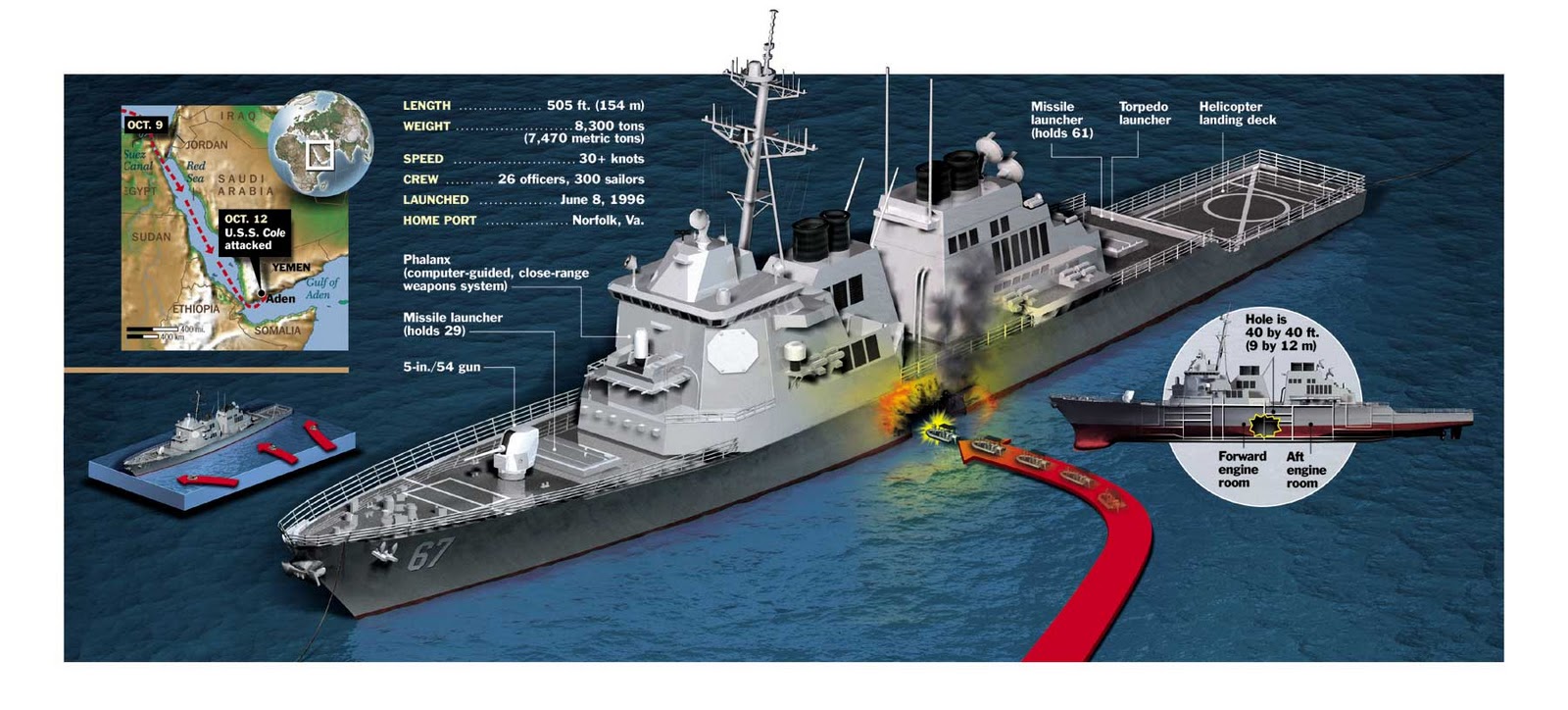
By: blackadam - 1st November 2014 at 02:37
The Sensor Becoming the Shooter
After decades of relying exclusively on laser and GPS for precision attack, the military and US special operations community is slowly opening to consider Electro-Optically (EO) guided weapons, gaining strike precision at extended range. In a recent test conducted by NAVSEA, six Spike EO guided missiles were launched from an USV-PEM unmanned boat, engaging targets 1.9 nautical miles (3.5 km) away. Such capabilities will further develop as EO guidance techniques become feasible and affordable, relying on matured image processing techniques, Micro-Electro Mechanical Systems (MEMS), miniaturized imaging sensors, navigation and communications derived from commercial off the shelf technologies.
This trend is correlated with a shift in military focus, from traditional linear battles toward asymmetric warfare. Different from the hardened, well-protected and distinct military targets of the past that could be neutralized by massive penetrating warheads today’s targets are vulnerable, yet illusive. They lack distinct signatures pursued by automatic target recognition, but are clearly recognized by the human operator, hence, bringing back ‘man in the loop’ control. Such control has been realized as imperative for modern asymmetric warfare, facilitating maximum flexibility in seizing short term opportunities while eliminating engagement of innocent people which the enemy often use as ‘human shields’, when briefly exposed in the open.
Outside the USA EO guided missiles became much more popular, with the Israeli Spike missile with its four variants leading the way for more than 20 armies worldwide, including the largest forces in NATO. Spike was developed and produced by Rafael Advanced Defense Systems. This weapon offers the most advanced level of EO guidance, dubbed ‘4th Generation’. The Israeli Tamuz – also known as Spike NLOS, was fielded by the IDF two decades ago, became the first land-based missile to strap a thermal imaging sensor to enable the operator to ‘see’ the target from the missile’s point of view. For the first time, the lengthy and complex ‘sensor to shooter’ coordination cycle was reduced into minutes and seconds.
Subscribe or Log-in to Defense-Update read the full version of this analysis
The Spike developer RAFAEL considers the system should maintain its development course as an EO system – enhancing the system through the improvement phased improvements – introducing Miniature Electro-Mechanical Systems (MEMS), large matrix imaging sensors and versatile actuating systems enabling manufacturers to drive weapons cost to the level of laser guided weaponry, shrinking the size to introduce smaller and lighter precision weapons, and enabling the warfighters on land, at sea and in the air to carry out their missions much more effectively, while remaining safe at stand-off distance.
Spike LR Missile launched from a Typhoon weapon station on an Israel Navy Super Dvora Mk 2. A similar configuration was recently tested by the US Navy, from an unmanned surface vessel (USV-PEM). Photo: RAFAEL
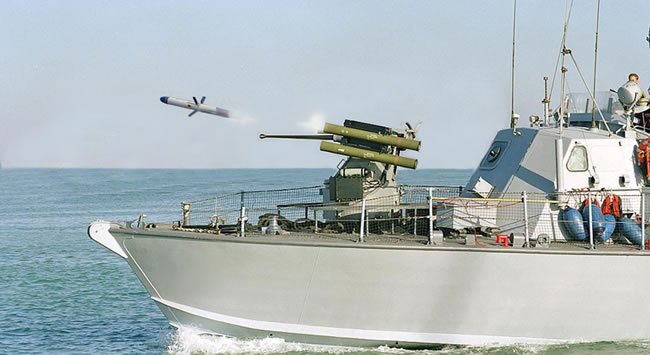
Spike LR Missile launched from a Typhoon weapon station on an Israel Navy Super Dvora Mk 2. A similar configuration was recently tested by the US Navy, from an unmanned surface vessel (USV-PEM). Photo: RAFAEL
http://defense-update.com/20121031_the-sensor-becoming-the-shooter.html#.VFRHL8k2SZ8
By: bring_it_on - 16th July 2014 at 06:12
But at what cost 🙂
By: MadRat - 16th July 2014 at 05:59
Without a doubt Standard missiles can strike tanks. Back in 1982 when the USS New Jersey was pounding a Syrian tank column it ran across my mind that one Standard shot was roughly one HE round from a battleship… only guided. Someone in the USN long before that time knew that, too, as almost every ship borne SAM has been dual-role. Standard shots are basically flexible delivery packages ranging from anti-missile to anti-ship to precision strike. In an emergency it can be an anti-submarine weapon. With its GPS, laser gyro, and programmable fuse; one missile does it all.
By: Jinan - 23rd April 2014 at 08:19
1982 invasion of South Georgia aka Battle of Grytviken, part of the Falklands War
Date: 3 April 1982
Location: Grytviken, South Georgia Island
Result: Argentine victory; Argentina seizes control of Leith Harbour and Grytviken.
Belligerents: United Kingdom Argentina
Commanders and leaders: Keith Paul Mills Carlos Trombetta
Strength 22 marines v. 1 Antarctic Survey ship w. 60 marines, 1 corvette, 1 Antarctic Survey ship
Casualties and losses: 1 wounded, 22 prisoners / 3 killed, 9 wounded, 1 corvette damaged, 1 helicopter shot down
The invasion of South Georgia (Spanish: Operación Georgias), also known as the Battle of Grytviken, took place on 3 April 1982, when Argentine naval forces seized control of the east coast of South Georgia after overpowering a small group of Royal Marines at Grytviken. During this engagement, ARA Guerrico was hit by small arms fire and 84 mm Carl Gustav anti-tank shells from a distance of 550 metres. More than 200 small arms rounds hit the corvette. The shooting killed one seaman and injured five others, damaging electrical cables, the 40 mm gun, one Exocet launcher and the 100 mm mounting. ARA Guerrico lost 50% of her firepower due to combat damage and had to spend three days in dry dock for repairs.

[ATTACH=CONFIG]227586[/ATTACH]
[ATTACH=CONFIG]227585[/ATTACH]
[ATTACH=CONFIG]227587[/ATTACH]
By: swerve - 21st April 2014 at 23:07
Sweden and Norway have used Hellfire for coastal defense for decades.
USN uses SM2 against air and surface targets.
Its a matter of proper guidance, fuzing and warhead effects against the target of choice.
Indeed.
The first ATGM adapted for use against ships that I know of was the French SS.12/AS.12. It was very heavy for an ATGM, at 76kg, with a 28kg warhead. For anti-ship use it was fitted with a delayed action SAP warhead which would penetrate thin armour such as the side of a ship then travel on for up to two metres before exploding. It’d do minor damage to a large ship unless one was very lucky indeed, but could be effective against small vessels.
It was fitted to helicopters & FACs, so not restricted to coastal use.
By: swerve - 21st April 2014 at 23:06
Ashm would not work against tanks, because their radar will not work for small targets on land. They are too big and not agile enough to find their way to a small tank. ATGM can be used against ships, because the are bigger than tanks and their guidance system works well against ships too. AAM works not well against land targets or ships because their search device is not made for such kinds of targets.
Depends on the missile & the seeker. Some of them have IIR seekers, not radar, & some are meant for use against fast & relatively agile targets such as FACs. They’re not all great big things: consider Sea Skua, for example. It’s smaller & lighter than the AGM-65 Maverick, which has been used successfully against tanks.
In theory, both IIR & radar seekers should be programmable to identify tanks as targets.
By: xena - 18th April 2014 at 15:06
I agree. But ATGMs can be used against small ships in coastal regions, not against big ships.
By: TR1 - 17th April 2014 at 08:13
No warship has armor as thick as the heaviest tank frontal arc arrays- they would weigh far too much.
But that would not be an issue. The HEAT stream of typical ATGMs has a relatively “short” reach. Warships have many spaced decks and bulkheads and hull layers.
HEAT warheads are meant to penetrate a really dense small array, not the great amount of space warships have to absorb a hit.
Further the stream is really localized, so unless someone happened to be right behind the hull where it hit….it probably wouldn’t do anything.
So yeah, no ATGM used today is anywhere near big enough to do anything substantial.
By: blackadam - 17th April 2014 at 07:58
Sweden and Norway have used Hellfire for coastal defense for decades.
USN uses SM2 against air and surface targets.
Its a matter of proper guidance, fuzing and warhead effects against the target of choice.
Sweden and Norway have used Hellfire for coastal defense for decades.
USN uses SM2 against air and surface targets.
Its a matter of proper guidance, fuzing and warhead effects against the target of choice.
Thank 🙂
Maybe HEAT ammo could against the warship hull ! Modern ships like the CG-47 class ships or the Aegis system fitted similar in design weight reduction. Therefore, they do not focus on armor, but for the Russian warships, they still focus on armor, I was reading the Kirov Battlecrusier class has 100mm armor hull on both sides, inside protected some place with 50-76mm armor …..

BQM-74E penetrate the hull USS Chancellorsville (Ticonderoga class)
By: xena - 17th April 2014 at 00:51
Ashm would not work against tanks, because their radar will not work for small targets on land. They are too big and not agile enough to find their way to a small tank. ATGM can be used against ships, because the are bigger than tanks and their guidance system works well against ships too. AAM works not well against land targets or ships because their search device is not made for such kinds of targets.
By: djcross - 15th April 2014 at 15:54
Sweden and Norway have used Hellfire for coastal defense for decades.
USN uses SM2 against air and surface targets.
Its a matter of proper guidance, fuzing and warhead effects against the target of choice.


 Sign In








 April 15, 2014 at 7:26 am
