Does anyone here have, or know of, a list of the squadrons that bombed the town of Cassino in Italy, and the benedictine Monastry atop of Monte Cassino, in March 1944?
Were the squadrons involved all USAAF? Or was the RAF also involved? Does anyone have a breakdown of the actual units, and the numbers of aircraft taking part?
Did the bombers have USAAF or RAF fighter escort?
Thanks.

By: Dave Homewood - 29th June 2010 at 13:30
The mysteries of the Kittyhawk photo are now completely solved thanks to the good folk on the WW2talk forum here
http://www.ww2talk.com/forum/italy/26973-downed-aircraft-cassino.html
By: Dave Homewood - 26th June 2010 at 10:59
Thanks for those thoughts James. Does anyone else have info to offer on this P-40?
By: JDK - 23rd June 2010 at 04:56
Interesting thread.
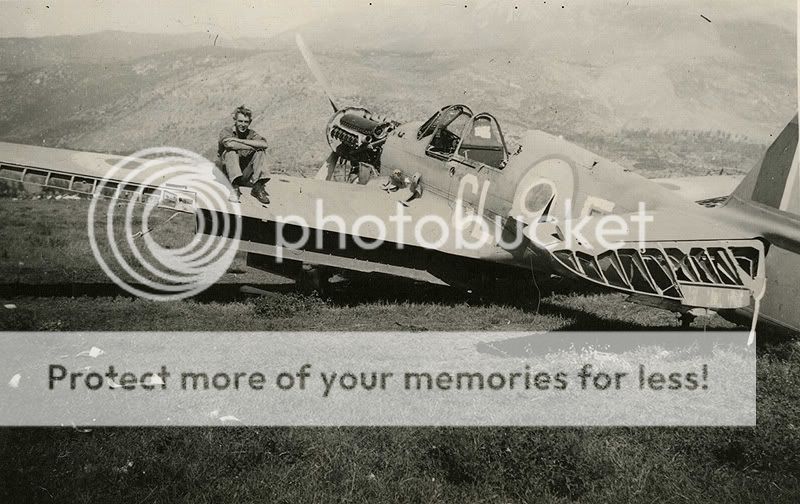
Looks like a P-40N (or RAF equivalent) going by the open rear to the canopy area.
‘GL’ gives 185 Squadron according to Delve’s Sourcebook of the RAF and a couple of other non-squadron units, while ‘CL’ is ‘SF Little Risslington’. Delve gives 185 as equipped with Hampden, Kittyhawk and Anson; the Squadron histories I’ve found talk about (after the Hampden period) Hurricanes and Spitfires, but in the right area and period and on ground attack, which is what Commonwealth P-40s were being used for. Also I don’t think Delve’s book covers non-RAF unit codes, so it could be SAAF, say.
HTH!
By: Dave Homewood - 23rd June 2010 at 03:15
I’m scanning some wartime photos from a soldier who was in Italy and came across this. On the back he’s written “Spitfire that was forced to land at Cassino aerodrome whilst still in Jerry hands”.
It’s actually a P-40 I’m sure and obviously photographed after the aeroplane was recaptured. But does anyone know what the story was? Where was the German aerodrome at Cassino for a start? Which squadron did this belong to? Is it RAF or SAAF? What happened to the pilot? Any details?
By: Dave Homewood - 11th June 2010 at 23:56
Thanks for the details guys.
By: oscar duck - 11th June 2010 at 23:54
The following information is drawn from “Air War Over Italy” by Andrew Brookes.
“Between 09.25 and 10.05hrs on the 15th February a force of 142 B-17’s (37 from 2nd Bomb Group, 35 from 97th Bomb Group, 38 from 99th Bomb Group and 32 from 310th Bomb Group) dropped 387 tons of 500lb general purpose bombs and 66 tons of 100lb incendairy bombs on the abbet buildings and courtyrads from heights between 15,000ft and 18,000ft. Within the hour a further 87 B-25’s (from the 321st and 340th Bomb Groups) and B-26’s (from 319th Bomb Group) added their contribution of 283 1,000lb bombs.
On the 16th the Desert Air Force launched 72 Kittyhawks in poor weather to continue the bombardment. Only 40 reached the Abbey to drop 14.5 tons of 500 and 1,000lb bombs. The next day 51 Kittyhawks bombed the abbey. Five groups of Mustangs and Kittyhawks bombed the abbey again on the 17th february between 16.00 and 17.00hrs, but the weight of bombs for both days only totalled 23.5 tons.”
Some snips from the USAAF Chronology website.
http://paul.rutgers.edu/~mcgrew/wwii/us … eb.44.html
TUESDAY, 15 FEBRUARY 1944
MEDITERRANEAN THEATER OF OPERATIONS (MTO)
STRATEGIC OPERATIONS (Fifteenth Air Force): In Italy, around 100 B-17s bomb the Monte Cassino Benedictine Abbey. 60+ B-24s attack the Poggibonsi marshalling yard, Campoleone and Porto d’Ascoli; heavy cloud cover causesnumerous aborts; all the missions are unescorted.
TACTICAL OPERATIONS (Twelfth Air Force): In Italy, B-26s and B-25s bomb the Monte Cassino Benedictine Abbey in support of the New Zealand Corps assault to establish a bridgehead across the Rapido River S of Cassino; other B-26s bomb the railroad at Monte Molino and marshalling yard at Montepescali; A-20s attack motor transport, roads and road junction in the Albano Laziale area and NW of Valmontone; P-40s bomb concentrations near Cisterna di Roma and dumps in the Valmontone and Rocca di Papa areas; A-36s hit concentrations N of the Anzio beachhead, strafe trucks and barracks in the Frosinone-Rieti areas, bomb the Tiburtina and Trastevere marshalling yards in the Rome area and hit buildings N of Velletri.
WEDNESDAY, 16 FEBRUARY 1944
TACTICAL OPERATIONS: ….. P-40s attack Monte Cassino Abbey, pound tanks, trucks, and troop concentrations along the US Fifth Army front, and hit the towns of Fondi and Roccasecca.
THURSDAY, 17 FEBRUARY 1944
TACTICAL OPERATIONS …. A-36s bomb Monte Cassino Abbey in the only air action on the US Fifth Army main front.JamesL
Member
RAAF 3 Squadron Kittyhawks bombed Monte Cassino..
On 16 February 1944, the day after the contentious destruction of Monte Cassino, Eaton took No. 3 Squadron through a break in the bad weather to attack the ruined monastery, the only one of No. 239 Wing’s units to successfully bomb its target that day.
——————————————————————————–
By: Richard gray - 11th June 2010 at 17:57
Seems different nos from different scources.
Wiki says.
The bombing mission in the morning of February 15, 1944 involved 142 B-17 Flying Fortresses together with 47 B-25 Mitchell and 40 B-26 Marauder medium bombers. In all they dropped 1,150 tons of high explosives and incendiary bombs on the abbey, reducing the entire top of Monte Cassino to a smoking mass of rubble. Between bomb runs, the II Corps artillery pounded the mountain.[33] Many Allied soldiers and war correspondents cheered as they observed the spectacle. Eaker and Devers watched; Juin was heard to remark “… no, they’ll never get anywhere this way.”[34] Clark and Gruenther refused to be on the scene and stayed at their headquarters. That same afternoon and the next day, in an aggressive follow-up, further artillery barrages and additional tonnage onto the ruins by 59 fighter bombers convulsed the rubble of the great abbey.
By: Atcham Tower - 11th June 2010 at 17:31
I have a small book which I bought at the reconstructed monastery some years ago. It is The Bombing of Monte Cassino by Bradford A Evans, publ 1988.
The devastating attack on 15 Feb 44 was carried out by 36 B-17s each from 15th AF’s 2nd, 99th 301st and 97th BGs. By an unfortunate coincidence the last three of the lead B-17’s serial was 666, the number of the beast. All these details are on the Mission Ops Order which is published in the book. They were supported by 88 B-25s and B-26s of the 12th AF, units not listed. There is no mention of any Commonwealth involvement and the AAF in WW2 says that the mission was unescorted.
The 15 March 44 missions are listed in the AAF in WW2 as being mounted by 12th and 15th AFs. P-38s provided fighter cover over the Cassino area but there is no fighter opposition. Thereafter in March, only 12th AF was involved, the 15th having reverted to its normal strategic role.
By: J Boyle - 11th June 2010 at 14:42
I’d always read it was bombed by B-25s & 26s in more of a tactical effort.
That B-17s were involved is news to me…but I certainly don’t dispute it.
BTW: My father flew with the 463rd BG, though later in the war.
By: oscar duck - 11th June 2010 at 13:53
I don’t think he was as he was wounded in action around then after being shot up by Bf109 near Venice.
By: Dave Homewood - 11th June 2010 at 05:47
Thanks Oscar. Was your late father-in-law onthe actual Cassino raid? And if so, did he record any memories of it by any chance?
By: oscar duck - 11th June 2010 at 05:40
A typical heavy bomber group in USAAF had four squadrons each with a notional 14 aircraft strength. Missions by the group ranged from 20-40 aircraft always depending on crew and aircraft avialablity. It was not unusual to have 50%+ losses due to combat/accidents etc. on a single mission.
By: Dave Homewood - 11th June 2010 at 04:49
Thanks Oscar,
Veterans I have talked with who were there recall B-25’s and Marauders as well as B-17’s. I believe around 250 aircraft took part in the raid but I have no idea how many aircrfat are in those bombardment groups, or how many squadrons are within each group.
One thing I’d particularly like to discover is if the RAF was involved, were there any New Zealand airmen above them on the raid, in bombers or as escorts.
By: oscar duck - 11th June 2010 at 04:37
Although the Boeing B-17 Flying Fortress was less important than the B-24 Liberator in the Mediterranean theatre, six Bombardment Groups did serve in North Africa or Italy, two of them serving from 1942 until the end of the war. That involvement began in November 1942 when two Bombardment Groups, the 97th and 301st, were moved from the Eighth Air Force in England to the Twelfth Air Force in North Africa. These were two of the most experienced B-17 units, and their departure from England slowed down the development of the Eighth Air Force’s offensive. In North Africa the B-17s were used against German and Italian military targets in North Africa, and to attack German shipping in the Mediterranean. Two more groups joined them in early 1943 (2nd and 99th). The four groups took part in the bombardment of the Italian stronghold of Pantelleria, the invasion of Sicily and the invasion of Italy.
Boeing B-17 over Messina Once the Allies were firmly established on the Italian mainland, the B-17 squadrons moved Italy, joining the 15th Air Force in November 1943 and making the actual transfer in December. They were joined by two more units, the 463rd and 483rd Bombardment Groups, in the spring of 1944, bringing the total up to six. At their peak there were 669 B-17 crews stationed in the Mediterranean theatre.
From their bases in Italy the six B-17 bombardment groups performed a mix of tactical and strategic missions. Tactically they supported the campaign in Italy itself, most famously bombarding the monastery at Monte Cassino,
+ my late father-in-law flew with 483rd BG in Italy..


 Sign In








 June 11, 2010 at 12:15 am