
By: Moondance - 11th March 2010 at 21:43
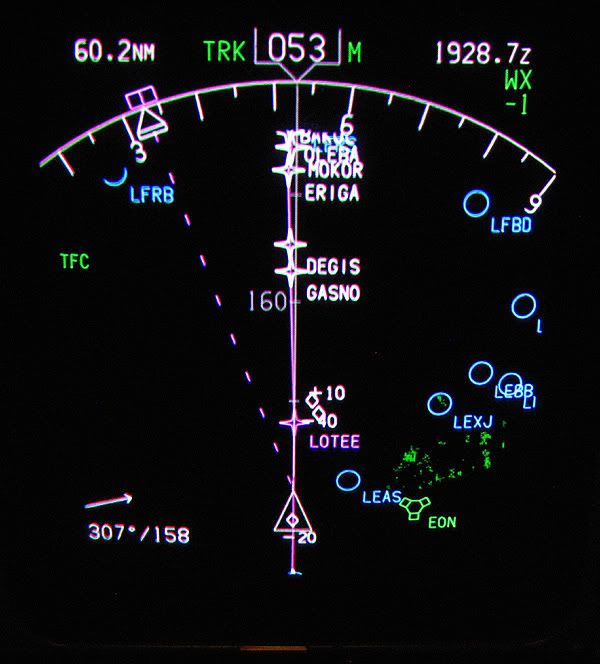
158 knots of wind, smooth as silk (and not often you see 20 degrees of drift on a jet)
By: Al - 7th March 2010 at 18:23
The high wind speeds found in jet streams aren’t turbulent in themselves – the flow can be quite laminar in the vertical and horizontal. The turbulence is caused by the shearing effect in the steep wind speed gradients found where the jet interfaces with the surrounding slow-moving air.
It’s a bit like a fast-flowing river – apart from disturbances caused by any underlying rocks in the flow, the eddies, whirlpools and turbulence are mainly at the sides, where the fast flow meets the river banks…
By: Arabella-Cox - 6th March 2010 at 11:32
Sarah
It might be turbulent aloft due to wind because of several phenomena. If the winds are near the ground they tend to follow the profile of the ground therefore will cause turbulence. If in mountainous areas such as over the Alps, this can extend up to high altitude. They are called mountain waves. Jetstreams (very high speed winds high up in the atmosphere, 35000ft +) are also usually turbulent. Try to Google “aviation meteorology” as there is still a lot more than what we have all said here.
Regards
Ralph
By: Deano - 6th March 2010 at 10:50
There is no limit to the winds aloft an aircraft can fly in. As 27vet says there will be a maximum demonstrated crosswind limit for each type. This is only the “demonstrated” crosswind limit though, meaning it’s the maximum xwind the test pilots have conducted. For insurance purposes the airline will be limited to this demonstrated xwind limit but can put more injunctions on what their crew can operate in. The a/c type I fly has a crosswind limit of 32kts, new first officers online are only allowed to land in ½ this limit until you have had the restriction lifted on your first OPC (Operator’s Proficiency Check).
There are also restrictions in place for the maximum surface wind allowed when landing, ours is gusting 55kts. There’s also restrictions on crosswind and tailwind components from contaminated runways etc.
Hope this helps
Dean
By: Arabella-Cox - 5th March 2010 at 07:01
I don’t know, but I once asked a similar question to you when I crossed the QE II bridge over the Thames in high winds.
My Renault Clio was all over the place, I don’t mind telling you.
By: sarah1980 - 4th March 2010 at 22:12
What about when you are cruising? What kind of wind speed does an aircraft normally fly in, or what is deemed as “vary fast” winds.
What kind of winds would be considered to windy to fly in?
By: Arabella-Cox - 4th March 2010 at 21:38
Maximum crosswind component for landing is between 25 – 45 knots depending on the type. But one could land in a 100 knot wind provided it is “down the runway”. I have landed with 73 knots in Cape Town, notorious for its windy conditions.


 Sign In








 March 4, 2010 at 9:27 pm