Hi all,
I was browsing through a dedicated Lancaster site the other day and came to realise that many aircraft only lasted a matter of weeks in service before being lost, with this in mind and the need to replace lost aircraft as quickly as possible, did the build quality of aircraft suffer during WW2 compared to those built before or after? I seem to remember reading many years ago that it wasn’t unknown for flying controls to be connected A about F but what about other aspects of the build, engines, airframe, wiring, etc the list goes on. Does anyone have any first hand knowledge of this and does this make restoring and running a WW2 vintage aircraft a different proposition from one built outside of this period? Cheers. Mark.

By: D1566 - 8th March 2014 at 09:37
Need help jogging my memory with this one, seem to recall reading ” the dam busters” one of the aircraft being a mare to fly everyone said it was the pilot, but turn out after a service Somethink was upside down. Someone will know on here.
^
^
^
Post 47 ? 🙂
By: Chowhound44 - 8th March 2014 at 07:31
Need help jogging my memory with this one, seem to recall reading ” the dam busters” one of the aircraft being a mare to fly everyone said it was the pilot, but turn out after a service Somethink was upside down. Someone will know on here.
By: robdd1 - 7th March 2014 at 20:04
Astir – picture and some details here, have to scroll down. Never seen this story before.
http://www.dailykos.com/story/2013/06/06/1213858/-The-hero-of-D-Day-the-Waco-CG-4A-assault-glider#
By: D1566 - 7th March 2014 at 14:56
Was there not a story in one of the books on 617 Squadron, in which Major Nick Knilans was accused of always making rough landings, until it was eventually discovered that the elevators of his Lancaster had been installed upside down? … sounds unlikely …
By: Astir 8 - 7th March 2014 at 14:42
There’s a very nasty picture of a Waco glider out there, with only one wing, about to impact vertically. I believe that it was the first out of a new factory and that the local mayor and other dignitaries were on board. Faulty wing strut assembly.
By: Richard W. - 7th March 2014 at 13:53
Surely there must have been others, but there’s only one incident I’ve heard of in the US where shoddy work caused a crash. It was a PB4Y Privateer in California that was on it’s maiden flight from the factory. The port, outer wing portion fell off and the 6 guys on board were killed.
The investigation found that it was missing 98 attachment bolts that should have been installed. Consolidated fired the 4 men who had omitted the bolts and then signed off on the inspections without performing them, and the company was found to be grossly negligent in the deaths.
The story is explained much better in this link:
By: bazv - 7th March 2014 at 12:56
Graham,
They also used to dope a piece of string on the edges of fabric covered control surfaces. Or just bend the trailing edge of a metal clad one.
Nice British engineering, and it worked.
Cees
To be fair cees- this was usually on aircraft without aileron trim tabs…so it was usual for the test pilot to ask for so many inches of trim on one side and then go flying again…often without stopping the engine : )
By: bazv - 7th March 2014 at 12:54
Were Supermarine not the first company to disperse production in a big way? Could this have something to do with the apparent quality issues? Oddly enough you dont seem to hear many stories of Spitfires that didnt fly ‘right’.
Supermarine could not cope with quantity production early in ww2 so yes the use of contractor building/shadow factories would play a part possibly – esp in the early days of shadow factory production.As Graham posted – there were a certain percentage of ‘rogue’ aircraft that had certain flying quality problems but these also occured postwar as well…certainly into the 60’s/70’s,one could see aircraft in storage with suspiciously low ‘hours’ on the airframe !
By: CeBro - 7th March 2014 at 12:47
Graham,
Yes, I remember that part. Nice pics too with the edge almost completely bent upwards They also used to dope a piece of string on the edges of fabric covered control surfaces. Or just bend the trailing edge of a metal clad one.
Nice British engineering, and it worked.
Cees
By: Graham Boak - 7th March 2014 at 12:43
Sounds a bit worrying to me – there are a lot more ways of hitting an aircraft to make it wrong than to make it right. There is a history of aircraft that were declared rogue because they could not be made to fly right. Many were scrapped, but sometimes studies found that this was due to build errors, but more often due variations in the aerodynamic shape rather than just bodged riveting. There is a story on one such example in (I think) one of the Spitfire In Action books from Ian Allan. That particular example (IIRC!) could indeed be fixed by an erk with a hammer and a block of wood, or perhaps some slightly more sophisticated equipment, but I think the key point is discovering just where and how much hammering to do.
By: QldSpitty - 7th March 2014 at 11:29
Give an Erk a hammer and a block of wood and he will make any plane fly right.
By: D1566 - 7th March 2014 at 07:35
Were Supermarine not the first company to disperse production in a big way? Could this have something to do with the apparent quality issues? Oddly enough you dont seem to hear many stories of Spitfires that didnt fly ‘right’.
By: QldSpitty - 7th March 2014 at 07:05
As noted in many Spitfire drawings..Jig drill off part 3xxxx-xx 🙂
By: bazv - 7th March 2014 at 07:01
Wasn’t there build quality problems with many Spit/Seafires made by Westland?
(When I say ‘many’ I mean in proportion to those built elsewhere. Spitfire The History is a probable source, but I don’t have it with me)
Sfunny… I always thought that Westland built Spits were of a fairly high standard !!
Also perhaps to be considered with the German aircraft quality,late in the war they were being forced out of their factories by Allied bombing etc and were building a/c in fairly primitive conditions !
By: Bager1968 - 7th March 2014 at 00:31
I vaguely recall that the Lancaster had a problem at one point with wing skins coming off due to rivets popping and the problem was traced to “tolerance build-up”. Hopefully someone more au-fait with that than me can explain it – I can’t bring it to mind at the mo.
Adrian
Simply put, it is a case where each part has a specific tolerance, and the overall assembly has a tolerance, but if all the parts are at the same side of the allowance tolerance (all on the “plus” side for example) the total of all the actual variances from the “ideal specification” exceeds the overall allowable variance.
I’ve seen it with avionics equipment where two circuit boards worked fine in different assemblies, and passed bench tests individually, but if both were put in the same unit the unit wouldn’t work.
A rivet which is at the smallest allowable shaft length/diameter & head size, installed in a hole drilled to the maximum allowable size, in a rib that is at the thickest allowed, might result in the rivet head/shaft being stressed past the breaking point – especially after a number of flights with the rivet moving around in the hole (and the wing skin shifting in relation to the rib) and wearing a grove in the shaft.
Have a series of such small rivets/large holes in the same rib and the whole section is susceptible to the whole string of rivets failing under stress.
By: Astir 8 - 6th March 2014 at 16:22
Somewhere I have seen a photo of a WWII RAF airframe fitter’s toolkit. It seemed to consist of one hammer, one chisel, one screwdriver. one “King Dick” adjustable spanner and a handheld pin vice. Not sure what you can maintain/repair with those! I also seem to recall reading that Packard Merlins came with a socket set! – but that the sergeants nicked them pronto.
By: hampden98 - 6th March 2014 at 16:07
I can recall two incidents of aircraft having controls wired incorrectly.
One was a Halifax that had the wires running the wrong way around the pulleys which would make it extremely difficult to fly (read in a book but others may recall the details).
The pilot of said aircraft was always being `ribbed` about his bad takeoffs and landings. It wasn’t until he returned from a raid badly shot up and crash landed that they found out
about the controls. It was mentioned afterwards that he was an exceptional pilot to have actually managed to fly it at all with the controls in that state.
The second was an F15 that crashed fatally in the UK because the controls had been reversed after maintenance.
By: Creaking Door - 6th March 2014 at 10:07
I noticed this relic that sold recently on eBay. It is claimed to be from Hurricane L1725 that was abandoned in cloud on 5th December 1939 and is part of an engine casting that supports the supercharger drive gears / clutches (ironically also containing the same bearing that I mentioned in my earlier post).
Anyway, the reason I posted the photographs…..just look at the state of that welding!
And that ‘ridge’ where there isn’t any welding; that’s an oil gallery isn’t it?
By: HR339 - 15th February 2014 at 19:11
Just to add some photographs to this very interesting thread, here are a couple of examples of wartime build quality from the fuselage of Mosquito TE758 (Later NZ2328). Firstly, the underside of bulkhead #6, looking up.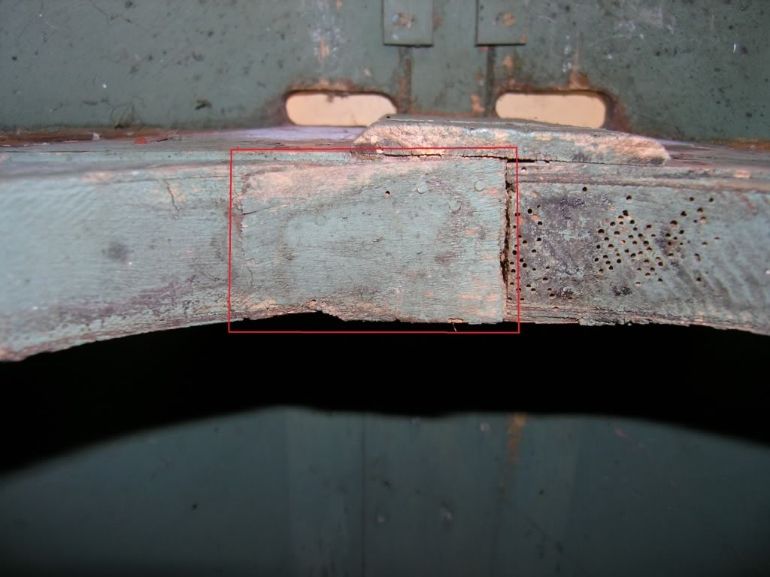
The two halves of the bulkhead are out of alignment vertically by about 1/8″ (!), so a small scrap of wood (outlined in red) has been tacked to the underside of the bulkhead and planed to the profile of the opening in the bulkhead. This bulkhead also had several sheared screws that had been hidden away under the doublers
Secondly bracket for hinge #5 – aft bomb door: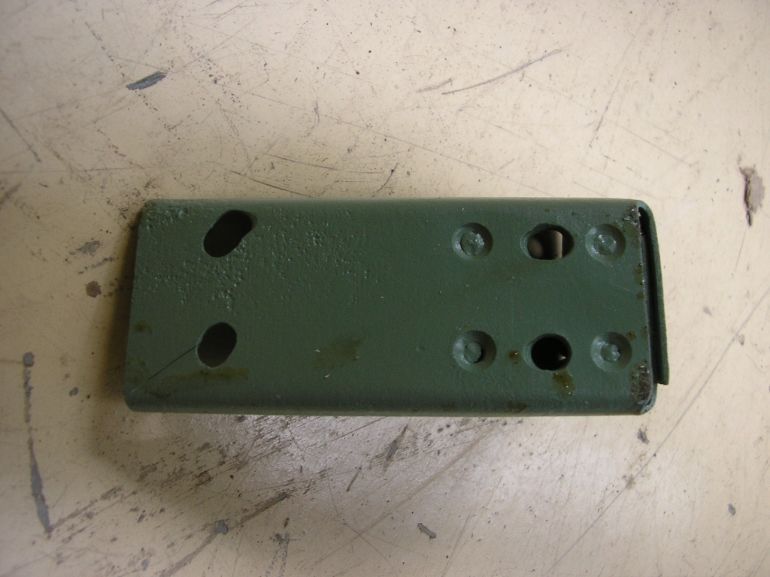
The bolt holes in the hinge bracket have been ‘eased’ to match the casting of the hinge. We are finding a lot of slotted holes in this area – perhaps indicative of a wider issue…. And yes, it got painted before re-rivetting – hard to get good help sometimes :eagerness:.
By: Avro Avian - 13th February 2014 at 11:56
Some of my experiences over the years:
Spitfires have had some of the worst workmanship I have ever seen – “wavy” freehand drilled rivet lines on fuselages comes to mind straight off.
Jig drilling from the Curtiss factory – I have seen a Curtiss Tomahawk rudder parts match drilled almost perfectly with corresponding P-40N parts – probably close to 10,000 aircraft between them.
Most Japanese aircraft I have seen were beautifully made – especially the early stuff – built like gliders – very light and easy to mess up. I saw real pride in workmanship.


 Sign In








 February 12, 2014 at 10:04 am