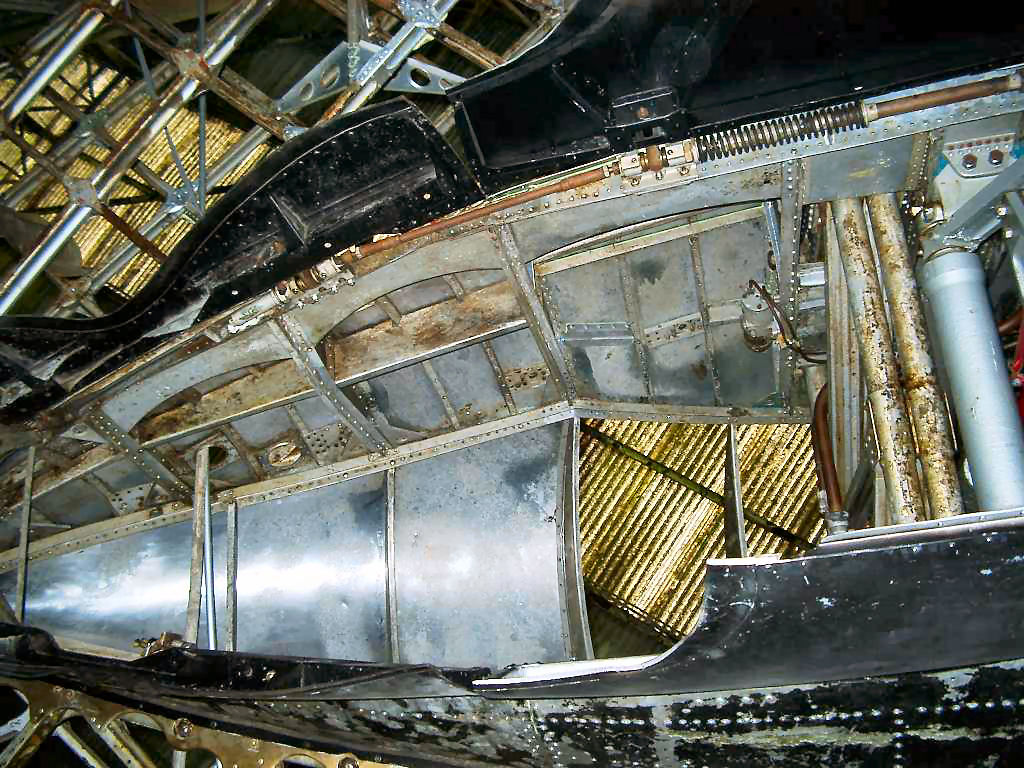
Found this in our garden it was being used as a fence panel. House is located less than a mile from RAF Alconbury, house is 130 years old.
Any help with identifying it would be great.
48” L
14″H
I’ve not yet cleaned it as I only recovered it yesterday evening.

By: FarlamAirframes - 3rd December 2024 at 15:40
wrt paint are you sure it is not a green primer with black on top as you see in rivet holes.?
Occam’s razor etc.
By: FarlamAirframes - 3rd December 2024 at 07:06
It may be a part number from the Mk1 but that does not mean it was not also used in later variants. There were many mk1 Halifax parts carried through into the later variants….only when the part was redesigned for a later mark would it have got a new part number .
By: tyler - 2nd December 2024 at 19:46
This is what I could find out so far
Bavz I found the following 408 & 409 = Wellington Ia
Here: https://www.key.aero/forum/historic-aviation/141318-aircraft-part-numbe…
“These were followed by 187 Mk IAs with Nash and Thompson turrets and strengthened landing gear with larger main wheels. Except for 17 Chester-built aircraft, all were manufactured at Weybddge.”
“Type 408 Wellington Mk IA: production version (187 built) with Pegasus XVIII engines, Nash & Thompson turrets and ‘dustbin’”
One question I have is does anyone have any photos or illustrations of Wimpys with the underside matching the colour on the found panel? As all I’ve found is the usual Black, Yellow or coastal command White.
I could only find 2 examples via IMW both from 24 squadron with a colour potentially matching the found panel. But those appear to be Wellington C.Mk XV’s which were converted 1a’s:
“Wellington C.Mk XV: service conversions of Wellington Mk lAs as transports for 18 troops.”
“The transports had their turrets removed and faired over, the bomb bay being sealed up as well, with seats for 18 passengers, and a passenger door fitted on the right. Early conversions of Wellington B.IA bombers became “Wellington Cargo Mark IA (C.IA)” transports, with later conversions being “Wellington C.XV” transports; while conversions of Wellington Mark IC bombers became “Wellington C.XVI” transports. There was also a single B.IA conversion as a “C.IX”, though details are not clear. A photo survives of a C.XVI with fake guns fore and aft, protruding from “turrets” that were painted on — how convincing this was, and if it ever did any good, is unclear.”
Does anyone know how many were converted to Wellington C Mk XV?
By: bazv - 2nd December 2024 at 11:00
Well done Farlam 🙂
408 = Mk1A ?
The Mk1A was apparently nailed together (completed) at Weybridge and Broughton.
I was trying to work out where the Inspection Stamp (LB Ltd) might have been – but there must have been hundreds (at least) of subcontractors working on parts for these aircraft.
(LB Ltd 12) would have been the personal stamp of an individual Inspector.
By: FarlamAirframes - 1st December 2024 at 08:49
I assume so. Also the Z is an N on its side.
By: tyler - 30th November 2024 at 17:38
FarlamAirframes thanks for the identification, I had just been reading a part number reference topic on here when your reply was posted.
Would I be correct in thinking it would be ID’d as a Wellington Ia due to the 408 part number prefix?
By: FarlamAirframes - 30th November 2024 at 17:14
Vickers Wellington Undercarriage door.
http://data3.primeportal.net/hangar/howard_mason2/wellington/images/wel…
Top of picture
By: tyler - 30th November 2024 at 17:09
My thought is that it could be pre late 40’s due to the diagonal/V structures potentially indicating this could be pre standardised semi monocoque design which went with the now standard practice of horizontal stringers & vertical farmers.
It reminded me of the Wellington design/structure.
The profile of the main structure is curved not flat the panel has been flattened slightly at some point in its life causing some of the formers to kink in on themselves on the skin face. The photos tend to flatten the appearance of the structure also.
By: tyler - 30th November 2024 at 16:09
2
By: tyler - 30th November 2024 at 16:03
Some photos of the panel washed and dry to try and show the exterior paint colour which seems to be a single colour that being Grey
By: tyler - 30th November 2024 at 14:15
Hello all, apologies for the delay in updating this thread the house has taken priority up to now.
I’ve managed to start cleaning up 2 smaller parts that came away from the main panel when removing it from the ground due to the rivets failing through corrosion.
1st part seems to read:
40816-33D
Z in a circle
LB Ltd 12 in another circle
2nd part seems to read:
26516 1?31 CE3
By: bazv - 7th July 2024 at 10:03
Perhaps Tyler will update us on any part numbers/inspection stamps he has found when he returns from his holiday to Mars 🙂
By: FKA Trolley Aux - 3rd July 2024 at 09:42
Also possibly around a retractable wheel underside of a wing. its not a removable panel, no fastners
By: Sabrejet - 2nd July 2024 at 13:04
Intriguing! A part that size will definitely have stamped part numbers, inspection stamps and probably inked numbering too. Needs a good clean and examination! For me it looks more 30s/40s than later than that.
By: FarlamAirframes - 1st July 2024 at 13:42
Part numbers definitely.
I have seen the V shaped reinforcing design on landing flaps – The Bucker Bestmann for example – but it was a lot smaller than this.
By: hypersonic - 29th June 2024 at 14:54
Tyler,
If you are in the Alconbury area – then you also have Upwood and Wyton close by.
The “outer” surface indicates some sort of camo colour scheme (green tint). Or is that caused by weathering?
There is no indication thus far that it is WWII vintage. It could just as well come from the 60’s or 70’s.
The oval shaped cut out would possibly indicate it comes from the wing root area, of the fuselage. If that’s true then a shallow wing root is being observed. That would indicate a relatively small sized aircraft.
As an avionics engineer I find the “V” shaped frame assembly, attached, slightly unusual. Most frame assemblies, in my experience, are vertical in their attachment to the skin. In this case they appear to be part of the structure of this section – no sign of cutting to aid removal from the airframe as a whole. This unusual design could poss be an aid to its identity. The sections flat profile (as apposed to curved) causes me concern. Flattening it out, surely would have pulled the rivets. I can’t see any evidence that has happened.
As someone has already said a Drawing No or Part No may well start the ball rolling at speed.
By: George H - 29th June 2024 at 11:03
I’m no expert on these things but Anson MK1 forward cockpit section might be a possibility.
By: bazv - 29th June 2024 at 09:41
Hi Tyler
Possibly the only way for a positive ID is to clean the panel and see if there are any part numbers/Inspection stamps etc.
regards baz
By: tyler - 28th June 2024 at 12:26
4th photo
By: tyler - 28th June 2024 at 12:24
3rd photo


 Sign In








 June 28, 2024 at 12:19 pm