 planeman6000
I think that the OTO Melara Super Rapid with Davide ammo would be a hard act to beat. For shore bombardment large calibre navalised MLRS are the way forward IMO, no way a major surface combattant should be getting within 30km of the shore to start shelling things.
planeman6000Very interesting Planeman,now the obvious question ,how long did it take you to collect and put all this information together? let alone do the drawings?
Cheers
Tiddles
One month to the day – I just looked back to check. I got a lot of info to make it possible but I reckon I’ll try smaller subjects next time around.
planeman6000[u] Conventional naval units[/u]
Some sources may not agree with numbers and minor details but overall view is pretty consistent.
Larger warships:
1 x “Soho” class missile frigate
2 x Najin class missile frigates
4 x Sariwon class gun corvettes
2 x Tral class gun corvettes
Fast Attack Craft (missile)
27 x Osa-I type missile boats
(15 x Soju Class missile boats)
(8 x Osa-I missile boats)
(4 x Huangfeng class missile boats)
3 x Chong-ju class missile boats
16 x Komar type missile boats
(6 x Sohung class missile boats)
(10 x Komar type missile boats)
Fast Attack Craft (Torpedo):
3 x Shershen torpedo boats
? x Sinnam torpedo boats
40+ x Sin Hung torpedo boats
12 x PT-6 torpedo boats
? x P4 torpedo boats (retired?)
1 x Chong Ju torpedo boat
Fast Attack Craft (Rocket)
62 x Chaho class
2 x Chong Ju class
Gun boats
7 x Taechong-I class
5 x Taechong-II class
6 x Hainan class
3 x Chodo class
18 x SO-1 class
12 x Shanghai-II class
?? x Shantou class
++
Soho class missile frigate
Dimensions: L 73.8m, W 15.5m, Displacement 1,845t
Armament : 4 x SS-N-2 Styx anti-ship missiles, 1 x 100mm main gun (crewed), 2 x AK-230 30mm AAA (automatic), 2 x twin 37mm AAA (crewed), 2 x 25mm AAA (crewed), 4 x RBU-1200 ASW rockets
Aircraft: Landing pad only, 1 x Mil Mi-17 Haze
Speed: About 25kts (highest estimate 27kts, lowest 23kts)
Built in 1983 in Najin, in service with the Eastern fleet, the infamous Soho class FFG is widely reported and listed by numerous credible sources, but few illustrations and seemingly no photos of this warship exist in Western media. An indigenous design noteworthy for its distinctive feature is that it employs a catamaran hull, the relative lack of activity and no further units suggest that it was not a success.
Najin class light missile frigate
Dimensions: L 102m, W 10m, Displacement about 1,500t
Armament : 2 x SS-N-2 Styx anti-ship missiles, 2 x 100mm main guns (crewed), 2 x twin 57mm AAA (crewed), 2 x AK-230 30mm AAA (automatic), 8 x twin 25mm AAA (crewed), depth charge rails
Aircraft: none
Speed: Est 24kts
Built in the early 1970s the Najin class is essentially the North Korean version of the Soviet Kola class light frigate, although curiously enough these were being built right about the time the Russian Navy was scrapping its Kolas. Despite their dated heritage, these ships are among the few truly ocean going warships of the North Korean fleet and have been relatively active, used as recovery ship escorts during north Korea’s ballistic missile test launches.
The original weapons fit included triple 533mm (21”) ASW torpedo tubes amidships but these were replaced by twin missile launchers and an extensively rebuilt superstructure in the early 1980s.
By modern standards these ship have extremely weak air defenses (despite bristling with AAA) and a somewhat puny anti-ship armament. It is incredible that the North Korean navy has not embraced automatic mid-caliber naval guns as has virtually every other navy.
Sariwon class gun corvette
Dimensions: L 62m, W 7.3m, Displacement about 500t
Armament: 1 x 85mm main gun (crewed), 1 x twin 57mm AAA (crewed), 4 x twin 37mm AAA (crewed, Some sources say twin 14.5mm).
Speed: 18kts
Basically an improved version of the older Soviet supplied Tral class minesweepers that are also used as gun corvettes (see below), the Sariwon is relatively limited in the modern environment. Sources conflict over the exact number built but at least some are active on the east coast.
Tral class gun corvettes
Dimensions: L 62m, W 7.3m, Displacement about 500t
Armament: 1 x 85mm main gun (crewed), 2 x twin 57mm AAA (crewed), 4 x 37mm AAA (crewed, Some sources say twin 14.5mm).
Speed: 18kts
Of pre-WWII Soviet minesweeper design, the Tral class are essentially obsolete and used for coastal patrol. Some sources suggest only one remains in service.
Soju/Osa-I type missile boats
Dimensions: L 43m, W 7.5m, Displacement 220t
Armament : 4 x SS-N-2 Styx anti-ship missiles, 2 x AK-230 30mm AAA (automatic, 2 x twin 25mm crewed AAA in some units as illustrated).
Speed: 34kts
The Soviets supplied 8 boats and North Korea locally produced 15 as the Soju class. The boats are essentially identical. Some sources, including a popular South Korean illustration of missile boats in tunnels, suggest that North Korea has Osa-II boats also but this is unconfirmed.
Type 021 HuangFeng class missile boats
Dimensions: L 39m, W 7.5m, Displacement 220t
Armament : 4 x HY-2 “Silkworm” anti-ship missiles, 2 x AK-230 30mm AAA (automatic).
Speed: 35kts
Chinese supplied variant of Osa-I design, it is not clear whether North Korea’s boats feature the improved ‘Rice Lamp’ fire control radar (see aft radome in illustration).
Chong Ju missile boats
Dimensions: L 42m, W 7.2m, Displacement 205t.
Armament: 4 x SS-N-2 Styx anti-ship missiles, 2 x AK-230 30mm AAA (automatic)
Speed: 22.5kts
Outwardly similar to the Soju/Osa-I missile boats, this design is actually a variation on the Chong Ju type. These boats are quite slow for fast attack craft but may retain the sonar of the other Chong Ju boats. If the sonar is removed, maximum speed may be increased.
Only three units were produces suggesting that it was not a huge success, or at least not a sufficient improvement over the Soju/Osa-I to warrant extended production.
Komar type missile boats
Dimensions: L 27m, W 6.4m, Displacement 80t
Armament : 2 x SS-N-2 Styx anti-ship missiles, 1 x twin 25mm AAA (crewed)
Speed: 30kts
The original Soviet missile boat design, 10 Komar boats were supplied and a further 6 locally produced as the Sohung class. These boats are dated and some may be inoperable.
Shershen class torpedo boats
Dimensions: L 34m, W 6.8m, Displacement 160t
Armament : 4 x 533mm (21 ») heavyweight torpedoes, 2 x AK-230 twin 30mm AAA (automatic).
Speed: 42kts
Although only three boats serve, these are probably the most capable of North Korea’s torpedo boats (discounting suspected unknown types).
Sin Hung light torpedo boats
Dimensions: L 18m, W 3.4m, Displacement: 25t
Armament : 2 x 450mm (17.7’’) medium weight torpedoes, 2 x twin 14.5mm AAA (crewed)
Speed: 40kts
Small and agile but extremely dated, the Sin Hung class is probably the most numerous North Korean torpedo boat and generally representative of the rest.
Chaho class rocket boats
Dimensions: L 28m, W 6.1m, Displacement 82t
Armament : 1 x 40(?) tube 122mm BM-21 rocket launcher with about 80 reloads, 1 x Zu-23 23mm AAA (crewed, bow), 1 x 14.5mm AAA (crewed, stern)
Speed: 40kts
Indigenous design, these small fast patrol boats pack a powerful punch although the accuracy and effectiveness of the rocket launcher is open to question. Interestingly three Chaho were supplied to Iran but feature a different superstructure with mast further aft, and Chinese 107mm MRLS.
Chong Ju class rocket boats
Dimensions: L 42m, W 7.2m, Displacement 205t.
Armament: 1 x 40(?) tube 122mm BM-21 rocket launcher with up to 80 reloads, 1 x 85mm main gun (crewed), 2 x twin 14.5mm AAA (crewed)
Speed: 22.5kts
Much larger than the more numerous Chaho boats, this class features a sonar although its purpose is confusing given its armament.
As with the Chaho the sources differ as to the exact number of tubes in the MRL. Reloads are stored in the bins at the rear of the boat.
Taechong-I gun boat
Dimensions: L 60m, Displacement about 250t
Armament : 1 x 85mm main gun (crewed), 1 x 57mm AAA (crewed), 1 x 25mm AAA (crewed), 1 x 14.5mm AAA (crewed), 2 x RBU-1200 ASW rockets, depth charges
Speed: 30kts
Slightly bigger and better than the previous Chinese and Russian supplied gun boats (often designed as Sub Chasers but woefully inadequate as such), the Taechong class is representative of a large number of generally similar gun armed patrol boats employed by North Korea.
Taechong-II gun boat
Dimensions: L 60m, Displacement about 250t
Armament : 1 x 85mm main gun (crewed), 1 x 57mm AAA (crewed), 2 x AK-230 twin 30mm AAA (automatic)5mm AAA (crewed), 2 x 14.5mm AAA (crewed), depth charges
Speed: 30kts
An improved version of the Taechong with noticeably improved air defences, the Taechong-II boats are probably the most modern conventional gunboats now in service with the North Korean Navy.
North Korea operates numerous other gun boats and minor units, as well as some landing ships and about 55 hovercraft.
List of Google Earth items of interest:
planeman6000Infiltration Mission
North Korea is one of the few countries publicly proven to engage in infiltration of spies, saboteurs and extraction of kidnapped civilians via its naval vessels. Mostly this aspect of naval matters is overseen by the “KWP Reconnaissance Bureau” rather than the regular navy. Primary targets are South Korea and Japan.
Although it is hard to say how much of this goes on, several craft have been captured or sunk over the years.
Type-A Basic High-Speed infiltration craft
Dimensions: L 11m, Displacement 3t
Speed: 50kts
Armament : Small arms and crew carried weapons, possibly including short range air-defence missiles and RPGs.
Probably the first type of infiltration craft used, these are disguised as small fishing boats but the upper structures are fake. Because the craft is very short ranged it has to be carried near to its target by a mother ship which is itself disguised as a fishing boat (see below).
The craft is vulnerable to detection by radar and is believed to be less commonly employed in recent years although one was captured by the Japanese in the late 1990s after its mother ship was sunk during a prolonged gun battle with Japanese Coast Guard.
Once the craft is close to the enemy shore the infiltrators land by swimming, probably aided by a small hand held underwater propulsion pack that looks like a torpedo.
Example Mother Ship
Dimensions: L 30m, W 4.5m, Displacement: 44t
Speed : 33kts
Armament : 1 x twin ZPU2 14.5mm AAA (concealed). Pedestal mount for 73mm SPG9 recoilless rifle (disguised as a winch), small arms and shoulder launched weapons (SA-16 Igla MANPAD (SAM), RPG etc).
Outwardly appearing as a fishing vessel, this craft can carry an infiltration boat in a rear hanger concealed behind clamshell doors and similar in concept to a Land Ship Dock’s (LSD) well deck.
Because the hanger is quite small non-submersible infiltration craft which are disguised as fishing boats (see above) must be assembled partly outside the hanger which makes the operation prone to discovery.
North Korea must use a wide range of mother ships some with hangers, some possibly towing their infiltration craft.
This craft is remarkably fast and has a hull not unlike a typical missile boat rather than a real fishing vessel.
Type-B Submersible Infiltration Landing Craft (SILC)
Dimensions: L 9.3m, W2.54, Displacement: 5 tons (est)
Speed: 30-40 kts surfaced; 12kts semi-submerged (est)
Range: 300nm surfaced (est)
Compliment: 3 (2x crew, 3 pax)
Armament: small arms
The first submersible infiltration craft was captured in 1983 by South Korean forces. The boat is launched from a mother ship as per the High Speed boat above, and approaches the coast at high speed. Close to the shore where radar/visual detection is most likely, the boat floods a compartment under the long foredeck and sinks to the point that the deck is awash and only the cabin is exposed.
The passengers reach the shore by swimming.
“Type-B” is not a North Korean designation. An improved version of the Type-B is reported with the cabin divided into two separate structures, one over the bridge and one over the passenger compartment. This arrangement is apparently intended to reduce the radar cross-section during the semi-submerged phase of the mission:
Type-C (SP-10H) Submersible Infiltration Landing craft (SILC)
Dimensions: L 9.3m, W2.54m, Displacement : 5 tons
Speed: 30-40 kts surfaced; 12kts semisubmerged
Range: 300nm surfaced
Compliment: 6 (2x crew, 4 passengers)
Armament: small arms
Captured during an infiltration mission in South Korea, this boat is generally the most widely reported and pictured example, but it’s generally only a minor variation on the Type-B.
Type-D Improved-SILC
Dimensions: L 12.8m, W2.95m, Displacement: 10.5 tons
Machinery: 3x 250 or 260 hp V8 (Johnson/OMC, etc)
Speed: 40-50kts surfaced, 4-6 kts submerged
Range: 200nm
Diving Depth: 3m snorkeling, 20 m maximum
Crew: 8 (4x crew, 1-2 escorts, 1-3 infiltrators)
Radar: Japanese made Furuno 1830
Armament: small arms
The I-SILC is fully submersible (i.e. a submarine) but approaches the shore at high speed on the surface like previous SILC. However, it can run almost fully submerged 3m below the surface with only the snorkel mast above the surface (the larger mast towards the rear of the boat). When not in use the snorkel folds aft to reduce the silhouette and radar signature.
In an emergency the boat can submerge completely to a depth of 20m (some sources say 25m) to avoid detection, but when fully submerged it cannot travel forward because it lacks electric motors.
Modular midget-submarine
Details: unknown
Despite its crude construction, this submarine is conceptually quite advanced; it can be dismantled and transported close to its target by larger infiltration craft.
In simplistic terms the submarine consists of a pressure vessel and three box-like floodable flotation tanks which are attached to the outside of the sub. The tanks have a boat shaped bow to assist surface running.
At least one example was captured in 1979.
SBS-2 Swimmer Delivery Vehicle
Dimensions: L 4.8m, W 0.76m, Displacement: 0.58 tons
Power: 1 electric motor, 1 shaft
Speed: 4 knots
Range: 85nm
Depth: 5-8 meters
Crew: 2
A typical wet-submarine used by frogmen, this boat is probably intended primarily for special forces strike using limpet mines.
planeman6000[u]North Korean Submarine Fleet[/u]
Note: Some submarines are assigned to reconnaissance and infiltration, for details of this mission and equipment see separate section.
22 x Type 031 (‘Romeo’) diesel-electric attack subs
4 x ‘Whiskey’ class attack/training subs (probably inactive)
20+ x ‘Yugo’ type midget subs
1 x ‘41m SSK’ diesel electric attack sub (probably inactive)
20 + x ‘Sang-O’ type midget subs
10+ x ‘P-4’ type midget subs
??+ x Other midget submarines and wet submarines
Type 031 (‘Romeo’) attack sub
Dimensions: L 76m, W 6.7m, Displacement 1,700t submerged
Armament : 8 x 533mm (21’’) torpedo tubes (6 forward, 2 aft) with up to 14 SEAT-60 heavyweight torpedoes or 28 mines
North Korea received some of these boats from China and subsequently locally produced some. Although they are relatively capable they are somewhat dated and ill suited to open ocean operations. There is no evidence to suggest upgrades.
’Yugo’ type midget sub
Dimensions: L 20m, W 2m, Displacement 90t (submerged)
Speed : 10kts surfaced, 4 kts submerged
Armament: 2 x533-mm externally-mounted torpedoes in drop gear in some variants, possibly torpedo tubes in some and none in infiltration variants.
The Yugo class is so named because it was built to plans supplied by Yugoslavia in 1965. North Korea had started an indigenous midget-submarine programme prior to that but had been somewhat unsuccessful, with a crude submarine being captured by the South in 1965 after its crew abandoned it when it was beached on a mudflat during a receding tide on the Han River:
Dimensions: L 5.7m, W 1.1m, Displacement: 3t (submerged)
Speed : 7kts (surfaces), 3kts (submerged).
Although the indigenous midget submarine appears to have been functional, it was very small and extremely limited for infiltration purposes which appears to be the primary peace-time operation for North Korean Navy.
The Yugo boats however are much larger and have room for 4-6 infiltrators and can carry torpedoes or mines for the attack role. They are relatively short ranged though so for infiltration (or attack in wartime) operations in the far south, off Japan or further away, they require transportation and launch from a mother ship.
The ships were built at Yukdaeso-ri shipyard on the west coast from the late 1960s through to the early 1980s at which time they were superceded by the generally more capable Sang-O type. Contrary to some sources, the North Korean Yugo submarine was not very similar to Yugoslavian operated midget submarines such as the impressive Velebit type.
In the early 1980s North Korea developed a much larger coastal submarine known, rather imaginatively, as the “41m boat”. No prizes for guessing the length of this submarine. It is not clear exactly what the boat looked like except that its sail is not unlike the Yugo’s in profile and that it was not a “teardrop” hull. The type does not appear to have been successful and only one is reported and it is unlikely to still be operable.
’Sang-O’ type midget sub
Dimensions: L 34m, W 3.8m, Displacement: 370t (submerged)
Power: 1 diesel, 1 electric motor, 1 shaft
Speed 7.2kts surfaced, 8.8kts submerged
Range: 1500nm
Max Depth: 150 meters
Crew: 15
Armament (attack sub): 4 x 533-mm torpedoes with no reloads (Inc Russian 53-65 ASW torpedoes)
Armament (recce/infiltration version): None. 5 infiltrators and 6 KWP Reconnaissance Bureau Cadre as passengers
Developed as a much improved follow-on to the Yugo type, the Sang-O is well known because one was captured by the South during a botched infiltration mission in September 1997. The Sang-O is much larger and longer ranged than its predecessor.
Some boats have the torpedo tubes replaced by a passenger space and diver swim-out door for infiltration and sabotage missions. The 1500nm range is useful enough to allow the boats to operate without a mother ship in most cases making them much less susceptible to detection.
Hypothetically these subs could be modified to carry anti-ship missiles or Shkval rocket-torpedoes but neither capabilities are reported.
’P-4’ type midget sub
Dimensions: L 29m, Displacement: 190t
Armament: 2 x 533mm (21’’) torpedo tubes (not fitted in infiltration version)
Another improved midget submarine design, the P-4 is smaller than the Sang-O but also seemingly more advanced. It features an unusual co-axle twin propeller consisting of a large skewed propeller and a much smaller conventional propeller; this arrangement is believed to be an attempt to reduce the submarine’s noise signature.
An example of this type of submarine was captured during an infiltration mission in 1998 and subsequently put into service with the South Korean Navy emphasizing the build quality of the boat. Interestingly the sensors of the captured boat, including the sonar, were of Japanese origin.
planeman6000Ballistic Missile Programme
Speculation continues surrounding the true and near future capabilities of the North Korean nuclear and ballistic missile programmes. There is no serious doubt that North Korea is now a nuclear power, and that they possess various forms of ballistic missiles, but the extent to which they have been able to marry the two is still somewhat contentious.
Really really brief backstory
Most of North Korea’s ballistic missiles are derived from the Soviet SCUD system which they obtained from Egypt. These missiles have been improved and ultimately resulted in crude medium/long range ballistic missiles.
Although the SCUD family of missiles could (and has in the past) been converted for naval launch (submarine or ship), they have relatively dangerous fuels that make storage and launch less robust than modern ballistic missiles.
Perhaps with this in mind North Korea has attempted to gain more modern ballistic missile technology as demonstrated by the 1993 arrest of a team of submarine-launched ballistic missile (SLBM) scientists recruited from the Russian Makeyev missile design bureau.
Also North Korea has obtained elements of R-27 (SS-N-6) technology which probably includes the solid fuels better suited to naval deployment.
Golf-II Class Ballistic Missile Submarine
Dimensions: L 98m, W 8.2m, Displacement 3553t (submerged)
Max speed: 15-17kts surfaced, 12-14kts submerged.
Ballistic Missiles: 3 x ballistic missiles, probably modified Nodong-I (related to SCUD, Nodong-I has a maximum range of about 1,300km and theoretically could be modified to carry a nuclear warhead)
Torpedoes: 6 x 533mm (21”) heavyweight torpedo tubes.
Crew: 83
Russia sold 10-12 decommissioned submarines to DPRK in 1993 with deliveries in subsequent years. The exact make-up of the delivery is open to speculation but it was widely and consistently reported to include a number of functional Golf-II class ballistic missile submarines. Generally accepted figure for Golf-IIs involved in the sale is 10.
Although Russia maintains that the submarines were to be dismantled under Russian supervision, it was widely thought that DPRK would attempt to bring one or more back into service, possibly by means of cannibalization. The Golf-IIs carried SS-N-4 ballistic missiles in Russian service.
Most observers do not believe that any of the subs have been returned to service but the possibility remains and there doesn’t seem to be any public domain evidence to confirm either viewpoint.
The north Korean Nodong-I missile is related to the SS-N-4 via the SCUD, but is about 1m longer which means that either the missile or the hull would have to be modified to accommodate it, but this is not all that far fetched.
Unlike modern ballistic missile submarines the Golf-II is a diesel-electric boat which limits its time underwater relative to other countries SSBNs but on the other hand the technology to maintain and operate these boats is well within DPRK’s means relative to nuclear boats. The submarine was designed for underwater launch of the missiles, from depths of up to 50m and speeds of up to 4kts and a firing interval of about 5minutes. Pre-launch time was about 45minutes. Even assuming lower operational specs for returned-to-service DPRK Golf-IIs with Nodong-I, we are still talking about a credible is crude SSBM capability.
Evidential leads: Sale widely reported but good source: http://cns.miis.edu/pubs/npr/vol02/21/gerard21.pdf
Armed Merchantman
It is widely speculated that a far more logical way to deploy a ballistic missile is by using medium/large merchant ships as launch platforms. North Korea operates and builds ocean going merchant ships. The missiles could be hidden amongst transport containers.
planeman6000I’m a huge fan of the artworks and speculations. Nice one!
planeman6000Yeah I could be wrong on the MD500s. DPRK is reported to operate large numbers of MD 500s though so I just saw small helicopters and said “Ahah, MD500… next…”
MD 500: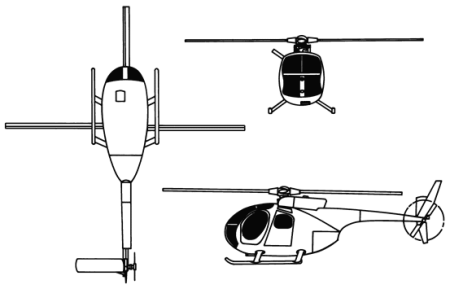
Hoplite: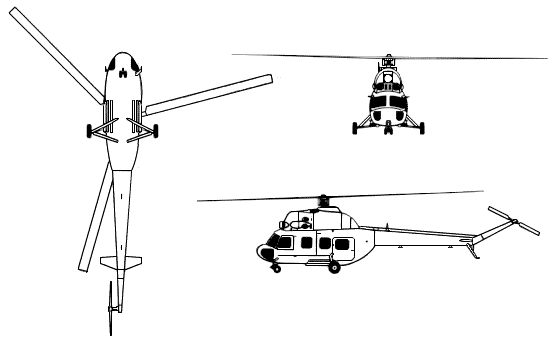
I think the three-v-four blade rotor is the determiner and I reckon these has three. Hoplite it is, …next…
BTW, Hoplite is an ancient Greek foot soldier with a long spear who fought in the Phalanx, and were the shock troops that helped Alexander the Great conquor most of the known world – a bit too cool a name for a rather impotent helicopter IMO.
planeman6000They always struck me as particularly vulnerable to enemy air defences and interception if spotted. Often their operational role will take them away from friendly air cover and dangerously close to long range SAM position, either ground based or ship board. And if the enemy has medium/long range interceptors. So if you are operating against a 2 penny enemy then cool, but against a credible enemy it must be a bit of a sucky situation to be in a slow PC-3 which doubles as a radio beacon.
Then again I’m only guessing :diablo:
planeman6000I’ve never even heard about any sthealth corvettes in North Korean navy and frankly I doupt that there is any at first place. Korean shipbuilding industry has been able to produce only the simpliest small chinese/soviet derivate vessels, biggest being the few “indegenious” frigates which are technologically around 30-40 years behind of anything modern. So I’m pretty sure that there is no shtealth corvettes…But I’m eager to hear where you have heard from this?
Well I’m not a sensationalist sort and to be honest I think a few stealth corvettes would count zip in the big picture, but as proof that DPRK can produce stealth warships, have a look at the “Tir” and “Peykaap” torpedo boats they supplied to Iran a few years back. Plus the submersible infiltration boats have been designed for radar stealth since the 1980s (not that it stopped a few being sank). I don’t want to give too much away about the “stealth” corvette except that it does appear to be stealthy and fast, but crap armament unless something is missed.
planeman6000I have a pic of the Soho, but you’ll have to wait :dev2:
Have you seen the stealth corvette Gollie? Seriously.
Also, re the 4 Huengfengs, are they C-801 armed or HY-2 armed? In fact so many questions….
planeman6000I agree with your overall assessment but I think you are in for a few pleasant surprises on some of their newer kit. Pleasant as in interesting I mean. Cheers though.
Yep Sang-O sub, one was captured after running aground. I have Sang-O, Yugo, P-4 and Iranian variant of P-4 (“Ghadir”). Also several other indiginous subs. A P-4 was also captured and is apparently now serving with ROKN in the “aggressor” role, which points to it being a decent sub in terms of build (crew safety) etc.
planeman6000Hasn’t TY-90 got a much smaller engagement envelope than SA-19? TY-90 as an AAM from helicopters has what 7km or there abouts so as a SAM without additional booster, what 5km????
planeman6000hmm, 054A does not use shtil.
Lol, hi mate. You going to lecture us on the differences between Shtil and HQ-16?
planeman6000I was thinking more in terms of SA-11/17 VLS as fitted to PLAN Type-054As


 Sign In







