 planeman6000
Two seat Indian MiG-29k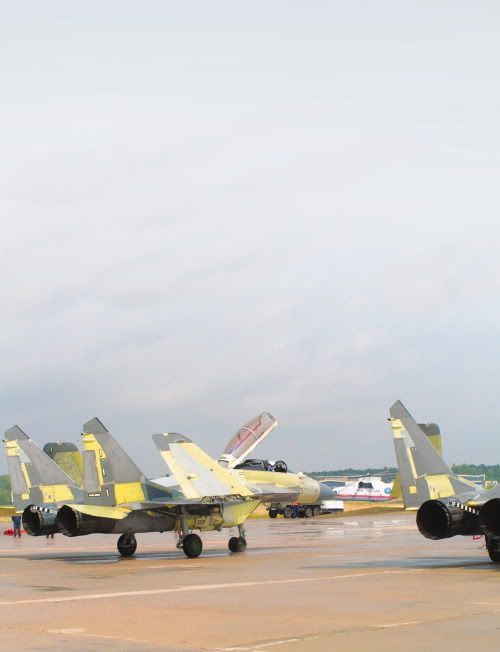
planeman6000Re Sao Paulo, I think that the Crotale was removed along with the 100mm guns. All photos of Sao Paulo show no Crotale.

And as the Foch with Crotale and 100mm DP guns
re MiG-29K yes it was not put into operation by CIS but is now re-entering production for India (albeit a much improved version). When Russian navy buys more combat jets the ‘new’ MiG-29K is probably just as likely as the Su-33.
Re Simbad, it’s very obviously inferior to the Sadral as a CIWS. Obviously they both use the same missile, but ne is crewed and the other automated, plus has more ready-to-fire rounds.
Sadral:
Simbad:
planeman6000I have a half completed missile boats comparrison to finish but I’m thinking of doing “small” carriers next. Problem is there are a hell of a lot of them so I might go into less detail and stick to the basics, plus divide into two categories:
STOVL (jet equipped) carriers
Invincible class
Cavour
Giuseppe Garibaldi
Principe de Asturias
Chakri Naruebet
INS Viraat
Juan Carlos I
USS America
Wasp class (forget Tarawa, too much same)
large through-deck helicopter carriers that could operate VTOL jets
HMS Ocean
Mistral class
Dokdo
Hyūga class
Any relevant info on any of the above welcome. Also if anyone wants to collate stats on general chractristics across the above ships that’d be great as I can’t be bothered to. Things like hanger size, command facilities etc.
planeman6000Excellent work, Planeman!
Nae Sao Paulo:
She now is fitted with two SAM twin launchers Simbad. One of the two cats is still out of order (lateral one). Never seen more than 6 A4K on board. 3 Super Etendard were on board in april-may 2004 (ARAEX). Project to fit the ship with Umkhonto SAM VLS.FS Charles de Gaulle:
Will soon have F2 and F3 Rafale M, multirole fighters. F1 version (interception) is now out of active service. Forbin DDG will be commissioned in december 2008 with ASTER 30 SAM. New shafts (probably 27 knots).AFSS Kuznetsov:
Not sure that this carrier is able to carry more than 40 aircrafts.X07
Thanks for the info. I was searching for info on whether SAMs had been added. By Simbad I take it you mean a crewed twin Mistral launcher? Why oh why oh why not at least Sadral??? And why not some of those radar guided single Bofors 40mm mounts that only Brazil seems to use?
Where abouts are the Simbad fitted?, I’ll update the relevant graphic.
Re the Rafale, it’ll be great when France does chose to deploy them in a truly multirole mode – as far as my research could ascertain only 3 strike equipped Rafales have so far actually been deployed and the Super Etendard is likely to remain as the ship’s strike platform for a couple of years due to costs. Now I agree, and I believe I commented to the effect that, France could deploy a much more potent all-Rafale multi-role air wing on the CDG at short notice if the need arose. Presumably more Rafales with strike capability enabled will deploy next time she sails (imminently?).
Re Kuznetsov max air wing, if you combined the hanger and deck storage you could certainly carry many more than the current typical air wings. As I showed Su-33 actually folds up quite small, and MiG-29K is a possibility. However, I can’t see a max air wing being deployed for some years due to airframe availability, cost, need and aircrew training needs.
Also, re the Argentinean deployments, I was aware of them but they don’t count as ‘typical’. Part of the basis for my comparison was Typical situations, not the maximum feasible or future fit – hence I didn’t go into great lengths about many of the things people have “corrected” me about. And also why I haven’t tried “defending” my analysis very much. 😀
planeman6000and no ski-jump.
planeman6000BTW – I’ve seen “kRuznetsov” like 2+ times 😛
It’s “Kuznetsov” 🙂
Lol, I think I have “Kremlin class” stuck in my head from the 80s. Too late to change, it’s on the pics too.
Re the FORT-M, I do make mention in the text. Do all the operational Kirov’s have it?
planeman6000Cheers guys.
A minor correction offered elsewhere: the catapults on the CVN-21 won’t be “steam” as per my illustration.
planeman6000I though the NSM was to be externally carried under the wings but in stealthy bespoke pods?
planeman6000[u]Large carriers not yet in service[/u]
Large aircraft carriers are a growth sector for naval shipbuilding. In a reverse of the gradual decline in operators following the second world war, a combination of recent naval lessons (for UK and France), regained pride (Russia) and new world powers (India, China) has led to a glut in new types.

Varyag, China
The Varyag (Chinese name unknown) is the sister-ship of the Kruznetsov. It was uncompleted at the collapse of the USSR and lay in Ukraine for several years before being sold to China. It was not fitted out and missing many key systems including the engines. After being towed to China it has sat in Dalian docks being refitted for several years. The pace of completion has been the source of much speculation with some people saying it’s far from complete whilst others believing she will sail any day. But, with the necessary aircraft to operate from it still to be delivered (Su-33s from China ordered in 2007) China probably isn’t in much of a hurry. Satellite image:
INS Vikramaditya, India
Although it has yet to be completed this carrier is worth comparing as it is rather unique. It is in fact a major rebuild of a Soviet Kiev class helicopter cruiser. Although the ship displaces over 40,000 tons it’s heritage provides for a relatively narrow flight deck. Certain details of its fit are still unknown but it is expected to operate MiG-29K Fulcrum multi-role fighters.
Vikrant class, India
This is Indias indigenous carrier design although it was designed with the help of an Italian shipbuilder and shows a close resemblance to the Italian Cavour design. This is however no reason to knock it! Of similar size to the Vikramaditya, it is much better optimized for flight deck operations thanks to it’s “clean sheet” approach.
Queen Elizabeth class, UK
The British CVF programme calls for the replacement of the three Illustrious class STOL carriers with two large fleet carriers. Uniquely for such large carriers these will be configured as a STOL platform but can be modified to a STOBAR or CTOL configuration.
Gerald R. Ford class, USA
The follow-on to the Nimitz class is the CVN-21 program. These are approximately the same as the Nimitz but feature and extensive modernization and deck rearrangement that moves the island (now with AEGIS phased array radars) further aft and reduces the deck-lifts from four to three.
Others not compared
Russia plans to build several more carriers and China is probably going to start building domestically designed types in the next few years. South Korea and Japan have also built new ‘carriers’ but these are too small for this comparison, being “STOL” carriers. The latest STOL carrier from Italy, Cavour, is extremely potent and intended to operate F-35s which will see the gap between “STOL” carriers and “fleet” carriers diminish. France may or may not purchase a second carrier, based on the British Queen Elizabeth type.
Typical air wings of the future carriers
The most obvious difference compared to the “in service” types is that all carry only multi-role jets.
The fit of the Chinese Varyag is most controversial. All that is known is that 50 “Su-33” fighters have been ordered from Russia. Although the specification is unknown I’d suggest that these will almost certainly have more modern avionics that the older Russia machines, and almost certainly be multi-role. Many people speculated that China would field a twin engine carrier version of the J-10. This does not appear to have materialized and at any rate the twin engine “requirement” for carrier aircraft is clearly not universal. I’ve also added some L-15 advanced supersonic trainers to the air wing. These seem a natural and cheap solution and have been shown at defence shows with short rangeTL-10 anti-ship missiles hinting at a naval use. These would be potent in close-air-support and light strike, as well as emergency air-defence (certainly better than the Brazilian Skyhawks!!).
The Indian warships were slated for naval versions of the LCA combat aircraft but this too seems to have not materialized and an upgraded version of the Russian MiG-29K Fulcrum is being delivered. Although less capable than the latest flankers, these are multi-role and feature a thoroughly modern avionics package.
The British carriers will deploy a cross-service fleet of aircraft including both Royal Navy (Fleet Air Arm; FAA) and RAF F-35B VTOL fighters which will use the ski-jump but land vertically as per the Harrier. Harrier GR-9s will also deploy in the early days of operations as F-35s are still being delivered. Unlike the other carriers the air wing is likely to have an amphibious support emphasis with Apache gunships and huge Chinook and EH-101 transports. Maximum F-35s would be 36 in normal operations but probably fewer on routine deployments (as shown).
The US carrier will carry F-35C fighters and probably still the relatively new F-18E/F Super-Hornet. Exact mix not clear. Possibly USMC F-35Bs may be carried, presumably using a catapult to launch(?) but landing vertically – this might pose operational challenges.
Deck layouts:
The Varyag will have essentially the same deck layout as the Kruznesov with the probable exception of not having the Granit missile silos in the middle of the foredeck. The Obvious loser is the INS Vikramaditya which has only deck-centre lifts both of which obstruct deck operations, including the ‘basics’ like landing. The island is also sub-optimally placed relatively close to the centre of the ship. By comparison the Vikrant is relatively optimally laid out, showing what a 30,000 ton STOBAR carrier should look like.
The Queen Elizabeth class are interesting in that they will be laid out so that only vertical landings will be practical, although the deck is designed to easily accommodate an angled landing run for STOBAR operations, and the addition of catapults with minimal rebuild for CTOL operations.
Both the British and American carriers will have highly advanced deck management systems that will allow a much reduced deck crew and more efficient operations. This allows the Gerald R. Ford class to reduce the number of deck lifts to three from four. Similarly on both the British and American ship the deck lifts are large enough to carry two jets or a wider aircraft.
Shipboard air defences

We can guess that the Varyag will not be fitted with the same sensors/combat system/weapons as the Kruznetsov. Although China is an operator of both the AK-630 and Kashtan CIWS I expect that the Chinese designed Type-730 is more probable, probably just 4. The VLS silos will probably be welded over and the space used to increase the deck or more likely just for storage because China does not operate any VLS type SAMs that are as short as the Klinok; HHQ-16 is probably about 6m long.
The weapons fit of the Vikramaditya has been the cause of some debate. Although there were reports that the Russian engineers could not find space for the relatively short Barak-I anti-missile missile favoured by the Indian’s, recent photographs show that the rear AAA positions have been raised. This could be to house the vertical magazines of the Grisom missiles for the Kashtan CIWS but this would result in the CIWS being mounted very high and potentially representing a landing hazard. My guess is that the raised section is to accommodate the Barak-I SAM:
The Vikrant class will probably also carry Barak-I but probably more missiles and with three OTO-Melara 76mm guns for added protection (depending on the ammo used the 76mm guns can be regarded as anti-missile defences similar or arguably superior to a CIWS). Some reports indicate that the Vikrant class will have a similar weapons fit to the new Kolkata class air-defence destroyer, but the relatively large size of the Barak-II or Shtil-1 (SA-N-11/SA-17 “Grizzly”) missiles (about 6m long) makes this unlikely IMO.
The Queen Elizabeth class is typically shown in official graphics with three Phalanx 20mm CIWS and 3 (or more?) 30mm crewed guns. It’s going to be disappointing to many Royal navy fans that the ship isn’t better defended, perhaps with Aster-15 (as per Charles De Gaulle) or CAAM (an advanced SAM with active radar guidance and approximately 20km range, similar in concept to the MICA-VL).
The US carrier will carry a substantially better defencive suite than the current Nimitz with the more capable ESSM missile in place of the Sea Sparrow (50km range vs about 15km, anti-missile capability etc).
planeman6000SA uses Starstreak SHORAD. Pitty the Za-35 never entered service, it’s a great looking piece of kit
What Brazil really needs is a naval area-air defence missile
planeman6000In terms of over-ther-horizon targeting for anti-ship missiles, approximately hopw far can the surface-search radar ofd a Helix detect an enemy warship? And Tu-95??
Does the SH-60 see further than the Helix?
planeman6000awesome
planeman6000Wouldn’t the RAF typically deploy a flight opr sqdn of F-35Bs onto one of the carriers at least a few times per year just to “keep the hand in”? – isn’t that what the Harriers are currently doing on the remaining Invincibles?
In a 9 aircraft squadron, how many aircraft would be in an ‘away deployment’ Flight? 5. 4 + spare?
planeman6000Re AEW. How many of the ASaC7s will remain in-service until they are replaced under the Future Organic Airborne Early Warning (FOAEW) programme? In fact, what has come of the FOAEW?
So the air wing is more likely:
30-36 F-35Bs (two squadrons RN, a flight or sqdn of RAF?)
4 AEW helicopters, probably still ASaC7 Sea Kings
6 Merlins or fewer Chinooks, but probably off-decked to other vessels for much of the time
???
planeman6000what will the air wing of the Queen Elizabeth consist off?
24 x F-35B
4 x Chinook
4 merlin ASW
4 Sea king AEW
2 Naval Lynx utility/ASW
???


 Sign In







