wrightwing
Not ashamed to distract in such a cheap way?.
Fuel-load and installed power are in some relation to each other.
I think it’s a fair observation to point out the hypocrisy of criticizing the F-35 for having a lot of internal fuel, yet extolling the Flanker for having a lot of internal fuel.
wrightwingUsing GPS aided weapons against a known fixed target is far different than using them against a recently relocated target such as a SAM battery. A fixed target can be accurately geolocated to within a fraction of a meter before the airplane takes off by using the excellent military maps generated over many years. Second, if a ground controller is within sight of the target he can use his GPS and laser rangefinder to provide the airplane with precise coordinates to be uploaded into the weapon while on the wing (this happens a lot in Iraq and Afghanistan). Its when the airplane tries to use its on-board sensors to generate a set of precision target coordinates that targeting errors occur and low Pks result (unless a terminal seeker is used).
That depends on how long the “recently” located target has been located though. It could also depend on if multiple aircraft are involved in the triangulation, along with brief LPI emissions for SAR updates, not to mention datalink updates after launch.
wrightwingI do like American logic. All three do feed the same dry-thrust by that. 😎
Flanker fans are always touting the internal fuel capacity, and it’s never a negative to carry more. :rolleyes:
wrightwingAs F-22 Raptor is the benchmark as far as supercruise goes, I’ll add this rough time estimation at full dry thrust for comparison. Later info indicate a higher fuel burn for both of them, which would favor a smaller engine.
F22 Internal Fuel ~18448 lbs
(2 x F119)
55000 lbs Mil thrust @ 0.7 lb/lb.hr~0.48~29 minGRIPEN NG Internal fuel ~7100 lbs
(1xF414)
~15000 lbs Mil thrust @ 0,7 lb/lb.hr~0.68~41 minSummary:~Gripen NG +41% increase in time over F-22 Raptor.
Perhaps we should have a discussion as to what minute supercruise suddenly become operationally useful ? 🙂
You can’t compare them that way to arrive at those numbers first of all. Secondly, the F-22 doesn’t have to be at military thrust to supercruise. Thirdly, the F-22 is supercruising at a higher speed, so even if those numbers for times were accurate, they wouldn’t show the whole picture. Lastly, the Raptor carries more fuel than that figure you listed. The question that’s more important, is -which plane can go further in distance while supercruising? The Raptor will travel further at M1.8+ in 29 minutes, than the Gripen will travel at M1.2 for 41 minutes.
wrightwingGPS update eliminates most of the autopilot error, but does nothing to mitigate the pointing error, which is the biggest contributor to miss distance if the radar shuts down early.
It shouldn’t be any less accurate than a JDAM though, which also uses GPS.
Now the blast radius is obviously different, so that may have to be taken into consideration here.
wrightwing2009-01-21 | During last Autumn, the Gripen Demo performed 40 sorties as part of the development programme that focuses on opening up the flight envelope regarding speed, altitude, angle-of-attack and loads. This year, the testing has continued at the same high tempo. Today’s supercruise flight is part of the ongoing high speed supersonic testing that will include supersonic flights, with different load alternatives.
Saab test pilot Magnus Ljungdahl flew the Gripen Demonstrator aircraft in supercruise.
“The flight was conducted over the Baltic Sea, my altitude was 28, 000 feet and the speed achieved was above Mach 1.2. Without using afterburner I maintained the same speed until I ran out of test area and had to head back to the Saab Test Flight Centre in Linköping.”
How large is the test area?
wrightwingTrue, but the only threat to a US CBG today is a lucky sub.
Viking was the only carrier based long range long endurance sub-hunter, Why on earth was that’un retired ??
That’s a good question. Not only were they good subhunters, but they offered good surface warfare capabilities too, and…..they had had a lot of airframe life left.
wrightwingF-14s were lucky to stay unbroken long enough to fly 4 times a week. While F-18s could fly twice a day for weeks and weeks.
New build F-14s wouldn’t have been as maintenance intensive. If they’d gone to the Super Tomcat 21 standard, that would have a lot more capabilities than the Super Hornet.
USAF should have built 2 wings of B-2s to complement the 2 wings of B-1s.
USN really needs a 1000+ NM radius attack airplane, but A-12 had too many warts.
I agree on both counts here. 20 B2s was ridiculous number in terms of overall fleet capability as well as economy of scale in purchasing. If the Navy had a 1000+NM strike aircraft, that’d be a significant force projection capability, in addition to keeping CBGs further away from a hostile shore.
wrightwingEven, if the landbased Air Defense Network is destroyed? What about air threats…..:rolleyes:
The way I read it, you all were in agreement.:confused:
wrightwingFirst day/days…makes no difference. It is idiotic to assume you will destroy an ENTIRE defense network in such a short time. And such that stealth is only useful/relevant during the opening stages of a conflict.
Exactly. In order to maintain Air Dominance, you need to be able to operate in a somewhat carefree manner over the battlespace. Whether you’re hunting SAMs, or the threat of residual SAMs exist, you’re going to want a more survivable platform.
wrightwingPlease define STEALTH.:cool:
In the context of a combat aircraft, it means that it was designed to very low observability to a variety of sensors, which is different than reducing the RCS of a conventional aircraft.
wrightwingBeyond 60k special equipment is needed, which is cumbersome and doesn’t help the pilot to fly his mission. Operationally such altitudes are useless, as they can only be achieved with prolonged afterburner use and supersonic speeds (yes, even the mighty mighty F-22 will have to use it).
They are printed everywhere because they impress they laymen (which they apparently do quite successfully) and have no tactical significance (a bit like top speed).
It adds practical value if your weapons have longer ranges than they otherwise would.
wrightwingI was under the impression that it was common knowledge that the F-22 operates at 65k. I thought it was mentioned in the reports on the first Cope Alaska exercises that the F-22 took part in.
Certain individuals here are under the impression based upon a graphic, that the F-22 operated in the 50k+ range(of course the last time I checked- 65,000 met that qualification), just like M1.82 meets the M1.5+ qualification. This is why they get so many things wrong, because they’re assuming that figures given on vanilla open source brochures/briefs/graphics, represent the max capability.
wrightwingAt least one F-104 pilot mentioned cruising at 73,000 and Mach 2 in afterburner. The F-4 set a sustained altitude record of 66,000 feet. The B-58 could cruise at 60,000+ feet. Then of course there was the Blackbird and U-2. Now if you’d said operational TODAY you might have had a point.
Well considering the F-22 is generally considered to operate in the 60-65k foot range, I’d have to disagree with the F-15 being the only operational US aircraft to exceed the Mirage’s altitude.
http://www.aviationweek.com/aw/generic/story_channel.jsp?channel=defense&id=news/aw042307p2.xml
“Senior Japanese officials want to buy the F-22 as a continuation of their long-standing policy to field the best fighter technology–an effort that earlier brought them the F-4J Phantom II and F-15J Eagle. In addition to carrying new weapons and sensors, the F-22 can operate about 3 mi. higher (at 65,000 ft.) than other fighters.”
wrightwingYou’re HO SO observant…
Coke Bottle Shape in 1948? NO mate…:cool:
http://www.vectorsite.net/avf102.htmlNO it doesn’t mate, it is consistent with the rest of L-M’s docs; but typical is your habbit to write W.H.A.T.E.V.E.R…
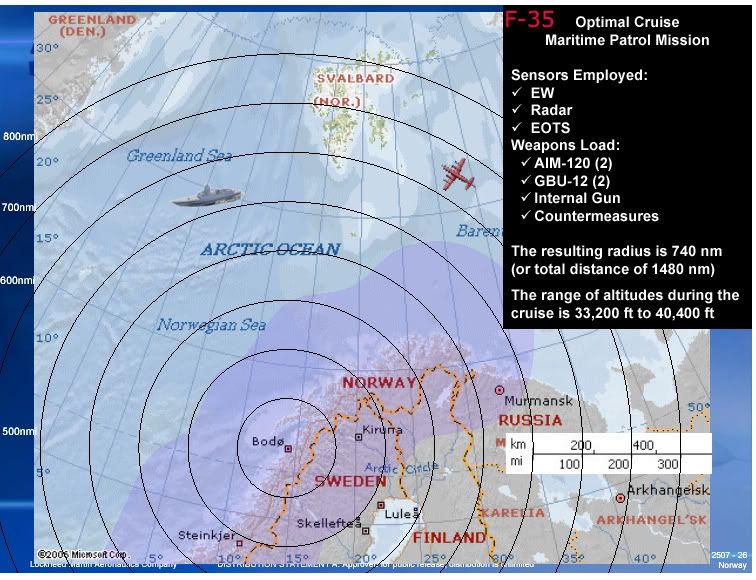
33/40.000 ft. vs a 35.000 ft Ceiling for Harrier II…
Optimal cruise is significantly different that maximum altitude, just like optimal cruise speed is different that maximum speed. A2G profiles will be flown differently than A2A.


 Sign In