wrightwing
Which has what to do with the TVC PST manoeuvers of the F-22?
It performs maneuvers that one would think could only be done with TVC.
wrightwingScooter. No intention for being confrontational here, but “LESS” Aerodynamic doesn’t mean much unless you REALY FCUK-UP a design.
Something else just to give you guys a clue:
Remember F-15 WAS designed to intercept M-25s and OPTIMISED for the role:
F-15 Ceiling: 65,000 feet (19,812 meters)
http://www.af.mil/factsheets/factsheet.asp?fsID=101That’s a FULL 15.000 ft higher than F-22 which interceptor role was mitigated with more modern Air-supermacy requierements.
F-22 Ceiling: Above 50,000 feet (15 kilometers)
http://www.af.mil/factsheets/factsheet.asp?fsID=199Considering F-35 primary role for STRIKE and FULL aerodynamic optimisation for it what do you think its Operational ceiling realy is?
Let’s keep it serious shall we?
You need to learn what the terms “class,” “above,” and “+/plus” mean when discussing specs. In the example you use above trying to compare the F-15 and F-22’s ceilings(and show superiority of the F-15), you’re failing to take into account that “above” 50,000 feet leaves a lot of room. Just like Mach 2 class, or 35,000lb thrust class, or SSNs 25+ knots, etc….
What that’s saying is that that is a minimum vanilla figure, and it’s none of your business just how high the real figure is.
An few examples-
http://aimpoints.hq.af.mil/display.cfm?id=8529
“And then there is the Raptor’s super cruise capability that lets it fly at supersonic speed without using fuel-guzzling afterburners as required by other fighters.
That saves us a lot of gas and opens up a whole host of things when you start talking about dropping bombs,” Krumm said. “You can imagine if you are 60,000 feet doing mach 1.9 (about 1,400 mph) and these bombs are flying out of your airplane, the swath of hell you can produce going through a country saying ‘I’ll take that target, and that target’.”
http://www.atimes.com/atimes/Japan/IE05Dh01.html
“The F-22 can also operate about 5km higher (at 65,000 feet, or 19,800 meters) than other fighters.”
wrightwingWhy Airshow aerobatics aside? I fail to see how the less aerodynamically F-35 without TVC should be able to do similar stunts as the more aerodynamic F-22 with TVC. Another thing of logic, you won’t see because you just consume but don’t think about it.
The Super Hornet puts on a pretty good airshow demo without TVC FWIW.
wrightwingWhen he wrote 9G then has he no clue about physics!;:rolleyes:;):diablo:
I suspect one doesn’t become chief test pilot of anything unless they have a pretty good understanding of what they’re talking about.
wrightwingMaximum flight speed, km/h: at high altitude 2,500 (=M2.35 with 2 x AL31FM engines) http://www.sci.fi/~fta/Su-35.htm
It has later been upgraded to the AL-35F, which provides more thrust while at the same time being lighter. http://www.globalsecurity.org/military/world/russia/su-35.htm
Also:
http://www.milavia.net/aircraft/su-35/su-35.htm
Perhaps i went ahead with my conclusion but not much
Well I respect you acknowledging that. I’ve yet to see anything with regard to the Su-35 having a higher top speed than earlier models. I have seen claims that it has better acceleration, some amount of supercruise, and higher engine reliability.
And what if i am supercruising at M1.2 and need to get more speed quick to gain advantage kinetically to get optimal performance from my missiles ?
again, why is acceleration from M0.9->M1.2 more important then M1.2->M1.5 ?
I never made that distinction. Even supercruisers are going to spend most of there time subsonic to get the most range. The more important stat is how fast can you go from subsonic to M1.5.
wrightwingIt would depend on the pilot skill, who had the first see advantage, airspeed/altitude. If the F-15 pilot can get the F-16 slow, then the F-16 is at a disadvantage.
wrightwingYou got it plain wrong. I cannot speak for all types but I was introduced in detail to a MiG-29’s N019EA radar (totally disassembled) where the radar repair guy has shown me inserted replaceable modules each containing data about radar returns of a specific type. I was told that the exact max. number of these modules carried at one stroke is still classified but let us assume it would be around a dozen. That means a vanilla MiG-29 would be able to recognize around 12 types of specific aerial targets and it is up to mission planner IQ to insert those containing the most likely encountered targets. That being said, you most probably won’t insert a module recognizing Mirage 2000 returns when you fly a mission over Japan, logically.
I am sure that more up-to-date radars are able to carry around a much larger sets of data but the principle is the same – your radar recognizes and adresses only those types of targets which were ‘told’ by the software. I am sure that it can also detect and track general type targets simply be recognizing large radar returns well above the clutter. The signature of F-22 probably stays only slightly above the clutter due to stealth and you need a good resolution to read the target (equals less range) but it could be greatly aided by recording known F-22’s radar returns.
The situation you describe seems to me like F-15s being able to pick up the Raptor but not able to recognize it because the radar was not ‘taught’ by system software that this ‘large clutter’ actually was a target. A rather simple software tweak could make much difference.
I understand this concept too. The point though is that you’re still going to have to get close before your system will detect and identify the VLO target.
If the VLO target sees you first which will almost always be the case, you’re still at a huge disadvantage tactically speaking.
wrightwingThis doesn’t MEAN a LWF replacement, can YOU tell the difference between the TWO?
Which is the most imprecise way to fool newbies like yourself into thinking it was designed like one, obviously they perhaps need your $ to pay for the US part of the programme, not mine.
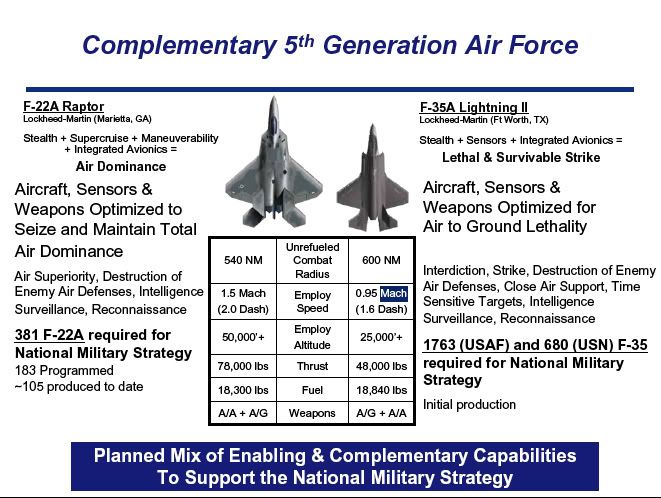
And you skiped the STRIKE role part of the F-16/F/A-18 ‘like’ aero performance, it’s in A2G confiruration that the F-35 is optimised not A2A as were the LWF designed and Optimised.
HERE> OPTIMISED FOR AIR-TO-GROUND LETHALITY.Doesn’t look like LWF requiered specs to me.
http://i146.photobucket.com/albums/r279/sampaix/AFAORG-DATS.jpgAs for what specs means, ask the guy responsible for those of LWF and FX (F-16 and F-15)…
http://www.youtube.com/watch?v=oC6bF4f2iiUStop making a damned fool of yourself, it is quiet obvious that you are lacking SO MUCH elements on the programme that you hardly can comprehend its role and the meaning of the word OPTIMISED in the first place.
Aircraft performances are resulting from Requiered Specs and deisng features, not requiered numbers or the FACT that the original role of the aircraft they replaces have changed…
Please dont bother me any longer with Wilkipedia’s stories, i got enough of Jane’s yearbooks at my disposal and TONS of docs on the subject including the programme requierement of the time (go dig them on the internet for a laugh)….
Meaning i can tell who knows about it and who does not, you DONT.
Why do you only include graphics that support your assertions, but discard the ones where LM/USAF claim 400 percent A2A superiority over legacy aircraft? While the percentage may be debatable, I’d think that they’d know what the capabilities/requirements for the aircraft are. One of those was flight performance at least as good as F-16/F-18, combined with VLO and 5th Gen avionics.
wrightwingMilitary are much more carefull about claims. The better sensor does not mean that you will detect something earlier. That claim is limited to a better chance to do so. The other way around, it is useless to claim the minimum RCS, which is limited to special circumstances and will be considerably less in others. A clever EW-suit will change the rules further.
The claim of the F-15 pilots has something to do with the related software. As long as a target like the F-22 is not integrated into that, it will be filtered out and ignored by the own system. By the way, why the USA does keep control of the software for its exports. When Austria did demand a free adjustable radar for the F-16s offered for a special price, the F-16 was out and the Typhoon was in, despite being much more expensive.
There are obviously scenarios where certain advantages would be offset/mitigated. I was talking strictly about a head on engagement, which is where the RCS advantage would be most noticeable. Of course if the foe is emitting, then the F-35/F-22 would most likely position themself to maximize their low observability.
I’d rather take my chances on the sensor array that has the better chance of early detection. I realize certain conditions might arise that creates more favorable odds, so nothing is an absolute certainty. It’s certainly better than 50/50 odds though.
wrightwingAnd a Flanker would know about the AWACs on its RWR, and no LPI mode of the SH is going to detect the Flanker before it detects the SH!
Lower RCS doesn’t mean detected last. Sensors count. Another fantasy you seem to have.
If you have 2 aircraft with similar sensor capabilities. The one with the lower
RCS will see the other plane first. Even if one plane’s sensors aren’t quite as capable, but it has a lower RCS, it can get closer to the other aircraft before being detected. The lower RCS can offset the sensor detection capabilities, unless you’re talking about a very poorly equipped aircraft.
LPI is not NPI. You are getting annoying.
Why do you think that Russia is working hard on AESA technology? LPI is an important capability given the capability of modern ESM/RWR systems against MSA/PESA systems.
Oh 10nm – 30nm wow! Might as well leave the radar guided missiles at home and go at it with just R-73M/R-74s. :rolleyes: Your number work truly amazed me, do you work for the MoD or DoD?
The IRBIS E is quoted as having a 90km(55.8nm) detection range against targets in the .01m^2 RCS range. This is under optimal conditions. Tracking ranges will be shorter. The F-35 and F-22 are generally given to have RCS size of .001m^2 and .0001m^2 respectively. Now I ask, given the orders of magnitude of reduction from .01m^2/55.8nm, what’s wrong with my numbers again exactly? And remember- tracking ranges are < than detection ranges.
Even Carlo Kopp’s numbers for RCS detection support my assertions-
Also remember in exercises vs. F-15s, pilots have visually spotted Raptors when their sensors couldn’t(or if they could, they couldn’t lock on). That should tell you something about the difficulty it is engaging at anything beyond WVR, unless the Raptor or Lightning pilot does something really stupid.
wrightwingWho cares? There is no guarantee the firing aircraft will get close enough to fire or that it will get through short range SAM cover.
What scenario are you using? An attack on Moscow? You’re using a 1 vs 1 analysis -plane vs. SAM. Any attack on a sophisticated air defense is going to be a major effort and involving F-22/F-35/EA-18G/F-18E/F(and if a coalition force is involved- Typhoons, Rafales, Gripens,etc..), EW aircraft, ESM aircraft, cruise missiles/AGM-130/AGM-84/AGM-88D/E/ALARM/GBU-39/40/stealthy stand off weapons(i.e. JSOW-ER/JASSM-ER, decoys), to say the least. To say that a lot of confusion will be going on for the SAM operators is an understatement.
If an EWLRS picks up the F-35/22, they are as good as dead. A few calls or radio transmissions are you are going to have SAMs pointing at them, interceptors heading their way, etc.
Just like with SAMs and Fighters, EWLRS is going to be detectable before it can detect. Assuming it does detect, it can’t provide precise information about the F-22/F-35, just that they’re in the area. In any event these sites will be high priority targets, as will cell networks.
As any formidable defense will.
An IADS with overlapping coverage for legacy fighters is far less problematic than when having to deal with targets where you have perhaps a 1/10- 1/100th the detection range. You need A LOT more radars, and A LOT more missiles/launchers, to achieve the same coverage. Not even Russia can afford to have overlapping coverage of the entire country, much less every possible target.
Haha, you ok expert – it won’t just cause you say so right?
Any signal can be detected. Even if it isn’t consistent on the RWR of the Flanker, it will still alert the pilot.
It’s not a matter of the signal being detected. It’s a matter of the signal being recognized. The way LPI works is by not looking like a search radar to a foe’s RWR/ESM systems. This doesn’t mean that it’s invincible or undetectable. It does mean that it’s not a certainty that a foe will be alerted in time to implement defensive tactics. Remember- F-22s have flown against aircraft with very good ESM/RWR systems in training, and been very successful.
wrightwingMiG-31 is superior in the intercept role, but would run into trouble in a dogfight with other fighters, Su-35 is a M2.5+ btw, and F-22 is a M2.4+
Source please
What makes you think acceleration just around the speed barrier is more important then anything else ? and what makes you think external weapons or not would make any difference ?
F-35 has more drag with its paltry 4 internal missiles then any eurocanard with 6 external missiles.
Beside that, drag isn’t a big issue at those speeds when it comes to acceleration
Because if you’re cruising at high subsonic, and need to get more speed quick to gain advantage kinetically, high acceleration allows you get to the optimal performance from your missiles. That’s just one reason that comes to mind.
wrightwingmeans.[/B]
Since mostly you two can’t comprehend what LPI realy means we can understand why…
Au contraire mon fraire, it is you that seems to have difficulty with the concept of how LPI works. Please cite one source showing how ill informed I am about the concept.:rolleyes:
wrightwingAnd again crosssection, crossection, megathust and only 1.6mach?
jet again nothing to say?
The point I think that needs to be made is that we don’t KNOW that the F-35 can’t exceed M1.6. That’s Lord ASSap’s assertion.
wrightwingJust to put things in a relative: I’m just trying to make you guys understand that LPI is no magic and that an LPI radars transmissions can still be detected! Not more not less.
I’d agree with this, as it’s a very fair assessment. I was just taking issue with some of the other posters who felt LPI was of no utility, and that threat aircraft would detect it at great stand off ranges.


 Sign In