wrightwing
In that case there’s the R-37M/KS-172 derivatives, and even then, a 25KM difference is a matter of a approximately a minute.
Here’s the takeaway- the launch aircraft can’t fire its missiles until it knows there’s a target. The R-37M/KS-172 could have a 5000km range, and it wouldn’t matter, if the launch aircraft can’t detect a target until its closer than 50km. The other important takeaway is that these are large/heavy missiles, which limits the number that can be carried, and when carried externally the speed and range of the launch aircraft. The F-22 and F-35 on the otherhand can take much greater advantage of their missiles, because they’ll be able to detect any 4th Gen fighter at extreme ranges.
Page 4 top right corner is what I’m getting at-
http://photos.state.gov/libraries/norway/45384/pdfs/F35Overview.pdf
wrightwingWRONG:😀
Where is the D for DETECTION in the achronyme LPI please?
intercept=detection in the context of LPI. The whole point of LPI is that it behaves in a manner that doesn’t set off RWR/ESM systems. It uses very low power, narrow beams, rapidly changing frequencies, so the foe’s warning systems filter it out as background noise. If you set your system filter threshold too low, you’ll get a lot of false alarms, much like a car’s radar detector when driving past grocery stores, etc…
EVERY EM emission IS detectable; Intercept implies a set of datas suffiscient to go pass the detection stage and LOCATE the source with enough accuracy to become useful.
Intercept=detection in the context of LPI. The whole point of LPI is that it behaves in a manner that doesn’t set off RWR/ESM systems. It uses very low power, narrow beams, rapidly changing frequencies, so the foe’s warning systems filter it out as background noise. If you set your system filter threshold too low, you’ll get a lot of false alarms, much like a car’s radar detector when driving past grocery stores, etc…
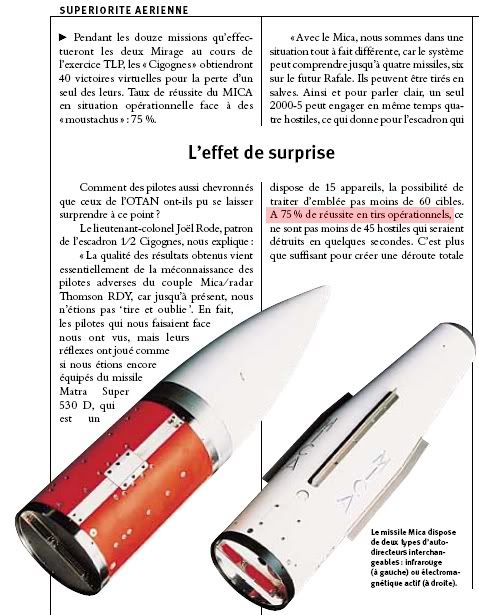
WRONG. They all can be launched without lock-on which is what our Mirage 2000-5Fs are doing regularly in BVR with an expected succes rate of 75%.
The RDY radar doesnt use lock-on modes and this doesn’t give the target ANY idea it have been fired upon.
What you meant perhaps is that there isn’t enough datas on range (Supposely), in particular for the EM AAMS, but a MICA seeker slaved or not to OSF can detect a F-35 in BVR easly, a Magic II probably would too since they do detect non-A-B KC-135 Fs BVR.
And BTW, this also applies ALSO reversed to the aircraft flying LOWER and SLOWER which AAMs NEZ, KINETIC ENERGY, SPEED and RANGE will be much lower.Something else, with 360* X 360* Link-16 remote targeting and firing capabilties demonstrated, plus i strongly suspect a possible upgrade from SPECTRA from A2G to A2A targeting there are scoops for a Rafale to detect and target F-35 in BWR totaly passively already today, without the RBE 2 AESA which will help detect L.O target way further too.
Of couse we won’t know about the SPECTRA A2A taregeting capability (or the lack of it) but it CAN detect a radar emission at more than 200 km with an angular precision of less than 1* and be used to guid an AASM to it for a kill, so i wouldn’t be surprised if with sensor fusion including Link-16 it wouldn’t be possible for a F3 to detect F-35 radar or radio emissions with enough precision to target it LOAL…
An LPI emission isn’t going to be detected at 200km. If that were the case, why bother using LPI at all, or use any kind of EMCON?
About roughly 2 hours i would estimate since they CAN do it with AAMs and a supersonic tank attached at M 2.2.
Let me get this straight, just so there’s no misunderstanding. Are you telling me that you believe that an EF/Rafale can supercruise for 2 hours?:eek::rolleyes:
The F-22 which is optimized for supercruising can only fly 300-350 miles in supercruise(or 150-175nm on ingress, and 150-175nm on egress). If we assume that it’s cruising at 1200mph, that’s about 15 to 20 minutes of supercruise, with the remainder of the flight at subsonic. The F-22 carries considerably more fuel than either of the EF/Rafale, and without any external stores(and despite what you think, AAMs, pylons, EFTs affect performance, both in terms of the speed and range the aircraft can travel vs. flying clean).
In short they dont fool me with the so called “L.O” thing we all know F-35 is WAY from being as L.O as the F-22.
.001m^2 vs .0001m^2
Of greater relevance the EF/Rafale are in the .1-.5m^2 RCS range
wrightwingThat’s true on a 1vs1 basis, but not quite likely in an operational scenario. For instance, when the F35 is detected by UHF radars, then they can send a team of fighters with mids to intercept it. One flying below the F35 could scan the target area to pick the F35 from background cold with its IRST and feed the target data to another plane flying way above for maximum effective range.
Say a typhoon cruises at M1.3 with AA load or a Rafale at M1.2. If it wants any chance to catch them, the F35 will need to light it’s pc, making it much much more detectable via IRST, and burning much more fuel in the process.
Nic
The F-35s won’t be flying by themselves either, and will most likely have additional support from AWACS, etc…
The EF/Rafale, just like the F-22 are limited in their supercruise ranges, which means most of the time, they’ll be at M.8-M.9, so it depends how far they are from their base to how much supercruising endurance they’ll have. The F-35s also have long range IRST, so they’ll have as likely a chance at detecting the EF/Rafale, as being detected.
wrightwingetc etc…
You dont get it do you?
DAS like EOTS aeren’t in the SAME league when it comes to performances IN ADVERSE WEATHER CONDITIONS.
They are Visual Meteorologic Conditions Limited (VMC).
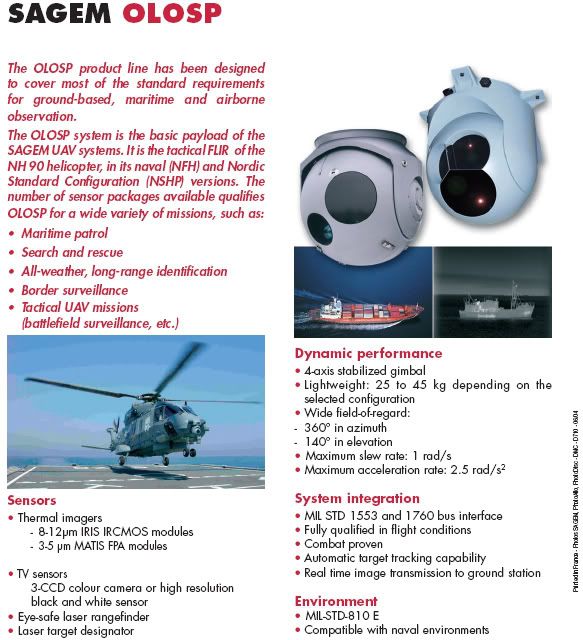
NOT the same generation, the fact that i posted this is only to give and indication of the technology in use in BOTH systems, there are developements on IR Missile detection AND IRSTS in the pipeline which are WAY more performant than this on DGA progammes right now.
SAGEM like Thales are aiming for FULL Long-range/All-Weather IR capabilties…
Please inform yourself.
No other aircraft has a comparable system to DAS right now, so you’re right that it’s not in the same generation. I’m curious to how you’re so well informed on what the limitations on the EOTS/DAS are. Apparently the customers of the F-35(who’ve seen the competition) don’t agree with you.
wrightwing.
Why “much closer?
Considering the FACT that already LPI radars of the RDY generation are detectable at more than 200 km and (in optimum condition) the 1990’s genration of European IRST capable of detecting a fighter sized target ad <> 130 km you tell me where the advantage will be when the NEXT generation of IRSTs will be in service…
There’s a big difference in detecting a 5m^2 fighter size target, and a .0001m^2 fighter size target. Let’s just use the IRBIS-E as an example for a moment- it is claimed to be able to detect targets in the .1m^2 range at 90km(and it’s a considerably more powerful radar than the RDY/CAPTOR/etc…), but its range against the F-22/35 will be 1/3 of that or less. The IRST will most likely see them before the radar will. The foe still faces the problem of locking his weapons on them as detection alone doesn’t mean that you are tracking/locked on with weapons, and the IR weapons have much shorter ranges than the IRST(this is true for the EF/Rafale as well).
As for the IRST- being capable of detecting targets at 130km doesn’t mean that all targets within 130km will be detected(especially targets that are designed to have low IR signatures). The field of view for an IRST is much more limited, in terms of the volume of airspace being scanned(i.e. the picture the pilot sees isn’t a simultaneous picture from sea level to 60,000ft over a 270 degree arc.) In otherwords, you have to be looking in the general direction and altitude that the foe is at.
It’s NOT about the AAM itself expecialy the IR BVR AAMs, it’s about the launch aircraft and its kinetic advantage (or lack of it).
Maximum ranges are for movies, in reality there are NEVER been a kill anywhere out of the first two third of the current AAM ranges.
Most of them BTW occured within the first third of their maximum range too, not to mention thre need to ID the target to avoid fractricide, if you cant do it visualy (Optronic) then you are at great risk to kill firendlies or give away your position by having to emit for request of ID from a remote source.
To that respect collaborative fight is also not going to work that much if you cant emit without being spoted which is going to happen every time you do emit EM anyway.
I am not bothered with AAM range matters, i am bothered with EM/IR discretion, target detection and identification, then we can compare AAMs performances and their respective NEZs because at the end of the day this is what reality is made of, rough datas aren’t too relevant in most cases.
This is where our pilots are aiming in termos of culture, they dont even think about METEOR and its future Kinetic Energy advantage, their problems lies in the aspects of the fight i mentioned and they are working much at reducing EM emitions…
It’s about the launch aircraft’s ability to detect a target as much as its kinematics, and missile performance. You can have a very fast plane, with very long range missiles, but if it can’t detect targets until it’s relatively close, the first 2 aspects aren’t particularly relevant. On the other hand, if your aircraft can detect targets at long range, and your missiles have a long range, the aircraft performance is less relevant. Where the F-22 excels is that it has all 3 of these traits(speed/altitude, long range detection, long range missiles).
wrightwingYou arer AGAIN bringing NOTHING new to the debate, and DAS only bring Imagery to the IR MLD function…
What i was saying was the whole spectrum of threat is already covered on a 360* X 360* buble a long time ago…
Already there just in case you haven’t noticed yet, only the imaging capability is missing but NOT for long, NOW since you seems to like taking the Mickey, have a good read on my previous posts and try to default the french developed technologies called “West” or “WORLD FIRSTS” coming our way…
For the time being, performances of this generation IRST is enough for classification as long-range/All-weather by the manufacturer and the DGA is looking in this precise direction for actual and future developements..
.What’s wrong with your understanding of the words 360* X 360*?
“Simple” MLDs provides for it just in case you didn’t comprehend it just YET and the only difference with DAS IS imagery.
DAS does considerably more than just provide imagery to the MLDs. It gives the pilot near 20/20 situational awareness(of anything flying or driving) in that 360 degree bubble at >40nm, GMTI, targetting info for weapons for LOAL, IFF, etc…
Additionally, it provides 360 degree coverage in real time, not just the ability to scan a 360 degree pattern as in the case of that helicopter sensor.
wrightwingYou’re mystaking Human technology for that of the Klingons.:D
L.O doesn’t MEAN undetectable, we know it we are developing BOTH the L.O and the “counter” L.O.
Where did I say undetectable? They are detectable, but only at much closer ranges, negating the kinematic range of the LRAAMs. In a nutshell, it doesn’t matter if the missile is capable of flying 300-400km, if the fire control radar can only detect the target at 1/10 that range. In fact those missiles(KS-172/R37) would be used in the ARM mode against an AWACS/C4I type aircraft, that have a lot of EM emissions, when flying that far. Their range against even a 4th Gen fighter, in SARH/ARH mode, would be considerably less.
wrightwing175 vs 200 is almost nothing in real terms.
What is going to be more interesting is the new weapons for the PAK-FA.
Those numbers are irrelevant against a VLO aircraft. You can’t fire at a target unless you know it’s there, and the PAK FA isn’t going to detect the F-22 or F-35 at hundreds of km, hence- the primary targets are AWACS/Tankers(i.e. large RCS, slow, ARM profile).
wrightwingI’ll skip the politics if you don’t mind.
The USAF doctrine for stealth as defined for F-22 requierements includes:
1) EM Low Observability. F-35 = + 0.5.
2) IR Low Observability. F-35 = / 0.0.
3) Supercruise. F-35 = / 0.0.
I dont realy care if F-35 RCS is lower than mine, if my aircraft doesn’t stay inside of his window of detection/engagement by a factor of 0.13 i’ll have ALSO 0.13 X time (and chances) to detect him (on the Mach scale from M 0.95 to M 1.3)…
This includes of course detecting LPI emission, having 0.13 X more time to look for it, locate it etc
And with IR systems as we know are in developement in Europe and else it’s going to happen sooner than later…
Then AGAIN there is the OTHER factor: Operational ceilling, giving extra AAM kinetic energy, enlarged NEZs and RANGE.
The final point is that the kinetic energy advantage which works for the F-22 will ALSO still work on my favour then, flying a Gripen, Typhoon or Rafale. 😀
Your putting as much faith in the ability to detect and DF the LPI signal, as the folks making the LPI systems are in that they won’t be detected.
If you DON’T detect the F-35’s radar, then he’ll spot you at 100+nm in a non-VLO aircraft, whereas the adversary won’t detect the F-35 till it’s in the 20-30nm(if that). That means that the adversary will always be within the NEZ of the F-35’s weapons before it detects the F-35. If by luck, the foe sees the F-35 on it’s IRST before its radar can detect it, it’ll still be within the NEZ(and the F-35 will still know about its presence). Even with a Meteor/R-27ER/R-77M1/etc… all that extra range isn’t going to help much if there is no radar lock.
As for the supercruise on the EF/Rafale/Gripen- what is their supercruise range? The F-22 can’t supercruise for its entire mission, and neither can they, which means that if the F-35 can only cruise at M.95, there won’t be a .4 mach advantage at all times. It also means that if it can supercruise, then it comes down to who can do it the furthest, for there to be any tangible advantage.
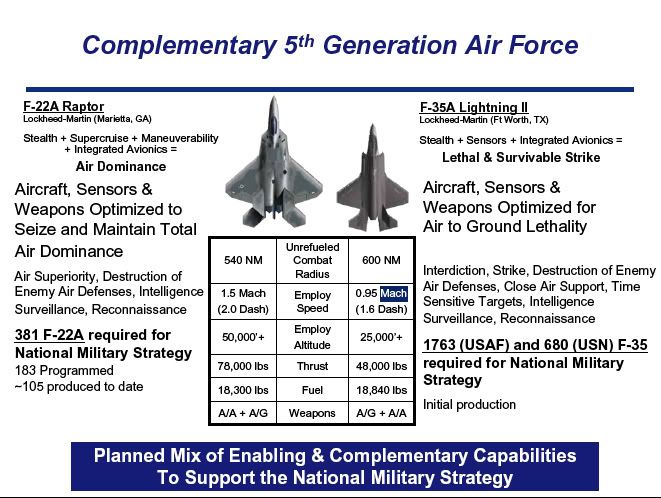
wrightwingJust posted by Rogerout (Thanks a lot) in another topic…
http://www.afa.org/ProfessionalDevel…Comparison.pdf
MEANING: Buy half of the necessary capabilties to obtain Air FULL Supremacy….The european and other F-35 clients have forgoten the HI from HI-LO couple methink, though some “Top Bass” from the same source was clamly saying that F-35 would out-turn a clean F-16 while in FULL A2G configuration which is according to aerodynamc laws, way off this planet’s technology level…
Consider: Winload+Lift Coefficient only for instantaneous turn rate, add thrust for sustained and you get the picture.
Of course we know that the F-22 can exceed 50,000 ft and M2, and the F-35A has a 673+nm combat radius(rather than the 590-600nm range previously stated). It’s interesting that you conveniently ignore this.
wrightwingThat DEBUNKING was hilarious. It established a primary assumption that the Aim 120D was longer ranged than the R 27ER giving a western airctaft 1st shot advantage. Obviously that “analyst” forgot to mention that a long burn R 77 is on the horizon as is the new Novator missile designed with the Indians. Even more amusingly, said analyst then goes on to postulate aesas in a jamming role, strange since there is no real funding for this capability in place at all, its just radar manufacturers speculating at this point. So vs a Su 35, no, a Western jet won’t get 1st shot unless meteor outranges the Novatar missile, likewise a ramjet R 77 is likely available within a few years of the Aim 120D service entry and certainly the novator missile and ram jet R 77 before F 35 entry (especially with its problems and delays in early development).
Such a debiunking is just one set of assumptions vs another. Kopps are more realistic for a 2013 timeframe.
If you’re talking about the KS-172 or R-37, those long effective ranges will only be useful for anti-AWACS/Tanker/etc…. The Su-35 most certainly won’t be shooting at F-22/35s from 300-400km.
The R-77M1 of which you speak is in the ~175km range according to the numbers I’ve seen. The AIM-120D/D+ are allegedly in the 180-200km range(and perhaps further when fired from an F-22). Of course we’ll have to wait and see, as neither weapons are in service yet.
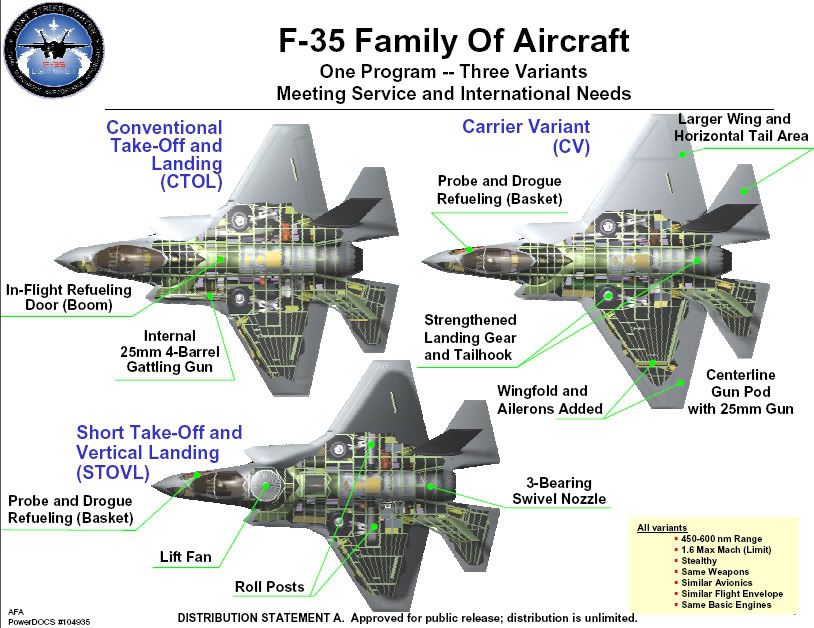
wrightwingWhat part of DESIGNED Mach LIMIT do you not understand?
It’s pretty CLEAR that a designed which LIMIT is M 1.6 isn’t going to go any faster no?
Now go and tell L-M the doc they provide their customers is inacurate and that the Mach LIMIT for all variant is NOT the limit.:D
That’s a vanilla, unclassified spec sheet using the KPP threshold. I’m having difficulty understanding why you believe that the actual max performance limits are put in an unclassified brochure. The original F-22 spec sheets gave a range of M1.8+ to M2 class. It has been stated by Paul Metz that it will do M2.42(and perhaps more). Why is it such a stretch that the F-35 might reach M1.8-M2(especially given the pilot observations and briefings stating that it’s no performance dog)?
wrightwingI think somebody doesn’t want to see an aircraft which can be more capable than F-22!But don’t forget if there wouldn’t be competition we couldn’t see such great aircrafts;)
I don’t see anything dubious in that article. Wasn’t the first flight originally planned to be a few years ago. If there are delays(which there obviously have been), it’ll mean that the first flight will be later than planned. This has nothing to do with not wanting to see an aircraft more capable than the F-22. It sounds to me more like some folks are unwilling to accept that there may be delays in the program.
wrightwingDid you get bashed up for the reference to the A7? 😀
Good one because it is what F-35 IS designed to do best…
How many A-7s will the F-35 be replacing exactly?:rolleyes:
wrightwingWhat you say Wrightwing is true today but not at the requirements stage. At that point the F 35 was conceived for battlefield interdiction with F22s (no one thought it would be cut to 200 units or less) and B 2s assumed to handle S300s. I should point out VHF stealth lacked angular accuracy, a source of comfort for the U.S. That has changed and a great many people do not accept its fundamental significance to U.S stealth. As for RCS, Im sure you are right thatb the F 22 and F35 have superb frontal and allaspect RCS figures (at least -30-40 decibels) BUT thats for X band.that translated to a marble or less. What alot of people fail to grasp is that at VHF frequencies an F 22 or F 35 will be the size of a beachball, quite a difference, hence claims of detecting F 117s at 40NM in jammed environments.
The F-117 didn’t have an extensive ESM system, and sensor fusion to provide the pilot a good picture of the threats though. Like I said, if a radar of any band is emitting, the F-35 is going to know about it, and where it’s at. That’s taken into consideration in route planning/tactics/choice of weapons to be used. It’s been known for quite some time that we weren’t going to have 750 F-22s(they started making cuts even while Bill Clinton was in office).


 Sign In