 wrightwing
When an aircraft is described as being an “all-aspect” design, it does not mean that all aspects have the same amount of RCS reduction as compared to a conventional design. It makes sense to concentrate on reducing the RCS of the front and rear aspects of an aircraft. Physics.
No one has said that all aspect means an equally low RCS from any aspect. It’s just that in no aspect is the RCS as high as a conventional design, as it’s designed to have a reduced signature from all angles.
wrightwingDefine superior stealth.
Lower optimal, and average RCS.
That means: a well positioned F-117 is stealthier than a well positioned F-22. A badly positioned F-117 is much less stealthy than F-22, maybe even less stealthy than F-15 or other teen fighters.
There’s no angle that an F-22 is less stealthy than a teen fighter.
wrightwingYes, I have and it says pretty much nothing to me. I don’t know what is the last time you have checked the shape of either F-22 or F-35 but they still featured quite a few edges. It’s nothing like the entire skin of the aircraft comprises one surface – not even close to that.
One surface as Radar sees it, is the point.
wrightwingYou are asking a wrong question. Instead you should be asking, why do they call an aircraft with obviously conventional RCS from many angles an “all-aspect stealth”, which it obviously isn’t??
BTW, in multi-target environment, the F-22 or F-35 might find themselves in an less than favorable position towards numerous emitters more than often, there is no way around it. In order to be illuminated directly from under, the F-22 doesn’t have to be directly over the emitter – it’s sufficient if the Raptor banks..
I disagree. The lateral sides of the Raptor are canted, but very flat. They can easily be illuminated in the way that travelling radar waves impact the lateral sides in perfectly normal angle – that means bounced back directly to the source. The only thing you can do is apply some damping to reduce amplitudes.
I think it might be you that’s asking the wrong question, as none of us here has access to info that would allow us to conclude that any angle on the F-22/35 had an obviously conventional RCS. On the one hand, you and Cola are saying that the F-117 has superior stealth due to the flat angles its facets have, and that curvature is unimportant. Now you’re saying that it’s a downside for the F-22/35, and that LM/USAF have it all wrong, and that the pilots that have flown against the F-22 numerous times(including in AESA equipped fighters, approaching from many altitudes/aspect angles) should’ve easily been able to spot it. The proof is in the pudding. Reality is simply not corroborating your assertion.
wrightwingHe’s also saying that the EF has a stealthier belly, since LM obviously paid no attention to this portion of the plane, in their designs.
wrightwingEven a satellite won’t be looking directly down on these aircraft except under very unusual circumstances, and their ESM systems will keep them from flying directly over a ground based radar site. The only time maneuvers presenting the top or bottom aspect would be performed, would be if the F-22/F-35 is at the merge with an enemy fighter. At that point, the element of surprise is a much lower concern. I suspect that some thought went into their designs to reduce the signatures even from this aspect, though.
wrightwingIt depends. For the record, I think that even F-22 maintains a purely conventional RCS when seen directly from top or bottom, or from an angle perpendicular to aircraft’s lateral surfaces. If someone wants to claim 0.000x sqm RCS from these angles, then a practical explanation of how it’s technically possible to achieve such RCS values under these conditions would be pretty useful. I don’t need hard evidence or manufacturer’s claims, a simple logical elaboration would do. If it’s possible, then it should be relatively easy explainable.
BTW, one question, are F-22’s wings dielectric / radar transparent?
At what point in time, will an enemy radar be looking directly up or down at an F-22/35? I suspect you won’t see either of them performing 90 deg climbs over enemy airspace. As far as RCS from the side, you’re definitely mistaken there. While not as small as when viewed directly from the front, the angles on the aircraft are specifically designed to reflect radar beams away from the source. That’s why all the angles are aligned, and there are no right angles.
wrightwingThe engineers can, of course, try to approach the RCS of a faceted design by fine-tuning the curves and the edges, application of new materials etc. but the curved surface still stays a handicap in terms of RCS.
Did you even bother to read the link posted earlier in the thread
Cashen’s electromagneticists saw that the same results-ensuring that every part of the surface was angled away from the radar in two dimensions- could also be achieved if the surface was curved. Indeed, if the entire skin of the aircraft comprised one surface, with curving contours of constantly changing radius and direction, there would be no edges or creases at all, avoiding any “hot spots” in the RCS.
Are you saying that you’re more of a subject matter expert, or just making a SWAG?
wrightwingJust because a particular aspect angle(the one that the enemy will likely see as the B-2, F-22, F-35 are approaching) represents the lowest RCS, does not mean that they have conventional RCS from different aspects. As for all of these compromises in shapes, you’d think that other fighter pilots would’ve already figured out strategies for dealing with the F-22, seeing as how it should be easily spotted from these other angles, seeing as how you obviously have access to info to support such claims..:rolleyes:
wrightwingI understand that, but was demonstrating that curvature, and round aren’t necessarily synonyms here. In fact check out some examples of 2 plane continuous curvature, and see if some don’t look remarkably like F-22 and YF-23, among other shapes.:cool:
wrightwingHere’s another example of curvature-
a 12″ radius guitar fretboard

vs. a compound radius fretboard
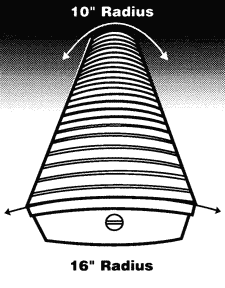
Now if you can’t see how an aircraft can have curvature, without being round, spherical, cylindrical, I’m not sure what else to tell you.
As for this statement
Ok, so the Rafale is more “curved” than F35 and particularly F117, so I guess Rafale is way stealthier than both those types?
You’d gotten on me since you thought I hadn’t read the article in that link I’d posted, but then post this? It was pretty obvious in the article that the RCS wasn’t dependent on how curvy the design was, so being more curved isn’t an advantage. The curves have to meet this criteria, which I already posted- constantly changing radius and direction.
Now if we look at the F-22 and F-35 designs, we see that both the curvature and planform alignment techniques are used, combined with materials, and paints, to reduce their RCS.
wrightwingHere are some definitions (and examples) that might help us out of this semantic quandry, that we seem to find ourselves in.
http://www.thefreedictionary.com/curve
curve (kûrv)
n.
1.
a. A line that deviates from straightness in a smooth, continuous fashion.
b. A surface that deviates from planarity in a smooth, continuous fashion.
c. Something characterized by such a line or surface, especially a rounded line or contour of the human body.

http://www.thefreedictionary.com/round
round 1 (round)
adj. round·er, round·est
1.
a. Being such that every part of the surface or the circumference is equidistant from the center: a round ball.
b. Moving in or forming a circle.
c. Shaped like a cylinder; cylindrical.
d. Rather rounded in shape: the child’s round face.
e. Full in physique; plump: a round figure.

http://www.thefreedictionary.com/obtuse
ob·tuse (b-ts, -tys, b-)
adj. ob·tus·er, ob·tus·est
1.
a. Lacking quickness of perception or intellect.
b. Characterized by a lack of intelligence or sensitivity: an obtuse remark.
c. Not distinctly felt: an obtuse pain.
2.
a. Not sharp, pointed, or acute in form; blunt.
b. Having an obtuse angle: an obtuse triangle.
c. Botany. Having a blunt or rounded tip: an obtuse leaf.
wrightwingAs for dealing with S-300s-
http://www.spacewar.com/reports/F-35_Jet_Designed_To_Take_Out_The_S-300_Battery_999.html
X band optimization doesn’t mean fully visible in the next band per se. L band, S band, etc… are all centimetric frequencies like X band, and their ability to detect/track will be degraded as well.
wrightwingThat and they’re failing to explain the B-2/F-22, and their RCS improvements over the faceted F-117(or the fact that no new stealth designs from any nation, are using the “superior” faceted designs). It’s just gotten asinine.
wrightwingCurved doesn’t mean shaped like a ball, or even round per se. It means that you’re not dealing with flat panels, but that there is curvature in the shape. It just so happens that this curvature uses varying radii, which has been calculated carefully in the design process.


 Sign In







