 wrightwing
You’re never going to see a promotional photo, with every conceivable load out. So long as compatible bomb racks are used, and the hardpoint supports the load, it shouldn’t be an issue.
wrightwing2nd: I really don’t think F-35 has anything over F-18 speed wise, so it doesn’t really change anything.
Can an F-18 fly at M1.6+ with AAMs?
wrightwingobligatory
got the link for that, i’d like to check the year and author
Well considering that it’s talking about the YF-22/YF-23, it’s got to be 20yrs old or more.
wrightwingYou distract from the facts. The “stretching” was forced by the delays in the development and in the constant need of extra money by that from the program, which was designated for the series-production! When the program money was used up that gamble of LM was over. Something similar happens with the F-35 program again. From 2008 we should have seen the series examples in rising numbers and it was not a shortage of money delaying it several times. Program money sheduled for building series examples is poured into the development again to cover up the problems. 😮
To stay within the legal cost-overrun of the program the procurement number will suffer for sure! 😎
Once the numbers started getting cut, the prices went up. When that happened, the numbers got cut again, and again, and again.
wrightwingF-35 is not considered VLO or as having all aspect stealth. But don’t let this little detail get in the way of your wishful thinking.
It is by the customers and manufacturer. I’d love to see the analyst who’s got data to the contrary.
wrightwingOstensibly, the F-35 would have the UCAVs out front, while providing sensor coverage, making for a pretty potent SEAD/DEAD combo.
wrightwingThe intent is to have F-35s control UCAVs in coming years.
wrightwingThese are some of the technologies being worked on-
(1) The JDRADM will be an AAM as well as a HARM.
(2) Advanced propulsion technology — which includes the Dual Combustion Scramjet (DCR) engine, a 7″ VFDR engine and advanced traditional rocket — is being matured.
(3) Advanced vector and attitude control system(s) — including multi-pulse lateral divert control thrusters, lateral exhaust jetting and traditional thrust vectoring — is being matured.
(4) Advanced light weight airframe technology is being matured.
(5) Advanced seeker technology — including seeker as fuse, multi-band seeker and high precision wide band passive receiver — is being matured.
wrightwingThe F-16Is use the same infrastructure as the F-16s still in use. The price claimed for a F-35A with similar services is ~160 mio $ or 18 aircraft for 3 bn $.
The running cost aside, because that have to be shipped to the USA for maintenance work to keep the warranty. The F-22A gives an idea about that compared to a semi-stealth SH.
That includes spare parts, new infrastructure, training, etc… That’s not the flyaway cost, that Israel would pay per aircraft.
wrightwingAfter three decades of technology advances it has to be so. By the way I do not see such a high number of F-35s to be procured really. The F-22A did not replace all F-15s and the F-35A will not replace all F-16s for similar reasons and by that we are back to our topic about a future mix of air-assets.
Not doing so in time we are trapped with a much smaller number of F-35s for all missions. 😉
What killed the F-22 was politics. Had it not had continuous cuts during the entire program, it would’ve had a much lower fly away cost. Additionally, the fact that it wasn’t available for export kept the numbers lower than it could’ve had.
wrightwingEOTS, and EODAS is far more than a MAWS.
http://www.lockheedmartin.com/data/assets/1232.pdf
Within the JSF’s overall mission systems package there is considerable overlap between the sensors. The best example is the aircraft’s electro-optical distributed aperture system. While not part of the EW suite, EODAS has six strategically placed, embedded sensors, providing a fully spherical, continuously operating IR shield that can identify and track threats such as missiles, vastly increasing pilot situational awareness, says Branyan. Operating in the midwave-IR range, EODAS can provide warning at “tactically significant ranges,” he says. EW and EODAS are two elements of an integrated sensor suite designed to detect and identify the full spectrum of air- and ground-based threats. EW, coupled with EODAS, provides integrated RF-IR domain coverage, Branyan says.
“It is important to note that as F-35 pilots fly a mission, the integrated sensor suite provides full situational awareness,” says Waldrop. Sensor information includes not only onboard radar, EODAS and EW, but also offboard information. This could involve data from E-3 airborne warning and control system (AWACS) aircraft, Joint STARS (E-8C ground surveillance) aircraft, data-linked air and ground intelligence, other combat aircraft, and both space- and sea-based elements. All the tactical/defensive information, both on board and off board, is fed to the pilot through the F-35’s integrated core processor.
And from an older LM presentation-
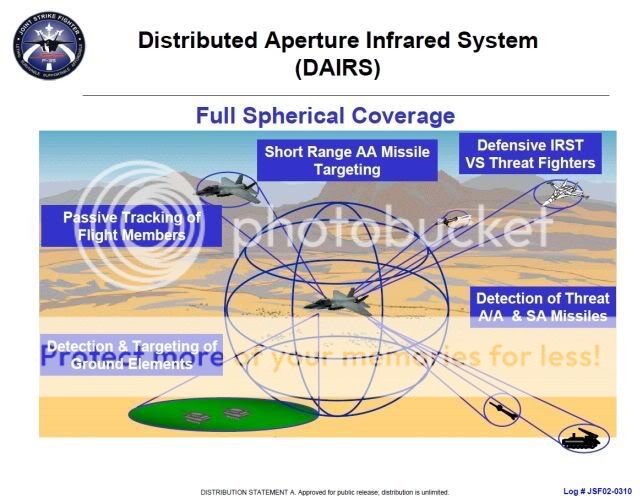
http://www.es.northropgrumman.com/solutions/f35targeting/
Northrop Grumman has developed the only 360 degree, spherical situational awareness system in the electro-optical distributed aperture system (DAS). The DAS surrounds the aircraft with a protective sphere of situational awareness. It warns the pilot of incoming aircraft and missile threats as well as providing day/night vision, fire control capability and precision tracking of wingmen/friendly aircraft for tactical maneuvering.
Designated the AN/AAQ-37, and comprising six electro-optical sensors, the full EO DAS will enhance the F-35’s survivability and operational effectiveness by warning the pilot of incoming aircraft and missile threats, providing day/night vision and supporting the navigation function of the F-35’s forward-looking infrared sensor.
The DAS provides:
•Missile detection and tracking
•Launch point detection
•Situational awareness IRST & cueing
•Weapons support
•Day/night navigation
wrightwingI imagine that the price difference between the F-16I isn’t too different either, especially when figuring the IAF wouldn’t even start receiving them till 2016 or later, especially when you figure in the costs of the additional equipment, that comes standard on the F-35.
wrightwingIf Israel sticks with the A model, then it’d be comparable in price to new F-15Is, unless they view even that to be too expensive.
wrightwingThat link was given by Tango III and it fits into our topic too. Here are the views from one of the future F-35 user briefed about its capabilities.
I didn’t see that article as being negative towards the F-35, and the one quoted, that you’re probably referring to was this-
“We only need a relatively small force, and it can be mixed with non-stealthy aircraft for a larger operational punch,” a retired Israeli army general says.
wrightwingThe difference is that if you have fewer strike aircraft to begin with, then the less you can afford to give up airframes for tanking purposes. The USN, on a conventional carrier has a lot more aircraft to work with. Nobody’s saying that it’s a bad capability to have- just that there are some trade offs.


 Sign In







