Avro Canada CF-105 Arrow
A true masterpiece of an aircraft;)
a V tail – yf23/ macair JAST style?
interesting…
couple years ago some body told me that’s one direction they were going with. I didn’t believe them because CAC has already won the competition.
🙂
Here is a blurred out and intentionally censored image of a desk-top model of that particular SAC 601 4th (5th) Generation J-XX concept – as seen in the drawing posted by Blitzo et al. Rumor has it that SAC 601 offered two different concepts – the J-19 and the J-21 – the J-21 is the concept with the twin V-tail, like that on the American YF-23. The J-19 concept looked more like the YF-22 / F-22. But of course Chengdu CAC 611 won the competion for the contest with their J-20 – that we all now can see. But SAC 601 might still be pursuing their efforts with advanced combat aircraft – giving the Chinese PLAAF more options. Just like the open competion between the L-15 and the JL-9 series for an advanced supersonic trainer.
First Italian supersonic aircraft
1957: The Aerfer Ariette was the first Italian supersonic jet aircraft – a prototype – it was a Sagittario derivative
🙂
Dassault Mystere IVN all-weather 2-seat prototype
😎
Happy Christmas and best to you on the holidays
Cheers to you Dieno
:D:D:D
I’d think TVC would negate the need for canards, especially if it already has an aggressive LERX.
TVC will only increase the maneuverability of the aircraft – even to the point of G-LOC – for the pilot any way!! And IMHO, I would estimate that the J-20 was designed to withstand beyond 9+ Gs, and with canards, an aggressive LERX, TVC, and a thrust to weight ratio greater than unity, this should put the J-20 into the realm of the super-maneuverability category.
😎

J-20 engine WS-15
This is a very detailed scaled model of the WS-15 engine.
😉
J-20’s engines
🙂
If the rumor prove correct, then the J-20 is powered by two Russian NPO Saturn 117S afterburning turbofan engines with 3d vectoring nozzles. These are engines that are also used in the Sukhoi T-50 PAK-FA and Su-35S fighters. The NPO Saturn 117S will power the Chengdu J-20 until China can fully develop the WS-15 afterburning turbofan engine – which will also feature 3d vectoring nozzles.
😎
Pinko,
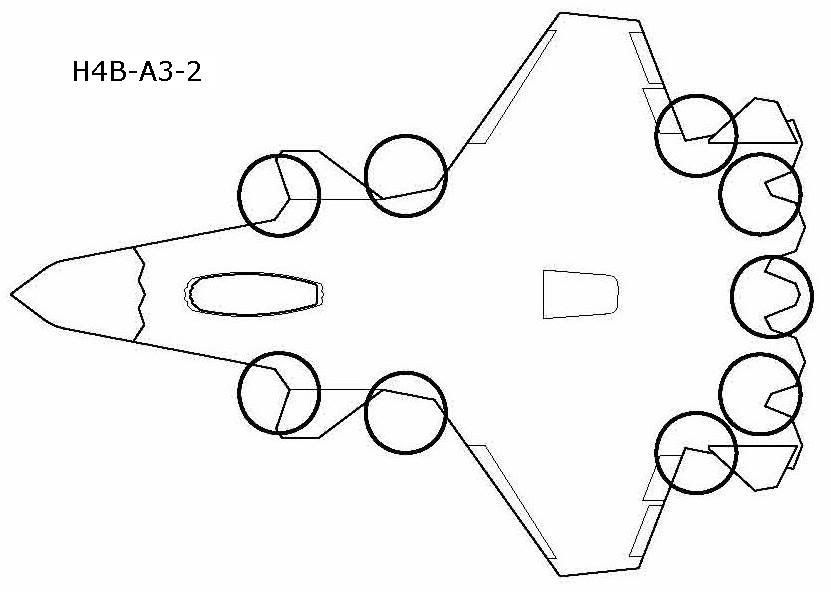
Any rumours on what the canards look like? Is it the forward swept ones like in the H4B-A3-2 or the more conventional ones?
More like the ones on “H4B A3 27”
In my opinion serial engines of the bird can be the Izdeliye 117 or 117s which are on Su-35s and PAK-FA prototypes today! Thats what Chineese officials interested in the Chinese airshow
I know that Medal64, and the Chinese are now in talks with the Russians for engines for the J-20, since the WS-15 will not be ready for installing in J-20s for a number of years yet to come. It had been decided about two years ago to install the Russian Saturn 117S engines in the prototypes of the J-20 until the WS-15 would be ready. So it is most likely that the J-20 prototypes will be powered by Saturn 117S afterburning turbofans – just as they are in the Su-35 and T-50 PAK-FA. Some observers have nicknamed the J-20 prototypes “PAK-FA-Shan”
J-20 engine
Possibility that the engines in the J-20 will be the 18-tonne thrust class WS-15, that will have 3d vectoring nozzles – like the nozzle being tested here at one of AVIC’s engine design institutes (probably in Shenyang)
J-20 / JXX at Chengdu taxi tests
No PSed images this time – and no CGs either. This composite drawing is based on the real J-20, and includes descriptions by eyewitnesses. The J-20 prototype is dark green in colour – and the eyewitnesses were speculating if it is some type of stealth or radar absorbing coating. There are twin vertical tails, somewhat similar to the F-117A, but on the J-20 prototype they are widely spread apart instead of being in a V-tail as on the F-117A. Side air intakes with DSI “bumps;” twin small ventral fins, near the wings trailing edge; and two under-wing pylons. The aircraft difinitely has canards and the whole forward fuselage – fuselage, cockpit/canpy and independently moving canards all seem to be one unit. The J-20 has a one-piece canopy; and there is a pitot attached on top of the nose of the aircraft. It is also reported that there is a red star on the vertical tails and the number “35” is on the side of the forward fuselage. It has a double-wheeled nose gear and single main landing gear units (tricycle type):cool:
Project 640’s radars and a 420-mm “Super Gun” ABM System
😎
The Chinese ABM System – Project 640 (1963 – 1980)
Project 640 ABM System
Development of Project 640 began on 15 December 1963. It was slowed down by the ABM Treaty between the Soviet Union and the United States; and it was finally cancelled altogether in March 1980. There were three different variant of the FanJi – FanJi-1; FanJi-2; and FanJi-3. The FanJi missile was a two stage weapon, and was semi-active radar guided. The radars were a large phased array radar – called or referred to as “7010”, which was situated on a hill side. And a mono pulse missile tracking radar called “110”. The Chinese also began development of an ASAT system in the early 1970s.
Fan Ji-1 ABM System
Real interesting stuff Eagle. Is this the same missile meant for ABM purposes and was to deploy a N-warhead.
Yes, it was designed, developed, but never deployed ABM system for defense against ICBM RVs. Mainly from Russia and the United States. And there were three different variants of the missile. And yes it was to use a nuclear warhead to destroy incoming ballistic RVs. It had all of the usual associated radars.
😉