 Fedaykin
Ummmm…I think you have been reading a few too many Tom Clancy novels (or those written by his ghost writer)!
China reveals J-20 to persuade America to continue building F-22 as a counter threat and make money for Chinese corporations? A bit of a tenuous concept to my mind…
In the end China has clearly stated it has a long term plan to modernise its armed forces, its defence industrial complex is working towards supporting that plan. With the recent improvement in their domestic R&D and manufacturing base development of new systems like the J-20 whilst exciting shouldn’t be seen with any nefarious eye.
Remember the PLAAF and PLANAF have a huge number of legacy fighters to replace like J7 and J8. Actually for that matter they have started to retire the earlier Su27SK purchased from Russia in the 90’s! Whilst J-10 and J-11 variants can meet the immediate need for new fighters it is entirely reasonable for the PLAAF and PLANAF to want indigenous fighters with characteristics like stealth and AESA radar.
So we now see CAC testing a fighter: the J-20 that meets their future needs.
FedaykinWhilst I am in no doubt that HMS Protector will be leased effectively off the self I have put some thought into what an ideal new build would be.
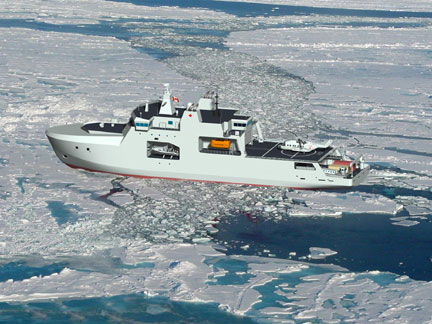
To my thinking a variant of the Norwegian Svalbard class or its derivative Canadian Artic Offshore patrol vessel would be perfect. Adapt the design with a twin hanger for the Lynx and leave out the sensor and weapons fit, also take the chance to build her propulsion and engineering systems closer to RN standards.
http://www.akerarctic.fi/15.%20McGreer_Arctic%20Passion%20Seminar%202010.pdf

FedaykinYep that is the case but at least the field of choice is now wider!
FedaykinWOW!!!!!!!!!!
That is a good picture!!!!!!!!!!!
Lots of detail for both aircraft!
FedaykinConsidering the in service date for QE is 2019 – 20 I would think some slippage with the F35C wouldn’t make much difference to the UK.
The UK is trying to push the F35 purchase as far as to the right as possible! There should be test airframes available in time for deck trials and if necessary the USN or Aeronavale could be asked to loan some aircraft and personel to qualify the ship.
FedaykinWhat a let down 😡
Anyway thanks for the updates.
I can already hear the skeptics saying the plane(s) don’t fly and are only runway show pony’s
Not really that surprising!
A photo op for the leader, test flying will start soon.
FedaykinI agree there is no way the UK could of supported 24/7 365 days a year but token deployments would of been possible.
Further from what I said earlier with this scenario Eagle would probably of been Phantomised as well rather then paying off. I also think a number of FAA pilots would more then likely exchange with the USN for operations over Vietnam which would of been interesting.
As I said earlier CVA-01 or similar would of survived and the aircraft replacement programs that led to Tornado would of been vastly different with the RN having a far bigger influence and to my mind more American input rather then European.
Then again with this scenario the Falklands would probably not of happened with the deterrent value of the large carriers BUT the Islands might well peacefully be the Malvinas now as the UK up to the war pretty much had a policy of slowly handing them over.
FedaykinWell two things come to mind if the UK had been involved in Vietnam and carriers were deployed to Yankee station.
1) CVA-01 or something similar would probably of survived and entered into service.
2) A push towards even greater commonality with the USN would be certain. So Hawkeye and Greyhound might well of found themselves on a UK carrier deck. Also Phantom and Bucaneer would probably of remained in service to the late 80’s maybe even mid 90’s before being replaced by a Hornet variant – possibly with the input of British industry.
FedaykinNo the MODs procurement and operation of those Mi-17 was purely to support training of Afghan pilots and would of had no bearing on US procurement decisions.
The Mi-17 was pretty much the only choice, the Afghan National Army Air Force (ANAAF) is pretty much standardised on the type, thats what their pilots and ground crew know. Any other choice of helicopter would bring an unnecessary logistical and training burden, actually they have talked about retiring the Mi-35 in favour of the Mi-17 due to the logistic burden. The Mi-17 is also pretty much designed for Afghan operations with its good hot and high capability and robust design.
There has been some mutterings in America and a protest from Sikorsky about US tax money going to buy Mi-17/Mi-171 rather then rebuilt S-61 Seaking but the US has made the right choice.
FedaykinSince, well, “never”.
And unless the proverbial Martians declares war tomorrow to UK PLC, the probability of that particular weapon being integrated in the Phoon is very dim. The useful life of the missiles is ending and the production line is closed for quite some time.Cheers
Indeed, ALARM will stay on the GR4 until she retires. After that well there was some talk about developing a SEAD version of Meteor but the cheapest option would be a purchase of AARGM which the Americans and Italians will integrate on the F-35.
FedaykinAnother thing to consider is suitable air to air missiles for the aircraft whilst the PiLi-12 BVR missile is probably suitable for internal carriage the standard WVR missile fielded by China the PiLi-8 is hardly suitable with its huge fins:

The PiLi-9 is probably more suitable with its smaller fins but its an export weapon with inferior performance to the PiLi-8. I highly doubt they would integrate the Russian R-73 so that leads me to the conclusion that they have something new in the pipeline.
FedaykinMuch like the T-50, I’d definitely also expect some changes before it enters production – very much an “YF-” rather than “F-“. The forward fuselage is not only weird from an aesthetical point of view, it looks like it would significantly restrict visibility over the nose for the pilot, compared to the F-22 and T-50, so that might well change. Other examples are the ventral strakes and engine nozzles, plus any details that may need improvement but which are not obvious on available imagery.
Hmmm, I would think with that bubble canopy visibility would be fairly superb.
FedaykinWell in the end Carlo Kopp is certainly no Mike Sparks and there is much he writes about which is rightly quoted in publications including AFM. There is much on his website when it comes air defence systems and UAVs that is very good.
Unfortunately his agenda when it comes to the F-22, F-35 and F-111 is found by many to be rather tiresome including the RAAF. If he actually listened to personel in his own airforce he would find they are very happy with their new Super Hornet and are very excited with the prospect of inducting the F-35. The F-111 were utter maintenance hogs and the F-22 is not for sale! In the end Australia fields the AMRAAM, AIM9X and ASRAAM all of which are very good missiles. Along with force multipliers like their new KC30 tankers and 737 AEW&C they are in a pretty good place when it comes to offensive strike and air defence.
Unfortuantely his alarmist agenda and propensity to paint any fighter aircraft built in the west which isn’t the F-22 or F-111 as useless and anything built by China or Russia as the grim reaper itself has lowered his standing in many circles. What really grates is Boeing in his own words graciously gave him a ride in the F/A-18F Super Hornet in 2001. Afterwards he wrote a fairly glowing article about his experience finishing with this conclusion:
The Super Hornet is a fighter with exceptional handling qualities, even by modern fighter standards, which even a novice can handle comfortably and with confidence at the edge of the low speed manoeuvre envelope.
The point which Boeing and the US Navy have made most convincingly, is that the aircraft’s flight control software is so robust that even a beginner on the type can fly it without embarrassing himself too badly. Sceptics should note that test pilot comments about fighters with this generation of flight controls being as easy to fly as a Cessna 172 are indeed correct. There is no room for argument here, as I had the opportunity to observe first hand!
In the hands of an experienced combat pilot, such flight control software means that the pilot can be wholly focussed on the furball in progress, and need not devote any thought to pushing the aircraft past the edge into a uncontrolled departure and resulting risk of a ground impact or successful enemy missile shot. The importance of a substantially departure resistant aircraft, especially if encumbered with stores, cannot be understated – carefree handling translates directly into combat effectiveness.
In a low speed post-merge manoeuvring fight, with a high off-boresight 4th generation missile and Helmet Mounted Display, the Super Hornet will be a very difficult opponent for any current Russian fighter, even the Su-27/30. The analogue and early generation digital flight controls with hard-wired or hard-coded AoA limiters used in the Russian aircraft are a generation behind the Super Hornet and a much more experienced pilot will be required for the Russian types to match the ease with which the Super Hornet handles high alpha flight regimes.
The reports emanating from carrier landing trials performed in the US cannot be disputed, the aircraft is a sheer delight in the circuit and will take much of the anxiety out of night and bad weather traps, especially for nugget fighter-attack pilots.
The cockpit ergonomics build upon two decades of Hornet experience, and make for a very comfortable and easy to use cockpit environment. Again, a novice pilot will find the MFD modes easy to navigate and easy to follow. The colour moving map display makes navigational orientation ridiculously easy, against the mental chores of VOR/DME/TACAN, radar mapping and INS/map-on-the-knee navigation. The prospect of MIDS/RWR/radar/IFF tracks being overlayed on the moving map will take much effort out of maintaining wider area situational awareness.
The radar is very easy to use in MMTI, GMTI and SAR spot mapping modes, and provides an excellent tool for highly accurate all weather maritime strike, littoral strike and battlefield interdiction operations. In particular, the ability to interleave MTI and surface mapping modes is exceptionally useful for resolving and identifying moving surface targets of opportunity.
In conclusion, the reports of the Hornet’s exceptional high alpha handling characteristics are provably correct. Established Hornet users should not be disappointed by this aircraft!
I assume he maintained this opinion right up to the point of the RAAF selecting the Super Hornet as an interim type in 2006 replacing the F-111 whereupon it becomes the worst possible fighter in the world and a disaster for the RAAF! He even had the cheek of adding a notice to the article stating that
Any attempt to present this article as an endorsement of the Super Hornet decision will be considered to be intentional and mischievous misrepresentation
!
http://www.ausairpower.net/SuperBug.html
So indeed take his opinion in certain areas with a pinch of salt!
FedaykinSea Skua is now the UKs only air launched dedicated anti ship missile. Only Lynx and Merlin can carry it (maybe a trials Britten Norman Defender as well) at the moment and that will probably be the same if the Future Anti-Surface Guided Weapon enters service.
As for the RAF, well the Brimstone would be reasonably effective in comparison to Sea Skua so it is a capability in kind against small targets. Also Brimstone was slated for F35 integration so the navy might get a capabilty in kind.
FedaykinThe other one to watch for will be ground test rigs for the EMALs system and arrestor system. Will they do working simulators to train the crew in their use or will they go the whole hog and create an operational land based system for testing and training ?
If the UK does purchase EMALS then it will use the facilities at NAS Lakehurst. You only really need the arrester gear for currency training, the French navy used NAS Lakehurst for Rafale testing. With EMALS the UK effectively gets the testing for free as the Americans need to do it! Also UK pilots training for carrier operations will do it in America anyway on the T45 Goshawk using NAS Lakehursts catapult.
If the UK purchased the Converteam EMCAT then there will need to be a UK based land based set up for testing. Most logically it would be set up where they intend to operate the F35C.


 Sign In







