 Fedaykin
In the end Meteor exists for two key reasons:
1) 1990’s UK projections of the lethality of current and future BVR missiles produced by Russia and China.
2) Not wanting a key weapon fielded by the Typhoon having a US Congressional veto. Every other weapon fielded by the aircraft has a European alternative.
FedaykinI think by 2020 Iran would still be flying F-4s and F14 aging birds. It is not a matter of money they have money to throw around but the thing is they have no supplier, who is willing to sell to Iran? Not the US. Not Europe. Russia and China wouldn’t either due to the risk of International sanctions by Sam, the Civil Aviation industry cooperation with Western nations is worth billions more than selling Iran a few fighters for chump change.
In respect of China it hasn’t bothered them before when it comes to sanction busting arms sales. China is too much of an economic power and a major creditor for the West, that gives them a degree of impunity in such matters.
FedaykinWell lets get away from yet another debate about China and look at Iran.
What do they field now and how would they want to replace it? I would think that they would want to cut down on the number of types they field whilst maintaining their domestic overhaul and design industry. They currently operate a couple of heavy types the F-14 and Su-24. Three medium types the F-4, F-1 and Mig-29. Two light types the F-5 and J-7. They also operate the Azarakhsh which is clearly an F5 rebuild and the evolutionary Saeqeh which appears to fall between a light and medium fighter.
So splitting at light, medium and heavy with some cross over of types between those classes we get a better idea of what they would like in an ideal world. If Russia comes back into play alongside China we get a possible range of aircraft that could meet their requirements.
Multirole Heavy: Su30, Su35, PAK-FA, J-11B and J-20.
Multirole medium: J-10, J-31, Mig-35 and Saeqeh (with new engines)
Multirole medium to light: Mig-35, Saeqeh (with new engines) and JF-17
Multirole light: JF-17, Yak-130 and Azarakhsh.
Point defence light: Azarakhsh.
Where there is cross over especially in the medium area then a dedicated type could be eliminated. Now just for the hard of thinking I am not suggesting they buy every single type above, I am suggesting that in each weight class there is a range of choices. Also we need to consider what a serious upgrade of their air defence environment would be like with modern radar and C4I facilities.
Personally I think a fleet consisting of:
Multirole Heavy: Su35 or J-11B
Multirole Medium: J-31 and Saeqeh
Multirole light: JF-17 and Saeqeh
FedaykinCertainly is certified but not available in numbers to allow exports. It will be a number of years before the WS-10 can be released for export sales, as it stands the engine is needed for domestic consumption.
FedaykinAh well here is the rub, Iran has not been impressed with the quality of the J-7 it inducted into service. Then again Iran is heavily into buying Chinese avionics and missiles so that attitude might change. MY gut feeling is the old engine issue rears its head again here along with an unwillingness to fund a new fighter procurement by the Iranian government. The Chinese fighters that would offer a significant capability improvement over what the already have use Russian engines, Russia won’t supply said engines due to its embargo.
Once good Chinese engines are available in numbers to allow exports that might well change. Areas of procurement that might well be more useful is an upgrade of the C4I systems and radars that the country fields. China makes some good radar systems these days, that combined with an upgraded GBAD network using indigenous and Chinese procured missiles might well be a more effective use of money. A few FD-2000 missile battery might well be interesting…
FedaykinNo, China needs Iran’s oil and Gas.
China has rejected the imposition of an arms embargo.
FedaykinA more realistic outcome of an easing of relations with America is other countries like Russia deciding to lift their embargo on arms sales. Even if your fantasy situation came to be mack8 Iran wouldn’t be upgrading their F-14 and F-4 again with new engines and Avionics, they would retire them in favour of new aircraft. Both types are receiving a SLEP now to extend their lives. The F-4 has a projected OSD of around 2025 and the F-14 as of yet indefinite date. Both types are still in service out of necessity due to the limited choice that Iran has on the global market. If they had the opportunity to replace them they would, they certainly wouldn’t be looking to America for an upgrade if they could buy American.
FedaykinAs for Boeing and South korea, talk about snatching defeat from the jaws of victory!
Curiously I think the South Korean desire to now field the F-35 is probably driven by Japan’s recent order! Can’t have the old enemy field a stealth fighter whilst they don’t.
FedaykinI know F-16E has no DSI, a crucially new technology incorporated since the 2000s. J-10B has it. This implies J-10B is more technologically advanced than F-16E. Name me 1 technology F-16E has that J-10B lacks. :rolleyes:
Goldust, we have been over this before! There is nothing magical or particularly advanced about DSI. It is a fixed inlet nothing more and nothing less! It offers advantages and disadvantages. Whilst it offers reduced maintenance and reduced radar signature it comes at the price of strangling engine performance in certain flight regimes, especially at high altitude and high mach numbers. If Lock Mart wanted to sell the F-16 with a DSI inlet it would, the aircraft performs perfectly well as it is and they see no need to.
All China has learnt how to do is fit a feature to some of their jets that Western manufacturers started experimenting with in the late 1970’s. Certainly an achievement for China but not something to crow about.
FedaykinAnybody notice that in the last few days after DESI the government have all of a sudden stopped talking about a UK order of 48 jets and gone back to talking about 138. Looks like the work of one journalist has thrown a massive spanner in the works for the government.
http://www.angusbatey.com/index.php?id=770&category=blog
A reduced order would do massive damage to smaller UK companies so after the question was posed some hectic face saving has kicked into action and the old number has been resurrected like Lazarus!
I wish I had been at the press conference to see the Ministers face as the Lock Mart representative explained what would happen to UK work share if the order was cut :dev2:
FedaykinMy word this article made my skin crawl there are so many factual errors and general $h1t stirring the author should be ashamed!
The aircraft were painted that colour on the advice of the manufacturer and the USAF not as some nefarious cost saving plot, the aircraft is packed with electronics that have a very sensitive thermal profile. Painting them that way ensures we don’t break a very expensive acquisition, the cost of qualifying a different colour scheme is secondary to the advice of the manufacturer and USAF! It isn’t as if RAF aircraft were not painted in “Flash white” in the past, it is a return to a traditional paint scheme for the RAF in many ways!
As for the refuelling issue, the aircraft has significant endurance. Qualifying probe refuelling is again an unnecessary waste of money when under most circumstances the internal fuel load is more then enough for a mission and if we really need to top the tanks off we use an allied tanker exactly the same as the E3D Sentry already in RAF service that also use the American boom method on top of using a probe. RAF E3D Sentry pilots prefer using the American boom anyway…
The people posting comments on the article in the DM website are even worse! They haven’t got a clue about the issues! This is my favourite:
The Boeing 707 on which the Rivet Joint aircraft is based is almost as old as the comet design on which the Nimrod was based. Both aircraft have their origins in the late 1940’s early 50’s and even the newest Rivet joint airframe is nearly 50 years old. Hardly new technology. It would have been better value to either keep the Nimrods flying or replace them with something much more modern.
– suffolk36, Bury St Edmunds, 23/9/2013 11:34
Gah the stupid hurts my head!
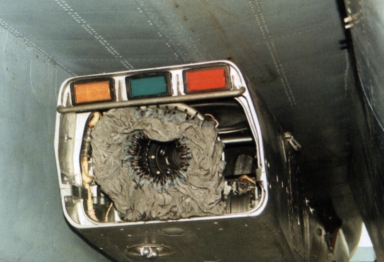
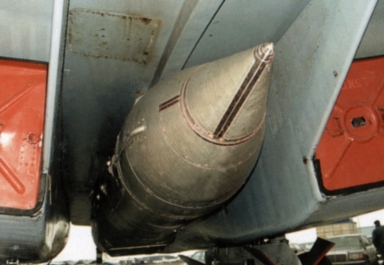
FedaykinWell this is a Su-27 variant with a UPAZ-1A Sakhalin pod mounted:
FedaykinAfter a bit of web news searching it looks like I am not the only person thinking T-X when it comes to editorial.
As for Israel they are already purchasing a type very similar to the Scorpion (actually better performing in many respects) the M346 Lavi. If they needed to press an aircraft into the role why purchase another type when they already have m346 Lavi?
FedaykinWith the Budget sequestration ongoing and the DOD/USAF agonizing over retiring a number of types including the A-10, B-1B and KC-10 the idea that funding could be found for a twin light attack jet is wishful thinking at best and a pitiful joke at worst.
Textron knows this full well! Yet there is a prototype so they clearly want to do something with it, there is pretty much no chance we shall ever see this aircraft being purchased by the US in this role so the question is “what is Textron’s game here”?
I wonder is this a sideways step at T-X?
FedaykinRussia is offering integration of Kh-31, AFAIK. That has been done before (Kh-29L on Iraqi Mirage F1EQ).
Integration of BVR AAMs is even more unique, the only case I have heard of was this:[ATTACH=CONFIG]220771[/ATTACH]
I could be wrong but I am sure that I read somewhere that this is a carriage trial rather then a serious integration of that missile on the F-14.AS it stands they have put in a significant effort to overhaul and re-life their time expired AIM-54 Phoenix stock. Apparently that has been met with some success and pretty much removed the need to integrate a different missile on the aircraft. Iran also makes an AIM-9 copy which probably completes the load out for this aircraft.



 Sign In







