Ok first forum issues for me:-
1. Forum won’t let me post more than one video in a post.
2. Forum won’t let me post a second post with a video citing “your post contains two videos”.
HAL’s test pilot Wg Cdr (retd) Unni Pillai, GM (Rotary wing), giving Thai pilots a walk around of Dhruv at U-Tapao, Royal Thai Navy Airfield.
Inside the cockpit.
Where did it improve. The old layout had less wasted space and was easy to use on a phone.
Select the mobile styles from the drop down menu on the bottom left side instead of vb4 default style.
Having no issues with the new layout.

Tejas Mk1 is an advance on MiG-21. Rather than risking getting into a situation where Rafale/Tejas Mk2 is late and needing to extend the life of MiG-21 aircraft, why not double Tejas Mk1 production? It’s a cheap insurance policy.
The double of zero is still zero 😉
But year, the latest report is that a sustainable rate of 16 Tejas will me achieved. Which means circa 2019-2020, HAL would be pumping out 32 aircraft annually. Had the procurement been not retarded and had Tejas been on time, that rate of production would have been achieved in 2016-2017 phase.
The phasing out of MiG-21 has been slowed down.
Update on ABM shield.
Saraswat, who has just been awarded the country’s third highest civilian award, the Padma Bhushan, said that DRDO had been able to develop key RF (radio frequency) seeker technologies for missiles in cooperation with Russia, and that in the last missile test, the seeker used was made in India. Digital processing in any case is based on DRDO’s own software.
Without the seekers, a missile would be an aimless vehicle.
The RF and IR (infra red) seekers (?) are meant for proximity and precision engagement of targets, and both these technologies are required for the anti-ballistic missile (ABM) capability as well as all kinds of missiles. Saraswat did not give details but said that India also was working on seeker technologies with other countries. (who?)
As for an ABM shield, he said that DRDO had conducted four endo-atmospheric (within the atmosphere) and two exo-atmosphere (outside the atmosphere) missile interception tests and that all six had been successful. “We certainly need more tests but we can say we have been successful in developing this capability.”
The last one, designated Advanced Air Defence (AAD) interceptor missile, and fired on November 23, was in fact a hit-to-kill test.
So far, DRDO has mostly been working on proximity, near-miss or zero-miss acquisition of targets. With these systems, an ABM missile blows itself up some nine metres from its targets. From now on, the effort will be to develop the hit-to-kill capability by directly impacting hostile targets.
IR seeker possibly under development with another nation. AAD has been confirmed as a hit to kill interceptor now.

The weapon on the wing station?. Isnt that the ASM-3 supersonic antiship missile?
Aww crap. You are right, I picked it up in another forum.
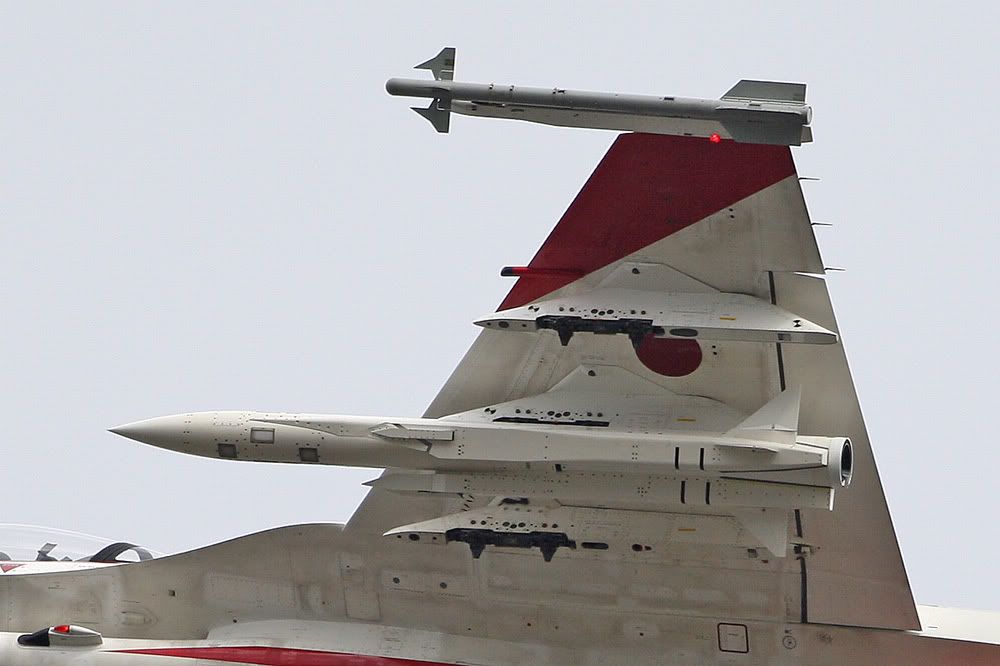
New air to air missile on F-2.
[IMG]http://i580.photobucket.com/albums/ss245/T-O-R-A/JSDF%20various%20photo…
Defence Acquisition Council to discuss Navy’s Rs 25,000 crore (~$5 billion) warship proposal
PTI Apr 1, 2013, 08.37PM ISTNEW DELHI: A Rs 25,000 crore proposal of the Navy for procuring four large amphibious warfare vessels is expected to be considered by the Defence Ministry here tomorrow.
A meeting of the Defence Acquisition Council (DAC) headed by Defence Minister A K Antony is also expected to approve amendments in the procurement procedure to give a bigger role to the indigenous industry for supplying military hardware to the armed forces.
“We are looking to add four more Landing Platform Decks (LPDs) in our fleet to operate alongside INS Jalashwa, the only LPD currently in service. The proposal is expected to come up for discussion at the DAC meeting tomorrow,” a Navy official told PTI here.
The procurement procedure has already begun with the release of the Request for Information (RFI) by the defence ministry, they said.
The four warships would be procured under the ‘Buy and Make (Indian)’ category of the defence procurement procedure under which the Indian shipyards, both private and public, would be required to form a partnership with foreign shipyards for the contract.
Hey Don Chan, any info on the new Japanese AtoA missile with an AESA seeker ?
] missile with an AESA seeker ?
This?
“Japan’s Air-to-Air Upgrade
Japan already has bought Raytheon AIM-120 Amraams, so why is it spending Â¥36 billion ($468 million) to upgrade about 60 F-2 fighters with the Mitsubishi Electric Corp. AAM-4B missile?”
Looks pretty much like Meteor, but with an AESA seeker.


A bit of strange news regarding MTA.
The Russian version of the aircraft is due to be fitted with PS-90A-76 engines each with a thrust of 14.5 metric tons. It is not yet known which engines the Indian version of the MTA will feature.
http://indrus.in/economics/2013/03/30/mta_to_enter_global_market_23377.html
With the advent of 5th Generation Stealth Fighters. Will AWACS Type Aircraft be able to survive???
Look at the number of countries investing heavily in bi static radar research. Couple that with greater processing power and in a decade or so, the odds won’t look as skewed as they look today.
I think you are talking about Region II in the envelope.
https://www.youtube.com/watch?v=OXKvNe2VWt4&t=960The Region I + II part of the envelope are around 100 degrees. So its a pretty tolerant flight control when it comes to allowed alpha.
Ok, so I looked up some stuff on Gripen’s flight envelope.
http://www.icas.org/ICAS_ARCHIVE/ICAS2000/PAPERS/ICA3113.PDF
So if my understanding is correct-
In Region I (unspecified angle of attack, some sources claim a +26 degree limit), the FCS allows the pilot full liberty (or at least very liberal control).
In Region II (+55 to -25), the FCS pushes the aircraft back into normal flight regime, ei Region I.
Region III (beyond +55 and -25) is not permitted in normal flight mode and available only to test pilots, in which Gripen has recovered from angles as high as +110 degrees ?