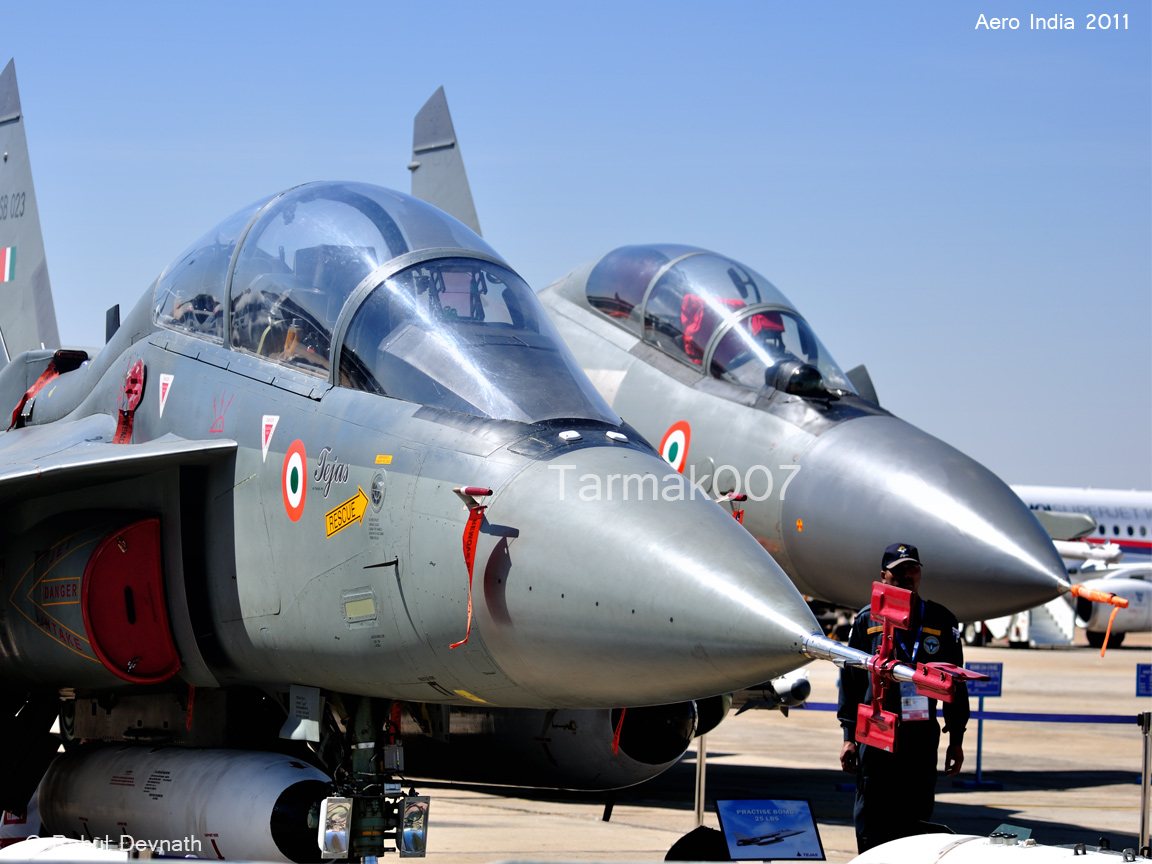
NP-1 will have its first flight soon as well as per Ananth Krishnan’s blog. Not including TD-1 and TD-2 (which were considered obsolete and stopped flying), the following Tejas’ are flying..
PV1, PV2, PV3, PV-5 (twin seater), LSP-1, LSP-2, LSP-3, LSP-4, LSP-5 and now LSP-7.
LSP-6 is yet to fly and it will be modified for high alpha flights. LSP-7 and LSP-8 are to be handed over to the IAF’s Aircraft and Systems Testing Establishment for evaluations.
PV-1 along with TD-1 and TD-2 are now used for ground testing only.
We have developed 2 technology demonstrators TD-1 and TD-2; we have the four prototypes PV-1, PV-2, PV-3 and PV-4. The Limited Series Production aircraft ranging from LSP-1 to LSP-4 are all flying. TD-1, TD-2 and PV-1 have now become outdated and are used for ground testing or testing of equipment that needs to be developed for the Tejas. All the aircraft from PV-2 onwards are participating in the flying test campaign. LSP-5 is currently the final ‘Standard of Preparation’ that we will deliver to the Indian Air Force (IAF) and this aircraft is expected to fly this month. LSP-6 and LSP-7 will follow and have been earmarked for the user evaluation by pilots belonging to the Aircraft Systems and Testing Establishment (ASTE).
Both the IAF and the Indian Navy have committed some money for the Tejas Mk-2 which will be equipped with a higher performing engine. We now have a concurrent programme to develop the Tejas Mk-2 version for the IAF and the Indian Navy. The PV-5 which is a trainer version of the Tejas’ is flying and another aircraft PV-6 is expected to fly by the end of this year. The maiden flight of the Tejas Mk-2 is expected to take place in December 2014 and production will begin in December 2016.
Edit: Nevermind, I got confused between PV-6 and LSP-6
With regards to the tank at center pylon, this picture should settle the issue. Seems like the center pylon can accommodate 800 liter (or is it 720 liter?) tank.
Nothing new on NP-1 then ?
Btw how many Tejas are flying at the moment ( including LSP-7)?
It seems LSP-1 to 5 (with LSP 1,4 and 5 doing most of the recent heavy lifting) and PV-2 that have been doing most of the flying. PV-3 flies rarely, TD-1, TD-2 and PV-1 are not flying anymore.
LSP-8 and LSP-6 (Weaponised trainer ?) should be flying within a few months along with NP-1 and NP-2.
^^ That was quick, quicker than NLCA.
The APU inlet indeed does seem smaller !!
^^ Yep, debunked already.
^^ The poor guy can’t help it if the program keeps missing deadline. What was supposed to be a Diwali present turned Christmas gift is arriving after Holi.
] missile with an AESA seeker ?
This?
“Japan’s Air-to-Air Upgrade
Japan already has bought Raytheon AIM-120 Amraams, so why is it spending ¥36 billion ($468 million) to upgrade about 60 F-2 fighters with the Mitsubishi Electric Corp. AAM-4B missile?”
Maybe the AESA seeker has a higher tolerance to counter measures ?
Soon… says AK
Then why havent the Russians themselves gone for the similar configuration in their Su-35s? And wasnt it a demand from Indian side to include canards?
Su-35 features a much lighter and modern radar, hence the lift from canards isn’t necessary. It will also mostly operate as a single seater. As far as I am aware, Indian demands were restricted to integration of avionics of their choice on it.
Whoever made this… just shut up and take my money !!! (and don’t forget to send me one)

Hey Don Chan, any info on the new Japanese AtoA missile with an AESA seeker ?
http://www.thehindu.com/todays-paper/tp-national/article2968219.ece
Nirbhay is a two-stage, surface-to-surface missile. While a booster engine would “kick the first stage” from the ground, the second stage has a turbo-prop engine, akin to an aircraft’s. It can carry multiple payloads and engage several targets. “Even if there are multiple targets, it can pick out a target and attack it. It is a loitering missile; it can go round and round a target, perform several manoeuvres and take it apart. It has precision, endurance and accuracy. It is an important missile,” DRDO officials said.
With a range of more than 750 km, Nirbhay can remain in the air for a long time. Capable of flying at the height of a tree (so, it is known as “tree-top missile), it can soar to a minimum of 10 km and a maximum of 50 km.
The DRDO will also soon test-fire Helina, the helicopter-fired version of Nag, the third-generation anti-tank missile. Helina is a portmanteau term, standing for helicopter and Nag (the cobra). Nag has ‘fire and forget’ and ‘top attack’ capability. Carrying an eight-kg warhead, it has an infra-red seeker and can destroy enemy tanks four km away. Based on the information available from the target, Helina will lock on to it midway through its flight and zero in on to it.
A modified version of Arjun-Mark I main battle tank will prove its mettle by firing a LAHAT missile from an Army range this month. The LAHAT (Laser Homing Attack or Laser Homing Anti-Tank missile) is a third-generation semi-active low-weight anti-tank missile. This version was fired from the Arjun tank in 2004. The Combat Vehicles Research and Development Establishment, a DRDO facility at Avadi, designed and developed the Arjun.
Nirbhay, Helina, Agni-V and LAHAT tests, all in the same month. This is going to be fun.

Updates on Kaveri.
So the revised engine will be rated at 91.6 KN ?
GSLV MK1 or GSLV MKIII?
GSLV III with indigenous cryogenic engine.