 Amiga500
According to Song’s wind tunnel test, actually coupling canard with leading edge will makes fighter become extermely agile without large wing spans (and large wing areas), actually wind tunnel testing suggesting at the phase of interests, a “strange phonoemen” arise, the smaller the wing spans, the higher the lift created due to the complicate wind field created by the coupling carcards, lead edges, main wings etc.
[sarcasm]
No! You are joking!?!
It wouldn’t be the same kind of phenomena discovered in every other close coupled canard design? :rolleyes:
Ye know, the things discovered in the States/Europe/Soviet Union way back in the 80s. [/sarcasm]
Just because the others haven’t seen fit to publish it, doesn’t mean they haven’t known about it.
I’m sure you’ll also note the paper addressed aspect ratios, not wing spans. One is not quite the other and it is important to realise that in the context of this discussion.
So by doing this, their design can both optimize the performance of the fighter at low and high machs, instead of have to making a trade-off like the other designs.
They have traded off transonic maneuverability in the core of the envelope for a higher fineness ratio. Like it or lump it, that is the way it is – the J-20 doesn’t offer much beyond that which hasn’t been seen on EF-T or Rafale.
High fineness ratio should enable high Machs. Ye know… like needed on an interceptor or high speed interdictor. 😉
So lets not wasting our time on this pointless and amaterish discussion, and leave it to true experters, thanks.
Don’t bring a knife to a gunfight. 🙂
Amiga500As for the noobish attempts on J-20’s manueavirity based on wing-area compuation, I would say, how about leave it to experters?
Just to quickly answer this – I don’t wanna brag, but seeing as I’m being referred to as a ‘noob’ or ‘amateur’ – I’d be safer just saying; I would doubt there are many more on the forum more qualified than myself to discuss this. 😉
Amiga500“Analyzing” pictures to figure out potential lift generated by body of an aircraft is really a pointless effort. One needs wind tunnel testing or relatively complex computer simulations.
Yes, well, to give any kind of quantitative comparison, I’d need to get some high fidelity geometries and somehow find the time to get a few simulations set up on the workstation. NOT gonna happen! 😀
However, qualitative comparisons can be made, assuming you have the acquired knowledge to know what to look for.
Amiga500XP I’m nottt, really. It could be that I’m reading very general claims and just assuming they mean level flight, but that isn’t necessarily a faulty assumption?
No, not just level flight, but flight up to ~16 degrees.
Then the LERX starts to kick in, but there are better ways of making lift until around 30 degrees. Afterwhich the vortices from the forebody starts to become significant.
From what I see, the J-20 wing is small for its size. Its competitors have more advanced lift generation mechanisms, therefore it cannot compete.
The Chinese are not stupid, far from it – from that the only logical conclusion is that they did not design it to compete with the F-22 or PAK-FA. Which makes it (a) an interceptor or (b) a striker or (c) both.
Amiga500As With the three coupled vortex generation mechanism, a higher Cl can be achieved, so you don’t have to pull as big AOA as other aircrafts needed to achieve the same level of lift, thus drag might not be as big as we expected?
I see what you are saying – but it depends on how drag varies with AoA – and that is not a consistent thing across different aerodynamic platforms.
again, Song’s study showed that for this particular Canard+LERX+blended wing body configuration, majority of lift is generated on the body and inner part of the wing, so that a relatively smaller aspect ratio can actually do better
Yep – the majority of lift is always generated towards the centre section of a wing – a quick look at any lift distribution plot will tell you that.
Did they keep the wing area constant (I would assume yes) and the taper ratio constant during that study? (I would assume no?)
It is not comparing like with like – I am dubious about the wing area, not the shape of the wing itself.
The angle of attack in that is nearly 35 degrees before appreciable differences between aspect ratio emerge.
If you pull an AoA of 35 degrees for any length of time in a dogfight, your energy levels will be very low.
Again, going back to what I’ve been saying:
The use of LERX to generate lift is high drag – while you can pull better AoAs, you destroy your energy levels in the process.
That paper is focussing on how best to make the LERX work. The F-22 and PAK-FA don’t rely on a mere LERX for lift in the 20-30 degree AoA*, they are much more sophisticated than that.
*eventually, the forebody will cause vortices to roll up and accomplish much the same as the J-20. But its not a part of the flight regime you want to be in for any length of time.
Amiga500So I was thinking about what you said regarding camber and fuselage lift, but I don’t know if that exactly stands up to evaluation.
It does.
but it doesn’t seem like planes like the F-16 and F-14 have any obvious cambering beyond the nose and cockpit, but there are claims of significant lift generated from the fuselage?
At what angle of attack?
Remember this:
I don’t exclude it.
But body lift does not provide a constant proportion of the total lift throughout the flight envelope.
Nor is the lift-dependant drag factor of body lift even close to a linear relationship with lift.
or this:
Yes. At high angles of attack.
Read what I am saying; The use of LERX to generate lift is high drag – while you can pull better AoAs, you destroy your energy levels in the process.
A LERX is no substitute for a bigger wing. That J-20 wing looks around the same size as an EF-T wing, only the J-20 is a substantially bigger/heavier frame.
Your forgetting what I am saying. 🙂
Amiga500I see the camber, but technically the nose of the plane is also a camber?
You mean over the cockpit?
That flow usually separates just over the pilots head.
Amiga500Probably the LEVCON is acting as a canard rather than another slat
Sorry, disagree.
The Levcon is not only inducing a pitch up moment about the aircraft’s centre of gravity, it is also enabling significant lift creation over the fuselage body.
At high AoA, flow that would otherwise separate off the fuselage, perhaps into a longitudinal vortex (a la LERX) will remain attached and will continue to provide conventional lift – so it acts very much like a slat.
Amiga500but no redundant sensors at the same location, do they?
Typically, you try to avoid that in-case of localised problems/damage.
So you’d use other sensors to try and build your picture – which might include use of inferred performance for different sections.
Amiga500Where does the JSF fit in that picture?
Easy answer – the JSF is sh!t.
Remember the rumours of a max turn rate of 4.something G at M0.85 at 15,000ft?
[which is less supposed to be substantially worse than an F-4 PhantomII]
Fundamental aerodynamics is why that talk is very believable (IMO).
Amiga500Doesn’t the body (fuselage) of the plane itself generate some lift without assistance from vortex generators though? Because that’s what I was primarily referring to.
http://en.wikipedia.org/wiki/Lifting_body#Body_lift
No no no no! Argh! No – those NASA lifting body things are completely different, as buzzlight year would say – they are falling with style.
Yes, a body can generate lift – but its ability to do that is a function of its camber.
Consider the F-15:
http://files.air-attack.com/MIL/f15/f15k_redflag_2_20080808.jpg
See the positive upper surface camber on what would be the upper external surface of the air intakes? That helps enable lift generation.
Compare that to the J-20:
http://static5.businessinsider.com/image/4df0a4c6ccd1d55d42100000/j-20.jpg
http://www.flightglobal.com/blogs/asian-skies/2011/01/07/j-20.jpg
Flat. Really flat.
Then the F-22 (the pics aren’t great, you’ll need to look at both to see what I mean):
http://files.air-attack.com/MIL/f22/f22kadena_3_0090117.jpg
http://www.tunersandmodels.com/wp/wp-content/uploads/2010/10/f22-f-15_and_f-22.jpg
But you can see how the F-22 has evolved from the F-15, it is a similar design philosophy, much refined, but a similar philosophy.
Amiga500But that’s not talking about body lift, or about how much lift the body itself contributes at different AoA, considering that I was asking about the body not contributing a constant proportion of lift during the flight envelope.
Yes it is.
No angle of attack on the LERX = no induced vortices.
The J-20 doesn’t, and uses the longitudinal vortices induced by a sharp AoA over the LERX to create lift.
Its the low pressure at the centre of the vortex that creates lift over the body of the J-20. If you aren’t at a high AoA, you aren’t creating those vortices and therefore you are not creating lift from the body.
Amiga500Your figures are different than what I calculated. I am not saying my figures are 100% true but I really trust the image processing software I use.
I have 40m2 for J-20 excluding canards, canards add another 8m2 or so.
F-22 has 40m2, too. Also, as far as I know its tail creates negative lift for most of the flight envelope.
Another point is F-22 MTOW is 38 tonnes.
Mine will be wrong to at least some degree – they are very approximate.
They also rely entirely on the accuracy of those drawings – which is dubious I guess.
I did another rough as check on another F-22 planform, ~44.5m2.
I’m seeing different MTOWs for the F-22, many stating 28 tonnes. But since af.mil has it at 38 tonnes, thats good enough for me.
What is the predicted length of the J-20? Much longer than the ~19m of the F-22?
The static margin of the F-22 is negative, for much of the envelope, the tail won’t be producing appreciable downforce, but would still produce lift.
Amiga500If that’s the case then…how do we know body lift is necessarily less at different AoA?
Through the lift generation mechanism.
No angle of attack on the LERX = no induced vortices.
No vortices = no low pressure streamtube above the body = no lift.
The F-22 and PAK-FA are quite different from the J-20, in that both have extensive cambering of their upper fuselage surface (the PAK-FA through the LEVCON). The J-20 doesn’t, and uses the longitudinal vortices induced by a sharp AoA over the LERX to create lift.
Amiga500Can you state the wing area of F-22 and your guess that of J-20?
Based on:
F-22 wingspan: 13.56 m
You’d get:
Root chord ~ 7.75m
Tip chord ~ 2.32 m
‘semi’-span ~ 4.84m
= Wing area ~ 48.75 m2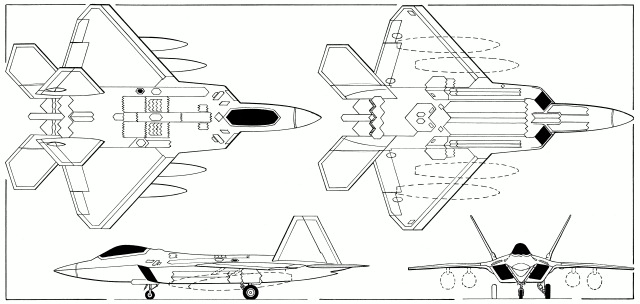
Based on (right drawing obviously!):
J-20 wingspan ~ 14m
Root chord ~ 7 m
Tip chord ~ 1.17m
‘semi’-span ~ 4.67m
=Wing area ~ 38.15m2
The MTOW of the F-22 is around 27 tonnes. The MTOW of the J-20 is speculated at over 35 tonnes. I’m sure you can get an idea of the comparative empty and fighting weights… From that will come your wing loading.


 Sign In







