 Amiga500
Just to be clear… if you are expecting a couple of photoshops with arrows and shaded parts on to impressive me…
dream on.
You have presented NO EVIDENCE whatsoever that the spray bars I pointed out earlier are not actually spray bars.
These fancy radar blockers in the reheat chamber (post spray bars*) do not exist. Grow up an develop a rudimetary understanding of aerospace engineering… please!
* THAT DOES NOT MEAN THEY DO NOT EXIST UPSTREAM (after your IR debacle, I can see how you mis-read any criticism of US equipment).
Amiga500Never heard of Photobucket or numerous others eh? :rolleyes:
Missed the couldn’t be bothered bit?
“Specifically, experts speculate that the F-22 engine exhaust radar blocker will be applied to the JSF as well. Engineers have toiled to develop a device to block the radar return of the exhaust cavity and simultaneously survive the extreme temperatures (Fulghum “Stealth is Still…” 46). Researchers from Lockheed claim to have developed a method of blocking the radar return of the F-22’s nozzles without compromising the fighter’s IR signature. . .”
(I suspect “Amiga500” will zoom right to the EJ200’s nozzle, be blinded by the struts visible there, completely miss everything else, and come back with something along the lines of “see, they’re spray bars just like the Typhoon!” )
I’m sure you’ll point to the bit where Amiga500 said exhaust radar blockers were impossible….?
I’m also sure you’ll point to the bit that specifically states (from your evidence…?) that those exhaust blockers exist downstream the AB injectors….
Amiga500Is resizing or cropping pictures beyond you or are you just trying to be obnoxious? :rolleyes:
To do so would need me to host them… can’t be bothered doing that.
Now as links… just for you. 😀
And no, those aren’t “spray bars”. (Oh don’t worry, clearer pictures are coming. :diablo: )
Very thick for spray bars, which suggests both block and spray in one.
I’m eagerly awaiting these pictures….
Amiga500That would be UPSTREAM of the radar blocker in it’s exhaust.
Yes that would be.
Unless you are now suggesting that a radar blocker would also block IR signature? :confused: (read the context of what you’ve quoted is :))
Why else would I talk about the combustor (i.e. IR) and not the turbine (i.e. radar)…?
The same place the afterburner spray bars are incidentally, UPSTREAM of the radar blockers.
Nope.
The radar blocker might be incorporated between final turbine stage and the spray bars, or as djcross as indicated as an integral part of the spray bars… but not downstream the spray bars… not at 2000+ degK.
Your original post is this:
[COLOR=”DarkRed”]And no, you can’t look up the exhaust and see the fuel injectors. If you look at the right pictures (and I have) and read the right sources (I have) you’d know there are radar blockers there which makes it so you can’t see them. You can see the radar blockers in the exhaust and you can see (from the engine exterior) that the fuel injectors for the spray bars are well upstream from the blockers. Right where they should be.
And its rubbish, as proven both by tempterature limits and this:
Clearly visible spray bars and the resultant combustion.
http://pds13.egloos.com/pds/200903/02/84/a0114784_49ab76bf4cdb7.jpg
Clearly visible spray bars.
If you still cannot see this as reality, then I cannot really help you any further bar getting someone from LM to take you to see the nozzles and explain them to you… and that is not gonna happen.
Amiga500If you want to believe the Raptor has no IR reduction features, you are free to believe it.
Just realised you generalised here.
I have never said the F-22 has no IR reduction features.
I am well aware of the fuel heat exchanger on the spine of the aircraft that transfers the heat soak from the wing leading edges to a location up over the back of the aircraft, reducing its frontal IR signature.
Again, I am specific here – there are no IR reduction features in the engine intakes* (not that there is any point burning energy trying to cool the intake pipe) or nozzles.
*bar possibly the same fuel-surface cooling system at the very leading edge of the intake inlets to reduce skin friction heating of the leading edges.
Amiga500The T-50 engines might have a layer of ‘ceramic’ RAM as a way to reduce radar and IR signature
No, no, no, no.
Its subject to the same problems as the F-22.
The heat is in the plume, not surface heating of the nozzle.
The YF-23 sheilded the initial plume from the ground and to a degree from the side due to the presence of its elevons until it had mixed somewhat*… but behind and above, and you’d see it. The YF-22/F-22 & PAK-FA are nothing like that**.
Besides, nozzles operate at 2000+ degC – so something is up with that quoted text. I suspect (but cannot be sure) that they are actually talking about the RAM layers applied to the fan on the Su-35/27/whatever BM to reduce the frontal RCS.
*see below:
**see below: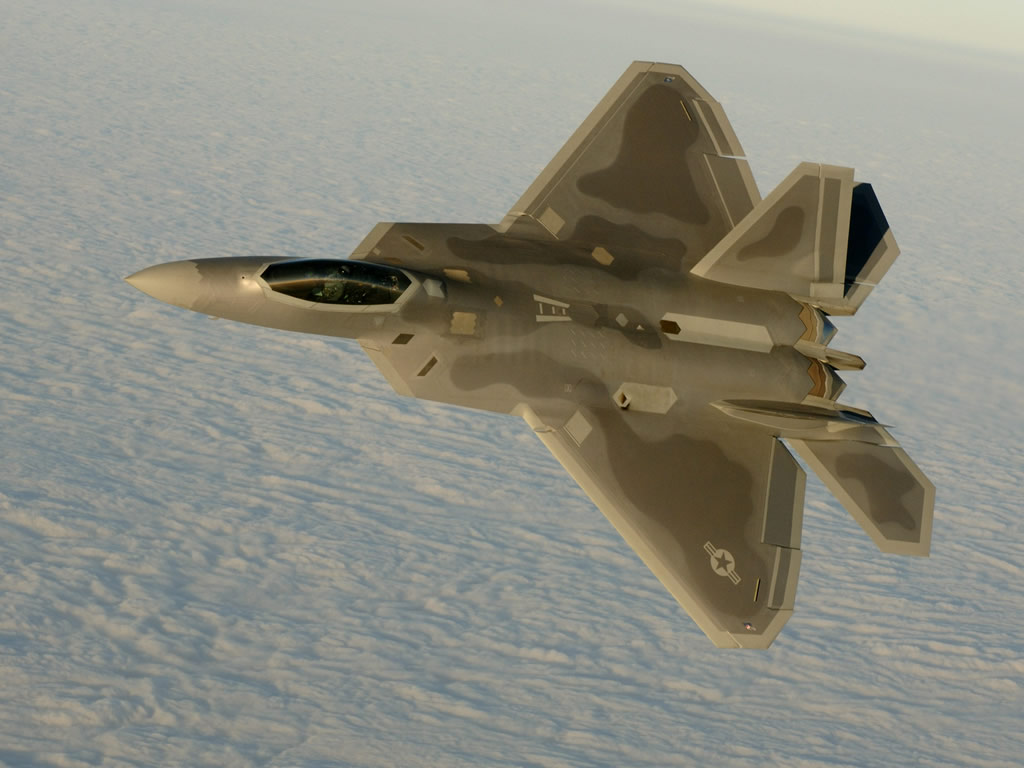
Amiga500I already have. I certainly did not make anything up.
If you think the F-22 covers up its combustor any more than the PAK-FA, then you need to brush up on basic turbojet/fan layouts… concentrating principally on where the turbine stages reside in a jet engine.
Amiga500If you take the trouble to look at the picture, you will notice, without much effort, that the afterburner is used (perhaps it’s during a take-off?).
No… really?
I hadn’t noticed [/sarcasm]
Why don’t you ask your friends at LM with whom “you’ve been talking to”? They should know. After all, they designed the thing.
I am asking you the question because you are adament they did design IR surpressive features in. Obviously you are going to have to provide some information on these (non-existent) features. Otherwise keep quiet.
I don’t have to ask them (again), because they’ve already told me… there is nothing in there to reduce IR. But seeing as you didn’t believe me, and are showing a startling disregard for basic fundamentals of jet propulsion, and of physics in general, your probably going to plough on ahead and insist you are right anyway.
They also designed the F-117, which lacks afterburners anyway, but still has similar arrangements in its nozzles and additionally has a mechanism mixing cold air with the fumes.
Similar arrangement?
That clueless meter just keeps on rising.
Amiga500What is the point of this picture? If it’s to show the F-22 has fire coming out the back in after burner well, hate to disappoint you, but so does the PAK-FA. Oh, and try more like 335lbs./sec. at ~2000K in afterburner.
Did I ever say it (the PAK-FA) was any different? Please point out where I said that. :confused:
You are off looking for an argument that doesn’t actually exist.
The 600 degK I spec’d there was supposed to be 900 degK. 600 degK is about the non-AB differential between ambient and plume (obv dependant on altitude).
The point of that picture was to ridicule the stupid notion of “covering up the heat source”. The heat an IRST sees is always the jet plume behind the aircraft, never the combustor heat.
Amiga500Even the cross section of the exhaust helps in the IR because the heat diffuses faster than with a circular exhaust.
The F-22’s chevron nozzles do not penetrate the ambient or exhaust flow, its not their design goal. Thus no added mixing from the chevron shape.
A rectangular nozzle will induce greater mixing of the flow due to screech… which will help attenuate the high temperatures of the jet plume. However, to put some numbers on it, a round jet will have a turbulence peak at around 6-9 nozzle exit diameters behind the exit plane itself. A square nozzle will reduce this to around 4-6… both of those figure ranges are dependant on a few things like aspect ratio or boat-tail angle.
Anyway, back to the point at hand. LM did not design any part of the ducting/nozzle for IR signature reduction. It is an entirely useless gesture to reduce your wake plume average temperature 5 metres behind the aircraft from (approx) 600 degreesK above ambient to 550 degreesK above ambient… (just realised that I’ve posted 600 degK in the earlier post, should be ~900 degK absolute)
And no, you can’t look up the exhaust and see the fuel injectors. If you look at the right pictures (and I have) and read the right sources (I have) you’d know there are radar blockers there which makes it so you can’t see them. You can see the radar blockers in the exhaust and you can see (from the engine exterior) that the fuel injectors for the spray bars are well upstream from the blockers. Right where they should be.
I do not know what fairy tales you’ve been reading, but there are few substances known to man that can withstand 1800+ degrees Kelvin without active cooling. There are none that can take those temperatures, and absorb EM waves.
You can read whatever you want, and you can look at whatever pictures you want. You are living in a dream world and unable to separate objectional reality from desire.
The injectors can quite clearly be seen here:

Amiga500That’s the beauty of it, I didn’t change anything. If you cover up a heat source, as the Raptor’s nozzles do, you will effectively decrease its IR emmision. Now, it may be a surprise to you, since erm… LM people didn’t told you: but it doesn’t take a PhD to grasp that.
Oh.My.God.
I actually thought you knew something about aircraft. I’ve re-evaluated your claim on knowing the M2000 wing root structure, and have concluded you probably didn’t have a clue there either.
Where do you think the combustor is in the engines of the PAK-FA? They are probably further from the nozzle exit than the F-22 (by dint of the 3D TVC requiring a longer leaf on the con-di nozzle).

Heat source covered?
If around 200 lb/sec of air is exiting the nozzle at, say 600 degrees Kelvin, what does the F-22’s nozzles do for IR?
I’m actually quite disappointed I have had to answer such a stupid post.
Amiga500Maybe the Russians do use some similar to avoid the need of a S-duct?!
I would seriously doubt it.
A blocker is a band aid fix at best.
It kills pressure recovery from inlet to fan face. I think there are figures on line for how much the blocker reduces SH engine/intake duct performance.
Amiga500True. But additionally, they can and they do hide the IR signature of the plane, which would be impossible with “legacy” nozzles, though in that case 3D TVC would be possible as initially desired.
Please tell me how.
While your at it bear in mind your talking to someone who did their phd looking at nozzle designs… and who has been talking to LM people about the F-22 nozzles.
I’ll be most interested to hear how you manage to change the laws of physics.
Amiga500No, actually the nozzles themselves are an IR reduction feature. That is why they are part of the airframe and not the engine itself, and additionally that’s why Raptor’s TV is limited to 2D.
No. They aren’t.
100% fact and not up for discussion. There is not one piece of the Raptor’s engine ducting, either up or downstream designed for IR suppression.
The nozzles are designed to reduce radar signature (in all directions bar being directly behind where you can look up into the afterburner fuel injectors).
I know 😉
Amiga500FlightGlobal’s take:
“But the exposed exhaust nozzles suggest that they don’t consider IR stealth to be that important.”
Just to nip the IR stealth thing in the bud.
As far as the engine nozzles are concerned:
The F-22 has no IR reduction features (the nozzles are triangular for radar, not IR reasons).
The F-35 has no IR reduction features.
The PAK-FA has no IR reduction features.
The YF-23 sheilded IR emissions from below and ahead of the aircraft.
The B-2 shielded IR emissions from below and ahead of the aircraft, and reduced it from above and behind the aircraft.
The F-117 shielded IR emissions from below and ahead of the aircraft, and reduced it from above and behind the aircraft.


 Sign In







