 Amiga500
Bit of a delay…
But better taking their time and getting it right than end up looking at a smoking crater at the end of a runway!
[also noises about an MRJ delay for Mitsubishi]
Amiga500And the older Flanker:

Not as pronounced a spread as the F-22, but more distributed than the F-16…
And the J-20 at lower AoA:

[Bit of an apples and oranges comparison, but you can see the two longitudinal vortices (from fore engine intake and forward of the wing root) and in the upper photo there is the beginnings of the formation of a vortex which will emanate from the canard tip – but that will pass over the wing only – not the fuselage and also note it doesn’t appear to be a cascade/sheet due to the 3D canard curvature.]
Amiga500I feel like I could learn a thing or two here. The J-20’s fuselage looks a lot like the F-22’s so why?
Compare the “shoulders”:


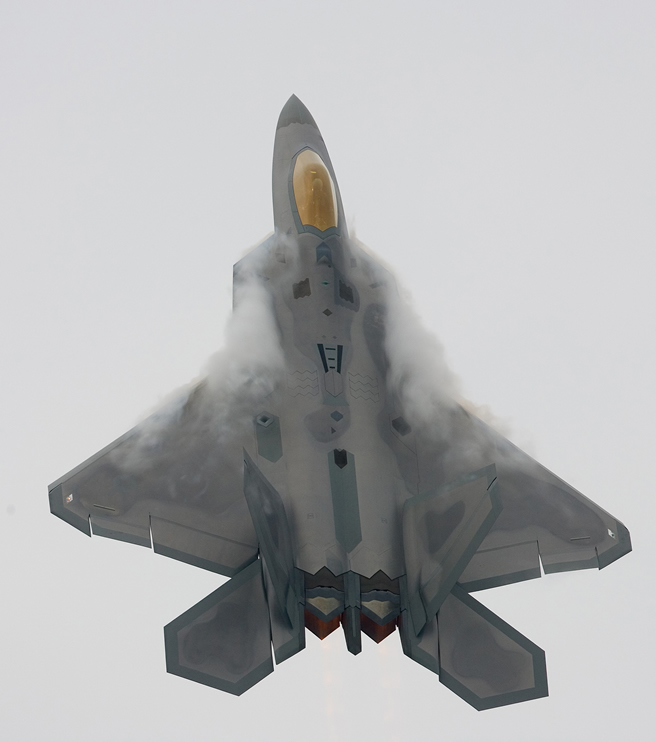
At moderate to high AoA, the F-22 generates a vortex cascade off the engine inlets over the fuselage upper surface. This cascade occurs as the flow can remain somewhat attached through the greater curvature of the fuselage “shoulder”. The forebody and the wing root/engine inlet extension will generate longitudinal vortices that transfer energy into the cascade to offset burst of the cascade as the AoA increases.
At the same AoA, the J-20 will generate a couple of longitudinal vortices off the canard and off the forebody. The curve on the shoulder is not pronounced enough to encourage a cascade. The canard can be used to generate a cascade, but this comes at the cost of the longitudinal vortex which would emanate from the canard tip and also it interferes with the vortex off the wing root/engine inlet extension.
The J-20 is using similar mechanisms to the F-16. The F-22 is using mechanisms more akin to the PAK-FA (which both are evolutions of the Flanker/Fulcrum philosophy).
See what I mean about the cascade/sheet compared to the longitudinal vortex?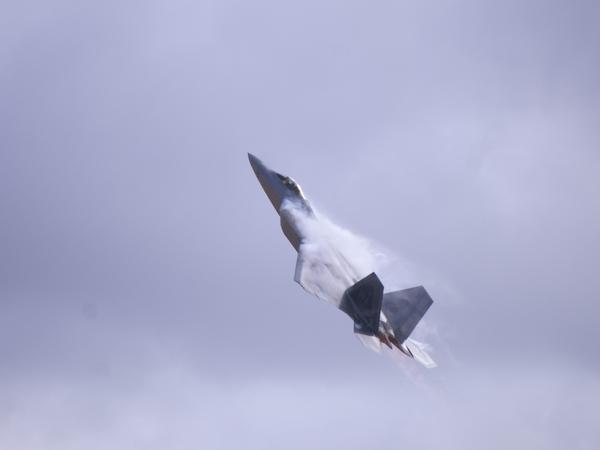

Amiga500Amiga500,
I am saying that there are a lot of photos which show what would only be a downforce on the nose (and a pretty large one) if the relative angle of the canards were acting as a control effectors. They are not.
Do not confuse a negative setting angle with respect to the airframe as a negative setting angle with respect to the freestream (AoA).
When an aerofoil section (or wing) experiences a positive AoA, the c.p. moves forward as the effective camberline (cambersurface) changes with leading edge and trailing edge stagnation point (line) movement;
The canards equivalent function is to ease pitchup requirements on what would otherwise be an entirely out of balance airframe with the wing so far back.
If they were worried about the balance of the airframe due to the wing being so far back, they’d have went for a conventional tail, moved the wing forward and made both the LE and TE have positive sweep angles. (or stuck with a smaller canard and done the same with the main wing)
That said, at high speed, canards have no function because they are attached to structure which would fold under the torsional loads if they were used as pitch effectors at speed.
The canard doesn’t carry the weight of the entire aircraft, nor is it expected to. I don’t know where you are going with that. The use of canards as high speed pitch controls is well demonstrated over a long time period.
The canards have another problem and that is that they are typically either slightly dihedraled or massively anhedraled to stabilize directional control and prevent excess rake.
But by the time you are playing superman with the nose honked way back, you may well -want- added yaw effect (from the twin rudders) so you can coordinate turns. Having canards neutralize sideslip is contrary to the point here.
The dihedral/anhedral on a canard is more due to vortex control at higher AoA than traditional stability. Especially in an aircraft with FBW on all control surfaces.
Keeping the canards neutral to the angle of flow in high AOA conditions thus looks like significant downforce, but it’s exactly the opposite: neutral, taking them out of the game altogether.
The photos do not have the canards neutral to the flow, they are still at a positive AoA (albeit negative setting angle). Also see the earlier point about shifting aero-centre of the wing with AoA.
Canards are generally worthless above what we would consider landing speeds and while this can (because of pilot G tolerance restrictions in using true accelerative departure rather than lift induced pitch pointing) include a lot of post stall nose control, it doesn’t make the canard penalty worth their restricted use overall.
I cannot begin to emphasis just how off the beaten track that is.
What canards do in highspeed flight is act as a big LEX which keeps trim forces on the tail small so that you don’t lose supersonic maneuver authority keeping the nose from Mach tucking. They become a necessary evil when you have such a long fuselage that you have to push the wing back to get the proper static margin relief between CG and ACL.
Agh. No. No no no no.
Mach tuck occurs in transonic flight only.
Shifting aero centre from subsonic -> supersonic will persist above ~M1.2. The c.p. at M0.6 will not be the same for 99.9% of aircraft at M1.5. [Interestingly, the YF-23 was supposedly close to being an exception to this – hence its alleged superior high speed maneuvering relative to YF22, which itself is top of the pops right now for supersonic turns.]
The canards in high speed flight are a more authoritative trim and control mechanism than anything on the trailing edge (or an elevator without TVC trim).
And actually, if you look at fluid dynamics, it is possible for a center of pressure to be so large as to act -outside- the body of the airframe and thus outside it’s total mass footprint. As I recall, it doesn’t typically happen outside of high end supersonics (around Mach 3.6 or 3.8 IIRC) but it is possible and it is what waveriders use to surf the shock with.
I believe you are confusing aero centre with mass centre. An aircraft will always pivot about its mass centre.
If the aero centre is outside of the mass footprint, then the aircraft will not fly very long. End of. There may be regions of higher Cp away from the aircraft near-stream, but the aero centre will always reside on the airframe.
The mass centre is the pivot about which the aero-centre acts when it is turning an aircraft. If an aircraft is in steady level flight, then by definition the aero-centre (of the entire aircraft, not just wing/body) and the mass-centre are co-located. There can be absolutely no exceptions on that point [well, assuming the thrust of the engine is also acting through the centre of mass].
Amiga500Clearly, the Sea Hercules would be a good option.
Erm, no.
10 nos.
Yet another LM powerpoint aeroplane promising much? I think best avoided.
Amiga500Why was Nimrod retired ?
I think it held up well, only its operational cost i dont know anything about
The MRA4 program was a disaster from the get-go.
The decision was made in 1996. At that stage the MR2 was 20 years old… which in itself was a refurb of airframes that were ~5 years old.
So… using 25 year old fuselages – designed in an era of paper drawings and built at a time where consistency between airframes was very much a background objective. These fuselages were to be mated to new wings with new embedded engines, which would once again have become a maintenance nightmare in time due to the long-recognised access issues.
Crazy. Nothing short of f**king lunacy!
The clowns that made that decision should be in prison for criminal negligence.
What they should have done (and still should do) is design a “plug-n-play” system which consists of (1)a hub, (2)sensor inputs and (3)terminal outputs.
Various combinations of sensors/terminals could then have been mixed/matched to C-295s purchased in the late 90s/early 2000s to fit the immediate need – in fact, with the C-295 running roughly parallel, Airbus could easily have incorporated airframe mods which would have made the C-295 better suited to the role – wired pylons for instance. When the A400M comes on line, the same hub can be replicated/transferred, allowing more/larger sensors/terminals to be added to the airframe.
The benefits being:
– new airframe(s) without the ever-present Nimrod issues.
– not tied to any particular airframe.
– flexibility in the fleet, can be converted to cargo if needed, or more MPA as needed and even within that with different aircraft types.
– strong position for export sales (can tailor the solution to an airframe size [aka price] the customer wants).
Amiga500I am sure masses will line up for their $500,000 tickets and air transport will be revolutionized.
Air transport? Ignore the stupid journalists suffering from acute ãrse/elbow.
This thing is paradigm shift in getting stuff into orbit. Look who else has been backing it.
Amiga500Another way to look at it – do we expect attack helos
and Su25s to wait for air superiority in a peer conflict? Wouldn’t make sense.
Depends on the combat zone…
The woods and valleys of Europe? or the open plains of a desert?
Amiga500Yes but what is quickly exactly…quick like chetah or quick like a little fish when you try to grap it?
Quick is getting from Mach 0.6 to Mach 1.2 in well under a minute and capable of 9 g turns to evade any inbound missile. You need to be able to push the missile into ultra-high g maneuvers of its own to effect an evasion.
[or, an alternative to quick is to have an extremely high degree of damage tolerance]
Amiga500Right and therefore you don’t need even a plane as capable as Ju-87 Stuka to do the job…DC-3 could launch missiles or Mi-8 or even Cessna-172 from 20 miles from target right ?
If you are going to the expense of using a missile motor and guidance for every single munition landed on the ground, then you may as well just use MLRS or a variant of.
If you are for dropping PG-bombs, then you have to be capable of removing yourself quickly from the dangerzone.
I’m sure your well aware of the extra range added to the likes of the SDB by a high speed & high altitude “drop”.
Amiga500The canards are in fact -neutral- to the airflow AOA, or they would become massive drag sources with huge cons spooling aft from them and a lot of unnecessary structural loading.
In a low speed condition the canards contribute control forces as pitchup that allows the tail effectors to remain neutral or even high-lift deflected with no downforce (landing and takeoff and some ‘dogfight’ conditions).
In a high speed flight (any time when there are vortices making ghost tracks over the wings) they are secondary to trailing edge effectors like flaperons or TVC because you are generating so much lift with the wings that you want to rotate around the primary airfoil’s center of lift, farther back.
Canards at high speed are largely worthless -except- as trim devices when you don’t want the nose to overrotate.
I don’t quite know what you are trying to say there.
Low speed flight; canards ~neutral for 0 aircraft AoA and no LE/TE devices deployed – this will change depending on slats/flaps deployment
High speed flight; canards slightly positive for 0 aircraft AoA [to counteract the shift rearward in the wing centre of pressure due to the changing lift mechanism from subsonic to supersonic flight]
Because of a canard’s worth as a trim device at high speeds, it is anything but worthless – it’s presence aids pitch up authority – and an equivalent elevator will tend to under-rotate the nose in the same scenario [unless TVC is used for supersonic trim à la F-22].
The aircraft always rotates around its centre of mass. No exceptions. The position of the wing/body aerodynamic centre relative to that is important and it will move from subsonic to supersonic flight.
Amiga500Maybe but that didn’t stop Stukas and IL-2s from being excellent and survivable CAS platforms…
In an era where aircraft had to close to within ~ <200 metres to have a reasonable chance of a kill.
200 metres =/= 20 miles
Ah, its not a fast jet…
Then it is a waste of time.
That would be counter-productive as you want all your fast jet assets to essentially focus on winning the air-war first, where F-15Es and Su-34s would be invaluable…
On the contrary; if you use ground attacks to :
(1) Break through the ground lines and overrun the local airfields with your ground units,
(2) Interdict fuel pipelines/transport to enemy airfields
(3) Direct attacks on airfields to destroy munitions/runways/service equipment
(4) SEAD (well, more wild weasel)
who then has greater control of the local airspace?
I’m sure Sun Tzu would have something good to say about focussing all your forces on only one aspect of the fight to the detriment of others…
Amiga500What is your solution???
My solution is irrelevant.
I’m pointing out one massive drawback to going for a pusher prop concept instead of a conventional tractor prop, after pilot protection, another issue would be the disturbed air the propeller would have to deal with reducing efficiency and yet another would be the tailstrike issue on a rough field.
Amiga500I remember seeing that design many many years ago. Yet, it still has merit. As it is a simple yet straight forward. I especially like the pusher propeller as it moves the engine back and up in the aircraft. Giving it the most protection.
At the cost of moving something even more delicate and precious to a more endangered location….
Amiga500“Contested airspace” could mean it is protected by mobile SAMs, AAA or DEW (future).
Hmmm, terminology check; is denied airspace not the name for airspace controlled by ground based assets?


 Sign In







