Amiga500
The F-35 would be pretty damn good…
If it weren’t for the STOVL requirement f**king the design team over.
Better length, better area distribution, better wing sweep, better finesse ratio, better T/W, bigger nose. It would kinematically be somewhere between F-16/F-15 and F-22 while having better sensors than F-22 and real cost savings of 1 engine.
LM have done alright-ish (despite lying through their teeth on “game changer” sh*te) given the sh*t sandwich they were handed by the DoD who lay down at the feet of the USMC while ignoring the USAF and USN.
Amiga500If it’s angle of attack, what is the motivation? Does this suggest that new designs will look to have no vertical surfaces for this reason?
To induce a 20deg AoA at that altitude and speed requires serious pitch authority. [Which the F-22 has due to the TVC use for supersonic trim.]
I don’t expect the Raptor to be able to sustain that, so don’t believe it to reflect excess power.
Amiga500I dont get it
Amiga500Ahhh, Malcolm Tucker… class!!!
Any word back from that f**king government department they set up to count the F**king moon? :highly_amused:
Amiga500thanks for the answer
but if the inwards curve LERX is better then why J-17 and F-18 use their massive outward curve LERX? , i mean their flight is obviously after Su-27 and F-16, why they didn’t use the better solution?
The “outward” LERX moves the wing-body centre of pressure forward at high AoA, this reduces the amount of pitch needed from the elevators – don’t forget, this pitch will be a downforce.
Thus, by relieving the downforce from the tail, overall lift can be equal or better to an “inward” LERX.
Also, when the aircraft does eventually stall (vortex burst), the removal of this additional lift forward of the aircraft aero centre helps induce a natural tendency to recover with a downward pitch. Hence the Hornet’s high AoA controllability without TVC.
Amiga500Wind farms are a waste of time and money until large scale storage technologies come to fruition anyway.
Amiga500So you don’t know the requirements.
You don’t know what trade-offs were examined.
You don’t the proposals.
…but of course you are already sure you know better. You realize this actually says a lot more about you than any bomber, right?
Blah blah blah.
I do know there was much hot air about cost control, minimal risk, mission creep control and statement of subsonic only.
Of course, minimal risk and no creep doesn’t tie in with trading off for supersonics… unless you are going to just build a new fleet of B-1b’s.
Amiga500Ha. No mission creep here then.
Here goes another bloated, late to the party, way over budget defense program.
And does anyone wonder why the world at large considers the US DoD to be a bunch of stupid, inept, spoilt brats when it comes to defence procurement? They essentially hold the country’s finances hostage with every program and refuse to learn from their repeated mistakes.
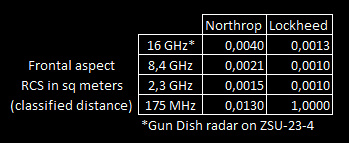
Amiga500So basically its a table on a Slovenian website with no explanation of where the numbers came from?
Amiga500Getting very much ahead of themselves.
I personally have great hope for the Sabre, but in terms of a passenger carrying “air” craft, not before 2040, at absolute minimum.
The first thing they will be doing will be full orbital insertions (i.e. satellite launches) as that is where the money is and there is no need for human flight certification. After that, they’ll be looking human cert for the ISS as a govt funded stepping stone (it has a safety net of funding). Then, you might get bizjet based products and after that, commercial passenger designs.
Here is what needs to be done (assuming they’re at TRL6, whereas I think they are at TRL5):
– Prototype to test engine functionality.
– Prototype to expand operational envelope (may require separate prototype).
– Prototype to evaluate engine endurance (may require separate prototype and significant program).
– Low weight non human orbital
– Med weight non human orbital
– Human cert orbital
– Bizjet sub orbital
– Commercial sub orbital
The sub orbital nature of point to point commerce may even require another test program for heat soak evaluation.
Amiga500but that is only a simple body, like the cylinder , a complicated body like an aircraft would be alot harder to predict the way that radar wave will interact with the body, the only way to know is if we have actual equipment to measure
Exactly. Hence how answering OooShiny’s (valid enough) question is impossible.
Just because the frequency isn’t X band doesn’t mean the RCS of stealth aircraft will suddenly go up to thousands square meters, For example : here is F-117 prototype RCS measure in test again different frequency
Where did that come from? I have to confess, I find it very hard to believe the 2.3 GHz figures unless the measurement was taken dead square and centre ahead.
Amiga500Other than a ~0.05dB/km difference in atmospheric attenuation between the 2GHz and 8GHz, can you tell me what the impact that difference in frequency has on the detection range of an aircraft sized target? What factor of range calculation does it alter and by how much?
No, I can’t.
I don’t know the numbers for how the change in wavelength will affect the RAM’s effectiveness. Nor can I state how much resonance there will be off features on the F-35 that are approximately 8-15cm in length.
How long is the aileron chord?
How long is the rudder chord?
How long is the slat chord?
Or the EOTS pod?
Or the width of the intake?
I know once the radar wavelengths are of the order of the part feature, VLO is out the window.
I believe it was a USAF general that commented:
“nothing invisible in the radar frequency range below 2GHz”
The A-50 is on the threshold of that…
Amiga500http://aerosociety.com/News/Insight-…-in-air-combat
Interestingly, the game database merges fighter ‘generations’ and ‘agility’ to give one overall number – rather than as seperate values. So the F-35 in CMANO has a fighter generation/agility in the ‘5’ class – on a par with the F-22/Typhoon/Rafale – while the the Su35 is 4.5
OK, so all the modelling with garbage going in.
I can’t even begin to imagine how much it (doesn’t) model variation of RCS with wavelength.
The frequency of the A-50 radar is ~2-4 GHz, which means a wavelength of ~7.5-15cm.
X-band fighter control radars are ~8-12 GHz, or 2.5-3.75 cm.
Ku-band is 12-18 GHz, 1.5-2.5 cm.
Quite the difference.
Disappointing really, given the potential.
[But I will probably buy it to play with. Loved the AWACs mode on F-22 and TAW. Even though my pilots were idiots with F-22s getting shot down by MiG-21s a regular occurrence! :highly_amused:]
Amiga500And fact remains, the F-35 will always enjoy a first-look-first-shoot advantage against the teens and Eurocanards.
I think that is a very, very disputable statement.
If both sides were relying solely on their airborne radar to acquire, localise and track, then I *might* agree with you.
But, they don’t.
Furthermore, first look does not necessarily equate to first shoot if you are unable to attain or retain as good a flight (launch) profile as the other guy.
Amiga500If the the F-35 is a dog then the entire navy Tac air force is a dog
Correct. The entire Navy tac air force is a dog.
But its got nice systems and is fairly reliable so they are happy with it* despite its range issues.
*Note it hasn’t had to defend a fleet against long ranged supersonic missile armed bombers yet. Their opinion may be subject to change at this point.
If High AOA is a failed strategy, ( No you never said it but its implied) then why is the Super Hornet a succes? Even scoring a F-22 kill?
The Super Hornet is not a success in ACM. Its OK at best, has good missile pointability, but when it’d come to a gun fight, an F-16 with an anyway half decent driver would keep energy up and end the fight on its terms.
When you see USN pilots talking about -16 vs. -18, how many discuss EM? Virtually none, because it doesn’t favour their steed.


 Sign In