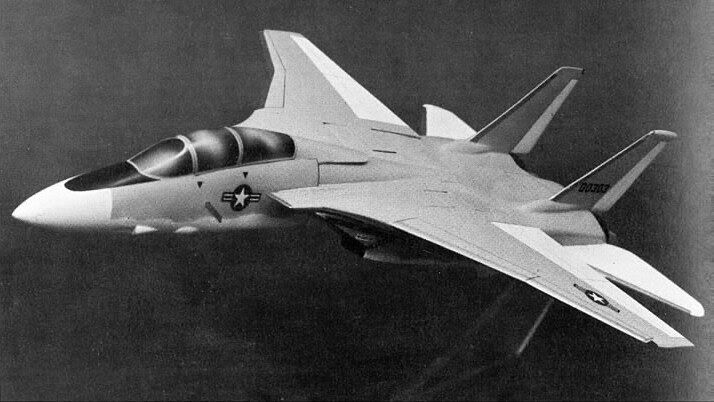
Pioneer
Here you go Rocky!
Another pic of the Design 303F study
Regards
Pioneer
Pioneer[QUOTE=JoeinTX;1087240]Funny, that LTV LWF candidate looks a lot like the Eurofighter Typhoon of today.
The USN could have lived comfortably with improved Phantoms throughout this time and done so at less cost to the taxpayer.
Grumman obvious pitched a highly modified F-14 to the USAF as a F-106 replacement, but the lack of a credible Soviet bomber threat against the “lower 48 states,” meant that there was no pressing need
QUOTE]
JoeinTX, as much as a Tomact fan as I am, I have to agree with your analogy re the “improved Phantoms“
One could almost base this analogy that in truth for its 32-year career, the Tomcat never used its Aim-54 Phoenix missile in actual combat! (Just my analogy)
Just to supplement your statement re the “modified F-14 to the USAF as a F-106 replacement“, I’ve posted a picture of the F-14 IMI proposal mock-up to meet that USAF RfP of 1972!
Regards
Pioneer
PioneerThe fixed wing Grumman VFX design 303F was one of eight final design configurations. I have no figures related to it, sorry.
I found this mate!
Although my 3-view drawing doesn’t look as clean-lined/refined as beautifully as your picture :apologetic:
Regards
Pioneer
PioneerSchorsh
From 1974 to 1985 it was really a very good fighter interceptor, but with the advent of fighters like the MiG-29K and Su-33, it started showing signs of obsolecence, the Su-33 and MiG-29K could take off without the aid of a catapult, as fighters would out turn and outmaneuver the F-14.
[/B]
Yes this is true that both the MiG-29K and Su-33 can take off without catapult, but this has less to do with the overall capability of these two planes, as opposed to the then Soviet’s problems with developing and fielding catapults, as well as their want and philosophy of simplicity, when it came to developing their (later Admiral Kuznetsov and Chinese Liaoning) class.
One has to remember that the none use of catapult by both the MiG-29K and Su-33 means that they can’t and don’t carry their full fuel and weapons load capacity, which negates overall range and loitering time on station, to say nothing of their sustainability and effectiveness in combat. When was the last time you saw a MiG-29K and or a Su-33 taking off with a full weapons complement for serious warfighting? Where as the Tomcat constantly launched with its full FAD complement of fuel and weapons to conduct its real-time mission!
Also can I add, that this no-need for catapult launch capability supposed advantage, in terms of real-world warfighting means that the Soviet’s decision to negate the need/want of catapults also had a further detrimental impact on its carrier full capability, in that without catapults, its carrier was unable to deploy an efficient AEW/AWACS (Yak-44E) capability to match and support the true effectiveness of its MiG-29K and Su-33 in the FAD mission.
Its apparent that the Soviet’s saw and appreciated the limitations of non- catapult equipped carriers, as its Ulyanovsk would have been able to carry the full range of fixed-wing carrier aircraft, as opposed to the limited scoped Admiral Kuznetsov, as it was designed and supposed to have been equipped with “Manyak” steam catapults! Its both good and at the same time a pity that the Soviet’s never completed Ulyanovsk!
P.S. please keep in mind, that the F-14D with the General Electric F110 engines capability it should have had from day one (alas GE F401), could launch without catapults if required in an emergency (although I must admit, I don’t know if this required a limitation of both fuel and weapons!)
Regards
Pioneer
PioneerI know this is a few years late pometablava, but I hope these might still be of some help!
Regards
Pioneer
PioneerI’ve said it once, and I say it again…the US Army could and should simply purchase the Agusta/Westland A129 International! Speed, survivability and a comprehensive armament the US Army has attempted to stick on and overburden the likes of the poor old make-shift Kiowa.
I can almost guarantee that what ever the US Army selects it will cost more than if it had simply purchased and fielded A129 International! Sad really 🙁
Regards
Pioneer
Pioneer[ATTACH=CONFIG]235303[/ATTACH]
Oh….also found this –
Pioneer[ATTACH=CONFIG]235302[/ATTACH]
“In the land-based F-18[L] Northrop has eliminated the weight and complexity required for carrier operations. As a result, multi-role performance is increased even beyond that of the Navy’s [F/A-18A/B] Hornet. The land-based F-18[L] provides greater acceleration, turn rates, payload, and range,
It is also less costly to operate and maintain.”
(Source: Land-based F-18 (Unknown magazine Northrop add from 1979)
Sadly and regrettably the RAAF in my opinion should have purchased the Northrop F-18L!
Regards
Pioneer
PioneerThank you my dear Forum colleagues!!
Once again I have asked and just like clockwork you have replied :applause:
This is what I love about this forum – the mass of individuals knowledge and wiliness to assist others.
I’m somewhat surprised that the, if google translate is correct (as my French is non existent :apologetic:) – The Breguet 941S was able to accommodate 40 passengers and 7 tonnes of cargo in a cargo hold 40% smaller than a “Hercules”. Its cargo hold dimensions being nearly 60m3 useful volume for a section of 2.45 2.25m for a 26m² floor.
It is somewhat deceptive, for I took the design as being somewhat larger and capable than a Buffalo or for that matter a G.222!
I guess at the end of the day it’s 4 x turboprops aren’t all that powerful all in all.
I do like the notion of the cross-linked engine arrangement though.
Thank you all again my friends
Pioneer
PioneerThat triple pylon design looks very impressive!
Regards
Pioneer
PioneerHope these help!!
Regards
Pioneer
PioneerUkraine Dispatches Modernized SU-27 Fighter Aircraft to the New Border with Crimea
Unfortunatly another case of corruption and government neglect!
Does/can the Ukraine able to support the up-keep of thier Flanker’s without Russian input?
Regards
Pioneer
PioneerGripen NG flight-tests Skyward-G IRST
Mounted ahead of the windscreen, the Skyward-G IRST unit for the Gripen E made its first flight on the Gripen NG technology demonstrator on 31 March.
How ironic and humiliating, that Western fighters are still only adapting “infrared search-and-track (IRST) system’s” in 2014. When the MiG-29 entered service with the Soviet Air Force in 1983 equipped as standard with IRST system, not to mention the excellent helmet-mounted sighting system!
Frustrating!!!!!!
Regards
Pioneer
PioneerExcept that the youngest P-3C is 28 years old (delivered 5/86) and the oldest is 36 years old (delivered 2/78), and they cannot last much longer.
So, you call an aircraft that has already achieved IOC in USN service (6 P-8As from VP-16 deployed from Jacksonville, Fla. Dec. 3 2013, to Kadena Air Base, Okinawa, Japan) “in development and not in full-proven operation”.
Are you seriously saying the RAAF should not buy it until after it has seen combat?
Since the first RAAF P-8As are to reach IOC in Australia in 2017, 4 years after USN IOC, I’d say they should be debugged by then.
The RAAF has contracted for 8, but with an option in the current contract for 4 more if the government approves them.
The RAAF has also committed to an unmanned partner aircraft (just like the USN), which should mean 16-24 total aircraft.
Thanks for your reply Bager1968
Sorry mate you’ve got me wrong.
4-months of IOC is not substantial in my view.
I wasn’t saying “that the RAAF should not buy it until after it has seen combat” at all! And yes we should wait until the bugs are ironed out. Surly as you correctly point out “the youngest P-3C is 28 years old (delivered 5/86)” . That’s 3 years!
My understanding of the Orion is that there’s nothing wrong with the aircraft itself. Sure it’s sensors and systems could be upgraded to keep it more than combat efficient, as well as its wings or airframe (or both being zero-timed) for far less than $4 billion.
I don’t recall there being a competitive tender put out for an Orion/ASW/MP replacement?
This Government we had six years ago did exactly the same thing with the non-competitive decision to go with the F-35, then the F/A-18E/F, when the F-35 program went balls-up
It’s just a little suspicious for me that once again this Conservative Government has been talking up Boeing in the media/public as a compensator for the demise of the Australian car manufacturing industry, and pow we’re purchasing 8 x P-8A’s at $4 billion. How much of this capability does the ADF need vs what it thinks is fashionable and it wants.
Hell $4 billion dollars in the ADF is a hell of a lot of money to be harassing asylum seeker boats and rescuing French and their pleasure craft 😀
Regards
Pioneer
Pioneer“Yes, they are infantry and not the AF, but their word counts for something” (TR1)
Yes one would think so! One should not forget that the principle reason the ‘Attack Experimental’ (AX) – A-10 program was followed through (even then to the protest of the USAF, who was infatuated with massive ‘fast movers’ like the Republic F-105), was because the US Army literally said to the USAF and Congress – ‘if you don’t give us this specialised aircraft our grunts need, we’ll have no choice but to acquire our own ‘fixed wing’ close support aircraft (aka the US Army’s comprehensive evaluation of the Fiat G.91R/3, Douglas A4D-2N Skyhawk and Northrop N-156F for the roles of organic FAC (Forward Air Control), tactical reconnaissance and CAS), regardless of the Key West Agreement (1947)’
It should also not be forgotten that with the USAF’s lukewarm agreement to go ahead with the ‘Attack Experimental’ (AX) – A-10 program. The US Army would forego the drive for their “Advanced Aerial Fire Support System’ (AAFSS), launched by the U.S. Army in 1964 with the intention of providing all ‘an army attack helicopter high-performance specialized in fire support.”
TR1, I don’t think you fully comprehend the politics and competitive nature of the U.S. military machine – USAF – ‘Infantry what’s infantry??’
How important is the Avenger cannon to the equation? No other type of aircraft can put those type of rounds on target, so fast and so many. (Freehand)
I totally agree with you Freehand! Once again people and organisations have become obsessed with technology, and think that ‘smart’/’precision’ bombs and missile can deal with everything on the modern battlefield. As a grunt, I cannot and would not call upon even a SDB II sized weapon if I was in close contact with an enemy. Whereas the A-10 with its GAU-8/A Avenger can and is called in for such accurate CAS fire, when in close contact with the enemy, with far less risk of sustaining friendly fire and collateral damage.
I think A-10 is no longer necessary for tank plinking, F-16 had a merry ole time plinking them in Iraq.
Why did the pilots call the new leisure tank plinking? (obligatory)
With all due respect obligatory, the Iraq War MkII, could hardly be claimed to have been a functional/viable hostile air defence threat to U.S forces. The ‘F-16 had a merry ole time plinking Iraqi tanks with such ease was specifically because the Iraqi’s no longer had any creditable intergraded air defence system, let alone weapons platforms, save that of the old true and trusted ZSU-23 and S-60 AAA. Most of the Iraqi SAM systems had been destroyed in the Gulf War 1, and what had not had fallen into disrepute or unserviceable. They even lacked MANPADS!
The freedom of such operations by the USAF negated any meaningful (true) threat, and allowed the F-16’s to operate at altitudes which would not be permissible in a ‘real war’ in my opinion
A-10 cannot operate in anything other than a permissive environment, there was a great article about the life expectancy for an A-10 pilot over CENTAG during the cold war, it’s worth a google. IADS have only gotten better, the A-10 cannot be expected to, and will not survive in a near-peer conflict such as the one you are implying. In GWI, A-10’s were restricted to within 30 miles of the Saudi Kuwait border, the one mission they flew over Republican guard forces (60 miles) resulted in two losses and seven damaged aircraft. (FBW)
Thanks FBW, I’ll look up that “article about the life expectancy for an A-10 pilot over CENTAG during the cold war”.
One thing I will say, not being an expert or anything, is that the I’m somewhat weary of such reports. The USAF (and for that matter all U.S military services) can be very productive in criticism about a weapons system/platform they neither want or deems as needing ‘urgent’ replacing. As already mentioned the USAF has been hell bent on the demise and letter withdrawal of the A-10, even before it was built, let alone put into operational service. Hell they even pushed for the acquisition of their nemeses service – the USN’s LTV A-7F Corsair to replace the ‘specialised’ A-10. Even though the evaluation of both aircraft proved once again that the A-10 was the better aircraft for the job! The USAF has never wanted the A-10 purely and simply because it’s not a ‘fast mover’, supersonic or able to carry eight air-to-air missiles. The USAF tried pushing for a so-called ‘specialised’ attack/CAS variant of it’s once love child – the General Dynamics F-16 (you know the Light Weight Fighter Program, the USAF did all in it’s power and every sly of hand to burn, bash and bury for the sake of more hot rods – their ‘FX’ – the F-15 Eagle!!) – aka the General Dynamics A-16.
I can’t help but wonder, with the USAF always using the analogy that given aircraft can’t survive the modern threat of modern generation air defence systems like that of the Russian’s and PRC, then why haven’t they completely and utterly neglected the SEAD and ECM role and mission?
I would expect A-10 to go down roughly as easily when hit by SA-3 as F-117, and it won’t dodge much better (obligatory)
I agree my friend, not many aircraft would survive a S-125 Neva direct hit period!
But then again, no other aircraft, with the possible exception of the Su-25 ‘Frogfoot’ was designed with so much intentional redundancy and protection incorporated into it’s design – something Fairchild (Republic) learnt and applied from it’s F-15 loses over Vietnam! Something neither the F-16 or F-35 can say!
An interesting thought might be that the U.S. Army take on the A-10C’s under their own ORGBAT After all in the late 1980’s, the U.S. Army argued “that the Key West agreement of 1948 under which they were prohibited from operating fixed-wing combat aircraft was now obsolete, and that the USAF’s A-10s should be turned over to them for use alongside AH-64 Apache helicopters. In 1990, Congress decreed that some USAF A-10As and OV-10 Broncos be turned over to the Army and Marine Corps beginning in 1991.
However on November 26, 1990, the USAF was ordered to retain two wings of A-10s for the CAS mission and announced that they would retrofit up to 400 existing Block 30 F-16C/Ds with new equipment to perform the CAS mission.”
http://www.joebaugher.com/usaf_fighters/f16_37.html
Thanks gents for your valued knowledge and input
Regards
Pioneer


 Sign In