BlackArcher
Maldives’ Dhruv helicopter
BlackArcherAs reported earlier, the Tejas Mk1 will participate in Exercise Iron Fist in February 2013 and will achieve IOC-2 by Sept 2013.
In other news 2 MiG-21 Type 96 currently used for fast-jet training will be reverting to combat duties after the Hawk Mk132 is fully integrated with the IAF’s lead-in training syllabus.
BlackArcherIAF’s first Pilatus PC-7 MkII. Pic courtesy of Livefist blog which picked it up from here..the IAF roundel is visible under the wing.
That really didn’t take long at all!

And HAL has had first metal cutting for the HTT-40 (Hindustan Turbo Trainer- 40) that is supposed to be used in conjunction with the PC-7 MkII in the future. From HAL’s newsletter
Turbo-prop Trainer’s First Metal Cut Launched ARDC launched the first metal cut for HAL Turbo-prop Trainer (HTT)-40 aircraft on August 22, 2012. The program is governed by strict time frame and ARDC is all geared-up to meet the challenge. Key achievements include completion of Preliminary Design Phase (PDP), finalization of Numerical Master
Geometry (NMG), Completion of Preliminary Wind Tunnel Testing, Design of major frames and system finalization.
BlackArcherThe refit is to take place in India yes, but AFAIK there isn’t any significant ToT involved. As for what countries are giving away – the IAF’s MiG-29 upgrade for 63 aircraft (as opposed to 49 Mirages) included an airframe modification, life extension and re-engining in addition to upgrades to the avionics, cockpit and integration of the HMDS. All for a third of the price. And then to top it off there was the sale of the MICA complement priced at startling $2.5 million each.
The Mirage-2000 upgrade did include ToT. And the cost of the MiG-29UPG upgrade (which is for 62 not 63 MiG-29s) is not a third of the price of the Mirage-2000 upgrade.
The cost of the contract for upgrade of the Mirage 2000 with the M/s Thales, France is Euro 1470 million while the cost of the contract with HAL is 2020 crores [about EUR 291 million; total for both is $2.04 billion, as of Dec 19/11]. The upgrade of the aircraft is expected to be completed by mid 2021. The cost of upgrade of the MiG-29 aircraft is USD 964 million and it is expected to be completed by 2016. The cost for upgrade of the Jaguar aircraft is Rs.3113.02 crores [about $585 million as of Dec 19/11] and the aircraft are expected to be upgraded by December 2017.”
First off, the MiG-29 upgrade cost $964 million without any new weapons, which is clearly not a third of the Mirage-2000 upgrade cost. Secondly, the effectivity of the upgrade should also be examined in terms of how many more service hours you’ll get per unit and compare that to the cost of the upgrade per unit. the Mirages will likely get an additional 20 to 25 years/6000-7500 hours or so. The MiG-29s will get an additional 10 to 15 years/1500 hours or so.
There’s also some grumbling about the short service life that would be left in some airframes after the upgrades are done, based on the promises in the 1982 contract and the quoted 9-year time frame for the work. The more relevant figure, however, is expected flight hours after the upgrade, which may include airframe refurbishment. The general expectation in published reports is about 20-25 years, or about 6,000 – 7,500 more flying hours, but this has not been explicitly broken down in reports we’ve seen.
The 62 upgraded MiG-29SMTs are expected to remain in service for 10-15 years, with their flight-hours lifetimes extended from 25 years/2,500 hours to 40 years/ 3,500 hours.
Clearly, we are paying more because HAL is going to upgrade 49 Mirages (after India buys 2 more Mirage-2000 twin seaters). This involved setting up new infrastructure at HAL to be able to support these fighters for another 20-25 years. OTOH, HAL’s labour rates being lower than those at Thales, it is possible that had Thales or Dassault done the upgrade at their end, the infrastructure cost would have been offset somewhat by higher labour rates. And these upgrades are quite man-hour intensive.
BlackArcherdon’t show prospects as orders for the Mi-26. Besides, I see that when I talk about the Ka-226, its not part of the answer. anyway, I don’t want to waste my time engaging in a discussion with a person like you (directed at JSR), so don’t waste your time replying either.
the IAF is looking to retire the MiG-27 fleet by 2017
BlackArcherBlackArcher, what is the status of the UPG upgrade? This report could conceivably indicate a switch to the new Zhuk-AE if the upgrade is modular and as so few UPGs have been completed. Personally, I’d wait for details of the radar for the IN’s second batch of 29 MiG-29Ks as these may (optimistically) receive the new AESA, because unless the RuAF orders the ’35, the IAF or IN will definitely be the launch customers.
Otoh, this report is by RFJ and hence needs to be taken with a kilo of salt.
As yet, there have been no MiG-29s upgraded to the UPG standard in India. There should have been around 6-10 MiG-29s already upgraded in Russia though. A lot of the time that has been spent has been on testing the upgraded Zhuk-M2E radar (which has IAF specific modes) which is a major part of the upgrade. While it makes a lot of sense to go for the Zhuk-A when it is available, since the MiG-29UPGs will be around till 2025 or so, I’m not sure about the IAF being ok with the additional time that it will take to first integrate, then test and then operationalise the Zhuk-A on the UPGs. with squadron strength dropping, those MiG-29UPGs with Zhuk-M2E themselves represent a very required capability.
And the IN’s second batch of MiG-29Ks were also contracted with the Zhuk-ME radars and not the Zhuk-A.
BlackArcherM2K line ceased to exist years ago, but they still could buy a few mirages from the French (even if most of these are quite old as well), or eventually buy UAE Mirages as an interim solution, buying probably up to a decade to decide what they want to do. As they already have the pilots qualifies to fly them, infrastructures to maintain them, the investment wouldn’t be too costly. They are, even for the oldest ones, in excellent condition and very well equipped and one can be sure they’d get a full support from the french to whom that may (re)open the possibility to get the UAE to buy some Rafales.
of course, to get them soon, the negotiations between Dassault and UAE should go fast, but as the two major points on which the negotiations stalled were the selling of these Mirages and the overall price, this market may encourage Dassault to make a better offer (with indian market, the UEA one and possibly the brasilian one to follow, it may be much easier for Dassault to propose rafales at quite a competitive price, by now.. )
actually the better fit would be the Qatari Mirage-2000-5s as opposed to the UAE ones. they have 11 of those and they have plenty of hours on them left having been used quite lightly, so they’d get 11 for the 12 the FAB has currently.
the IAF evaluated them and found them worth purchasing but the price negotiation didn’t work. They were costly though- close to $40 million each, but Qatar was willing to sell their MICAs with the fighters and spares as well.
BlackArcherWhoa Whoa Whoa, MiG-29Upg part two ?
And what does the IAF do with the Zhuk-M2E radars on the MiG-29UPGs? Retire them within a few years of their entering service with the IAF?
BlackArcherYou can do your own research.
The point is, they are all produced by the same holding- and it has massive backlogs.I am sorry your nationalistic feathers were ruffled, but the Indian tenders for the Heavy Lift and Attack helos really are too insignificant to “test” the relationship with Russia.
Ka-226 would be a more significant order, but since Russian Helicopters ain’t hurting, they have no reason to get too upset.
You’re the one claiming that they don’t need orders for the Mi-26T and the Ka-226 since they have enough domestic orders..so why shy away from providing the figures? I know the real reason..had the figures been large enough you’d be jumping over yourself to provide them.
Ok, one order for 18 Ka-226TG from Gazprom..Apart from that two orders for $1.5m for 10 Ka-226 for the Moscow City Govt way back in 2001 and $25m for 6 Ka-226 from the RJAF in 2007..
and for the Mi-26T,
From “Helicopter International”, Vol. 35, Number 4, Jan.-Feb., 2012:
http://www.aviapress.co.uk/heliint.pdf
The Russian Air Force is planning to upgrade its fleet of heavy lift Mil Mi-26 helicopters and order additional aircraft from the Rostvertol plant to increase strength to around 50-52 helicopters.At the beginning of October only 23 of the 30 Mi-26 on strength were serviceable, with seven aircraft awaiting overhaul or repair. The plan is to bring these helicopters back into service with upgraded avioincs and powerplants, whilst also ordering 22 new Mi-26 for delivery over the next several years.
So 22 new Mi-26T for the RuAF..that’s a whopping 6 more than the IAF wanted ! 😉
those numbers are big enough for you to be nationalistic and boast how insignificant the Indian orders were for Russian Helicopters? :rolleyes:
BlackArcherArbalet is not even operational yet on the Mi-28, so yes it was clearly disadvantaged in that area compared to Longbow which has been around for a little while.
That photo is a mockup.
That really wasn’t India’s problem though, was it? The IAF had a requirement of a mast mounted radar and both the contenders had operational radars or at least a planned mast mounted radar. That doesn’t in any way tilt the balance in any one contenders favour deliberately as was suggested by someone else.
BlackArcherI think it would be best if India pulled out of the Il-214 project and instead went for C-130. India gains no technical base / experience with the Il-214 since it has no input in it other than a few avionics. So instead we could go for the best in industry plane in that category, C-130, and have it license built by Tata.
Tata would gain aircraft building experience instead of wasting more money on that failed PSU known as HAL.
I agree that India should simply dump the MTA program. the MTA has gone nowhere and there is really precious little to gain by collaborating with the Russians on that anyway. But, as things stand, HAL is still slated to go ahead with it..sometime in the future..:rolleyes:
The better option would’ve been to go with Embraer on the KC-390. India would’ve given an order much larger than that of any other customer currently involved in the program and could have as a result contributed more as well.
BlackArcherYeah, check the Russian Helicopters portfolio.
This order does nothing to hurt them, since they are heavily backlogged anyways, both in export and for the first time, domestic orders.
So how many orders for the Mi-26T and the Ka-226? Why not just give a direct reply?
BlackArcherSince one of the Indian requirement was a mast mounted radar the outcome of the tender was crystal clear, they are trying to reinvent the wheel for political reasons, brivery or both.
What do you mean? the Mi-28NE had a mast mounted Arbalet radar. That requirement did not in any way skew the decision in either party’s favour.
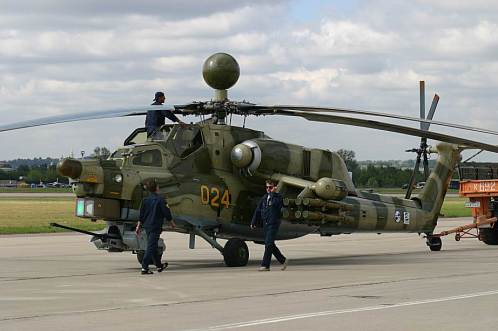
BlackArcherIndia is going to be the latest customer for the AH-64 and will be getting 22 Apache AH-64D for an estimated cost of $1.4 billion. i.e an average of $63.64 million/unit, making it even costlier than IAFs current Su-30MKI.
Have you seen the number of weapons that the DSCA notification included in the proposed sale?
Just to save you the trouble and for future reference, I’ve posted the DSCA notification and quoted the relevant portions
DSCA Notification- 22 Apaches for India as part of a PACKAGE
The Defense Security Cooperation Agency notified Congress on December 22 of a possible Foreign Military Sale to the Government of India of various engines, equipment, weapons, training, parts and logistical support for a possible Direct Commercial Sale of 22 AH-64D Block III Apache helicopters. The complete package is worth approximately $1.4 billion.
Each AH-64D itself is not worth $63 million. The following list shows just why the TOTAL figure comes up to $1.4 billion
If the Government of India selects the Boeing-U.S. Army proposal, the Government of India will request a possible sale of 50 T700-GE-701D engines, 12 AN/APG-78 Fire Control Radars, 12 AN/APR-48A Radar Frequency Interferometers, 812 AGM-114L-3 HELLFIRE LONGBOW missiles, 542 AGM-114R-3 HELLFIRE II missiles, 245 STINGER Block I-92H missiles, and 23 Modernized Target Acquisition Designation Sight/Pilot Night Vision Sensors, rockets, training and dummy missiles, 30mm ammunition, transponders, simulators, global positioning system/inertial navigation systems, communication equipment, spare and repair parts; tools and test equipment, support equipment, repair and return support, personnel training and training equipment; publications and technical documentation, U.S. Government and contractor engineering and logistics support services; and other related elements of logistics support to be provided in conjunction with a proposed direct commercial sale of 22 AH-64D Block III APACHE Helicopters. The estimated cost is $1.4 billion.
What differentiate the Indian condition from that of prior deployment of AH-64 is that, unlike the earlier 2nd & 3rd rate opponents the helo was employed against, the two adversaries against whom IAF is likely to employ the AH-64 is Pakistan & China, both of whom are well-trained professional militaries. In the western front (Pakistan), there are two areas – desert/plains & to the north-western sector (Kashimr), with full of terrain that can help in laying ambush. The Eastern front is low on plains and is primarily rich for laying ambush on any airborne attacker.
An argument often said against the current gunship Mi-35 in Indian service (by the media/’experts’) is that it cannot be used in high places and was a useless purchase. So many were hoping to see the AH-64Ds to be employed at high altitude due to its superiority over the Mi-24. But the real performance envelop says it will only be operating where Mi-24/35s used to operate and not at high altitude theater.
the Mi-24/35 is indeed not useful in higher climes. The operating height ceiling effectively ruled out its use in the Kargil conflict and that is a fact that the IAF acknowledges and is not some thing that the “media/experts” (as you call them) have cooked up. the LCH had a specific requirement that it be capable of operating at higher altitudes because the IAF had to make do with the Mi-17 rigged as a gunship at higher altitudes, which was far from being the best platform.
the Apache is not being acquired for the IAF to use at higher altitudes. the Rudra (WSI Dhruv) and the LCH will be used for that. the Apache will be used to replace the Mi-24/35s that have reached the end of their service lives.
So considering the Polish experience, what chance does AH-64Ds have in a modern day battle ground and what chance that it can get ambushed?
Since itz cost is very high, even loosing a couple of these will be a severe dent on pocket.
I’ll turn around the question and ask- what chance does ANY gunship have? Does the Mi-35 or Mi-28N have a better chance? If you lose your aircrews is that less important to your overall battle plans as opposed to just a dent to your pocket? If the IAF has just a 22 strong AH-64D fleet or a 22 strong Mi-35/Mi-28N fleet, the end result of a devastating ambush will be the same as far as the results of the battle for the IA will be.
You make it out that this is an issue specific to the AH-64D which is not the case. Against clever tactics from a well trained and intelligent enemy SAM force, any gunship may struggle.
OTOH, from the Indian perspective, the AH-64D is by far the most modern gunship out there and the improvement in the avionics on board and the weapons employed will be worth it as opposed to the Mi-24/35s that the IAF operates today. Overall, it will be far more effective in stopping an armour advance as opposed to the existing gunships of the IAF.
BlackArchersweden would never sell any fighter to algeria, thats my 5 cents anyway
why not? same reason as they didn’t sell the Gripen to Pakistan?


 Sign In