 BlackArcher
another delay? Till when are their Mirage-2000s supposed to be in service?
Why can’t Brazil at least upgrade those Mirage-2000Cs from the Adl’A to allow them to operate them for another 15 years at least, in an upgrade similar to that of the IAF. That would release some pressure on the FAB due to the new fighter selection delays.
BlackArcherIndonesia to rely on upgraded F-16s and future K-FX figther with South Korea for its fighter needs
They have no plans on adding additional Su-27s or Su-30s and are happy with just 1 squadron of Sukhois and 24 upgraded F-16s till the KF-X arrives and they can equip with 3 squadrons of them.
The reports of the Indonesia AF’s size growing to 200 odd fighters with a large complement of Su-27s seems to have been either unsubstantiated or they’ve dropped those plans due to budgetary constraints.
BlackArcherBlackArchertook them that long to realize this? they’ve been flying it for about a decade now..
It must’ve been a design flaw that was only discovered through some accidental situations. Otherwise, its the Sukhoi design bureau that would’ve discovered it, not the IAF, who’re the operators not the designers of the FCS.
BlackArcherin his words.. they are all excellent aircraft.
which of course is true- none of the MRCA contenders are fighters to be scoffed at and had they joined the IAF’s enemy air force’s fleet, would’ve caused quite a bit of concern.
all of the airplanes that were evaluated had their own strong points. They had their own weak points as well, which was what led to the one with the fewest weak points, getting through to the final stage and out of those the Rafale emerged the cheaper (and as per many reports, it was the favoured fighter for the IAF too). Vishnu Som is one of the better defence journos in India, and while his reports aren’t very technical (and he himself is humble enough to accept that on BRF), he presents the facts far better than someone like Shiv Aroor, who has also had joyrides on board MRCA contenders (and those were pretty much just joyrides- they give precious little information on the capabilities of the aircraft).
BlackArcherSo you cant jump from SH to F-15 or F-16 with the same G-suite and just plug in???:eek:
can you jump from a Gripen to a Rafale to a Typhoon to a Su-35 to a MiG-29 and just plug in your g-suit?
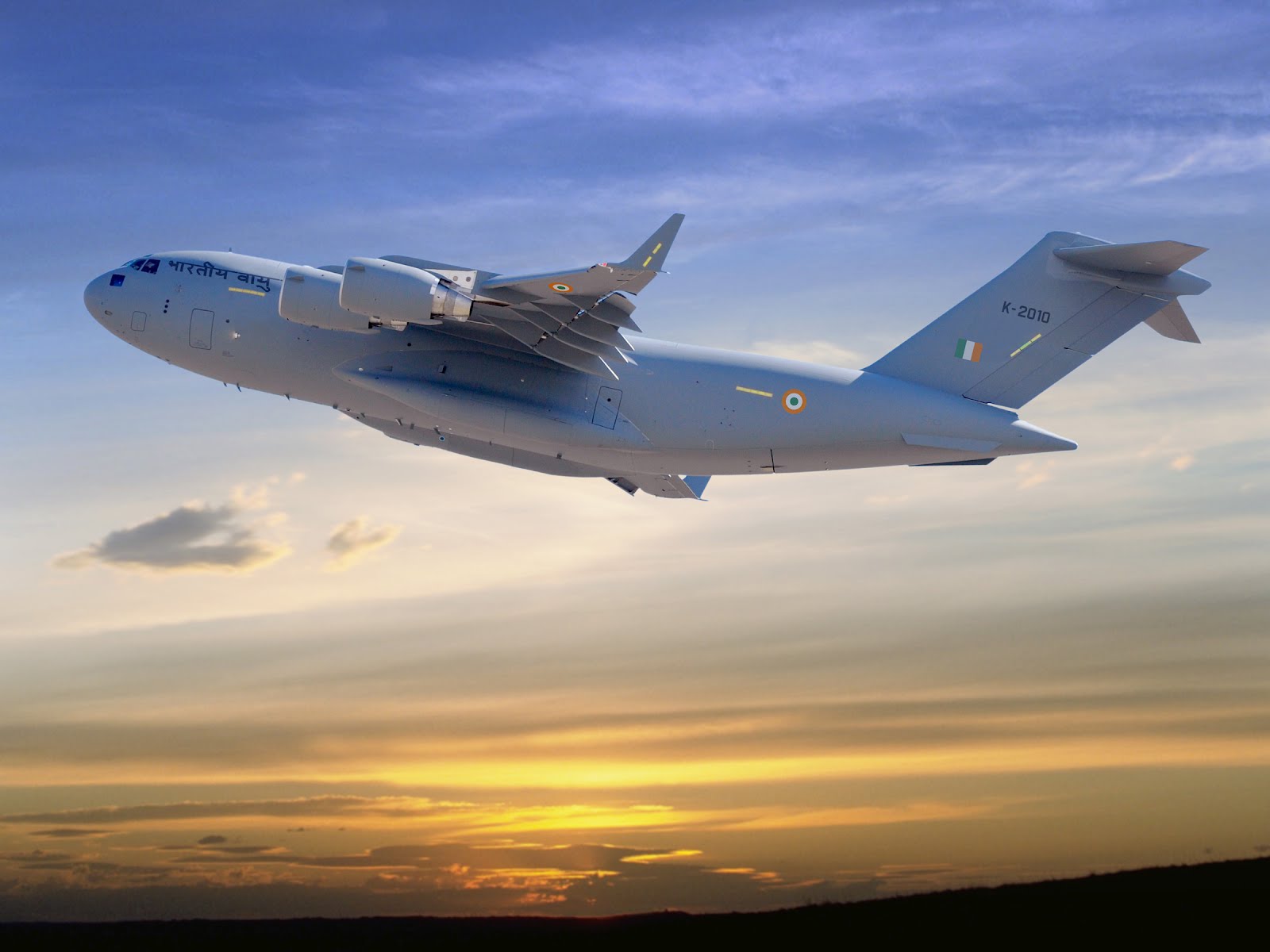
BlackArcherWhat the IAF’s C-17s will look like…first one to be delivered to the IAF in May-June 2013 and all the remaining 9 by the end of 2014.
picture courtesy Livefist blog
BlackArcherAt dogfight if the both aircraft has the same aerodynamic configuration, engines, hud or hmd, whose pilot is better that wins!
That is assuming a fair fight, one that begins with both pilots in the same situation, having no advantage of situational awareness over the other, both with the same set of weapons and in nearly the same fuel state. Of course, in reality, such an ideal set up can only happen in an exercise that has its own RoEs.
Such topics never end well, and generally plunge into flame wars.
BlackArcherGood thing that IAF has refused the LSP’s. I could see pilots being killed by them.
I presume HAL has been aware of the problem for several years and wonder if in that time they have come up with a robust production method to ensure the problem will not arise with series production aircraft. I hope that the C of G and positions of centre of pressure on a correctly assembled aircraft are where intended by the designers. If not, the designers have a big headache, don’t they?
wait till you hear something official from the IAF or some reliable sources. Vijainder Thakur is a known baiter of the Tejas and has written some rubbish articles in the past.
BlackArcherTurkey might well be a dysfunctional country in many respects but it is in no risk of an Islamic style rebellion, its military is secular in nature and won’t stand for that.
How’re they secular? they’re extremely intolerant of the Kurds.
BlackArcherAfaik it was just an MoU to market the plane in India ?
It may well be so- but this is a golden opportunity for the private sector to get a foot firmly in the door. If they succeed in this assembly (which is what its going to be initially) and then manufacture and assembly of the transport, they’ll be far better placed to demand that the govt. give them a larger share of the future pie in license manufacturing and eventually even design and manufacture (even though they have zilch aerospace design experience, all pvt. sector players put together in India).
BlackArcherThe IJT was originally supposed to be inducted by 2009. Then 2011. Every time it ‘gets back on track’ we just hear of more mishaps and schedule slippages.
The IAF should just ditch the program and buy the M-311 or a high-performance turboprop like the PC-21 for the intermediate trainer role.
Really speaking, there is no extremely pressing need for the HJT-36 to enter service right now. The IAF isn’t going to replace its entire Kiran fleet in one go. Even after the Kirans are gone, the IAF will have a sufficiently large number of PC-7 MkIIs that it could use to increase the syllabus and flying hours on the basic trainer and then skip the intermediate phase and send pupil pilots onto the Hawk 132s.
If the HJT-36’s stall and spin tests go alright and it enters service in 2015 or even 2016, it’s far better than opting for an off-the-shelf foreign design that means a large outflow of currency and does nothing to take India’s aerospace industry forward. Plus you’re assuming that off-the-shelf purchases materialize overnight. There is such a lot of bureaucratic hurdles to cross before the Govt. approves such a purchase (which’ll be fought tooth and nail by HAL and MoD) and the OEM will also have to establish its own production facilities for such a type before it can meet an IAF demand. Far more prudent to just back the HJT-36 to fruition and sort out the issues, rather than giving up and taking what seems (but isn’t) the easy way out.
BlackArcherDef Min clears Rs 12,000 cr proposal for 56 aircraft
Who else if not HAL ? Mahindra (said to be considering buying beechcraft) or Tata (which has expressed the desire to partner with Lockheed Martin to produce C-130J in India should there be a large enough order) ? Or will L&T-Cassidian will expand its portfolio from defence electronics to aircraft assembly ?
The C-130J is too big an aircraft to replace the HS-748 Avro in the IAF. It’s primarily used for light cargo and troop ferry roles now and the C-27J Spartan or the C-295 will be the likeliest replacements for it.
Here’s a very interesting read – an article by Gp. Cpt (retd) Kapil Bhargava on the HS-748 Avro in India.
BlackArcherNews on the PC-7 Mk2 and finally some news on the IJT too
Bangalore: The Indian Air Force (IAF) is gearing up to induct the first batch of Swiss Pilatus (PC-7 Mk II) basic trainer aircraft (BTA) in Bangalore. Scheduled to arrive in January 2013, the Pilatus turbo-prop aircraft will be used for Stage-1 training of rookie pilots. In the first lot, the IAF will receive six aircraft out of the total 75, as per the Rs 3,000-crore-deal inked in May 2012. Thereafter, every five planes will make touchdown every two months.
Air Marshal Rajinder Singh, Air Officer Commanding-in-Chief, IAF Training Command (TC), Bangalore, told Express that a team of pilots, technicians and ground crew are heading to Switzerland. “The three-months training will start in October and they would impart training to IAF officers after returning. We have begun setting-up infrastructure to house the aircraft. The hangars and other ground installations have been inspected and certified by a team from Switzerland,” Rajinder Singh said.
With Pilatus joining the fleet, the IAF hopes to up the flying hours of cadets from 30 to in excess of 60 hours. Then on, the Stage-II will be on Kirans and Stage-III on British Hawks. “We have not cut down the number of flying hours in training and there is no compromise on quality. A basic Pilatus trainer simulator too would join us soon. We hope to have adequate number of PC-7s by the end of December 2013,” Rajinder Singh, said. Currently, the first two stages of training are done on Kirans.
While the Kirans are set to be phased out by 2015 and the IAF not sure of getting Hindustan Aeronautics Ltd (HAL)-built Intermediate Jet Trainer (IJT) as a replacement, concerns were already hovering around. “Inordinate delay in rolling out IJT will be a problem for the IAF in 2015. In my opinion, to get IJT by 2015 is a near-impossible task and the IAF will have to re-design its basic, intermediate and advance training. If we are up against the wall by then, the training will have to be on PC-7 and Hawks,” says former IAF Chief Air Chief Marshal (retd) Fali Homi Major.
HAL says that the IJT was back on track after the April 2011 mishap. “The second prototype has undertaken few sorties after the modification. We are now preparing for completing the tasks of stall and spin tests, which are major requirements for certification of this class of aircraft,” HAL said in an official communication. “The first two limited series production (LSP) aircraft are also undergoing the installation of the modified control circuits and will join the prototype aircraft soon to enhance the developmental flight activity,” HAL added.


 Sign In








