BlackArcher
20 Mk1 + 20 Mk1 + 83 Mk2 + reserves + options
how many is that ?
I think that he forgot that 40 Tejas Mk1s will be serving by the time the Mk2 enters service. 🙂
BlackArcherThe mk2 is scheduled to fly “in 2015 or 2016” link.
Allow for some delays and then some years of flight testing. Let’s say it becomes introduced in 2020 with production of 10 a/c a year — by 2025 there will be 50. OK, perhaps not “tiny”, but still a rather smallish number.
I think it will be an open question if IAF really wants to order much more than that given that by 2025 focus will be on 5. gen and UCAVs…
Considering that ADA has done the wise thing and kept airframe changes rather small (more than Gripen C to NG but a lot less than Hornet to Super Hornet) and not introduced new control surfaces, they should be able to meet the timelines set, provided they don’t run into some unforseen issue.
Give 2 years for flight testing them and you have the first Tejas Mk2 entering IOC by 2017 and IAF will start recieving them from 2017 onwards itself. And HAL’s rate of production can be increased, a number of 14 per year has been touted as well. It will be based on the economical numbers that can be produced for the total numbers ordered. If the IAF orders 83 Tejas Mk2s, then maybe only 12 per year will be manufactured but if more orders are placed, then HAL can ramp up production if required.
Overall, the numbers of Tejas Mk1 and Mk2 in the IAF will at least match if not exceed that of the MRCA. Even if follow-on orders for the MRCA are to be placed, they won’t be arriving too soon. They will be produced only after 2020-23 or so.
BlackArcherI note that the comparison has been misleadingly skewed by “C-band data link”, as if data links using other frequencies don’t count. Not really worth looking any closer.
I think thats called ‘Spin’. SAAB are acknowledged masters at that.
BlackArcherthis comparison is crap….nothing is right 😉
might be more useful if you can point out the “crap” parts. So we know that Sweden doesn’t operate the EMB-145, but it does operate the Erieye on a Saab platform doesn’t it ?
BlackArcherTejas Mk2 picture by Shiv Aroor (who got to fly in a Rafale). The additional 0.5m seems to be distributed just aft of the cockpit and the wing-body blending has been made much much smoother. Looks just perfect now !

BlackArcherSarang display team


Notice the flock of birds..


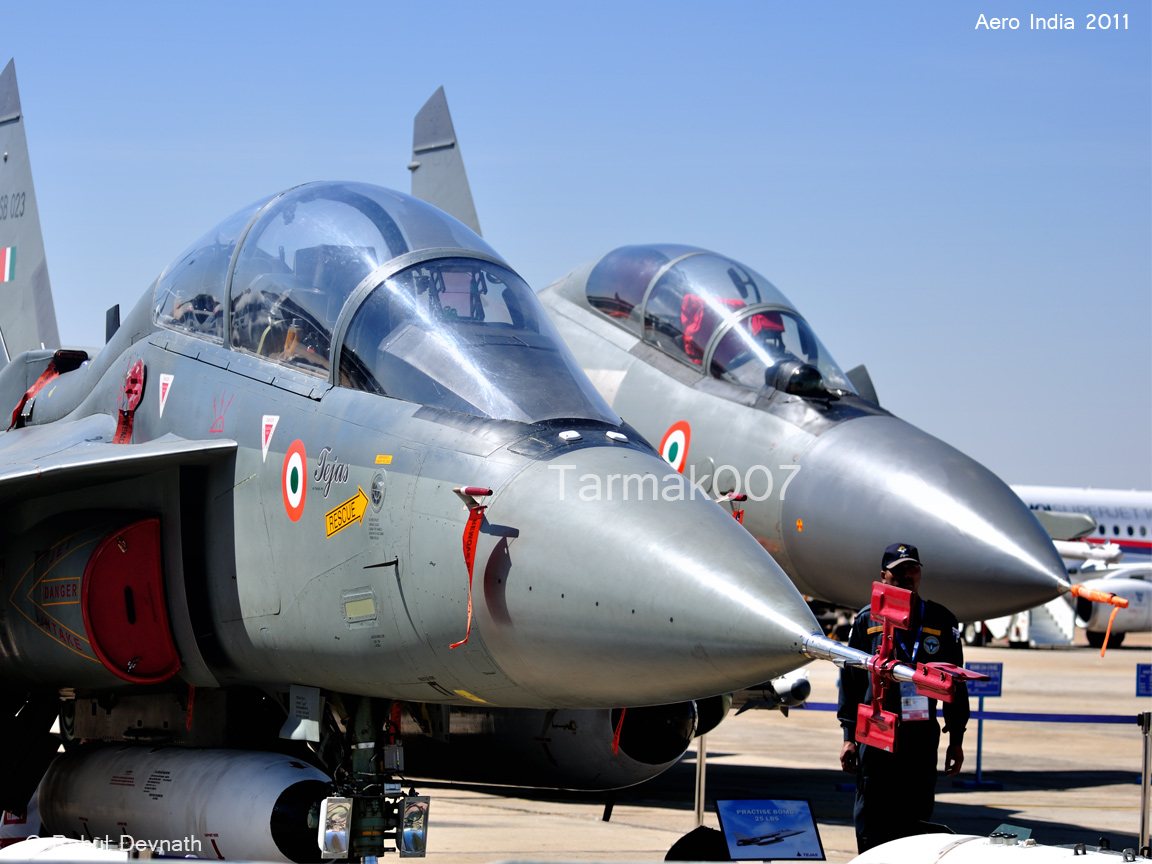
Indian Navy guys with Tejas twin seater..the man in the middle in the suit is retd Adm Arun Prakash (one of the first to fly the Sea Harrier in the IN) and the guys flanking him are Navy deputed test pilots for the Tejas program. The man with the beard is Captain Jaydeep Maolankar who gave a great presentation on the Naval LCA, including the issues with the aircraft and the future testing program off the Shore Based Test Facility and Afloat tests.

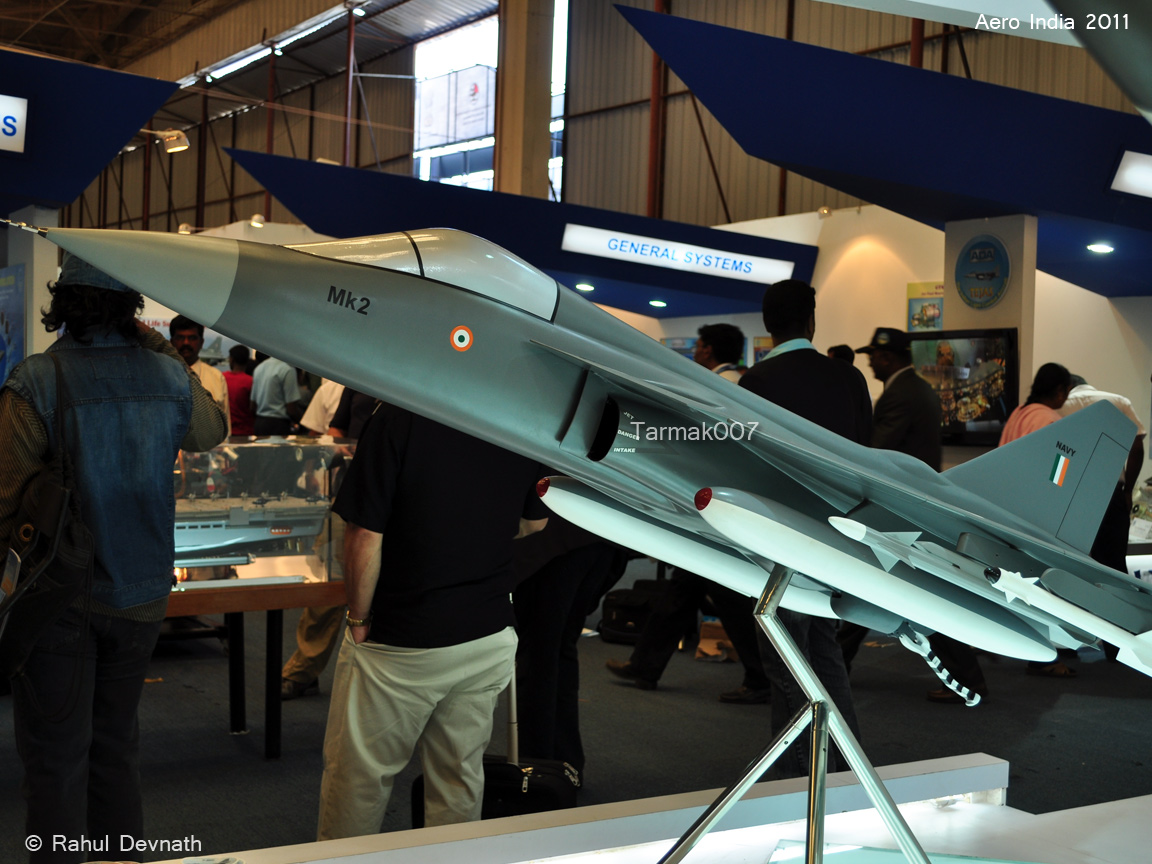
Beautiful N-LCA Mk2
BlackArcherIf the AMCA was a single engined fighter it would need a really powerful engine to be a stealth fighter considering the internal volume of stealth fighters is generally much more than regular fighters.
With no such engine available, and with India wanting an indigenous turbofan (and the only one available is going to be in the 90kN class) to be used on the AMCA, it leaves no option but to go with 2 engines.
As for Russia partnering India, it is actually a very remote possibility. Russia has decades of expertise on fighters and would almost naturally assume the lead role in such a fighter project, whereas what India wants is to develop the expertise by doing the bulk (not all) of the design and development work within India itself.
Which is why smaller nations with solid experience would be better partners- they could contribute technologically but not necessarily push for design lead. And considering Dassault’s history in this matter one might think that they would’nt fit it so well. SAAB OTOH are possibly the best partners for ADA/DRDO/HAL on this project.
BlackArchersorry what i meant to say is how does LUH differ from Dhruv. not LCH. my bad.
Single engined compared to the twin engined Dhruv. Slightly more than half the empty weight of a Dhruv. Meant to replace the large numbers of Cheetah and Chetak helicopters in IAF and IA service.
BlackArcherAMCA looks like a baby PAK-FA! Is it known if Sukhoi or other russian aircraft design bureaus are involved in designing the AMCA ?
In my honest opinion , going in the realm of speculation, but if the russians get into some sort of deal with the indians regarding AMCA , a sort of reversed FGFA joint venture , it would be a great idea.
A russianized AMCA , with russian engines ( i’m sure they can easily come up with upgraded 10tf class RD-33 derivatives, such projects were /are in the work for years , isn’t it ?) and avionics, and maby custom russian design features would be a wonderful suplement for PAK-FA, and i would think at a fraction of the cost of developing a LMFS from scratch.
Anyway just a random thought.
There is no doubt that HAL’s experience with the PAK-FA based FGFA will cross pollinate to the AMCA project as well. And with India sharing the IP for the FGFA with the Russians, there will be avionics, LRUs, RAM coatings, actuators, etc. that are definitely going to be shared between the platforms.
But, as of now, the Russian side has not shown any interest in approaching India and looking to partner it in the AMCA program. It would make sense for them as well, since they have a large fleet of MiG-29 class fighters that need to be replaced and the AMCA is in the MiG-29 weight class.
One thing that has been seen is that the scientific community in India tends to gravitate more towards Western systems as compared to Russian systems. The HJT-36’s AL-55I engine was the only exception and that too because there was no alternative available and the Larzac was considered underpowered. So, it would seem more likely that ADA (HAL is not the lead agency for the AMCA, ADA is) will try to see if the MRCA winner OEM can be partnered on the AMCA. SAAB has already expressed willingness to join the program and EADS has been consulting with them lately. Dassault too had an association with ADA, although that ended early in the Tejas’ development program.
As for the AMCA’s engines, the most likely candidate is the Snecma-GTRE Kaveri engine with ~90kN thrust. The RD-33 has not really interested India much beyond the MiG-29s it operates.
BlackArcherWhy does it need the more powerful EPE if it already has a respectable TWR?
:diablo:
Scooter has his loyalties and that explains why he defends the Shornet. No harm in that.
But recently in AW&ST itself, an official associated with the Shornet program himself said that the Shornet is drag constrained and the EPE engine was specifically aimed at addressing the performance issues that the IAF is concerned about.
The IAF quite clearly wants a multi-role aircraft with emphasis on performance since avionics are in flux mostly and can be specifically developed to be more modern as time progresses. However, if the platform has poor acceleration, climb rate and maneuvering performance, that will put it most likely at the bottom of the IAF’s wishlist.
BlackArcherOf course the Super Hornet is going to feel sluggish compared to the others. It’s a carrier capable aircraft carrying over 3000lbs of external stores (2x Mk 83’s, 2x BVR missiles 2x winders), whereas the others have a pair of winders at best…
Beef up the other aircraft so they can take off and land from a carrier, load them up with 3000lbs + of external stores and let’s see their airshow routines…
However it is a good thing that an aircraft is not bought because of pure performance alone, though I imagine an extra 8000lbs of thrust and reduced drag (in likely future operational configuration compared to the present) will improve things a fair bit…
There is a point of the Super Hornet carrying those stores during it’s routines at airshows. Regrettably that point is lost on many.
Cheers,
AD
While you make a valid point about the fact that the Super Hornet carries additional weight thanks to it being a naval aircraft, that really doesn’t matter to the IAF. Why would it ? They aren’t landing their fighters on aircraft carriers or launching them off catapults, so as far as they’re concerned, its additional weight that isn’t needed.
The fact that the SHornet carries a few more stores during airshows than just the dummies that others carry (which simulate weight and drag even though they’re dummies) is not lost on those who really understand what aerobatics displays mean. But the fact is that the IAF will put a premium on aircraft kinematic performance and this isn’t the SHornet’s strong point. With the F414EPE engines’ additional thrust this may be offset, as well as the CFTs and stealthy and lower drag weapons pod, but the evaluation was done without any of these features, so the IAF cannot rate the SHornet on potential future capabilities.
However, it does stand a far brighter chance than does the F-16IN, which stood little chance thanks to sales of Block 50s to PAF.
BlackArcherMBDA and Rafael competing for missile for Jaguar
European company MBDA and Israel’s Rafael are going head to head in two major guided weapons projects for the Indian air force, with decisions to potentially come from late this year.
First up is a requirement to provide a next-generation close combat missile for the Hindustan Aeronautics-built Sepecat Jaguar, with the companies respectively offering their ASRAAM and Python 5 designs.
The Jaguar integration poses a unique challenge for the bidders, as the selected weapon must be carried on a rail launcher above the aircraft’s wing.
Both companies will provide test weapons for captive carriage flights to be conducted in India within the next several months, and Indian observers will visit Israel and the UK to witness live test firings in the second half of this year.
“We are confident of integrating the weapon with the Indian air force’s Jaguar, and have already done work to ensure its compatibility,” says Frank Morgan, MBDA’s head of UK airborne systems. The company several years ago fitted the type beneath the wing of a Royal Air Force Jaguar as part of a trials programme for the service’s now-retired type.
Rafael’s director of air-to-air programmes Shmuel Paz points to the company’s past experience in integrating Python-series missiles with around 10 combat aircraft types. He also cites its recent success in adding the Derby beyond visual-range missile to the Indian navy’s British Aerospace Sea Harrier FRS51 fighters.
The air force is also to choose between rival systems as part of an upgrade package for its Dassault Mirage 2000s. MBDA and Sagem are offering the latter’s AASM bomb guidance kit, while Rafael is promoting its 2,000lb (907kg) Spice 2000 design. “We hope that this year will be a year for a decision,” says Rafael air-to-surface systems director Yuval Miller.
BlackArcherNG offers E-2D to Indian Navy claiming that if it buys them alongwith the USN, it will enjoy economies of scale..Seems like the E-2D is quite likely to be chosen.
Northrop Grumman says that if India purchases the company’s E-2D airborne early warning & control (AEW&C) aircraft at the same time as the U.S., it will gain a price benefit from economies of scale.
India’s current requirement is for one squadron of four AEW&C aircraft, with two more as options. It is believed the Indian navy requires 12 in the coming years.
With the warming of U.S.-India relations, India is among the first countries for which the E-2D Advanced Hawkeye has been approved for export. The Indian navy made a formal request for the sale last October.
“The challenge with the E-2D is we’re building small numbers,” says Tom Trudell, Northrop’s E-2D manager for international business development. “This is a low-rate production/niche program.”
The Indian navy is still awaiting a response from the U.S. on a request to add further capability to the export version of the E-2D. U.S. Defense Secretary Robert Gates has said the delay is simply due to bureaucratic inefficiencies, Trudell says.“We believe the request for proposals should emerge,” says Gyanendra Sharma, managing director of Northrop Grumman India. “We are in dialogue with the [Indian defense ministry].”
A sole-source contract is expected. The Indian navy is anxious to procure the system, but India’s slow procurement process may hold up the decision.
BlackArcherPossibly the least bit of speculation to date. Ajai Shukla is ex-army, and has been to Aero India, where he has got to interact with IAF officers, so this must be at least close to the truth.
the fact that the MiG-35 is out of the MRCA race is pretty much confirmed now that they didn’t even turn up for the airshow.
BlackArcher

 Sign In