 BlackArcher
I don’t think that Jaguars operate at a higher altitude than Mirage-2000s in the IAF. At most the Jaguars operate at medium altitude since they’re underpowered at higher alts. yet the Mirages don’t have black anti-glare paint applied whereas the Jaguars do.
My guess is that certain aircraft have problems with glare on the HUD due to their nose slant and that to take care of that issue, this paint is applied.
BlackArcherTejas completes its drop tank jettison trial successfully. An important program review meeting with the IAF is due for Dec 21 and should decide whether the IOC is achieved by Dec 27 or not.
Tejas jettison trials successful
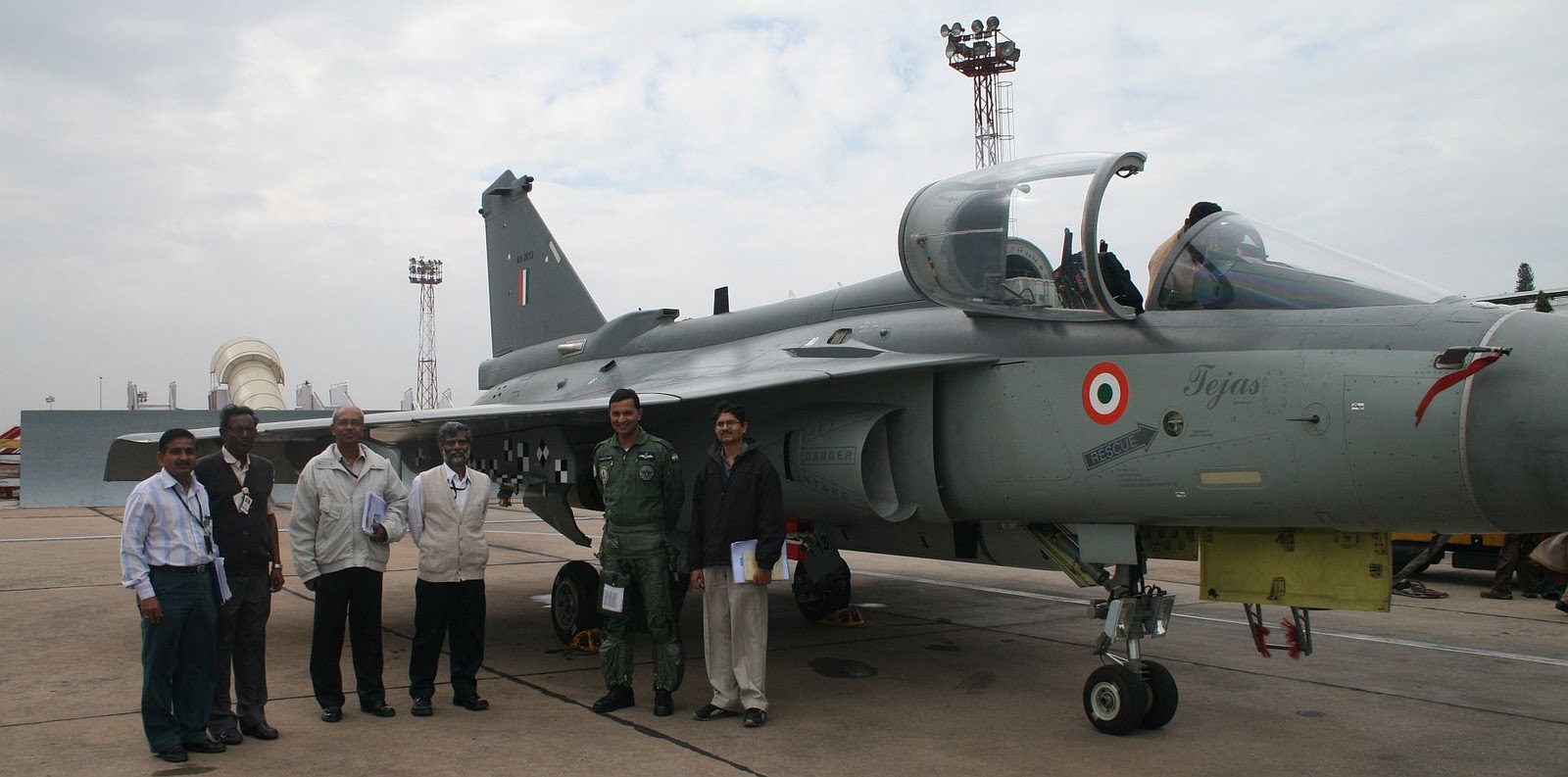
Picture shows one drop tank was jettisoned while the other wing drop tank was still there. Shows that the LCA’s FCS can handle large asymmetric loads in flight.
BENGALURU, India — India’s Tejas Light Combat Aircraft successfully completed a drop tank trial over the Aeronautical Test Range at Challakere in Chitradurga, near Bengaluru, on Dec. 17.
P.S. Subramanyam, chief of the Aeronautical Development Agency, tells Aviation Week that a 1,200-liter drop tank was jettisoned from a Tejas limited series production (LSP-3) aircraft piloted by Group Capt. Suneet Krishna.
….Indian media are keeping a close watch on the program, which has been hampered by time and cost overruns. With a Dec. 27 deadline looming to complete the certification process, ahead of its scheduled initial operational clearance (IOC), the focus now shifts to New Delhi for a crucial review, scheduled on Dec. 21.
The Indian air force (IAF) chief is expected to make a final decision on IOC at this meeting, which would signal IAF pilots to fly Tejas to check its handling qualities and other advanced features. This would also pave the way for its squadron formation sometime in mid-2011, by the time the remaining platforms (LSP-7 and LSP-8) would have joined the flight line.
Series production (SP) is expected to start next year. “The onus will then shift to Hindustan Aeronautics Ltd. to stick to the delivery schedules and roll out the first SP block of 20 Tejas,” a source says. “These fighters will get into the first squadron.”
BlackArcherI doubt the M2k or MiG-29UPG will last any longer than 2025. These upgrades are merely a stop gap until the AMCA/MMRCA are available, because these will be the true successors for aircraft like the MiG-23/27/29, Jaguar and M2k. Tejas will replace the MiG-21s. I suppose the the FGFA will ultimately replace the Su-30MKI when it is fielded in numbers. By the time the FGFA is likely to be inducted the oldest Su-30MKIs are 15-20 years old. By the time 200-250 FGFAs are in service ~2030 at the earliest the fleet will be another ten years older. I think that the FGFA is not complementary to the Su-30MKI but in fact its successor in the mid term. Upgraded “medium” fighters/attackers in the IAF will be phased out when enough MMRCA and Tejas are around to allow them to be withdrawn without further declining squadron numbers. I’m yet interested to see when the AMCA gets ready, is there even a timeline?
The IAF has committed to the AMCA and preliminary funding has been provided as well, and work should begin in mid-2011. First prototype should be rolled out by 2017, so given around 7-8 years from first flight to the time it reaches IOC it may be entering squadron service around 2025 or thereabouts. FOC will be a couple of years after that maybe.
The upcoming Aero-India 2011 should be a time when a lot more information will be available and a possible final configuration will be shown to the public.
Since Snecma’s tie up with GTRE for the Kaveri’s further development is now supposedly very close (as mentioned by a Snecma exec recently during Sarkozy’s visit) they should hopefully have a working 90kN thrust engine by 2017-18 at least.
Plans for Advanced Medium Combat Aircraft
Y. Mallikarjun
HYDERABAD: India has embarked upon an ambitious project to indigenously design and develop a fifth generation Advanced Medium Combat Aircraft (AMCA) by 2017.The government released Rs. 100 crore last month to the Bangalore-based Aeronautical Development Agency (ADA), which will spearhead the project, to prepare feasibility studies in 18 months.
Disclosing this to reporters here on Saturday, ADA Director and Programme Director (Combat Aircraft) P.S. Subramanyam said AMCA, when developed and produced, would probably be the first medium combat aircraft with 20 tonne weight in the world. Similar aircraft being developed by the United States and Russia are in the range of 30 to 35 tonnes.
Mr. Subramanyam said AMCA was meant to fill the gap for the Indian Air Force as the Light Combat Aircraft (Tejas) would meet the low-end requirement and Sukhoi-30, the higher end. Once inducted, the IAF would have small, medium and heavy combat aircraft…
A large part of the aircraft would be made of carbon composites. The entire project would cost $ 2 billion.
Once the funds were received after the submission of the feasibility report, the agency planned to develop two technology demonstrators and seven prototypes, he said. ADA was identifying technologies for 5th generation combat aircraft. Earlier, Mr. Subramanyam made a presentation on Technological Challenges in Future Fighter Aircraft at the Aviation Conclave which concluded on Saturday.
more details are available on this page and AW&ST had a very recent report on it as well.

BlackArcherIt is loads of money,
FGFA + AMCA + MMRCA + LCA + LCA MK2 + Su-30MKI & M2000 upgrade,
all to be operational ~2015-2020 or so, in the F/A alone,
and all to be operated 40 years i take it ?
That’s not counting how many UAV IAF intend to induct,
let alone any other assets.How serious is India on AMCA program ?
Let’s try to quantify expenses
FGFA $30bn times A for 40 years of service
MMRCA + $9bn times B for 40 years of service
AMCA + ? times C for 40 years of service
LCA + ? times D for 40 years of service
LCA MK2 + ? times E for 40 years of service
Su-30MKI + ? times F for 40 years of service
M2000 + ? times G for 40 years of service
UAV + ? times H for 40 years of service
There are Jaguars that are being upgraded to DARIN 3 standard, those that are at DARIN 2 std and also the 63 MiG-29UPGs that will be around for another 15 years. But the MiG-29UPGs, Jags and Mirage-2000-5s will all be retired by 2025-2030.
BlackArcherBlack R-73.. not sure about the angle, as same MiG-29 models and Su-30 models have black and no black! even within the same air force 😮
Black R-73?
Anyway, all IAF MiG-29s have the black anti-glare paint applied in front of the canopy. I don’t really get what you’re saying here.
BlackArcherMore information on the Light Combat Helicopter “Tigerbird” as Air Marshal Barbora called it..
BlackArcherIt must be a national preference coupled with the cockpit angle downwards to the radome. Why else would a regular Indian LCA single seater have no anti-glare paint whereas the twin-seat PV-5 prototype that has a slight nose droop feature the anti-glare paint?
Tejas PV-5 twin seater with small application of anti-glare paint
BlackArcherand how much weapons load will it be able to carry with the external fuel tanks?
total 4 pylons free + 1 chin pylon for the Litening LDP. That doesn’t take into account central fuselage hardpoint, but we don’t see the LCA carrying anything on that center point.
What has this question of yours got to do with the claim that it can only fly for 45 mins anyway?
BlackArcherI dont see the issue of the AESA RADAR or its technology to be specific a big issue, India has the chance to buy an Israeli AESA radar for the LCA and it has now just signed a contract with Sukhoi to develop a Fifth gen aircraft and there is also talk of future upgrades of the Su-30MKI containing Russian AESA radars…Also would SALEX not sell an AESA radar to India if it needed one?
So I really do not see the need to spend an arm an a leg on the MMRCA for an AESA radar. Considering the MMRCA (technologically) will be a stop gap until the FGFA comes into service and the LCA MK2 is fly it makes very little sense to buy an expensive aircraft.
Spend as little as you can and use the money that you saved for the AMCA program.
India is not buying AESA radars for the LCA from Israel. They have an indigenous AESA radar program in the works and they are now seeking to partner with either Elta or EADS. A RFP is out in that regard. This AESA is to be used on the Tejas Mk2 variant that is due to be operational by 2017 or so.
And the purpose of the MRCA is not merely to get AESA radars. That is quite an inane assumption really. the AESA is but one aspect of the whole MRCA program, albeit an important one.
The main point here is to get a fighter that is proven and at least to some point, mature in capabilities, yet has technologies and upgradability that will allow it to be kept operationally relevant for another 3 decades.
BlackArcherOne has to look at what goals a partnership can bring to Turkey-
1) Funding- and a 4.5 gen fighter will cost a heck of a lot just in setting up the necessary infrastructure to design and develop such a fighter.
2) Infusion of experience and technology as well as an assured sale of XX number of these fighters, which will bring down unit price and make the fighter more affordable for possible exports.
Lets take KAI as an example here. They spent on the T-50 program with Lock Mart fulfilling offset obligations by supporting the program. The design takes very heavily from the F-16 and yet since it involves a new and smaller fighter, it requires a lot of original design work as well. Much of the T-50 program relied on Lock Mart’s knowledge and its F-16 and F-35 experience. But KAI, having spent the required money to come up with the facilities for R&D on the T-50, and having done a lot of the ground work on the design, is only now in a position to reap the rewards with the F/A-50 and then the KF-X. They used a similar approach on the Surion too, and only now when they are more confident, are they thinking of producing an all-new attack helicopter design. And they already had the KT-1 Woong Bee experience prior to this, so they had as much experience earlier itself as TAI does now.
TAI’s timeline is so optimistic that it would be a rather foolish to go ahead with a 2023 in service date and no other major partner (like Boeing, Lock Mart, EADS, Saab, UAC) to do a lot of hand-holding and guiding and with a lot of off-the-shelf and later on integrated equipment like on the Gripen NG. I mean look at the PAK-FA’s T-50 prototype flying today and with all the engine, airframe, radar and integration experience that the Russians have and all the experience that the Indians have in avionics, computers and other subsystems, they still expect the PAK-FA to only enter service in 2020. The F-35 program, its development issues and its timelines also support this.
Pakistan or the JF-17 Block II is not the ideal partner in this sense since the JF-17 is essentially a CAC program and relies almost totally on Chinese R&D. Whereas Pakistan is now establishing manufacturing for it and has gained mostly in that respect and some abilities to henceforth integrate avionics without Chinese help. So what does TAI gain from such a partnership when this new fighter is supposed to better F-16 Block 50s at a later date and that cannot be expected from the JF-17, for which even matching the F-16 Block 50 at a later date would be a huge achievement ? Maybe some funding but not enough for an equal partnership which will cost a billion to a couple of billion at least which Pakistan likely cannot afford since it has J-10s to acquire and at a later date the J-20 too.
And what would Pakistan gain if the JF-17 Block II is chosen ? A heck of a lot- but if the offer is to participate in a totally new program instead of just taking the JF-17 and developing a variant, then it might be too costly for Pakistan to participate, since for sure future JF-17 development will suffer as a result of diverted funding.
The fact is that for TAI, production is not likely going to be the bigger problem since they have been manufacturing and upgrading F-16s locally- it is the mastering of the varied and complex technologies that go into the fighter design and its associated systems right from the beginning that is the bigger headache and requires someone like Boeing, Lock Mart, EADS, Dassault, Saab or UAC to be involved from the beginning.
As I’ve said before- maybe the best approach would be partner someone like Saab on the Gripen NG and develop a new variant of it, one that has substantial changes to the airframe, beyond just modified landing gear, fairings and new engines like it does have now. Here, a re-sized and possibly 10-15% larger Gripen NG with semi-conformal weapons carriage and a couple of modestly sized internal bays to hold some A2A or A2G weapons and conformal fuel tanks to reduce RCS when carrying drop tanks would be a true 4.5 gen fighter. On the same side, ask GE to develop an even higher thrust variant of the F414 using CMCs to use on this 10-15% heavier fighter.
It will be cheaper to develop than a fully new 4.5 gen fighter and will offer substantially better capabilities than the F-4E-2000 or the F-16 Block 30s, heck even the F-16 Block 50 would pale against such a fighter. If it is affordable then it will hold the possibility of being exported to nations that don’t want a F-35 and cannot afford the larger PAK-FA/FGFA or the Chinese J-20’s upfront acquisition or maintenance costs over lifetime. But then a US sourced engine will become an issue since the US will not want any foreign fighter to eat into F-35 sales and so the engine issue will also have to be resolved separately.
For funding, they could also look towards Saudi Arabia or UAE. UAE especially has been very keen on absorbing technology and may well be interested in a future replacement for their F-16 Block 60s, especially since they seem ready to retire fighters with plenty of life and capabilities left in them like the Mirage-2000-9.
Time will tell as to what choices are made and how successful they are but this is an interesting program (that is if it does go beyond being a concept).
BlackArcherThe Tejas can fly longer, but it currently doesn’t yet have the OBOGS fitted on. This will be done sometime next year since the OBOGS was certified only recently.
Without an OBOGS, the fighter needs to carry onboard liquid oxygen for the pilot and his g-suit pressurisation and this puts a limit on the fighter’s endurrance. For longer duration sorties, more cylinders are needed, and if OBOGS was meant to be used, then they would make no special arrangements to add additional cylinders for longer duration sorties.
It has nothing to do with anything else. With 2 external 1200 litre drop tanks and 2400 litres of internal fuel, it can easily fly for more than double the duration currently quoted.
BlackArcherWhich tranche of the typhoon is being sold to India if it is tranche 1 then typhoon has an advantage as certain airforces are looking to go to tranche 2 or 3
What do you mean “which tranche” ? The only Tranche 1 fighters available are second hand ! 😀 And the MRCA deal isn’t for second-hand fighters.
The Typhoon that will be sold to India if it wins the MRCA competition will be likely Tranche 3B configuration with AESA added in.
BlackArcherMore details on the PAK-FA project between HAL and Sukhoi.
NEW DELHI: It will take a decade for India to begin inducting the first lot of the 250-300 advanced stealth fifth-generation fighter aircraft (FGFA) it is going to jointly develop and manufacture with Russia.
As per the detailed roadmap finalised between India and Russia, the “series production” of FGFA will be launched in 2019, with the actual deliveries to begin in 2020, sources said.
The stage for the entire FGFA programme, which will see India spending upwards of $35 billion over the next two decades in its biggest-ever defence project, will finally be set this week.
With Russian President Dmitry Medvedev in town, New Delhi and Moscow will ink the $295 million preliminary design contract (PDC) for FGFA on Tuesday. Then, over the next 18 months, the two sides will work out the detailed design and other agreements to kickstart the actual building of FGFA.
“Forty Indian designers and scientists will be stationed in Russia, with a similar number of Russians here. A secure data link will also be set up to ensure both sides are fully in the picture all the time,” said a source.The total cost of designing, infrastructure build-up, prototype development, flight testing and the like has been pegged at around $11 billion, with both sides chipping in with $5.50 billion each in the “50-50% partnership”.
India, for instance, will spend $2.50 billion of its $5.50 billion share in setting up infrastructure for manufacturing plants, tooling facilities and hangars.
…..Cash-strapped Russia is already flying the prototype of its single-seater FGFA called Sukhoi T-50. While the Indian FGFA will basically be based on this fighter, it will “be tweaked to meet IAF requirements”.
For one, IAF wants a twin-seater FGFA, with one pilot actually flying the jet and the other handling sensors and weapon systems. Russia, however, feels adding a second cockpit will “adversely impact” the stealth.For another, IAF is keen on a new engine with “a greater thrust” than the one Russia is currently using for its FGFA. “All these things will take time and money… Six to seven prototypes should be flying by 2017. It will take about 2,500 hours of flying to get the final flight certification,” he said.
With IPR (intellectual property rights) being “equally and jointly vested”, India and Russia may also decide to sell the FGFA to “third countries” by mutual consent.
BlackArcherI have the same fear. Its a costly endeavour and without having done a 3rd generation or 4th gen fighter as yet, to go directly to a 4.5 gen fighter is a HUGE jump and the timeline indicated of service entry by 2023 is too optimistic.
And from the links provided by medal64, while it seems that Turkey does have the R&D and facilities for several development programs in avionics, radar, etc. there is nothing concrete regarding any airborne radar or RCS measurement and shaping technologies, to just speak of a couple of technologies. Where is the experience in designing a fighter’s FCS ? Integrating technologies from various sources is a lot less challenging than coming up with everything on their own, so an experienced partner is definitely required.
I’m not saying that it cannot be done, but its a costly affair and will definitely require a lot of foreign assistance.
BlackArcherI don’t think its size going to be as big as typhoon, its probably going to be an lightweight fighter and the two seated trainer version. But sure it must have better capabilities than the aging F-16s! So I think we can call it at least 4,5 generation! But I don’t know how much foreign support will the Turkish defence industry need or will they! But if we think that, its the first Turkish indigenous fighter aircraft project and some components will need to get from abroad or there will create joint ventures. Maybe a foreign partner for getting some key technologies. But the design and the integration of the systems will be done by the Turkish Aerospace Industries, TAI. So its a good project for the Turkish aerospace industries to increase their capabilities with such a complex fighter aircraft project 🙂
It will be a tough task to better the F-16..does Turkey have experience in developing the Fly-by-wire or Fly-by-light FCS that modern fighters have? Even South Korea didn’t attempt its first fighter on its own and needed Lock Mart’s assistance.
That apart, what experience does Turkey have in advanced wind tunnel testing, CFD, AESA radars, electro-optical systems and in stealth technologies? The Hurkus may well be a challenging program but a new 4.5 gen fighter will be a lot more challenging. Integrating equipment sourced from abroad will be easier than developing all this in-house in such a short time-frame.
They will either have to seek a partner like EADS, Saab, Boeing or Lockheed Martin otherwise this will be an exceedingly difficult task to achieve. The approach taken by TAI for the T-129, that is going with an existing A-129 design and improving on it will be more practical.
Could this be just a bargaining tactic to get South Korea to offer more of an equal partnership in the KF-X ?


 Sign In








