 BlackArcher
Teer-
I’m skeptical of your chart. If the Mk2 is 1,000 kg lighter than Gripen NG then they’ve pulled magic. Growing 1.5 meters only adds 500kg. Magic. And at the length you posted they may as well substitute F110 for F414. If they are overtly concerned with price they would go P&W. Any of the three engines are a leap forward from Al-31F1.
I would have loved to see twin F125 in the 11,000 lb st range, which is well within growth from Honeywell’s 2010 software-updated production variant. F125 has been run conservatively. Two are comparable to F414 singles and would be easier for field crews to swap. Ease of handling swaps is vastly under-rated, which is one reason MiG-19 remained so popular for so long.
Gripen NG empty weight was originally targeted at ~7000 kgs, but ended up overshooting that by 1000 kgs to end up at 8000 kgs. Some over-engineering may have resulted in that target empty weight being over-shot by such a large degree. Anyway, 7500 kgs is do-able. The Tejas Mk1 was designed with over cautious conservatism. Having spoken to ADA guys, the conservatism was clear and consequently factor of safety used in design was a little higher than it needed to be. Lessons should have been learnt and the over-engineering will no longer be an issue.
As for the F110, what is its weight? And what are its dimensions when compared to the F-414?
The fact that the Gripen NG program went with the F-414, which is like an incremental change over the F-404 versus going in for an entirely different family of engine suggests that the same problem was faced by 2 different programs by 2 different OEMs and they both found similar solutions.
BlackArcherFirstly a moaning session about an unrelated event doesn’t prove an F-16 shot down.
and Secondly lets not throw shade here. You want us to take the word of a military who in panic posthumously gave the highest military award to someone who was alive! just because a day before Pakistan awarded their highest military award for the Kargil conflict.
https://en.wikipedia.org/wiki/Yogendra_Singh_Yadav
The Param Vir Chakra was announced for Yadav posthumously, but it was soon discovered that he was recuperating in a hospital!
Not very different from what the Pakistanis did just a few weeks ago..thought that the pilot who was injured and admitted to Command Medical Hospital was Indian. Announced it through their Prime Minister and the DG ISPR spokesperson. Grandiosely spoke about how they would take care of that person, hoping he would recover.
And then, 2 hours later did a volte face and said “hey, we’ve actually got just 1 Indian pilot in our custody”.
Obviously, whoever in the Pakistan Army briefed their superiors about the national identity of the injured pilot, goofed up big time and when that mistake was discovered, the cover up began.
Of course, all those videotaped eyewitness accounts that claimed 2 parachutes or 3 parachutes being seen were bogus and those were Indian agents spreading lies in PoK. And the videotaped eyewitness account of a PoK national stating that he and others beat up a “Sikh” pilot and handed him over to the PA was also bogus, isn’t it?
BlackArcherTeej-
I don’t think you gave a fair comparison between Gripen and Tejas. Obvious stuff like pylon count substituting an argument concerning range is ignoring the obvious. Tejas is a lightweight fighter relabeled as a medium. Its internal fuel tank squarely leaves it in the light category, regardless of carrying external fuel. The drag index will eat up any significant fuel gains underwing due to their choices for being an overly short design like you would expect out of a light fighter. And marketing garbage doesn’t alter takeoff distance while carrying its big tanks creates a dangerous combination of overweight, underpowered, and too little control surface while operating from its intended deployment points with a significant bomb load. Tejas will be kept light or suffer in obvious ways. Then you compare the RWR and SPJ between the two as equal. Thales and Saab subcontractors have Cadillac systems compared to secondhand export models being proposed for Tejas. It reminds me of the bogus invulnerability of Bison with their internal SPJ in international exercises. Elderly F-16 or unproven JF-17 technology is being claimed to have done one in. (I still believe it was a SAM, but none of us will get the truth for decades.) The Tejas will get a slightly better generation compared to the Bison’s, but its doubtful it will perform any better. You brought up the small ground footprint and its mobility as being some sort of standard. Not at all. And currently Tejas has a slim if not non-existent supply chain that has ti be established. Not comparable at all.
I don’t understand what the issue is with internal fuel. The MWF is to carry 3300 kg of internal fuel. That is at least 1000 kg more than the Tejas Mk1, ~100 kg more than Mirage-2000 and ~100 kg less than Gripen NG. So how is the MWF going to be in the light category?
See the table below for comparative figures. Table courtesy of Indranil Roy and Nilesh Rane’s excellent analysis of the Tejas Mk2 MWF fighter

The MWF is now longer than a Mirage-2000, and about 0.6m less than the Gripen NG. Plus, a whole lot of studies were going on through 2015 till 2018, on ways to reduce the drag on the Mk1 design. There are plenty of design improvements that have been brought into the Tejas Mk2 MWF design as a result.
As can be seen from the table above, the Tejas Mk2 MWF is firmly a Mirage-2000 replacement now, whereas the Tejas Mk1 was a MiG-21 replacement with specs based on that requirement.
BlackArcherIt really is post-truth age.
Pot calling the kettle black.
Considering the fact that the Prime Minister of Pakistan as well as the Director General ISPR of Pakistan, both went on TV press conferences and announced that they had a second pilot, who was admitted to hospital.. heck they even mentioned the hospital name, Command Medical Hospital..and that pilot vanished into thin air after discovering his true identity. Almost unbelievable incompetence. And it revealed that a soldier’s sacrifice would be hidden for a lie to stand.
Plus,
The whole “No F-16s participated in the strike” claim of Pakistan’s DG ISPR which was also disproved with the AMRAAM evidence.
BlackArcherThe 16th Series Produced Tejas Mk1 fighter (SP-16 with registration number LA-5016) had its first flight a few days ago. The No.45 ;Flying Daggers’ Squadron will get its full complement of single seat fighters by the end of March 2019.
The second squadron No.18 ‘Flying Bullets’ will be stood up and begin receiving its first FOC Tejas Mk1 fighter from October 2019. What wasn’t yet fully clear is where the new squadron will be based. It previously flew MiG-27MLs from Kalaikunda AFS in West Bengal.
But it now appears that No.18 ‘Flying Bullets’ squadron will be reformed at Sulur AFS, where the current No.45 squadron is based. And No.45 ‘Flying Daggers’ will be moved up north, closer to the Pakistan border.
he 16th series produced Tejas (LA-5016) completed couple of her production sorties by last evening. Flying Daggers will be in full strength before end of this financial year. With FOC in kitty, the final set of aircrafts with FOC standard will start coming into production line. As per HAL Chairman, HAL will put all effort to deliver all the 16 aircrafts by March 2020. Appears to be a tall order. But keeping in view of the maturity level achieved in both the production lines, Let us hope this target is achieved without any big hurdle.
LCA Tejas squadron to be moved from South to air base near Pakistan border in 2020
After coming under criticism for fielding Mig-21 Bisons against advanced Pakistani F-16’s, Air Chief Marshal BS Dhanoa was questioned why India’s LCA-Tejas fighter jet was not used against Pakistan?
Dhanoa clarified that once the foundation for second LCA-Tejas Squadron is done, first Squadron will be shifted to forward base close to Pakistan border likely in 2020. First Squadron Flying Daggers No. 45 is currently carrying out Initial user operational flying of LCA-Tejas aircraft delivered to them and in the process is also training its engineering crew to carry out routine maintenance with help of HAL.
No. 45 Squadron Indian Air Force (Flying Daggers) which is based at Sulur Air force station in Tamil Nadu is yet to gain full squadron strength which likely will happen by end of this year, the formation of the second squadron will start, once the fresh batch of FOC Certified LCA-Tejas MK1 aircrafts start arriving from October onwards .
Dhanoa last month at FOC certification handover ceremony of LCA-Tejas had said that LCA-Tejas behaves like a fighter aircraft and also act like one and air force has total confidence in the capabilities of the aircraft as recently demonstrated at the Iron fist Air exercise and now are flown regularly by the first Squadron in regular operating conditions.
Once again, “likely will happen by end of this year” refers to March 2019. That is the financial year end.
BlackArcherExactly the reason I came to this forum, to meet like minded teenage girls like you. Is that not what forums are for?
Now to the substance, with respect to the F16 shoot down in Pakistani counter strike, the only facts known are that the Indian Air Force has claimed to shoot down a F16 and has said it has electronic signatures and provided evidence of parts of an AMRAAM missile used from F16s. The Pakistani government has denied the same and the US government has not confirmed or denied it.
There is a lot of discussion on which forum where incredulity is expressed on how a Mig 21 shot down a F16, however the simple point missed is that it is not the Mig 21 of the 60s.
I am going to refer to the Balakot strikes.
The only facts known in this case are that the Indian government has claimed a successful hit, no information on number of casualties, all the bunkum is quoted from sources quoting other unnamed sources.
Pakistan (not journalists, not third parties) has refuted the strikes and has said that there was no damage.
Pakistan has denied permission to international journalists to visit the actual site after initially saying they will take them on a ground tour and then only allowing them as far as the base of the hill top.
I’ve seen reports within Pakistan itself that question why the Pakistan Govt. denied access to local and international journalists, if indeed only some trees had fallen nearby and no damage was caused to the facility.
I’ve seen a video posted by a Gilgit based analyst where a PA officer appears to be talking to some people who have lost their near and dear ones to the air strike. That senior PA officer refers to a figure of 200 people that died. But all that is evidence that won’t be considered irrefutable, and so the Pakistan Govt. will continue to deny its involvement in terrorism, its direct support, arming and training of Jaish-e-Mohammad and Lashkar-e-Taiba, or the effect of the airstrike.
Plausible deniability has always been the modus operandi. It won’t change.
BlackArcherBlackArcherRegarding the IRST for the Tejas Mk2 MWF, there was a report that it may be a variant of the indigenous IRST being developed to replace the Russian OLS-30 IRST on a part of the IAF’s Su-30MKI fleet. Looks like the DRDO labs will tie up with Samtel for the IRST.
News report from May 2018
The Defence Acquisition Council (DAC), chaired by Defence Minister Nirmala Sitharaman, on Monday approved the procurement of equipment for the Defence Forces valued at over Rs. 6,900 crore including the development of the IRST for Su-30MKI. “The DAC also accorded approval for undertaking Design and Development of the Long Range Dual Band Infrared Imaging Search and Track System (IRST) for SU-30 MKI aircraft under ‘Make II’ sub category and subsequently, for procurement of at least 100 IRSTs under ‘Buy (Indian–IDDM) category. The system will be able to operate in day and night conditions and will substantially enhance the capabilities of the aircraft,” the government press release said.
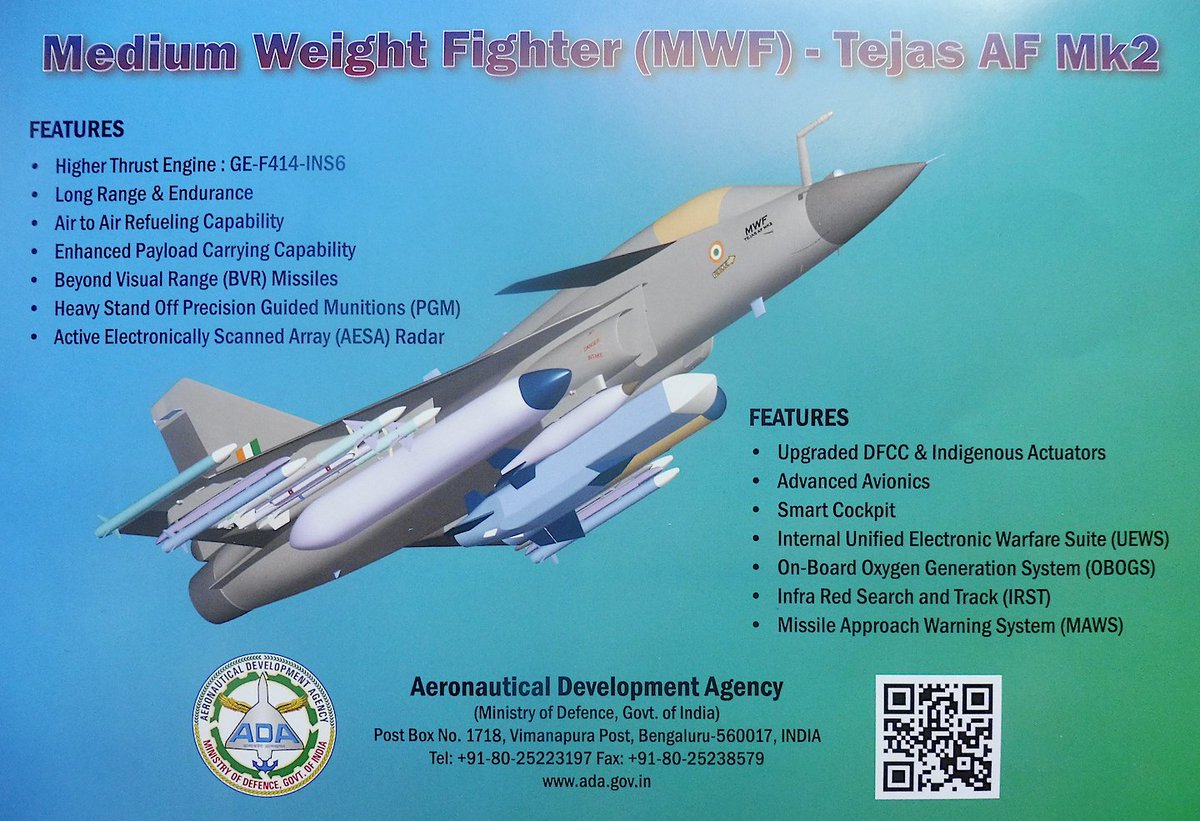
IRST on the Tejas Mk2 MWF
Samtel CEO interview- SP’s Aviation
SP’s Aviation (SP’s): How would you describe the journey of Samtel from business of picture tubes for television market to the challenging defence electronics?
Puneet Kaura (Kaura): Samtel was set up in 1973 and is today the leading manufacturer of advanced displays in India. The journey from picture tubes to avionics started in 2001 with the takeover of Thales Germany by Samtel to form Samtel Electron Devices GmbH at Ulm, Germany. Later, in 2004, Samtel got its first order from the Defence Research and Development Organisation (DRDO) to develop multifunctional displays (MFDs)—the ones which are flying on Su-30MKIs today. That gave the impetus to Samtel to set up a defence avionics division—Samtel Display Systems in India. Today Samtel Display Systems has two strategic joint ventures (JVs) in defence avionics; one with the Hindustan Aeronautics Limited (HAL) and another with Thales Avionics. There are also strategic tie-ups with global aviation majors such as SAAB and Honeywell.
SP’s: Can you elaborate on the USPs of Samtel?
Kaura: Samtel has always been a technology focused company and we have achieved the singular status of being the only company in India which indigenously offers the complete package of LCD ruggedisation, electronic hardware designing, development of embedded systems along with associated software, mechanical packaging and thermal management under one roof. Our JV with HAL was India’s first public-private partnership in avionics domain in India, and has now achieved the unique position of having a primary cockpit display qualified for induction on Su-30MKI. We are now working towards building a centre of excellence for state-of-the-art cockpit displays which would help the Ministry of Defence (MoD) to become self-reliant in this domain.
SP’s: Are your offerings compatible with Russian platforms?
Kaura: The MFDs designed and produced by us have been qualified for induction on Su-30MKI aircraft. The next generation large size smart multifunction display is also ready, and has given us the unique distinction of being the only company in India to have an avionics display at par with the global suppliers in this domain. Discussions are on with some key customers on upcoming Russian platforms for LRUs, infrared search and track (IRST), and other avionics systems as well.SP’s: Can you tell us about the Mirage fleet upgrade deal and particularly in view of the JV that seems to be in place between Thales and Samtel?
Kaura: The Indian Government has signed the deal worth $2.4 billion ( Rs. 10,800 crore) with Thales and Dassault Aviation for upgradation of its ageing Mirage fleet. As 30 per cent of the worth of the deal needs to be invested back into the Indian defence sector as offsets, a large part of the offsets should be expected to be fulfilled through us. As per the JV’s mandate, Samtel Thales Avionics will provide the basis for all future aerospace development for Thales in India.
SP’s: What challenges do you foresee in your journey?
Kaura: Challenges never end; they just get replaced by newer challenges. Ten years back when we took over Thales Germany and set our first footsteps in avionics, it was a new area for us. Conventionally, the cockpit displays were either imported or were assembled in India by suppliers using foreign-made components. There was a huge void and need for these products to be developed and produced in India indigenously. However, since the technology was never developed in India earlier, there was initial scepticism from the industry, which we believe, we have just not been able to overcome, but also surpass.
We now see ourselves moving ahead of cockpit displays and proving our capabilities in avionics. Our JV with Thales already encompasses manufacturing of HMDSs, which are a complete system in themselves; sensors such as IRST, which will be a first-time-in-India product and other modern avionics systems. Besides that, we are also setting up capabilities in obsolescence management, automated test equipment and built-to-print solutions. Going forward, our original strength—cockpit displays will be just one segment of our complete suite of offerings. From picture tubes to cockpit displays, and from here to a complete avionics house, is what I see Samtel emerging as.
BlackArcher
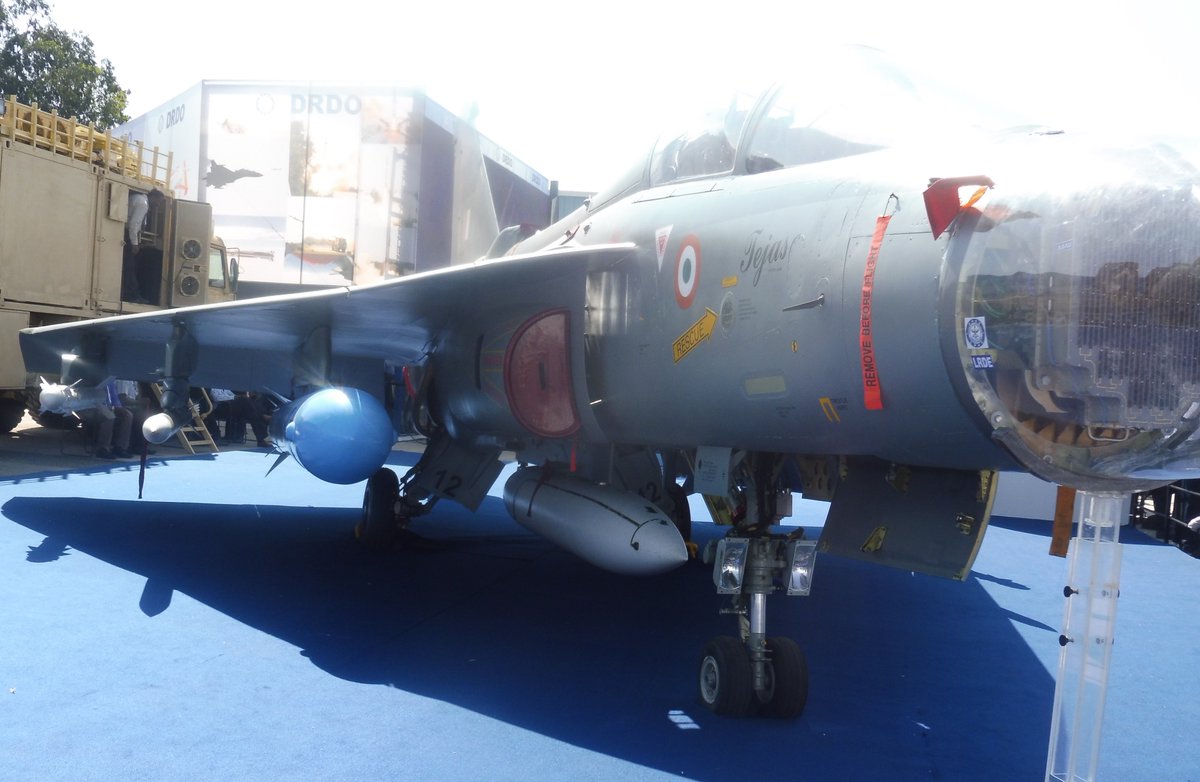
LCA Mk1 prototype with the new centerline mounted supersonic drop tank.
BlackArcherFound a decent image of the LCA Navy Mk2 design with the new stabilator control surfaces and the vortex flaps in place of the LEVCONs on the LCA Navy Mk1


BlackArcherInteresting stuff, turning the Hawk into a viable light attack aircraft.
Integrating a radar would not be so simple though. There is no space in the nose for a radar let alone provisions for cooling and power supply. Look at the Hawk 200 – the added avionics basically occupy the front seat area.
Such a modification would not only be pretty expensive but also extensive, resulting in a different aircraft, and defeat the purpose of having combat-ready trainers for war-time emergencies.
The Hawk was already being used with rocket pods and even dumb bombs. See the image below from Vayu Shakti 2019
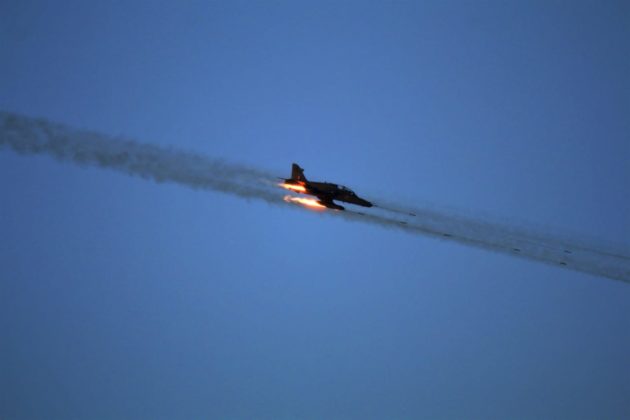
But, the ability to use stand-off PGMs will be a big capability jump and will allow the Hawk to be used without exposing it to the kind of danger that a CAS mission would. Or even when using dumb bombs right over the target and running the risk of exposing itself to supersonic fighters. Being a sub-sonic jet, it would be vulnerable, even when protected by escorts, so limiting its utility in highly contested environments.
I agree with you that adding a new radar would not be simple, but it can be done. Question is whether there is enough value associated with doing that, versus the cost of the upgrade. A small Elta 2052 radar, similar to what is on the Jaguar DARIN III could possibly be integrated I guess, if such a requirement were to be put forth by the IAF. The Jaguar’s nose was also modified to fit that AESA radar in place of the Elta 2032 on the Jaguar IM and to replace the LRMTS on the earlier Jaguar IS DARIN II. Hawk 200 was from an earlier generation when radars were heavier and bulkier.
But I doubt that the IAF will see adequate value in that to ever bother. This is a secondary attack role, and resources would need to be allocated to the primary fighters and strikers first for combat capabilities.
BlackArcherA few more images that were not posted earlier, from Vayu Shakti 2019
Jaguar
Su-30MKI
Upgraded Mirage-2000I

BlackArcherIAF Tejas Mk1 dropping 2 1000 lb dumb bombs during Vayu Shakti 2019. Posting here since the mods decided to can the Tejas thread due to a couple of trolls.

BlackArcherDRDO’s Smart Anti-Airfield Weapon (SAAW) to be tested from a modified Hawk AJT in April 2019. The Hawk-i program is meant to convert the Hawk into a light bomb truck and arming it with stand-off weapons is to keep it as far as possible from enemy fighters while engaging ground targets as far away as 80 kms. Of course, the Hawks would have to be escorted by fighters in any scenario, but what this will allow is the IAF to use its large Hawk fleet as additional light strikers.
And the ASRAAM will at least give them a decent self-defence capability. Putting a small AESA radar into the nose and changing the nose profile, as on the Jaguar DARIN III should have been explored as well, but the cost of the upgrade would have gone up significantly. But if the IAF wants that, it should be possible as well.
Courtesy of Livefist
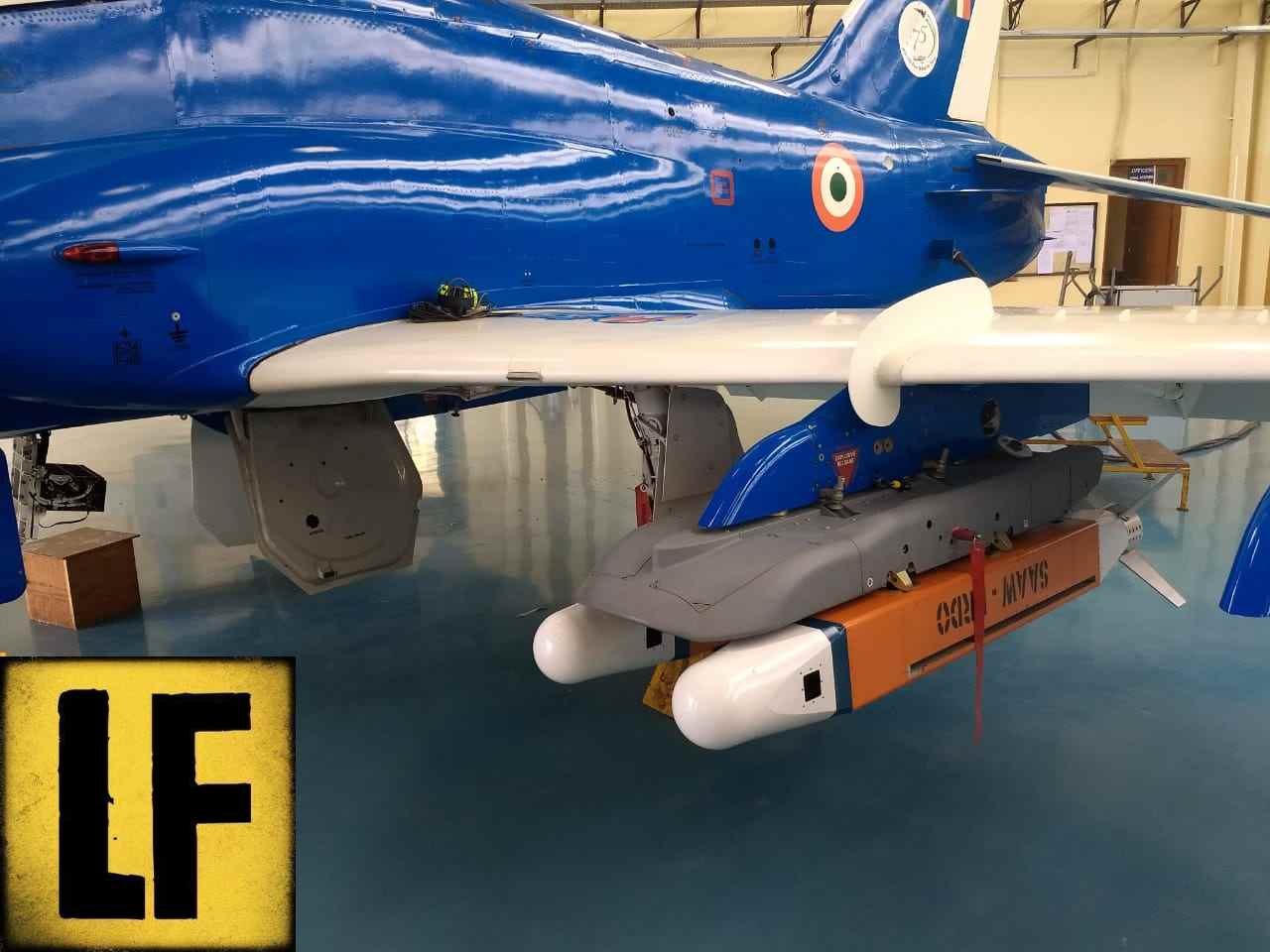
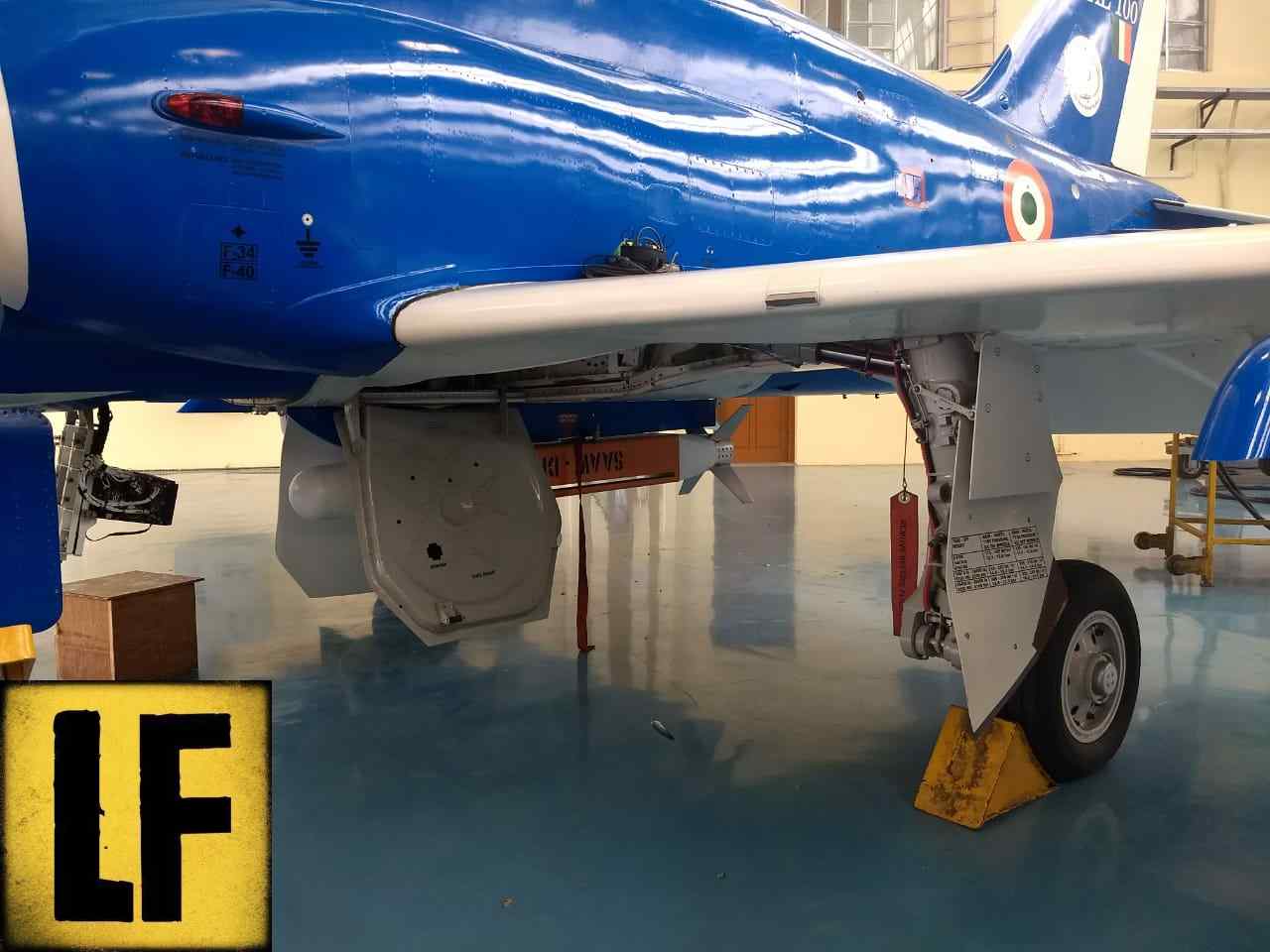
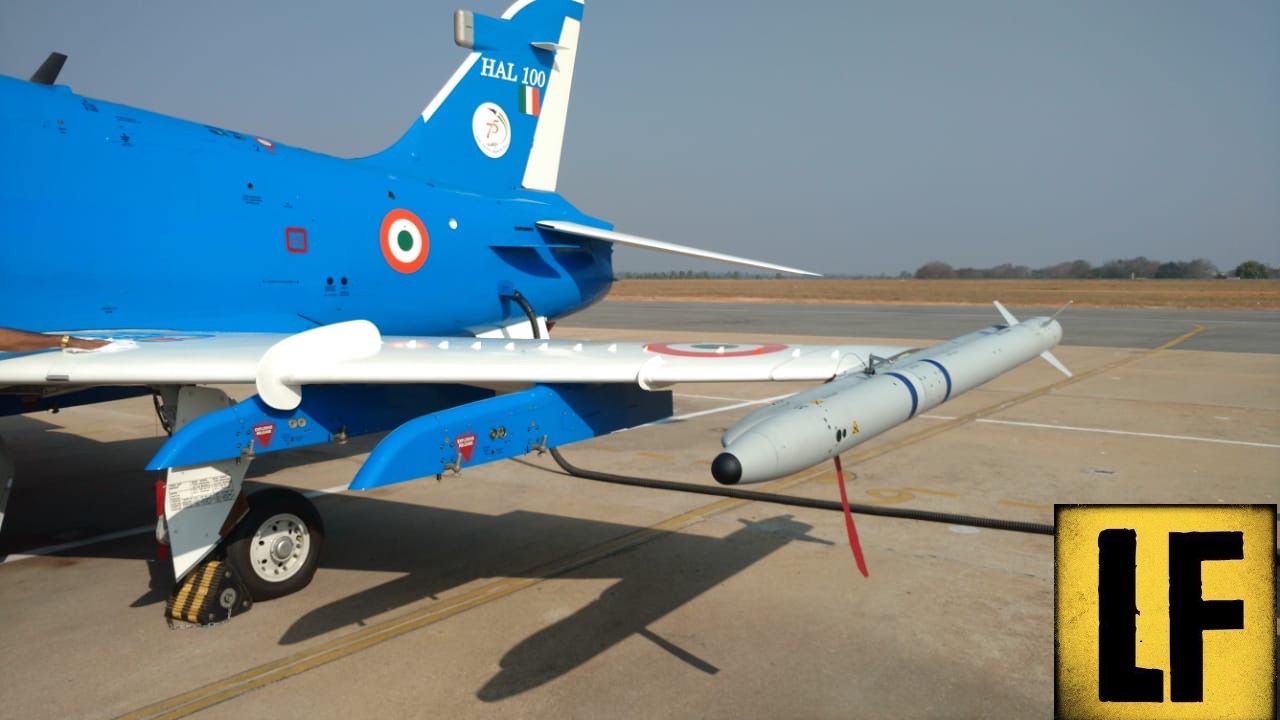
HAL’s souped up Hawk all set to fire Indian SAAW weapons
In April over the Bay of Bengal, a stubby orange box-shaped weapon will separate from an aircraft flying at 20,000 feet, flip open a pair of angular wings from its sides, and glide over the sea towards a pre-designated spot 80 km away at sea. The weapon, called SAAW — short for Smart Anti-Airfield Weapon — is an in-the-works Indian munition designed to destroy runways at stand-off distances. The aircraft dropping the weapon will be a Hawk-i, on its first ever weapons run. The weapon will be in ‘fire and forget’ mode with inertial guidance.
..
The Hawk-i program began in 2014 and is centered around replacing the baseline Hawk’s British mission computer with an Indian one, allowing its developers the flexibility to sling on weapons of choice and give the aircraft the ‘brains’ it needs to generate weapon solutions and fire those weapons. In the absence of a primary radar, to give pilots of the Hawk-i a point and shoot capability, they fly with Israeli Elbit Dash V helmets. Livefist learns that weapon algorithms from the DARIN II and III upgrades effected on the IAF’s Jaguar fleet have been used in the Hawk-i’s mission computer that also uses a HAL-developed real time operating system (RTOS).The idea is that when the IAF’s Hawks receive the Hawk-i upgrade, they’ll be able to join the battle if a war breaks out, and not have to sit on the ground. Since their straight wings don’t permit fighter-type speed to get away from a sticky situation, the Hawk-i is being kitted out for light strike missions at stand-off distances, including interdiction and close air support. But Hawks turn and climb very nimbly, therefore making their weaponised avatar suitable for operations close to the border or Line of Control for ‘hit and run’ missions. The SAAW test from the Kalaikunda air base in April will be the first of many flights to prove the Hawk for small offensive missions as a smart bomber.
Other weapons options on the Hawk-i will include high speed low drag bombs, sensor fused weapons (like the Textron CBU-105 operational now on IAF Jaguars) and laser guided bombs. Apart from the Litening laser designation pod, the platform will also be able to deploy an electro-optical tactical reconnaissance pod or an active phased array self protection jammer pod. The upgraded aircraft already gone ahead and integrated a CMDS (Counter Measure Dispensing System) and is shortly integrating a radar warning receiver (RWR).
Other add-ons in the Hawk-i program include a virtual training simulator and a 3D digital map generator to keep new generations of pilots abreast with the latest flying aids.
With the SAAW program gaining momentum, I’d expect the Tejas to be the next platform to be integrated with this precision guided glide bomb. The box shape and the light weight allows multiple bombs to be carried on a single rack. So, in a single sortie, a Tejas could possibly carry 4 to 6 SAAW PGMs. Su-30MKIs should be able to carry far more.


 Sign In







