First arrested landing for Naval LCA
link
It has also put India on the world map as a nation with the capability to design a deck-landing aircraft.
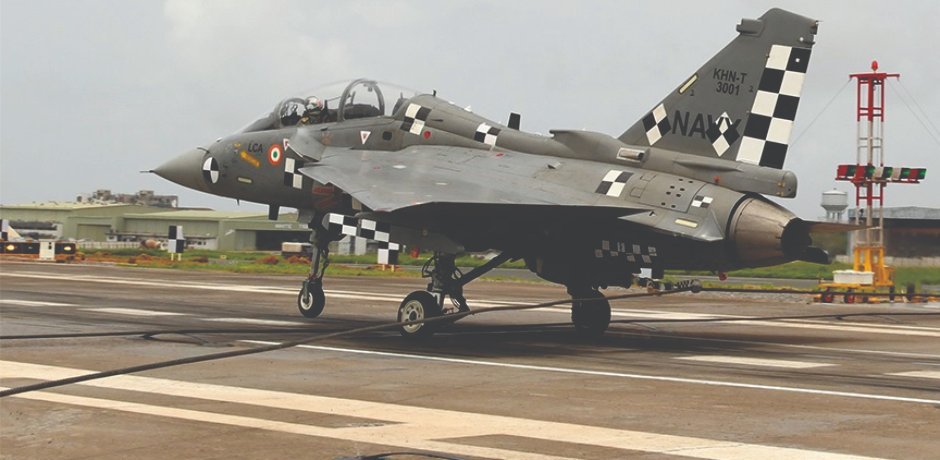
According to sources, NP-1 (Naval Prototype), a trainer, did the first arrested landing at the shore-based test facility (SBTF) situated at INS Hansa in Goa. The SBTF replicates a static model of the Indigenous Aircraft Carrier (IAC) being built at the Cochin Shipyard in Kerala.
“Today’s milestone comes after several years of flight testing and four campaigns of dedicated testing at SBTF. It was a text-book landing,” says an official who was part of the Goa campaign. The NP-1 was piloted by Cmde J A Maolankar (Chief Test Pilot) with assistance from Capt Shivnath Dahiya (Landing Safety Officer) and Cdr J D Raturi (Test Director). “The arrested landing heralds the arrival of true indigenous capability and displays the professional prowess of our scientific community. Aeronautical Development Agency, along with design, build capabilities of HAL, DRDO and CSIR labs have played a big role in executing today’s landmark event,” says an official.
Sources confirm that the landing speed of NP-1 was at 132 knots and the sink rate at 4.4 m/s while the arrester hook load was about 37 tonnes. The arrestor hook and other systems were developed by Aircraft Research and Design Centre (ARDC), a division of HAL. “All systems performed as expected during the arrested landing,” says an official.
..
I hope the Indian Navy goes on to place an order for some twin seat LCA Navy Mk1 fighters to be used as trainers. Can be embarked on INS Vikramaditya and also shore based at INS Hansa, allowing rookie Navy pilots to train and master the skill of landing on an aircraft carrier. Will have a much lower operating cost than twin seat MiG-29KUB or Rafale/Super Hornet which may be chosen next.
This will also help to speed up the development and testing of these technologies and techniques for the LCA Navy Mk2, which is currently in development.


 Sign In